
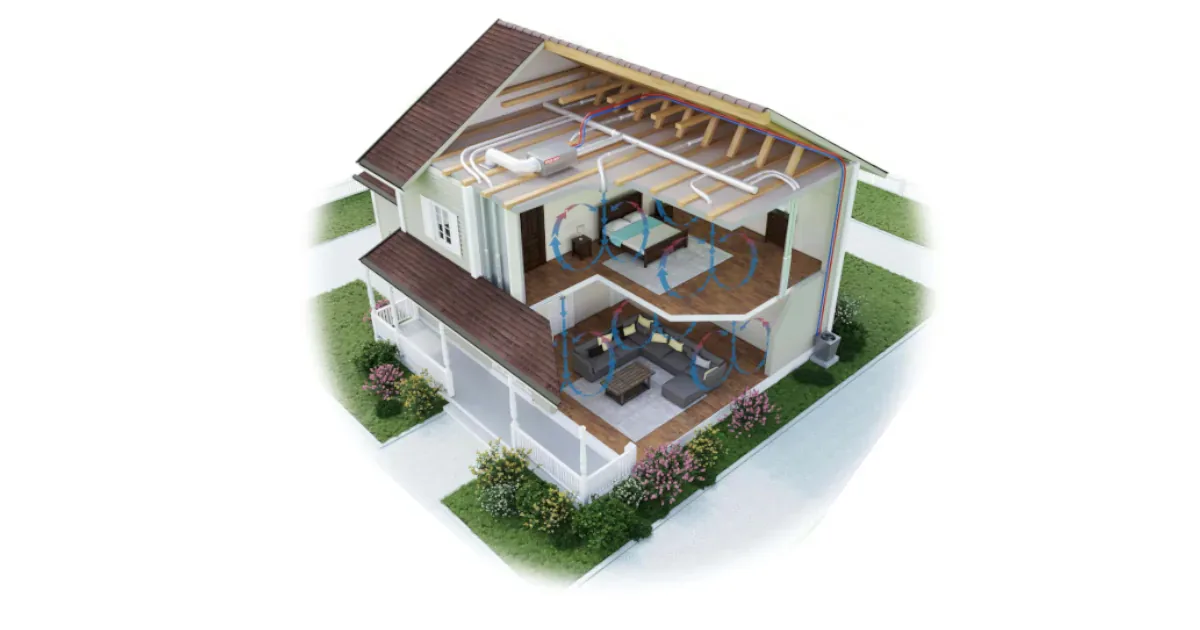
A central heating and cooling system, usually called central heat and air, is one set of equipment that heats or cools air in a single place and pushes it through ducts to every room. Matching that equipment to a particular house is the residential system design and installation side of the work. In a Sacramento home it is almost always one of three pairings: a gas furnace with a split air conditioner, an electric heat pump with an air handler, or a packaged unit that holds everything in one outdoor cabinet. All three share the same five parts (thermostat, indoor unit, outdoor unit, refrigerant lines, and ductwork) and differ mainly in how they make heat.
- What Is a Central Heating and Cooling System?
- The Three Central Pairings Sacramento Homes Use
- How Central Air Conditioning Works
- How Central Heating Works
- Does the Furnace Control the AC?
- What SEER2, HSPF2, and AFUE Mean in 2026
- Which Central System Fits a Sacramento Home?
- Two Steps Before You Replace a Central System
- How Alpha Mechanical Can Help
- Frequently Asked Questions
Key Takeaways
- Central means ducted. One indoor air mover serves the whole house. Ductless mini-splits condition one room per head and are not central systems.
- A furnace makes heat by burning gas. A heat pump moves heat with refrigerant and can run in reverse, so one outdoor unit heats and cools. A packaged unit puts either combination in one cabinet outside.
- Sacramento's normal January low is 39.2°F and its normal July high is 92.6°F, with about 14 days a year at or above 100°F (NOAA 1991 to 2020 normals). Winters are mild enough that a heat pump is a full heating option, and summers are hot enough that cooling capacity matters more than heating.
- Any split air conditioner under 45,000 BTU per hour installed in California since January 1, 2023 must rate at least 14.3 SEER2 under federal law. ENERGY STAR sets 15.2 SEER2 and 7.8 HSPF2 for heat pumps.
What Is a Central Heating and Cooling System?
A central system conditions air in one place and distributes it through supply ducts, then pulls it back through return ducts to condition again. The word central separates it from room-by-room equipment such as window units, wall furnaces, and ductless mini-splits, which each serve one space.
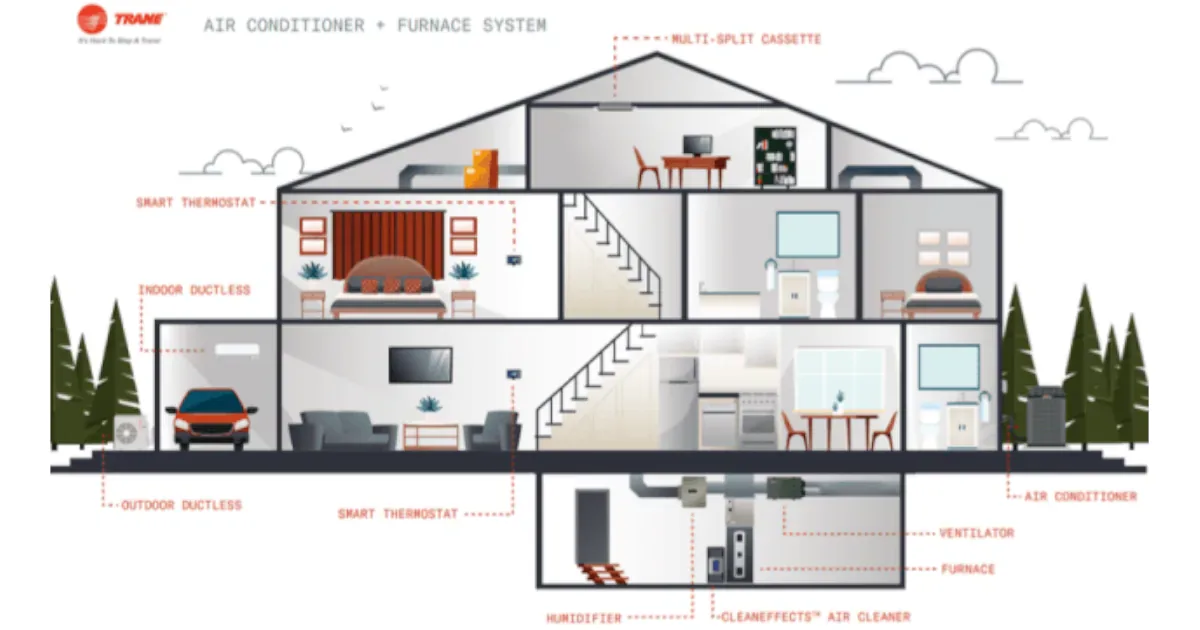
Every central system has the same five parts:
- A thermostat that measures room temperature and tells the equipment when to run. A blank thermostat screen stops the whole system, heating and cooling alike.
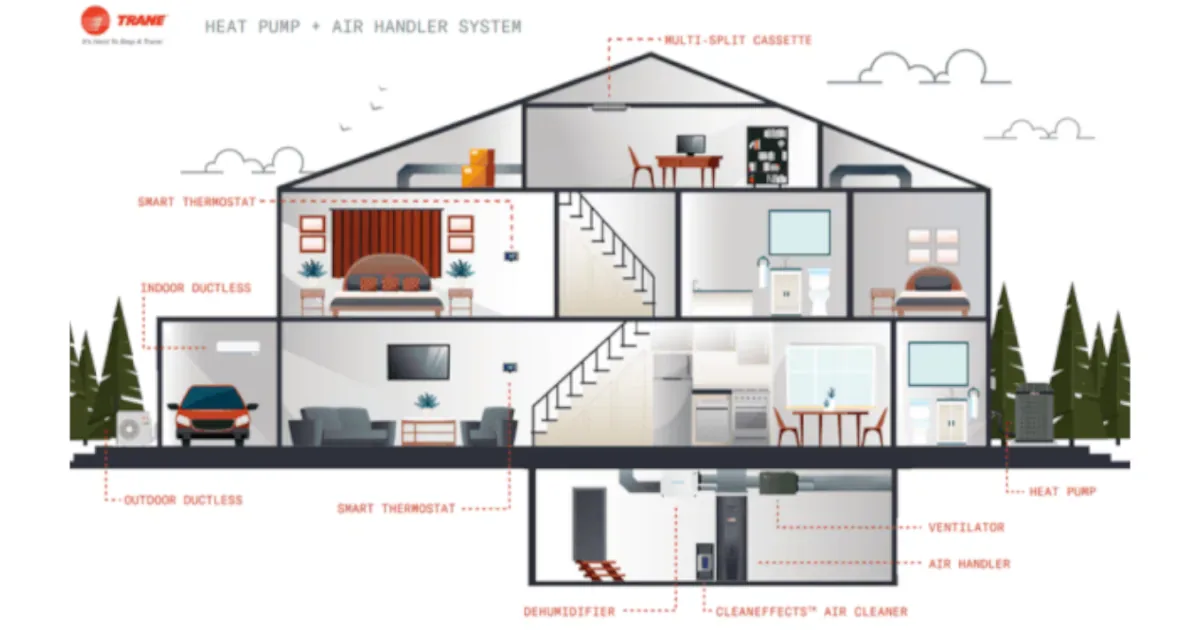
- An indoor unit that holds the blower fan and the indoor coil. In a furnace system the furnace cabinet is the indoor unit. In a heat pump system it is called an air handler.
- An outdoor unit that holds the compressor, the outdoor coil, and a fan. Homeowners call it the condenser.
- Refrigerant lines (two insulated copper pipes) that carry refrigerant between the indoor and outdoor coils.
- Ductwork that carries conditioned air out and room air back. Leaky or undersized ducts waste the output of even a new system, which is why duct sealing and repair often comes up during a replacement.
When the thermostat calls for cooling, the outdoor unit and the indoor blower run together. When it calls for heat, either the furnace burners light or the heat pump reverses. The rest of this guide walks through each of those sequences.
The Three Central Pairings Sacramento Homes Use
Split, ductless, and packaged is the buying-decision view of system types, and our 2026 HVAC buying guide covers it. This guide answers a narrower question: which heating source is paired with which cooling source inside a central system, because that pairing decides how the system works.
| Pairing | How it heats | How it cools | Where the equipment sits | Energy source |
|---|---|---|---|---|
| Gas furnace + split AC | Burners heat a metal heat exchanger; the blower pushes air across it | The AC coil sits on top of the furnace; the outdoor condenser rejects heat | Furnace indoors (closet, garage, attic); condenser outside | Natural gas for heat, electricity for cooling and the blower |
| Heat pump + air handler | The refrigerant cycle runs in reverse and pulls heat from outdoor air | Same refrigerant cycle, forward direction | Air handler indoors; heat pump outside | Electricity only |
| Packaged unit | Either a gas furnace section or a heat pump, built into the cabinet | Built-in AC or heat pump section | One cabinet on the roof or a ground pad; only ducts enter the house | Gas plus electricity, or electricity only |
A fourth arrangement, dual fuel, pairs a heat pump with a gas furnace as backup. It is a variation on the first two rows rather than its own category, and the heat pump versus gas furnace comparison explains when it earns its extra cost.
How Central Air Conditioning Works
Central air conditioning does not make cold. It moves heat from inside the house to outside using refrigerant, a fluid that absorbs heat when it evaporates and releases heat when it condenses. The cycle runs the same way whether the outdoor unit is a straight air conditioner or a heat pump in cooling mode.
- The thermostat reads a room temperature above the setpoint and closes the cooling circuit. The outdoor unit and the indoor blower start.
- The blower pulls warm room air through the return duct and the air filter. If you are not sure where that filter is, see where the HVAC filter is located.
- The filtered air passes over the indoor evaporator coil, which is full of cold, low-pressure liquid refrigerant. The refrigerant absorbs the heat and boils into a gas. The air leaves the coil cooler and drier, and the blower sends it through the supply ducts.
- The refrigerant gas travels through the larger copper line to the outdoor unit, where the compressor squeezes it into a hot, high-pressure gas.
- The outdoor fan blows outside air across the condenser coil. The refrigerant gives up its heat to that air and condenses back into a liquid.
- The liquid returns indoors through the smaller line, drops in pressure at a metering device just before the evaporator coil, and the cycle repeats until the thermostat is satisfied.
Two failure patterns follow directly from this cycle. If the system runs but the house never reaches the setpoint, start with why an AC runs but will not cool the house. If the indoor coil ices over or the air is only slightly cool, the signs of low refrigerant are the first thing a technician checks.
How Central Heating Works
Central heating starts the same way, with a thermostat call, and then splits into two very different processes depending on whether the house has a furnace or a heat pump.
Gas furnace
A furnace makes heat from scratch by burning fuel. In Sacramento that fuel is almost always natural gas from PG&E, with propane in outlying areas. The sequence on a modern furnace runs in a fixed order, and each step has a safety check:
- The thermostat calls for heat and the control board starts the inducer motor, a small fan that clears the heat exchanger and pulls in combustion air.
- A pressure switch proves the inducer is moving air. Until it closes, nothing else happens.
- The igniter glows or sparks, the gas valve opens, and the burners light. A flame sensor confirms the flame within seconds or shuts the gas off.
- The burners heat the inside of the heat exchanger, a sealed metal chamber. Combustion gases stay inside it and leave through the flue. A cracked heat exchanger is the one furnace fault that is a safety problem, not a comfort problem.
- After a short warm-up delay, the blower starts and pushes return air across the outside of the heat exchanger and into the supply ducts.
- When the thermostat is satisfied, the gas valve closes first and the blower runs a little longer to move the remaining heat out of the cabinet.
When a furnace runs but the air feels cool, one of the steps above is being skipped or cut short. The furnace blowing cold air guide sorts those causes by symptom.
Heat pump
A heat pump is an air conditioner with a reversing valve. In heating mode the valve swaps the roles of the two coils: the outdoor coil becomes the evaporator and absorbs heat from outside air, and the indoor coil becomes the condenser and releases that heat into the house. Even 40°F air holds heat that a refrigerant boiling far below freezing can absorb. The valve switches automatically on the thermostat call, and the homeowner never touches it. Our heat pump explainer covers the components in more depth.
Two things surprise first-time heat pump owners. The supply air feels cooler to the hand than furnace air, because a heat pump delivers a steady stream of moderately warm air instead of short blasts of hot air. And on cold, damp mornings the outdoor unit periodically runs a defrost cycle to melt frost off its coil, which briefly sends cool air indoors. Both are normal. If the air stays cold, the heat pump blowing cold air guide explains what is not normal.
ENERGY STAR's certification for cold climate heat pumps requires units to keep at least 70 percent of their rated 47°F heating capacity at 5°F (ENERGY STAR heat pump key product criteria). Sacramento's normal January low of 39.2°F (see the climate section below) sits far above that test point, so a heat pump here runs well inside its comfortable range.
Does the Furnace Control the AC?
Not exactly, but they share parts. In a furnace-plus-AC pairing, the furnace cabinet houses the blower that moves air for both heating and cooling, and the AC's evaporator coil sits in the plenum directly above the furnace. On a cooling call the thermostat energizes the outdoor condenser and tells the furnace control board to run the blower at cooling speed. The burners stay off.
That is why a furnace problem can show up in summer. A failed blower motor, a dead control board, or a tripped furnace breaker will stop the AC even though the outdoor unit is fine. It is also why the AC not turning on checklist starts at the furnace switch and the breaker panel, not at the condenser.
In a heat pump system the air handler plays the same role, and in a packaged unit everything shares one cabinet and one control board.
What SEER2, HSPF2, and AFUE Mean in 2026
Equipment ratings changed in 2023 and the labels you will see on quotes in 2026 are the new ones. Each rating answers one question.
- SEER2 (Seasonal Energy Efficiency Ratio 2) rates cooling efficiency over a season. Higher is better. Since January 1, 2023, a split air conditioner under 45,000 BTU per hour installed in California must rate at least 14.3 SEER2, and larger split units at least 13.8 SEER2 (10 CFR 430.32(c), the federal minimum standard). Single-package air conditioners must rate at least 13.4 SEER2.
- EER2 rates cooling efficiency at a fixed 95°F outdoor temperature, which is closer to a Sacramento July afternoon than a seasonal average. The same federal rule adds an EER2 floor in the Southwest region, which includes California: 11.7 EER2 for smaller split air conditioners rated below 15.2 SEER2.
- HSPF2 (Heating Seasonal Performance Factor 2) rates a heat pump's heating efficiency. The federal minimum for split heat pumps is 14.3 SEER2 and 7.5 HSPF2. ENERGY STAR certification requires at least 15.2 SEER2, 7.8 HSPF2, and 11.0 EER2 for split heat pumps (same ENERGY STAR criteria page cited above).
- AFUE (Annual Fuel Utilization Efficiency) is the share of a furnace's fuel that becomes heat in the house. The federal minimum for a standard gas furnace is 80 percent AFUE today, rising to 95 percent for furnaces manufactured on or after December 18, 2028 (same 10 CFR 430.32 rule). ENERGY STAR already requires 95 percent AFUE or higher for gas furnaces sold in the U.S. South, which includes California (ENERGY STAR furnace criteria).
One more 2026 change affects the cooling side of every pairing. EPA's Technology Transitions rule restricts refrigerants with a global warming potential of 700 or greater in new residential air conditioning and heat pump equipment, with compliance dates that began January 1, 2025 (88 FR 73098, October 24, 2023). New systems ship with lower-GWP refrigerants, and what that means for an existing R-410A system is covered in our guide to the 2025 refrigerant mandate.
Which rating tier to pay for (standard, high, or super efficient) is a budget question, and the 2026 buying guide linked above works through it. This section only explains what the numbers measure.
Which Central System Fits a Sacramento Home?
Climate decides more than brand does. NOAA's 1991 to 2020 normals for Sacramento Executive Airport put the normal January low at 39.2°F and the normal January high at 56.0°F, while the normal July high is 92.6°F and the station averages about 14 days a year at or above 100°F (NCEI station USW00023232 monthly normals). Two conclusions follow.
Cooling capacity is the constraint, not heating. Any of the three pairings can heat a Sacramento house on a 39°F night. Not every one of them can hold its setpoint on a 100°F afternoon if it is undersized or its ducts leak in a hot attic. Size and duct condition matter more here than in a cold-climate city.
A heat pump is a full heating option here. Sacramento winters sit far above the 5°F cold-climate test point, so a heat pump does not need gas backup to keep up. Whether it is cheaper to run than a gas furnace depends on your PG&E gas rate and SMUD electric rate, which is the subject of the heat pump versus gas furnace comparison linked above. SMUD's heat pump rebates are tracked in the SMUD rebates guide.
Practical fit by pairing:
- Furnace + split AC fits a house that already has a gas line, a working furnace, and an indoor equipment location. Replacing only the failed half is common, and our guide to repair versus replace explains when that makes sense.
- Heat pump + air handler fits an all-electric home, a home without gas, or an owner who wants one outdoor unit for both seasons. It also fits a house whose furnace and AC are both near end of life, since one outdoor unit replaces two.
- Packaged unit fits a house with no indoor space for equipment, which in Sacramento often means older single-story homes and condos with rooftop units. Everything is serviced outside.
Two Steps Before You Replace a Central System
Step 1: Get a load calculation, not a rule of thumb. The industry method is ACCA Manual J, which sizes equipment from the house's insulation, window glazing, orientation, and duct leakage rather than square footage alone (ACCA Manual J). ENERGY STAR's buying guidance says the same thing: a system that is too large or too small will struggle to meet the home's comfort needs, and the contractor should verify the size with Manual J (ENERGY STAR heat pump buying guidance). An oversized air conditioner satisfies the thermostat quickly and cycles on and off, which is the pattern described in our AC short cycling guide.
Step 2: Hire a licensed C-20 contractor and check the number. HVAC installers in California work under the Contractors State License Board's C-20 classification (warm-air heating, ventilating, and air conditioning). Alpha Mechanical holds CSL# 967727, and you can verify any contractor's license at the CSLB license check. Our guide to choosing a heating and air conditioning contractor lists the other questions worth asking before signing.
How Alpha Mechanical Can Help
Alpha Mechanical services all three central pairings in Sacramento, Fair Oaks, and the surrounding suburbs. If your existing system is misbehaving, our heating repair and AC repair visits start with a flat $89 diagnostic that is credited toward the repair. Seasonal maintenance is a flat $99 for a heating tune-up and $125 for an AC tune-up. The diagnostic fee and our price guarantee are on the guarantee and rates page.
If the system is at end of life, we install furnace replacements, heat pump replacements, and full HVAC installations, and the options on our financing page cover replacements. Call 916.848.5980 or book online to schedule.
Frequently Asked Questions
How do heating and cooling coils work?
The indoor and outdoor coils are heat exchangers for refrigerant. The evaporator coil absorbs heat from the air passing over it, which boils the refrigerant into a gas. The condenser coil releases that heat, which turns the refrigerant back into a liquid. In an air conditioner the indoor coil always evaporates and the outdoor coil always condenses. In a heat pump the reversing valve swaps those roles for heating.
Does one HVAC system both heat and cool?
Yes. A heat pump heats and cools with the same outdoor unit and air handler, and a packaged unit builds both functions into one cabinet. A gas furnace only heats, so it is paired with a separate air conditioner that shares its blower and ductwork.
What are the different types of central HVAC systems?
Central systems come in three pairings: a gas furnace with a split air conditioner, an electric heat pump with an air handler, or a packaged unit that holds either combination in one outdoor cabinet. Dual fuel adds a gas furnace as backup to a heat pump. Ductless mini-splits are not central systems because they have no ductwork.