

If the igniter glows but the burners never light, the furnace gas valve is not opening. Most of the time the valve itself is fine and simply never received its 24-volt signal, because an earlier safety device, a closed manual shutoff or low gas supply pressure stopped the ignition sequence first. A failed valve coil or a stuck valve is the less common cause. A homeowner can safely confirm the shutoff, the thermostat and the flash code, while testing and replacing the valve is gas work for a licensed technician.
- How a furnace gas valve works
- Signs of a bad furnace gas valve
- What you can safely check
- What a technician tests
- Repair or replace a furnace gas valve
- Gas smell and carbon monoxide safety
- Why valves act up after a Sacramento summer
At a glance
- The control board opens the gas valve only after the inducer runs, the pressure switch proves draft and the igniter is hot, so a valve that never opens often points upstream.
- York boards report no flame after three ignition trials as 7 red flashes, and Carrier variable-speed furnaces report an ignition lockout as status code 14.
- Burners that keep burning after the thermostat is satisfied can mean a leaking or slow-closing valve, which is a shut-it-off-now problem.
- A gas valve is a sealed safety component that gets replaced, never repaired, and the new valve's pressure is set to the furnace rating plate.
- If you smell gas, leave the house and call PG&E at 1-800-743-5000 or 911.
When to stop troubleshooting and call. Stop the moment you smell gas (leave the house and call PG&E at 1-800-743-5000 from outside), if the flame is yellow or lifting off the burners, if the burners stay lit with no call for heat, or if the next step means opening the gas train. The checks below tell you which part failed, not how to swap it. Alpha Mechanical runs same-day weekday no-heat calls across the Sacramento metro (next business day in peak weeks). The flat $89 diagnostic is credited to the repair: book heating repair or call (916) 848-5980.
How a furnace gas valve works
A furnace gas valve is an electrically operated safety valve that controls the flow of gas to the burners. A typical replacement valve, such as the White-Rodgers 36G and 36J series, contains redundant and main solenoid valves, a pressure regulator and an on/off switch, all powered by 24 volts from the furnace control board.
The valve is the last step in a fixed sequence. On a call for heat the inducer motor starts, the pressure switch closes once it senses draft, and the hot surface igniter heats up. On the York furnaces in the Y82V installation manual, the igniter glows for about 17 seconds before the ignition control opens the gas valve, and the control makes three attempts to light before it locks out.
Manifold pressure is the regulated gas pressure the valve delivers to the burners, and it must match the furnace rating plate. The White-Rodgers regulator adjusts between 2.5 and 5.0 inches of water column on natural gas and between 7.0 and 12.0 on propane, and the manufacturer warns never to use a valve set for natural gas on propane or the reverse.
Once the burners light, a flame sensor is the metal rod that proves the flame by carrying a tiny DC current through it. York lists normal flame sense current at about 3.7 microamps, a low-signal warning at 1.5 and a lockout at 0.1. If the flame is lost, the control shuts the gas valve off.
Signs of a bad furnace gas valve
Most "bad gas valve" symptoms have a more common cause, so match what you see before blaming the valve.
| What you notice | What it usually means | What to do |
|---|---|---|
| Igniter glows, no flame, then several retries and a lockout | No 24 volts reached the valve, low gas supply, or a failed valve or coil | Check the shutoffs, read the code, then call |
| Flame lights, then goes out within a few seconds | Flame sensor or low gas pressure more often than the valve | See the cold-air troubleshooting guide |
| Burners stay lit after the thermostat is satisfied | Leaking or slow-closing gas valve | Turn off the gas and power, then call |
| Repeated clicking with no ignition | An ignition or control problem upstream of the valve | See why a furnace won't turn on |
| Gas smell at the furnace | Possible leak at the valve or piping | Leave the house, then call PG&E or 911 |
The manufacturer codes back this up. York's manual lists 7 red flashes for a flame that could not be established in three ignition trials, and tells the technician to check the gas valve switch, gas pressure, the valve, the flame sensor and the igniter. It lists 1 red flash for flame sensed with no call for heat and names a leaking or slow-closing valve as the cause. Carrier's troubleshooting guide reports status code 14 when the furnace fails to ignite or prove flame in four attempts, and its control auto-resets after three hours.
What you can safely check
These checks involve no tools, no wiring and no gas fittings. Work through them in order.
- The thermostat. Confirm it is set to heat and a few degrees above the room temperature.
- The service switch and door. The furnace service switch, which usually looks like a light switch on or near the furnace, must be on, and the lower door must be seated so its safety switch is closed.
- The manual gas shutoff. On the gas line to the furnace, the handle is open when it runs parallel to the pipe.
- The switch on the valve. Many valves have an on/off switch or knob on the valve body, and York's manual lists it as the first thing to check for an ignition lockout. It should be on. If it won't move by hand, leave it alone.
- Other gas appliances. For example, if the stove burners light, gas is reaching the house.
- The flash code. Count the flashes through the door window and write the number down.
Stop there. Never tap or strike a gas valve to free it, and never short its terminals to test it, a practice the White-Rodgers instructions specifically warn against. If you have an older standing-pilot furnace and the pilot won't stay lit, that is a thermocouple and pilot question, covered in our pilot light relight guide.
What a technician tests
A technician works out whether the valve failed or never got the signal to open.
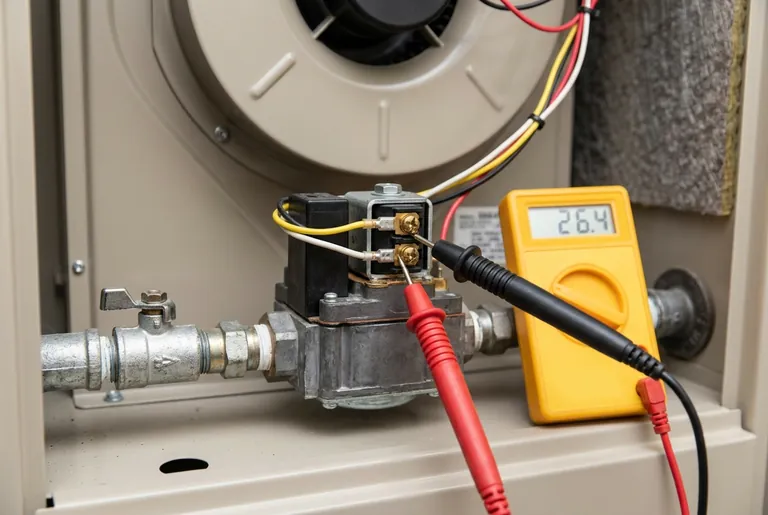
- Voltage at the valve. 24 volts at the valve terminals during the ignition trial with no gas flow points at the valve. No voltage points upstream, at the control board, the pressure switch, a limit or a rollout switch.
- Coil resistance. An open reading on the valve coil means the coil has failed.
- Gas pressure. A manometer on the inlet and outlet taps shows whether supply pressure is in range and the manifold pressure matches the rating plate. York's manual gives a natural gas inlet range of 4.5 to 10.5 inches of water column.
- A leak test. After any gas work, every connection is checked with a leak detection solution or soap suds, and never with a flame, as the valve instructions require.
Repair or replace a furnace gas valve
A furnace gas valve is replaced, not repaired. It is a sealed safety component, and the White-Rodgers instructions say that if the control will not move by hand, you should not try to repair it and should call a qualified service technician. The replacement must suit the furnace and its gas type, and the technician then sets the manifold pressure to the rating plate and leak-tests the connections.
What moves the price is the valve and the access. A two-stage or modulating furnace uses a more complex valve than a single-stage one, a manufacturer (OEM) part costs more than an approved universal part, and a furnace in a tight attic takes longer than one in a garage. Rather than quote a national average, we give you the exact installed price in writing before any work starts, and the flat $89 diagnostic is credited to the repair.
In California, the contractor you hire for this work should hold a C-20 license, the CSLB classification for contractors who install, service and repair warm-air heating systems. Alpha Mechanical holds CSL# 967727.
Gas smell and carbon monoxide safety
If you ever smell gas, leave the house and call PG&E at 1-800-743-5000 or 911. PG&E's gas safety page lists the sights, sounds and smells of a natural gas leak. In the Sacramento area, natural gas comes from PG&E, while SMUD provides electricity only.
A damaged burner or incorrect gas pressure can cause incomplete combustion, which produces carbon monoxide. The CDC counts more than 400 deaths a year in the United States from unintentional carbon monoxide poisoning not linked to fires, and recommends a battery-operated or battery-backup CO detector in every home. A cracked heat exchanger is another way carbon monoxide can reach the living space, and our cracked heat exchanger guide covers its warning signs.
Why valves act up after a Sacramento summer
A gas furnace in the Sacramento Valley can sit idle through the whole warm season, often in an attic or garage. When the first cold snap arrives, a sticky valve, a dirty flame sensor or a tripped safety shows up all at once, and every heating company is busy at the same time.
Run the furnace once in October, before you need it, so problems surface early. A furnace tune-up is the time to have the burners, the flame sensor and the safety controls checked. If you live near our home base, our Fair Oaks furnace repair page covers local service, and the Sacramento furnace troubleshooting guide sorts every other no-heat symptom.
About this guide. Written by Andrey Yev for Alpha Mechanical. Editorial review on September 29, 2026 checked every code, pressure and safety statement against the York, Carrier and White-Rodgers manufacturer documents, the CSLB, PG&E and the CDC, all linked above. You can read more about us on our Why Alpha page, or contact us at (916) 848-5980.