

A furnace pressure switch that won't close stops the furnace before the burners light. You hear the inducer motor start, nothing ignites, and the control board flashes a pressure switch code. The usual causes, from most to least common, are a cracked or clogged switch hose, a blocked vent or intake pipe, a plugged condensate drain on a high-efficiency furnace, a weak inducer, and last of all a failed switch. You can safely read the code and look at the hose, the drain and the outside vent. The meter and gauge tests are a technician's job.
- What the pressure switch does
- Pressure switch error codes by brand
- Why a pressure switch won't close
- What you can safely check
- What a technician measures
- Never bypass the pressure switch
- Keeping the switch out of trouble
At a glance
- The pressure switch proves the venting system is clear before the control board allows any gas to flow, so no draft means no ignition.
- Three flashes on Goodman and York control boards indicates a switch stuck open, and Carrier variable-speed furnaces display status code 32 or 31.
- Most "bad switch" service calls turn out to be a hose, vent, condensate drain or inducer problem rather than a defective switch.
- A homeowner can safely read the code and inspect the hose, the condensate drain and the exterior vent, and should stop there.
- Never jumper the switch, because it is the safety device that keeps combustion exhaust out of your house.
When to stop troubleshooting and call. Stop if the code comes back after the safe checks below, if the lockout repeats more than twice, or if you see soot or smell exhaust at the furnace. Those point at the inducer, the flue or the heat exchanger, not the switch. Alpha Mechanical runs same-day weekday no-heat calls across the Sacramento metro (next business day in peak weeks). The flat $89 diagnostic is credited to the repair: book heating repair or call (916) 848-5980.
What the pressure switch does
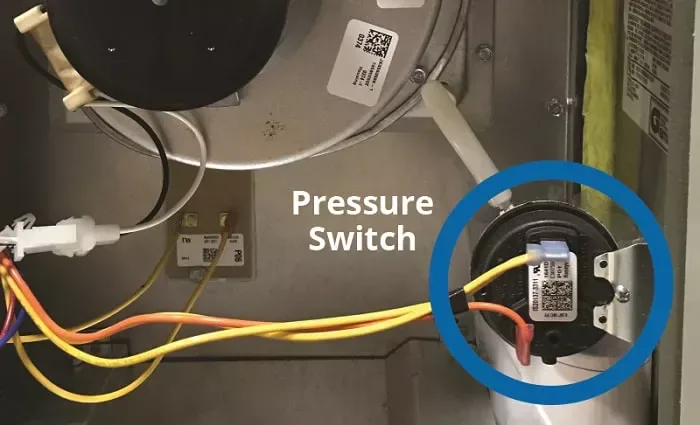
A furnace pressure switch is a small safety switch that closes only when the furnace vent is pulling air the right way. It sits next to the inducer motor, the small blower that starts first on every heat cycle and pushes combustion gases out through the vent.
The switch is normally open, and when the inducer spins up it pulls a slight vacuum through a thin rubber hose connected to the switch. Draft is the name for that pull. Once the draft is strong enough, a diaphragm inside the switch closes the contacts and the control board moves on to the igniter and, a few seconds later, the furnace gas valve.
The whole ignition sequence takes well under a minute. On the York furnaces in the manual cited below, the hot surface igniter glows for about 17 seconds after the inducer starts, and then the ignition control opens the gas valve. The circulating blower follows about 30 seconds after the flame is established. If the pressure switch never closes, that sequence stops at the first step.
York's installation manual puts the job in one line: the pressure switches monitor the flow through the combustion air and vent piping, and they shut off the gas valve if the vent is blocked or the combustion air blower fails. That is the whole point of the part: if exhaust can't leave the house, the furnace must not light.
Every switch has its activation point printed on its label. Inches of water column is the measurement unit for these very small pressures, abbreviated in. w.c. on the manufacturer label.
Pressure switch error codes by brand
Most modern furnaces identify which switch problem they detected. Look through the small window in the lower door for a blinking diagnostic light, and count the flashes before you open anything, because on most furnaces removing the door interrupts the power and can clear the code.
| Brand and board | Switch stuck open (won't close) | Switch stuck closed | Source |
|---|---|---|---|
| Goodman (GMSS92 family) | 3 flashes | 2 flashes | Goodman GMSS92 specifications |
| York (Y82V family) | 3 red flashes | 2 red flashes | York Y82V installation manual |
| Carrier (variable-speed 58 series) | Code 32 (low-heat switch) or 31 (high-heat switch) | See the door legend | Carrier troubleshooting guide |
Codes vary by model and board, so always check the legend printed inside your furnace door. Two details from those manuals are worth knowing:
- Carrier gives the switch 45 seconds. On the variable-speed furnaces in that guide, the low-heat switch has 45 seconds to close after a call for heat. If it doesn't, the board flashes code 32, shuts down, waits two minutes and tries again.
- York counts repeat openings. Six red flashes means the switch opened four times during one call for heat. The furnace then locks out for an hour before it restarts.
Some furnaces, Coleman among them, word the same fault as "combustion air switch failed to close." It means the same thing, because the combustion air switch is the pressure switch and it never saw enough draft from the inducer.
Why a pressure switch won't close
A switch that won't close is usually telling the truth, because something upstream is starving it of draft. Carrier's guide lists the usual suspects: a sag in the vent pipe, a clogged drain trap or line, excessive restriction in the combustion-air or vent pipe, and a damaged or loose inducer wheel. In rough order of how often we find them:
- The hose. A cracked, split or kinked hose, or one with water sitting in it, and even a pinhole leak bleeds off the draft.
- A blocked vent or intake. Debris such as leaves, a wasp nest or a bird nest in the pipe where it leaves the house.
- A plugged condensate drain. A high-efficiency (condensing) furnace produces water from its exhaust, which drains through a trap, and if the trap or the drain line clogs, water accumulates and the switch cannot sense the draft.
- A weak inducer. A dirty wheel, worn bearings or a slow start, which is an inducer problem rather than a switch problem and is covered in the inducer motor guide linked above.
- Wiring. A loose or corroded terminal at the switch or the board.
- The switch itself. A torn or stiff diaphragm happens, but it belongs at the bottom of the list.
In Sacramento these faults cluster around the first cold snap, when a furnace that sat idle all summer in an attic or garage restarts with whatever settled in its venting and condensate drain. Older induced-draft furnaces are also common in the 1980s and 1990s tracts, for example in Gold River, and their hoses and inducers are now old enough to fail.
If your switch closes and then drops out mid-cycle, the story is similar: a partly blocked vent, water in the hose or drain, or an inducer that can't hold its speed.
What you can safely check
These checks need no tools and no live wiring, so set the thermostat to off first and work through them in order.
- Read the code. Count the flashes twice and write the number down.
- Inspect the hose. Turn the furnace off at its service switch, remove the upper door, and follow the rubber hose from the switch to the inducer housing, looking for cracks, a kink, a loose connection or water inside it. Don't blow into the switch port, because the diaphragm is delicate.
- Check the condensate drain. On a high-efficiency furnace, look for water pooling near the trap or a drain line that isn't draining.
- Check the exterior pipes. A high-efficiency furnace usually has two plastic pipes where it vents through a wall or roof, and you can clear leaves or a nest you can reach from the ground.
- Test one cycle. Reinstall the doors, restore power, set the thermostat to heat and observe one complete cycle, and if the code returns, stop.
That is where homeowner checks end, because the next steps involve a live circuit and a gas appliance.
What a technician measures
The deciding test is a pressure reading. A manometer is an instrument that measures the very small pressures a furnace produces. The technician connects it to the switch hose with a tee, operates the inducer, and compares the measured draft with the rating printed on the switch.
- Draft above the rating, switch still open: the switch is bad. It gets replaced with the exact part number and rating.
- Draft below the rating: the problem is upstream, in the vent, the drain, the inducer or the heat exchanger. A new switch would not fix it, and a cracked heat exchanger has its own warning signs.
Carrier's guide works exactly this way. For one variable-speed family it calls for at least 0.95 in. w.c. across the heat exchanger at low heat (0.75 on the smallest model) and 1.90 at high heat before it blames the switch (Carrier troubleshooting guide). Those numbers are for that model, and your own switch label gives the ones that apply to you.
The switch itself is a small, inexpensive component, so the diagnosis is what you are really paying for, because installing a new switch on a blocked vent only relocates the problem. Our heating diagnostic is a flat $89 and is credited to the repair if you go ahead with furnace repair.
Never bypass the pressure switch
Some online advice says to jumper the two switch wires so the furnace runs, and you should not do it. The switch is the part that proves exhaust is leaving your house. With it bypassed, the furnace can fire into a blocked vent, and carbon monoxide has no smell.
The CDC counts more than 400 deaths a year in the United States from unintentional carbon monoxide poisoning not linked to fires, plus more than 100,000 emergency room visits. The CDC's advice is simple: install a battery-operated or battery-backup CO detector. If a CO alarm sounds, get everyone outside and call 911.
Keeping the switch out of trouble
Most switch lockouts come from conditions an autumn inspection catches: the hose, the ports, the condensate trap and the vent termination outside the house. A furnace tune-up before the first cold night is the right time to have them examined.
If your furnace runs but blows cold air and shows no code, start with why a furnace blows cold air. For every other no-heat pattern, why a furnace won't turn on sorts them by symptom.
About this guide. Written by Andrey Yev for Alpha Mechanical. Editorial review on September 29, 2026 checked every code and number against the Carrier, Goodman and York manufacturer documents linked above. You can read more about us on our Why Alpha page, or contact us at (916) 848-5980. Alpha Mechanical has repaired furnaces across the Sacramento region since 2011, from Fair Oaks to Folsom, CSL# 967727.