A furnace blowing cold air is almost always doing one of three things. The blower is running on the thermostat's FAN = ON setting with no call for heat. The burners lit, then a safety device shut them off while the fan kept going. Or the burners never lit at all. In Sacramento a fourth case shows up once heating season starts: the house has a heat pump rather than a furnace, and the cool air is a normal defrost cycle.
- Start Here: What Is the Air Actually Doing?
- 7 Common Reasons Furnace is Blowing Cold Air
- 1. The Thermostat Fan Is Set to ON
- 2. Restricted Airflow Tripped the Limit Switch
- 3. A Dirty Flame Sensor
- 4. Ignition, Pilot Light and Gas Supply Issues
- 5. Clogged Condensate Line
- 6. Air Duct Leakage
- 7. Your Furnace Isn't Warmed Up Yet
- When to Stop Troubleshooting and Call
- When Sacramento Furnaces Start Blowing Cold
- Preventative Measures and Maintenance Tips
- Frequently Asked Questions
Set the fan to AUTO first. If the air is still cold ten minutes later, the fork below tells you which of the other three you have, and where troubleshooting should stop. Alpha Mechanical charges a flat $89 diagnostic on weekdays across Sacramento County.
Key Takeaways:
- Sort by symptom before you sort by cause. What the air is doing, and when it turns cold, narrows seven possibilities down to one or two.
- Fan set to ON is a false alarm rather than a fault. The blower runs continuously and moves room-temperature air between heating cycles, which feels cold on your skin.
- Burners that light and then quit point at a safety device doing its job: a tripped high limit from restricted airflow, or a flame sensor that has stopped detecting the flame.
- Duct leakage is the quiet one. ENERGY STAR puts typical duct loss at about 20 to 30 percent of the air moving through the system, which shows up as lukewarm air rather than cold.
- Stop and call at the first sign of a gas smell, repeated limit trips, or a suspected cracked heat exchanger. Those are not homeowner checks.
Not sure cold air is your exact problem? Our Sacramento furnace troubleshooting guide routes every no-heat symptom - dead furnace, short cycling, weak heat - to the right fix.
Start Here: What Is the Air Actually Doing?
Most troubleshooting guides sort by cause. Homeowners experience symptoms, not causes. Start with the row that matches what your vents are doing right now.
| What you observe | Most likely cause | Go to |
|---|---|---|
| Fan runs constantly, air is room temperature, never warms | Thermostat fan set to ON instead of AUTO | Reason 1 |
| Warm for a minute or two, then cold, blower keeps running | High limit tripped by restricted airflow, or a dirty flame sensor | Reason 2 and Reason 3 |
| Cold from the start, burners never light | Ignition, pilot or gas supply | Reason 4 |
| Cool air in short spells, outdoor unit steaming, then warm again | Normal heat pump defrost, not a furnace fault | Heat pump blowing cold air |
| Air is lukewarm everywhere, some rooms worse than others | Duct leakage | Reason 6 |
| Straining, grinding or whining, then the furnace quits | Inducer motor | Signs of a bad inducer motor |
That last row is worth reading twice if you are not certain what you own. A defrost cycle is a heat pump briefly running in reverse to melt frost off its outdoor coil, and while it does that the indoor air turns cool. Lennox puts a normal defrost cycle at 5 to 15 minutes, with the system checking for frost every 30 to 90 minutes while it heats. If the cool air arrives in short bursts and ends on its own, nothing is broken.
7 Common Reasons Furnace is Blowing Cold Air
Technicians work these in a rough order: most common and cheapest first, gas-side and safety last.
1. The Thermostat Fan Is Set to ON
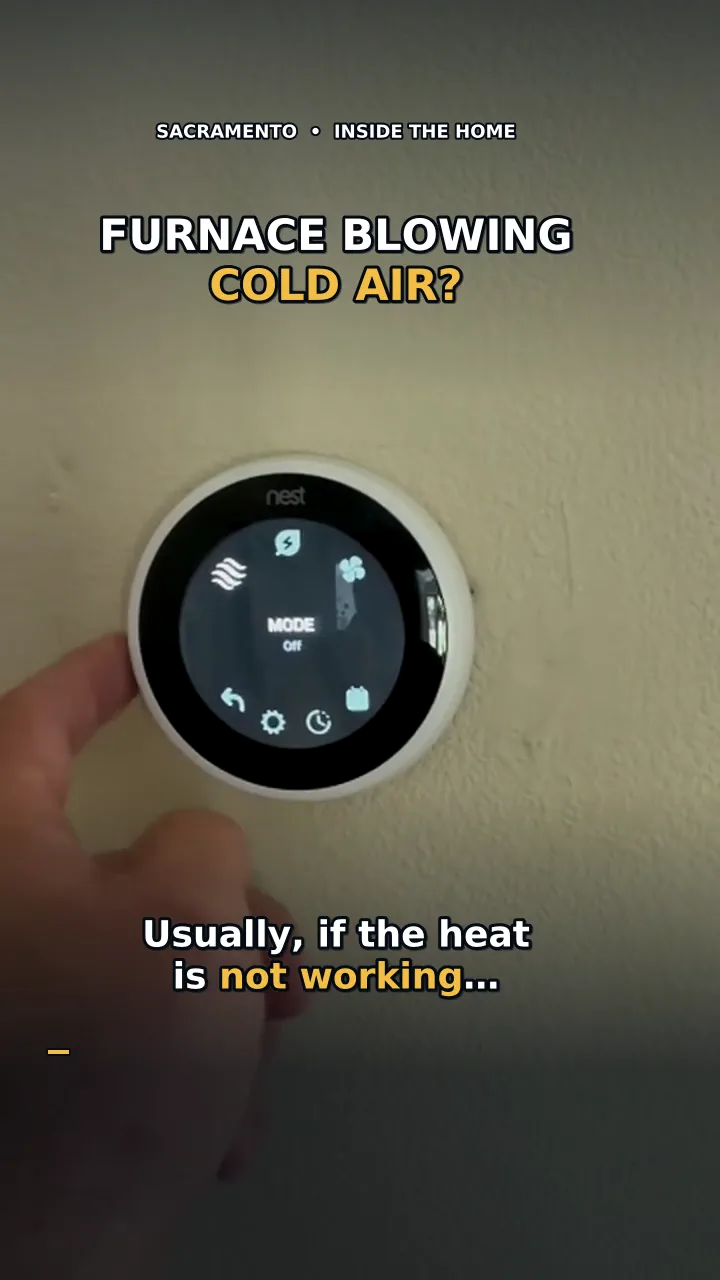
Check this before anything else, because it is the one cause that is not a fault at all. The fan switch has two positions. On AUTO, the blower runs only when the furnace is producing heat. On ON, the blower runs continuously, which means that between heating cycles it is circulating room-temperature air past your skin. Room-temperature air moving over skin feels cold, which is why this setting fools so many people.
Set the fan to AUTO and wait. Then confirm the mode is HEAT rather than COOL, and that the setpoint is above the current room temperature. If your thermostat is battery powered, weak batteries can leave a display lit while the call for heat never reaches the furnace, so replace them before assuming anything worse.
With the fan on AUTO, the mode on HEAT and the setpoint high enough, cold air means the problem sits downstream of the thermostat. Keep reading.
2. Restricted Airflow Tripped the Limit Switch
This is the case that produces warm air for a minute or two and then cold air with the blower still running. Carrier's guide on this symptom describes the mechanism directly: furnaces carry safety controls that monitor operating temperatures called limit switches, and when the system overheats the furnace shuts the burners down while the blower keeps running to clear the heat.
A high-limit switch is the temperature cut-out that does this: it opens when the air around the heat exchanger gets too hot and drops the burners out. Overheating almost never starts at the furnace, though. It starts at the airflow. A loaded filter, closed or blocked supply registers, or a crushed return can all starve the heat exchanger of the air it needs to shed heat into. The burners run, the plenum climbs past the limit setting, the limit opens, and the burners cut out while the fan carries on. When that loop repeats every few minutes, the furnace is short cycling, and timing the cycle is the fastest way to narrow the cause.
Two checks are yours. Pull the filter with the system switched off and hold it up to a light; if you cannot see light through it, replace it. Then walk the house and open every supply register and clear anything sitting against a return grille.
What is not yours: a limit switch that keeps tripping after the airflow is clear. Repeated trips point at the heat exchanger, the blower, or the limit itself, and each of those is a service call rather than a homeowner fix.
3. A Dirty Flame Sensor
A flame sensor is a thin metal rod sitting in the burner flame, and its whole job is to confirm the flame is there. Bryant puts the failure plainly: a dirty or faulty flame sensor fails to detect the fire inside the combustion chamber, prompting the system to close the gas valve as a safety precaution. The furnace lights, loses confirmation within a few seconds, shuts the gas off, and leaves the blower pushing unheated air.
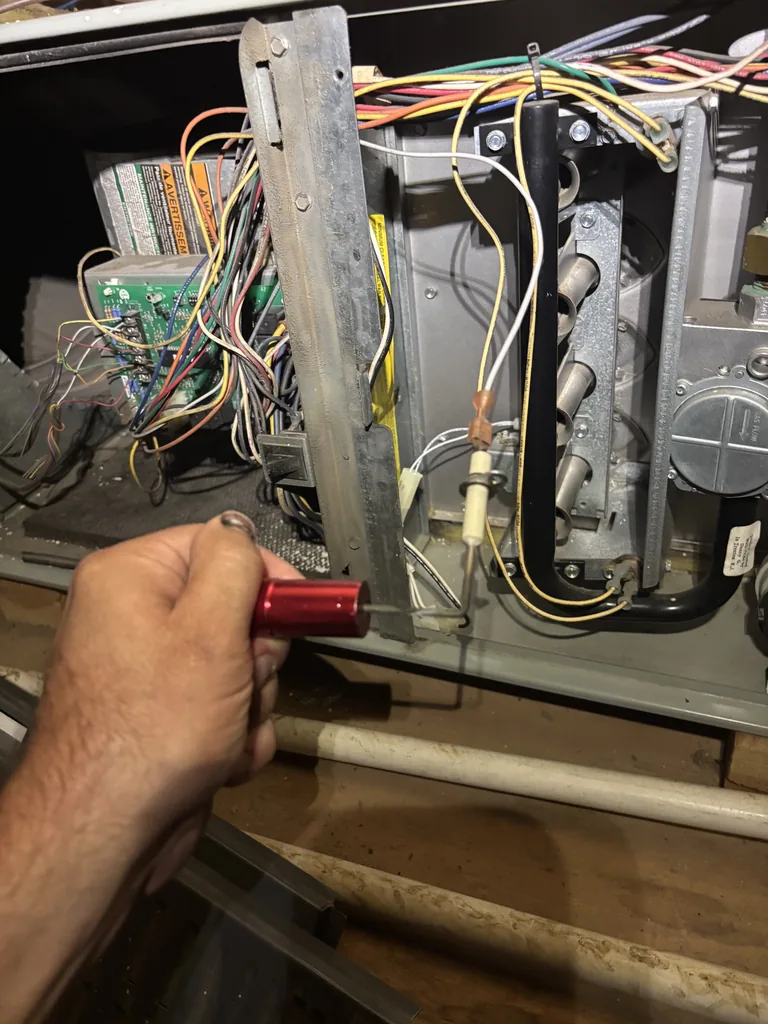
Timing is the tell. Ignition happens, you hear it, and the burners quit almost immediately, then the cycle repeats. Bryant lists a safety lockout among the reasons a blower runs with no heat, and on most systems the control board flags the fault with a flash code before it stops trying.
Cleaning a flame sensor means pulling it from a live gas appliance and refitting it correctly. A visual check through the inspection port is reasonable. Beyond that, hand it to a technician. It is a small part and usually a same-day repair.
4. Ignition, Pilot Light and Gas Supply Issues
If the burners never light at all, the problem is in the ignition path. If you suspect a gas leak, call for a professional contractor to be safe.
Older furnaces use a standing pilot with a thermocouple, a safety device that shuts the gas off if the pilot goes out. A dirty or failing thermocouple stops signalling correctly and the pilot will not stay lit. Our guide on a pilot light that will not stay lit covers relighting safely and when to stop.
Newer furnaces have no pilot at all. They use a hot surface ignitor or a spark ignitor, and a failed ignitor produces exactly the same symptom: a call for heat, an inducer that runs, and no flame. Gas supply itself can also be the cause, whether the valve is partly closed or the pressure is low. Gas valve work is licensed-technician territory, and furnace gas valve troubleshooting explains why.
If the furnace does not even attempt a start, the fault is further upstream. Our guide on a furnace that will not turn on picks up there.
5. Clogged Condensate Line
High efficiency furnaces produce water as a by-product of combustion, and that water leaves through a condensate drain. When the drain clogs, many furnaces sense the backup through a float or pressure switch and shut the burners down rather than risk water damage.
The signs are visible before the furnace quits: water pooling near the unit, damp patches, a musty smell, or visible sludge on the drain line. If you see any of those, shut the system off to stop the backup from getting worse.
Clearing a condensate line properly means locating the blockage, clearing it without cracking the PVC, and checking the trap and the switch that shut the system down. If the line is damaged rather than blocked, it needs replacing. A local specialist can clear it during a furnace repair visit, and an annual furnace cleaning and maintenance visit is what keeps it from recurring.
6. Air Duct Leakage
Duct leakage rarely produces genuinely cold air. It produces lukewarm air, uneven rooms, more dust, and heating bills that do not match the runtime. ENERGY STAR estimates that in a typical house, about 20 to 30 percent of the air that moves through the duct system is lost due to leaks, holes, and poorly connected ducts.
In this region that loss is usually happening in an attic, which in a Sacramento summer runs far hotter than the house and in winter runs far colder. Heated air escapes on the way to the room, and attic air gets pulled into the return side of the system to replace it.
Sealing and insulating are the fixes here, not cleaning. Mastic sealant or foil-backed tape on accessible joints, insulation on runs through unconditioned space, and a pressure test to confirm the system is actually tight afterwards. Age, rodent damage, and poor original installation are the usual causes.
7. Your Furnace Isn't Warmed Up Yet
Sometimes patience is all you need. Many furnace models hold the blower back at the start of a cycle on purpose. Carrier describes it as a fan limit switch that allows the burners to warm up the heat exchanger before the blower pushes air into your living areas. It exists precisely to stop the system blasting cold air at startup.
That delay is measured in minutes, not hours. If the air is warm within ten or fifteen minutes of a cold start, nothing is wrong. If it never warms, go back to the fork at the top.
When to Stop Troubleshooting and Call
Some symptoms are not troubleshooting problems.
A gas smell. Stop. Do not test anything further. Our position is unchanged: if you suspect a gas leak, call for a professional contractor to be safe.
Repeated limit trips after the airflow is clear. A new filter and open registers should end a limit-trip pattern. When it continues, the cause is inside the furnace.
Anything past a visual check on the flame sensor or burners. Both live in the combustion path.
Suspected cracked heat exchanger. This is the one that changes the stakes, because it can put combustion gases into the air you breathe. The CDC describes carbon monoxide as an odorless, colorless gas that kills without warning and recommends battery-operated or battery back-up CO detectors near every sleeping area, replaced on the manufacturer's schedule or every five years. Our guide to cracked heat exchanger symptoms covers what the failure looks like. Shut the furnace off and call.
Electrical faults. A breaker that trips every time the furnace starts is telling you something, and resetting it repeatedly is not the answer. Blower and inducer faults belong here too: straining, grinding or whining before the furnace quits is the last row of the table at the top, and that row is a repair call.
Alpha Mechanical runs a flat $89 diagnostic on weekdays, and it goes toward the repair. We cover Fair Oaks and Greater Sacramento, and heating repair has the full scope.
When Sacramento Furnaces Start Blowing Cold
Cold-air calls here follow the weather, and the weather here has a sharp edge to it.
We pulled NOAA's 1991 to 2020 climate normals for Sacramento Executive Airport (station USW00023232) for this guide rather than quoting a national figure. Here is the heating load by month:
| Month | Heating degree days (normal) | Share of the year |
|---|---|---|
| September | 4.7 | 0.2% |
| October | 78.6 | 3.2% |
| November | 335.3 | 13.8% |
| December | 550.2 | 22.6% |
| January | 539.4 | 22.1% |
| February | 380.8 | 15.6% |
Two things follow from that curve. September asks almost nothing of a furnace, so a fault that developed over the summer stays invisible until the first genuinely cold night in October, when the load jumps roughly seventeenfold. And December and January together carry 44.7 percent of the annual 2,436 heating degree days, which is when a marginal system tends to fail and when getting onto a service schedule is hardest.
The practical version: if your furnace blew cold air last winter and you never had it looked at, October is the month to deal with it. A pre-season visit is a scheduled appointment. That same failure in January is an emergency.
Preventative Measures and Maintenance Tips
Most of the seven causes above are preventable, and the prevention is unglamorous.
An annual professional inspection, ideally in autumn before the cold sets in, catches the flame sensor, the limit switch behavior, the condensate drain and the heat exchanger before any of them strand you. Our guide to what an HVAC tune-up includes covers exactly what a visit should touch.
On your end, four habits do most of the work:
- Replace the filter every 1 to 3 months, or more often if the house is dusty or you have pets.
- Keep supply registers open and return grilles clear.
- Test the thermostat and the carbon monoxide detectors, and replace thermostat batteries annually.
- Seal and insulate accessible ducts, especially any running through an attic.
Frequently Asked Questions
Is it urgent to fix a furnace that blows cold air?
It depends on which of the three cases you have. A fan set to ON is not urgent at all. Burners that light and quit are worth fixing quickly, because the underlying airflow or sensor fault tends to get worse. A suspected gas leak or cracked heat exchanger is urgent immediately, and neither is a homeowner check.
Could a dirty air filter cause my furnace to blow cold air?
Yes, and it is one of the most common mechanical causes. A clogged filter starves the heat exchanger of airflow, the furnace overheats, and a safety limit shuts the burners off while the blower keeps running. That is why the symptom is warm air for a minute or two, then cold. Change the filter every 1 to 3 months to prevent it.
How often should I service my furnace to prevent cold-air issues?
Once a year, ideally in autumn. In Sacramento that means before the October step up in heating load, when the first cold nights expose faults that stayed hidden all summer. Between visits, change the filter, keep registers and returns clear, and test the thermostat and CO detectors.
Is it safe to ignore a furnace that only blows cold air occasionally?
Check what your outdoor unit is doing first. If you have a heat pump rather than a furnace, short spells of cool air with steam rising off the outdoor unit are a normal defrost cycle, and Lennox puts that at 5 to 15 minutes. If you have a gas furnace, intermittent cold air points at a sensor or limit fault that will worsen, so address it early, and call an HVAC professional immediately if you ever suspect a gas leak.