

A failing furnace inducer motor shows up five ways: a grinding, humming or squealing noise when the furnace first starts, an inducer that does not spin up at all, a blinking error code on the control board, weak or no draft so the pressure switch never closes, and a furnace that runs in short bursts and quits before the burners light. Furnace inducer motor repair almost always means replacing the motor or the whole inducer assembly rather than rebuilding it, and at Alpha Mechanical that starts at $480, with the flat $89 diagnostic credited to the repair.
- What's the function of furnace inducer motor in an HVAC system?
- Value of proper furnace draft inducer motor maintenance and replacement
- How to tell if a furnace inducer motor is bad?
- What the noise is telling you
- Frequent Reasons for Furnace Inducer Motor Failure
- Inducer motor or blower motor? How to tell which one you are hearing
- What it costs to replace a furnace inducer motor, and when it is worth it
- Carrier, York, Bryant and Payne: what changes by brand
- When to conduct furnace inducer motor troubleshooting and when to call a professional?
- Preventive Maintenance for Furnace Inducer Motors
- A Sacramento no-heat call, start to finish
- Frequently Asked Questions
Key takeaways
- Earliest sign: noise in the first thirty seconds of a heating cycle, before the burners light. It usually arrives days or weeks before the motor quits.
- Most confusing sign: a pressure-switch error code. The switch is often fine; the inducer cannot pull enough draft to close it.
- The repair: a replacement motor or inducer assembly, not a bearing rebuild. Oiling a seized motor is a stopgap, not a fix.
- Repair or replace the furnace: under about ten years, replace the motor. Past about fifteen, price the repair against a new furnace first.
- Stop and call: a motor that grinds at every start or never spins, repeated lockouts, a burning electrical smell, or any gas odor.
The inducer is the first motor to run in every heating cycle. If it cannot prove draft, the pressure switch blocks ignition and nothing downstream happens. That is why a failing inducer usually looks like a dead furnace rather than a noisy one, and why the control board often reports a pressure-switch fault when the pressure switch is fine.
This guide covers one component. For the full no-heat walk-through, from thermostat to safety switches, see our Sacramento furnace troubleshooting guide.
When to stop troubleshooting and call. Stop if the inducer grinds or screams at every start, if it never spins at all, if the furnace has locked out on the pressure switch more than twice in a row, or if you smell gas (leave the house and call PG&E at 1-800-743-5000 from outside). Everything past the filter, the flue outlet and a visual check is meter and gas-train work. Alpha Mechanical runs same-day weekday no-heat calls across the Sacramento metro (next business day in peak weeks), and the flat $89 diagnostic is credited to the repair: book heating repair or contact us at (916) 848-5980.
What's the function of furnace inducer motor in an HVAC system?
Before warm air reaches the vents, a fixed sequence has to complete. Six steps run in order: thermostat, inducer motor, pressure switch, igniter, gas valve, flame sensor, blower motor.
The draft inducer motor is a small motor-driven fan mounted at the flue, and it is the first thing you should hear after the thermostat calls for heat. It pushes combustion gases out through the exhaust, clearing any leftover fumes from the previous cycle before the burners light. When it works, the furnace vents safely and runs efficiently. When it weakens, the entire venting safety chain weakens with it.
The 80% AFUE furnaces common in older Fair Oaks and Sacramento homes depend on this inducer-driven draft, and ENERGY STAR's furnace guidance covers how draft design tracks efficiency ratings. A weak motor is a safety problem before it is a comfort problem.
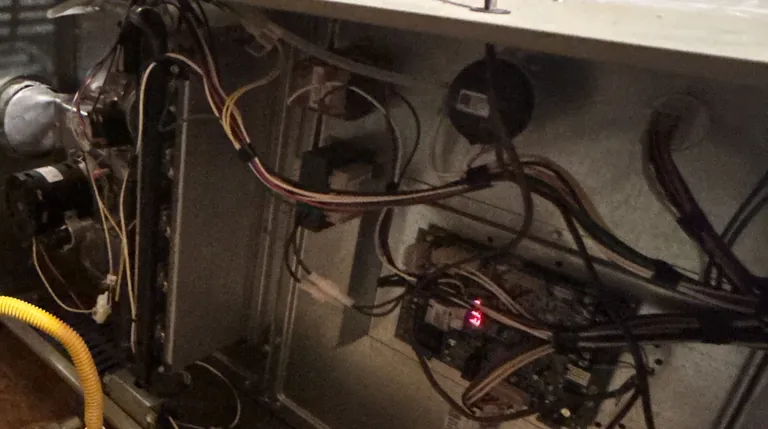
Sacramento wears these motors in a particular way. Our winters are mild and swing hard between warm afternoons and cold nights, so furnaces here short-cycle rather than running steadily. All that starting and stopping is harder on inducer bearings than the continuous running a colder climate would produce.
Value of proper furnace draft inducer motor maintenance and replacement
When the heat stops, the inducer motor is not the first thing most homeowners think of. Furnace manufacturers build a handful of failsafes and sensors into their products, and the inducer is one of them. It functions as a safety device: it creates the negative pressure that purges the heat exchanger of combustion byproducts, including carbon monoxide, and sends them out through the vent or chimney.
If that draft is not maintained, one of three things happens. You get no heat at all because the furnace will not ignite. You get gas odors around the unit. Or the fan starts making noises that get worse every week until it seizes. In most cases the fix is replacement of the motor or the whole inducer assembly rather than a repair to it.
Heat not running? See our Sacramento furnace repair service for a same-day diagnosis.
How to tell if a furnace inducer motor is bad?
Five signs, in the order you are likely to notice them.
1. Noise at the start of the cycle
Grinding, humming, squealing or rattling in the first thirty seconds, before you hear the burners light. This is the earliest warning and the most useful one, because it usually arrives days or weeks before the failure. A noise that is getting louder week over week is a bearing wearing out, and it will not recover on its own.
2. The inducer does not spin at all
The thermostat calls for heat, the board energizes, and nothing moves. Sometimes you hear a hum with no rotation, which means the motor is receiving power but the shaft is seized. Sometimes there is silence, which points at power, the board, or a failed capacitor rather than the motor itself.
3. A blinking error code, usually pressure-switch related
The pressure switch is a safety switch that closes only when the inducer pulls enough draft through the furnace. The control board reports what it can measure, which is that the pressure switch never closed. It cannot tell you why. A pressure-switch code with a noisy or hot inducer almost always means the inducer, not the switch.
4. Weak or no draft at the exhaust
The motor turns but cannot move enough air to pull the pressure switch closed. This is the hardest sign for a homeowner to confirm safely and the most common reason a furnace locks out with no obvious noise.
5. Short cycling before ignition
The furnace tries, times out, waits, and tries again. After roughly four attempts the board stops sending voltage to the inducer entirely and locks the furnace out until it is reset.
What the noise is telling you
The sound is diagnostic. Most inducer failures announce themselves before they strand you, and what you hear narrows the cause considerably.
| What you hear | What it usually is | Safe to keep running? |
|---|---|---|
| Loud hum, nothing spinning | Motor energized, shaft or wheel seized | No |
| Grinding | Worn bearings, metal on metal | No |
| Squealing or high-pitched whine | Dry or failing bearings | No, book it now |
| Rattling or tapping | Loose wheel, debris in the housing, cracked fan blade | No |
| Rumbling that stops once the burners light | Often an out-of-balance wheel rather than the motor | Book it, not an emergency |
Two things this table cannot settle for you. First, the same sounds can come from the blower motor, which runs at a different point in the cycle; the next section separates them. Second, a burning or electrical smell alongside any of these is not a bearing. That is a winding failure. Shut the furnace off at the switch and call rather than running it to see what happens.
Frequent Reasons for Furnace Inducer Motor Failure
The signs above are what you notice. These are what actually caused it.
Worn bearings. The most common failure by a wide margin, and the one Sacramento's short-cycling accelerates. Bearings dry out, the shaft binds, the motor draws more current, and the housing runs hot.
Excessive moisture or condensation. High-efficiency furnaces produce acidic condensate. A blocked condensate drain backs water into places it does not belong, including the inducer housing.
Dirt and debris buildup. Dust on the wheel unbalances it. Debris in the flue makes the motor work harder to move the same air.
Electrical issues. A failed run capacitor stops a mechanically sound motor from starting. So does a board that has stopped sending voltage after a lockout.
Blocked venting. Debris such as leaves, nests or ice in the exhaust termination forces the motor to work against pressure it was not designed for. This one is worth checking from outside before anything else, because it is free.
Age. A 20-year-old inducer that has cycled through two decades of Sacramento shoulder seasons has done a great deal of starting and stopping.
If the inducer spins and the pressure switch closes but the burners still never light, the fault has moved downstream to the ignition side. See furnace gas valve troubleshooting for that branch.
Inducer motor or blower motor? How to tell which one you are hearing
Timing answers this, and it takes ten seconds.
The inducer runs first, alone, before ignition. It is the small motor mounted at the flue. If the noise happens in the first thirty seconds and there is no air coming from the registers yet, it is the inducer.
The blower runs last, after the heat exchanger warms. It is the large motor that moves air into the house. If the noise starts a minute or two into the cycle, when warm air actually arrives at the vents, it is the blower.
The symptoms differ too, and this is the more useful distinction. An inducer problem produces no heat at all, because ignition never happens. A blower problem produces heat that does not reach you, so the furnace runs and the registers are weak. Both motors fail the same way, through bearings and capacitors, but only one of them stops the furnace from lighting.
If it is the blower: what the symptom means and what the repair costs
The blower is the large motor that pushes warm air into the house, and it fails in a different order from the inducer. Read the symptom before anyone prices a motor: a run capacitor or a control board produces the same "dead blower" as a dead motor, at a fraction of the cost.
| Blower symptom | Most likely cause | First move |
|---|---|---|
| Hums but never spins | Failed run capacitor | Capacitor test, the cheap outcome |
| No hum, no response; burners light, then shut down on the limit | Control-board fan signal, wiring, or a dead motor | Meter diagnosis |
| Runs, stops mid-cycle, runs again later | Motor overheating on its thermal protector, usually a loaded filter or tired bearings | Filter first, then the motor |
| Squeal or screech | Worn bearings (a belt on older units) | Plan the replacement |
| Runs constantly | Fan relay stuck, or the thermostat fan switch set to ON | Settings, then the relay |
| Weak air at every register | Loaded filter, crushed duct, or a motor running slow | Filter, then a static-pressure check |
PSC or ECM changes the repair. Furnaces carry one of two blower families. A PSC (permanent split capacitor) motor is the simpler single- or multi-speed design in most older furnaces: inexpensive, fails predictably (capacitor first, bearings second), replaced like for like. An ECM (electronically commutated) motor is the variable-speed design in newer and higher-efficiency furnaces, and it is built as two parts, the motor and an electronic control module bolted to its back. On many ECM failures only the module needs replacing. Ask for that option before approving a full motor swap. Not every ECM is variable-speed, though. Furnaces made since July 3, 2019 have had to meet the federal furnace fan standard, and DOE's final rule notes that a constant-torque motor, often called an X13, meets it. That motor runs on fixed speed taps like a PSC and holds a set torque, not a set airflow, so DOE notes it may not keep airflow up in leaky or overly restrictive ducts; a variable-speed (constant-airflow) ECM is designed to hold airflow as resistance rises. For a weak constant-torque blower, check the filter and ducts before condemning the motor, and order a factory replacement by the furnace model number so it matches the original motor's programming.
What a blower repair costs. These are published national ranges, not Alpha's prices. This Old House's 2026 guide puts the motor itself at $170–$2,400 before installation with $150–$250 of labor, a PSC motor at about $575 on average against about $875 for an ECM, and an ECM control module on its own at about $520; Trane's repair-cost table lands the common blower case at $300–$900 and a blower capacitor at $100–$250. Alpha Mechanical's flat-rate starting price to replace an indoor fan motor is $490, and the $89 diagnostic is credited to the repair; the full matrix is on Guarantee and Rates. Whoever does the work, get the itemized split: part, labor, diagnostic.
When a failing blower argues for replacing the system. A blower motor typically lasts 10–20 years, about as long as the furnace itself, so a top-dollar ECM replacement on an 18-year-old furnace can be money you spend again when the heat exchanger or the board goes next season. Past about fifteen years, price the motor against the furnace that replaces it: our furnace replacement page and the repair-or-replace factors walk that decision.
What it costs to replace a furnace inducer motor, and when it is worth it
The inducer assembly is the motor, the fan wheel and the housing the wheel spins in, and on most furnaces it is replaced as one part rather than rebuilt. That is why furnace inducer motor repair is, in practice, a replacement: the job is confirming the inducer is the fault, fitting the correct part for that furnace, and proving draft, ignition and venting afterward.
Alpha Mechanical publishes flat-rate starting prices rather than hourly labor. Gas valve or inducer motor replacement starts at $480. The diagnostic visit is a flat $89, applied to the repair if you go ahead, and not charged at all if we cannot identify the problem. The full matrix of common repair prices is on Guarantee and Rates.
Whether replacing the motor is the right call depends almost entirely on the age of the furnace.
Under about ten years, with no other faults: replace the motor. The rest of the furnace has years left and an inducer is a normal wear part.
Past about fifteen years, which is the ENERGY STAR replacement threshold: price the repair against a replacement before committing. An inducer failure at that age is frequently the first of several, and money spent on a motor is money not spent on the system that replaces it. Our furnace replacement page covers what that decision looks like, and financing is available if the timing is bad.
Between ten and fifteen years: the deciding factors are whether the heat exchanger is sound and whether the furnace has already needed a major part. One repair on an otherwise healthy furnace is worth it. A third repair usually is not.
Carrier, York, Bryant and Payne: what changes by brand
Less than you would expect. A dry bearing sounds the same in every cabinet, and the diagnostic sequence is identical across brands because the underlying physics are identical. Two things genuinely differ.
The error-code pattern. Every manufacturer uses its own flash-code scheme on the control board. For example, a Code 3 on one brand is not a Code 3 on another. The code list is printed on the inside of your furnace's door panel, and that panel is the authority for your specific unit rather than anything you read online, including this page.
The part number. Inducer assemblies are not interchangeable between brands or even reliably between model years within a brand. This is the main reason an online part order goes wrong.
What does not differ is the diagnosis. A hot housing, a wheel that will not spin by hand with the power off, and a pressure-switch code together mean a seized inducer whether the badge says Carrier, York, Bryant, Payne or anything else. Alpha Mechanical services all of them.
When to conduct furnace inducer motor troubleshooting and when to call a professional?
There is a clear line here, and it is worth knowing before you open anything.
Reasonable to check yourself: the exhaust termination outside for nests, leaves or ice; the filter; whether the breaker or furnace switch has tripped; and whether the condensate drain is backed up. All of these are free, and all of them can produce symptoms that look like a failing motor.
Not a homeowner job: anything past the door panel. Inducer replacement involves gas-furnace venting and 120V wiring, and in California that is licensed work. Alpha Mechanical holds California C-20 contractor licence #967727. The licence number is public, so check it, along with anything else about us, before you let anyone open the furnace. Beyond the licensing question, an inducer is diagnosed with a meter rather than by swapping parts, which is what makes the online-part-order route expensive.
Furnace inducer motor not working as it should
The furnace tells you it has given up in a specific way. If the inducer does not start when it should, the board recognizes it and shuts down, waits, and tries again. After roughly four attempts it stops sending voltage to the inducer altogether and locks the furnace out. At that point the furnace will do nothing until it is reset, and resetting it without fixing the cause simply repeats the sequence.
Preventive Maintenance for Furnace Inducer Motors
Basic upkeep genuinely helps. Keeping the venting clear and the unit free of dust reduces the load on the motor, and both are things a homeowner can do. What that upkeep cannot do is find a bearing that is beginning to fail, test a capacitor, or measure draft.
That is what an annual inspection is for, and it is worth booking before the season rather than during it. A technician can catch a noisy inducer in October, when it is a scheduled repair, instead of in January, when it is a no-heat call. Our furnace cleaning and maintenance service covers what a full inspection includes.
A Sacramento no-heat call, start to finish
February 2026, Citrus Heights. A homeowner's furnace had been getting louder over about a week. It started as a faint whine and by Friday it sounded, in their words, like metal grinding on metal. They had been hoping it would settle down. On Friday the noise stopped, and so did the heat. The furnace would hum for roughly thirty seconds, click, and shut down.
The red herring. The control board was flashing a Code 3, "Pressure Switch Open". Reading that literally, the homeowner had nearly ordered a replacement pressure switch online.
What the technician found. We dispatched the same day. Rather than starting at the switch, the technician went to the source of the hum. The black motor housing of the draft inducer was extremely hot to the touch, which points at seized bearings. With the power off, the small wheel on the motor would not turn by hand at all. It was stuck solid.
The actual problem. The pressure switch was working correctly. It stayed open, blocking ignition, because the seized inducer could not create the vacuum needed to close it. The switch was doing its job, which is to prevent the burners from lighting when there is no draft. The grinding noise earlier in the week had been the bearings failing.
The fix. The technician replaced the draft inducer assembly. The new motor spun up, draft came back, the pressure switch closed on its own and the burners lit.
Worth noting: the furnace was a York, roughly 25 years old. That is well past the fifteen-year threshold discussed above, so a repair at that age restores heat but does not reset the clock on the rest of the system. That is a separate conversation from a February no-heat call, and the right order is heat first.
The lesson. A pressure-switch code is often the messenger rather than the message. If you hear grinding, squealing or vibrating in the week before a failure, the inducer is the likelier culprit than the switch it reports.
If your furnace hums and quits, or the inducer is loud enough that you have noticed it, the next step is a diagnosis rather than a part. Alpha Mechanical books same-day diagnostic visits on weekdays across Sacramento and Fair Oaks. Flat $89, applied to the repair if you go ahead, and not charged at all if we cannot identify the problem. Heating repair in Sacramento.