

Furnace short cycling is a furnace that keeps turning on and off: it lights, runs briefly, shuts off before the house reaches the thermostat setting, and then starts again. The fastest way to narrow the cause is to time it. Burners that go out within seconds of lighting point at flame sensing. Burners that run a few minutes and then cut out while the blower keeps going point at overheating, which usually starts with airflow. A furnace that runs a normal-looking cycle, satisfies the thermostat quickly and restarts soon after points at the thermostat, or at a furnace that is too large for the house. The mirror-image fault, a furnace that will not shut off, has its own short list, and this guide covers both.
- What Counts as Short Cycling?
- Signs Your Furnace Is Short Cycling
- Time the Cycle: Three Windows, Three Cause Families
- Shuts Off Within Seconds: Flame Sensing
- Shuts Off After a Few Minutes: Overheating
- Runs Normally, Then Restarts Too Soon: Thermostat or Sizing
- Why Sacramento Winters Expose an Oversized Furnace
- The Other Fork: A Furnace That Will Not Shut Off
- Why Resetting It Over and Over Makes It Worse
- What You Can Check Safely
- What 13 of Our Job Records Show
- Frequently Asked Questions
- Getting a Short-Cycling Furnace Fixed in Sacramento
Key Takeaways
- Time three cycles before anything else. Seconds, a few minutes, or a normal run that restarts soon each point to a different cause family.
- Manufacturers do not agree on a normal cycle length. Trane says a furnace cycle is generally at least 7 minutes, Carrier flags cycles under 5 to 10 minutes, and Bryant puts normal at 10 to 15 minutes or longer. Honeywell Home says a typical forced-air system cycles about five times an hour.
- A clogged filter, closed registers and a badly placed or misconfigured thermostat are the causes a homeowner can fix. The flame sensor, the limit switch, gas pressure, venting and the control board are technician work.
- Sacramento's mild winter, 2,436 heating degree days a year at Sacramento Executive Airport against 6,067 at Detroit Metro Airport in NOAA's climate normals, gives an oversized furnace far more mild hours to cycle through.
- Resetting a furnace again and again clears the evidence and gives the fault another run. Change the filter, reset once, write down any blinking light, and call if it comes back.
What Counts as Short Cycling?
Short cycling is a heating cycle that ends before the house reaches the thermostat setting, followed by a restart. Trane defines it the same way, as a furnace that "turns on and off in a very short time, before reaching the set temperature." Trane also says that "in general, a furnace cycle will be at least 7 minutes long" (Trane, Furnace Short Cycling). Carrier describes short cycling as cycles "often less than 5 to 10 minutes" (Carrier, What Is Furnace Short Cycling?). Bryant says normal heating cycles "typically last 10–15 minutes or longer" (Bryant, Furnace Short Cycling).
Three manufacturers, three numbers. Nobody publishes one threshold, so treat a run of a few minutes as worth a closer look rather than as a verdict. Two things matter more than the stopwatch. The first is whether the house reaches the setting: short cycles that leave the rooms cold are the problem. The second is the weather. Trane notes that on a very cold night, frequent cycling can be normal because the house is losing heat faster.
Counting cycles per hour is the other way to judge it. Honeywell Home says "a typical forced air system will cycle about five times in an hour, this is normal." For high-efficiency (90%+) gas furnaces it recommends a thermostat cycle rate of 3, meaning "the heating system will cycle a maximum of 3 times in an hour" (Honeywell Home, Thermostat Cycle Rate; Honeywell Home, What Is a Cycle Rate?). The arithmetic helps. A furnace that starts every 20 minutes is cycling three times an hour, and one that starts every 12 minutes is cycling five times. One that starts every 5 minutes is cycling 12 times an hour, more than double Honeywell's typical figure.
Signs Your Furnace Is Short Cycling
Carrier lists the signs homeowners notice first: "Rapid Cycling: The system turns on and off repeatedly in short intervals. Temperature Fluctuations: Some rooms feel cold while others are warm, or the house never quite reaches the thermostat setting. Increased Energy Costs: Your heating bills spike despite the home feeling uncomfortable." To that list, add the things you can hear and see:
- The burners light and go quiet over and over, well beyond the five or so cycles an hour Honeywell calls typical.
- The blower keeps running after the burners go out. That is the overheating pattern, covered below.
- A blinking light on the furnace, or a furnace that stops trying altogether. That is a lockout, also covered below.
The costs build quietly. Trane lists what ongoing short cycling leads to: "Decreased comfort," "Reduced energy efficiency and increased gas bills," "Increased wear and tear on furnace components" and "Potential damage to the furnace heat exchanger." For example, a furnace that relights a dozen times an hour puts a dozen starts an hour on its igniter and its gas valve.
Time the Cycle: Three Windows, Three Cause Families
Turn the thermostat up two or three degrees, stand where you can hear the furnace, and time three cycles on your phone. Start the clock at the soft whoosh of the burners lighting, stop it when they go quiet, and note how long the furnace waits before it starts again. Write it down. That note is worth more to a technician than any description of the symptom.
| What you time | What usually causes it | What you can do | What needs a technician |
|---|---|---|---|
| Burners light, then go out within seconds, and the furnace retries | Flame sensing, such as a dirty or failing flame sensor; sometimes ignition or gas supply | Nothing inside the furnace. Count the retries before it stops | Flame sensor, ignition, gas pressure |
| Burners run a few minutes, then cut out while the blower keeps running | Overheating: a clogged filter, closed or blocked registers, a tripping limit switch; venting on high-efficiency furnaces | Change the filter, open every register, clear the return grilles | Anything that repeats once the airflow is clear |
| A normal-looking run, the house warms fast, and it restarts within minutes | Thermostat placement or settings, or a furnace sized larger than the house needs | Check what sits near the thermostat, and its settings | Thermostat wiring, a sizing check |
| It never shuts off, or the fan runs nonstop | Fan set to ON, a failed thermostat, a filter so loaded the house cannot warm, leaky ducts, a control or blower fault | Set the fan to AUTO, check the filter, try the thermostat on OFF | Control board, blower, duct leakage |
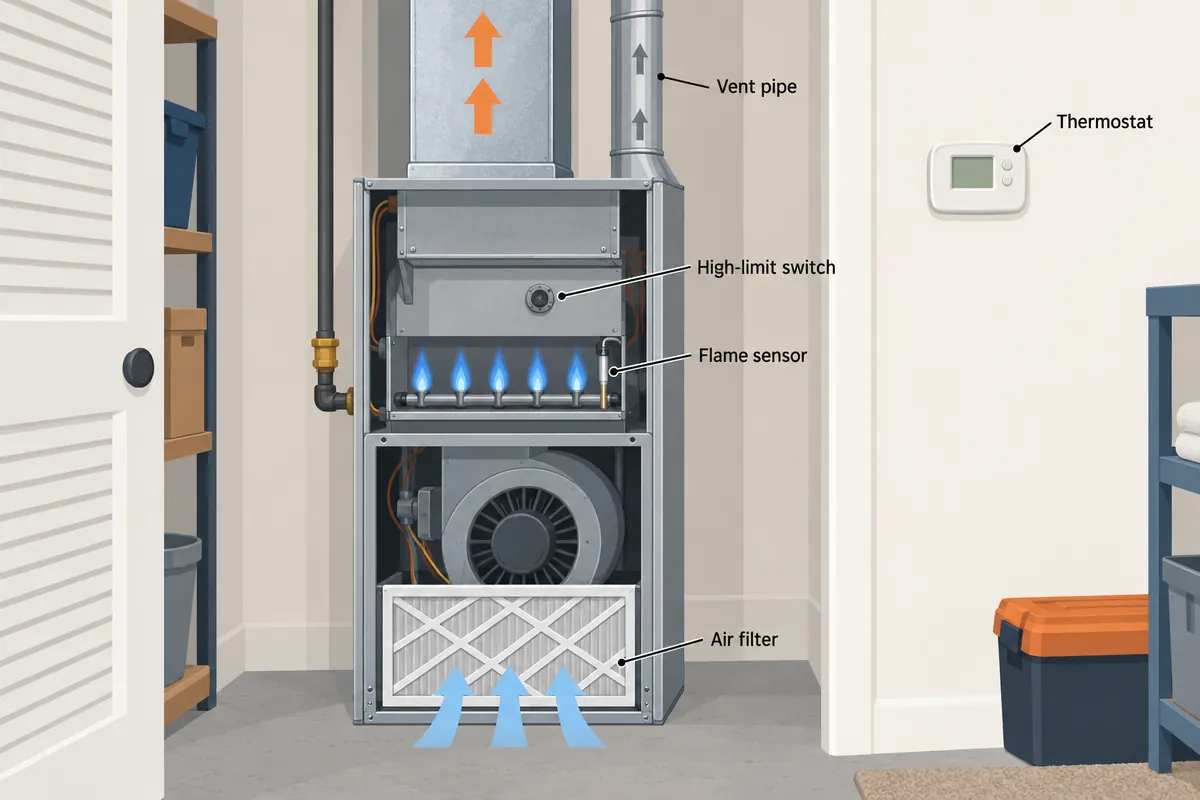
Illustration: where each timing window points. Seconds point at the flame sensor, a few minutes at the high-limit switch and the airflow through the filter, and a normal run that restarts soon at the thermostat.
The rest of this guide takes those rows one at a time. If your furnace is blowing cold air at the registers rather than cycling, start with our guide to why a furnace blows cold air instead. If the furnace will not start at all, why a furnace won't turn on covers the no-start checks.
Shuts Off Within Seconds: Flame Sensing
When the burners light and die within a few seconds, the furnace usually cannot confirm the flame. Homeowners often describe it as the furnace running for 30 seconds or so and shutting off, because the burners are the last thing to light. Carrier explains that before the gas valve opens, "the draft inducer motor clears the heat exchanger of residual gases, and the igniter (either a spark or hot surface igniter) begins to glow" (Carrier, What Is a Furnace Gas Valve?). A flame sensor is a metal rod that sits in the burner flame and proves to the control board that gas is actually burning. Trane explains that the flame sensor "is designed to ensure that the gas valve only opens while flames are burning." When it fails, "a faulty or dirty flame sensor can malfunction and turn off the furnace prematurely" (Trane, Furnace Main Burner Shuts Off After Ignition).
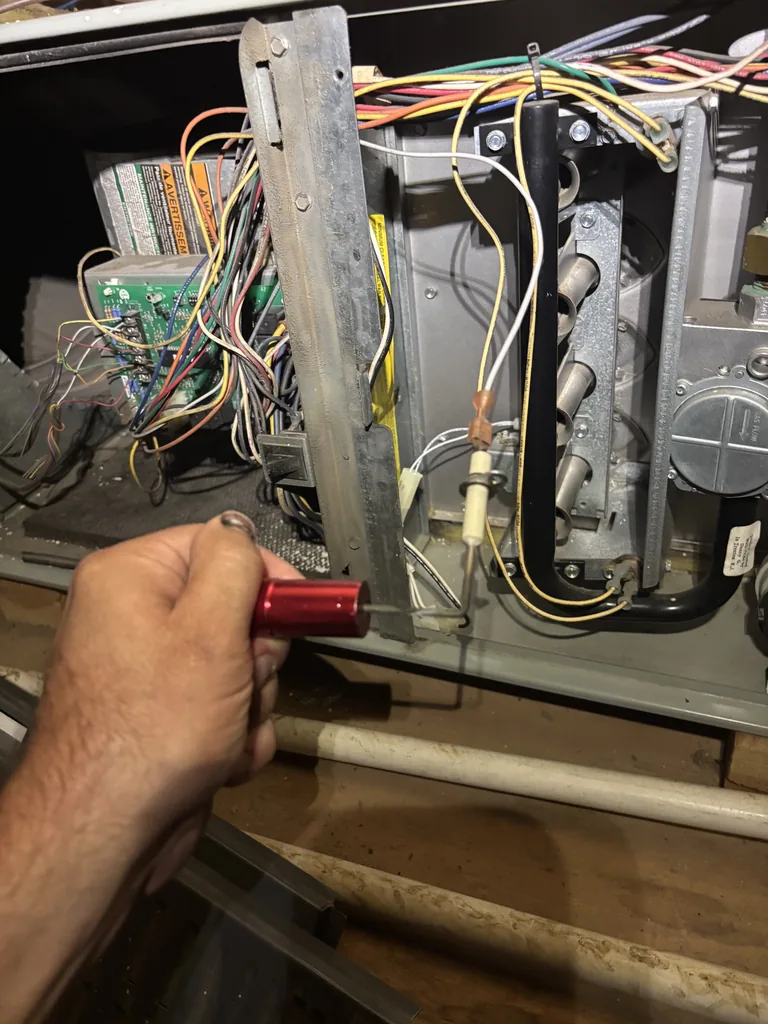
This is the textbook seconds-long cycle, and our own records show it. In December 2021 a Fair Oaks homeowner (95628) described a gas furnace that "kicks on and igniter lights but turns off a few seconds after gas gets going." The technician cleaned the flame sensor in the Rheem furnace. In January 2023 a Citrus Heights call (95621) came in as "the heater turns on, but then turns off in a couple of minutes." The record shows the flame sensor cleaned and a second finding: the furnace needed leveling so its condensate would drain to the right side.
Some manufacturer pages walk homeowners through cleaning the sensor with the power and gas shut off. Our line sits before that step, because it means opening the burner compartment of a gas appliance. If the furnace will not light at all, rather than lighting and quitting, our guide to why a furnace will not turn on covers the no-ignition side.
Shuts Off After a Few Minutes: Overheating
A furnace that heats for a few minutes and then drops its burners while the blower keeps running is usually overheating. A high-limit switch is the temperature safety that shuts it down. Trane describes it as monitoring "the temperature inside the supply plenum, and if it gets too high, the limit switch shuts off the gas supply to the burners" (Trane, Furnace Limit Switch). Once the heat exchanger cools, the furnace lights again and the loop repeats. At the registers, that pattern reads as warm air for a minute or two and then cool air, which is the limit-trip case our cold-air guide covers from the register side.
The overheating nearly always starts with airflow. Carrier's troubleshooting table lists a "dirty filter, closed supply registers, or blocked vents" and says to "replace a dirty filter and make sure registers are open and unobstructed" (Carrier). Three of our job records fit this window:
- Fair Oaks (95628), February 2023: reported as "heater shutting off after a while." The technician switched the blower speed to medium-high for high heat and noted that if the problem persisted, the gas pressure would need to come down.
- March 2022, no address on the record: "heater shutting off prematurely." The technician opened all the vents and reduced the gas pressure. The flue vent piping was clear.
- January 2024, no address on the record: "Furnace keeps turning on and off." The zoned furnace was shutting off on its high temperature control, and the technician reduced the gas pressure a little.
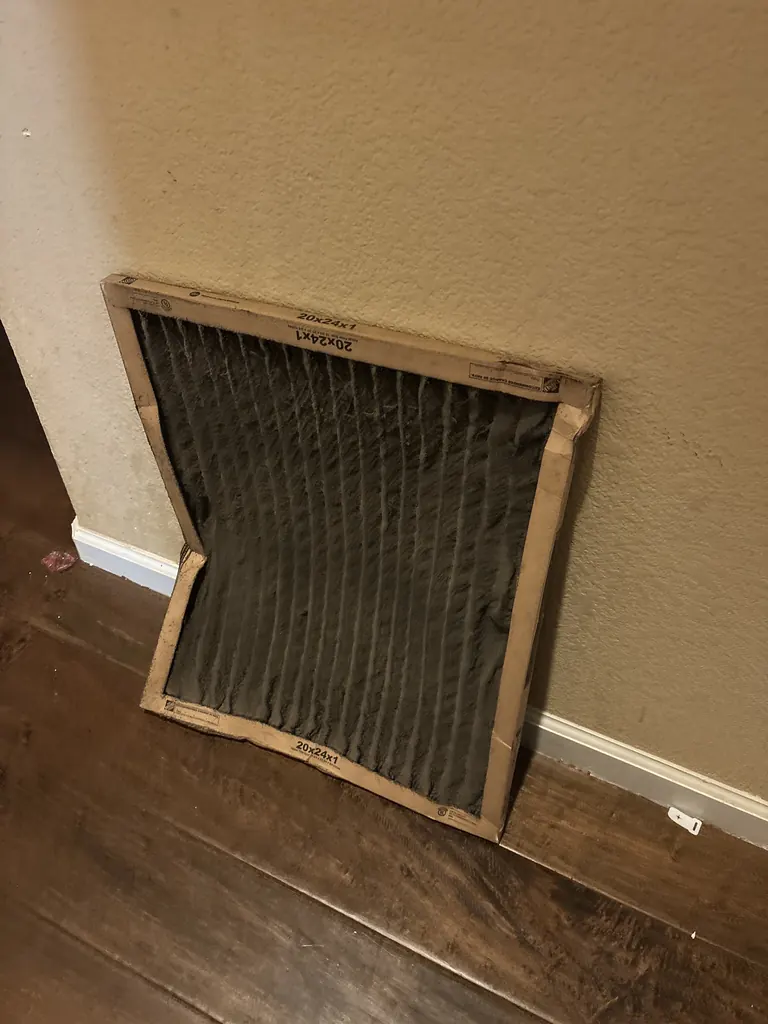
A loaded 20x24x1 filter pulled from a Sacramento return grille on one of our service calls, July 2026. The media has bowed out of its frame.
Blower speed and gas pressure are adjustments a technician makes with instruments. Your part is the airflow you control: the filter, the supply registers and the return grilles. If a new filter and open registers do not end the pattern, the repeats are a service call, and Trane is blunt about the part itself: "Don't attempt to bypass or reset the limit switch."
High-efficiency furnaces add one more cause in this window: the venting. One February 2023 record, with no address on file, reads "Heater turns off before reaching temperature." The vent pipe had a slight downward slant that collected water, and the furnace shut off whenever water collected in the pipe. After the technician strapped the pipe, the record reads that it all worked well. Our furnace pressure switch troubleshooting guide covers the venting side in more depth.
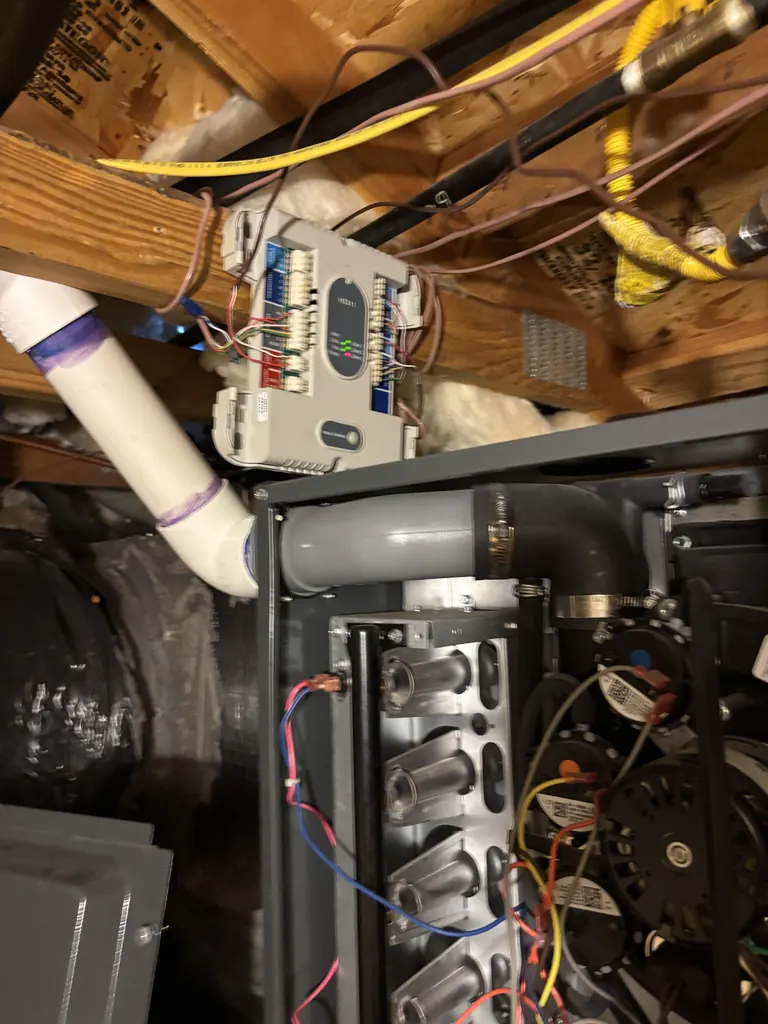
An attic high-efficiency furnace on one of our Sacramento calls, September 2026: the burners at lower left, and the plastic vent pipe joining the furnace through a rubber coupling at the top. Everything in this compartment is technician territory.
Runs Normally, Then Restarts Too Soon: Thermostat or Sizing
If each run looks normal but the house warms fast and the furnace starts again a few minutes later, look at the thermostat before the furnace. Carrier recommends installing a thermostat "on an interior wall away from direct sunlight, exterior doors, windows, air vents, drafts, and heat-producing appliances." A thermostat above a supply register or in afternoon sun reads the house as warm before the rooms are. It shuts the burners off, then calls again as soon as its own spot cools. Trane adds that moving an improperly placed thermostat can resolve short cycling.
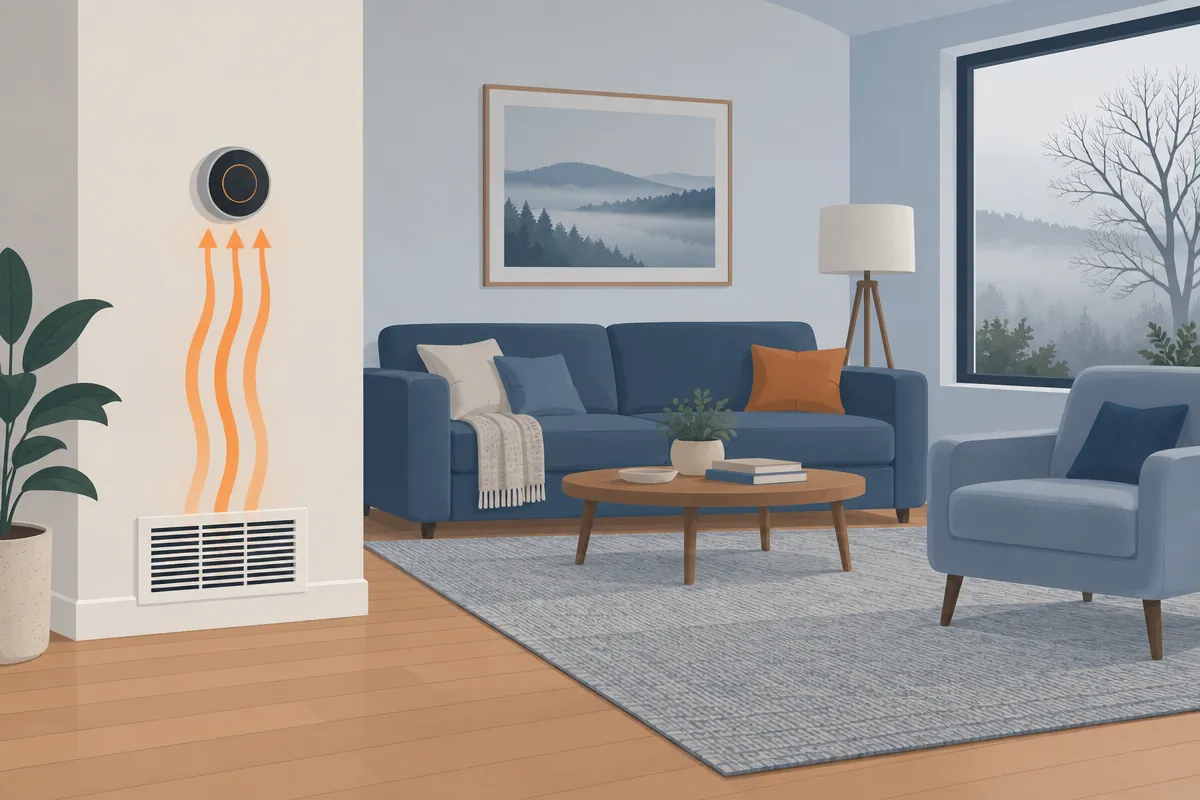
Illustration: a thermostat above a supply register reads the register's warm air, not the room.
The thermostat's settings matter as much as its spot. Honeywell Home notes that some thermostats let you set the cycle rate to match the heating system, "whether it is forced air, high efficiency forced air, electric forced air, or baseboard hot water." The operating manual, it says, "will tell you to match the cycle rate setting to your heating system type." A new or replaced thermostat set up for the wrong system type can cycle a good furnace more often than it should. Settings cause the opposite fault too: in one of our 2025 records, a heater that would not turn off was fixed with thermostat configuration alone.
If the thermostat is in a sensible spot, set up for the right system, and the pattern has been there since the furnace went in, sizing is the next suspect. Trane calls an oversized furnace "the most common cause of furnace short cycling," and says that if the furnace "has been short-cycling since it was first installed, it may have been improperly sized for your home." Carrier puts the mechanism plainly: "If a furnace is too large for the calculated heating load of your home, it will heat the space too rapidly. This causes the thermostat to satisfy quickly and shut the unit off." Trane also points out that a correctly sized furnace can become oversized later, when insulation or other upgrades lower the home's heating load. Carrier notes that the Department of Energy recommends sizing with a recognized load calculation, such as ACCA Manual J, "rather than relying on rules of thumb."
Not every manufacturer ranks the causes the same way. Bryant calls a dirty air filter "the most common and easily fixable cause of short cycling," and Carrier calls it "a leading cause." That disagreement is one more reason to time the cycle rather than start at the top of someone else's list.
Why Sacramento Winters Expose an Oversized Furnace
This is the part the national guides skip. Heating degree days measure how much heating a climate demands: the U.S. Energy Information Administration counts them from how far each day's mean temperature falls below 65°F, and says a heating degree day "measures how much heating we need to keep a building warm" (EIA, Degree Days). NOAA's 1991 to 2020 climate normals put Sacramento Executive Airport at 2,436.1 heating degree days a year. Detroit Metro Airport sits at 6,067.1, about two and a half times as much (NOAA NCEI, U.S. Climate Normals). The normal January average is 47.6°F at Sacramento Executive Airport and 25.8°F at Detroit Metro. That comparison matters for this search in particular, because two of the contractor pages in the top ten results for it in a Sacramento search are written for Michigan homes.
A furnace is sized to hold the house on a design cold day, not an average one. ENERGY STAR recommends that load calculations use the ACCA Manual J 99% heating season design temperature for the nearest weather station (ENERGY STAR, Design Temperature Limits). The 2019 edition of its Design Temperature Limit Reference Guide, linked from that page, sets 29°F as the coldest heating design temperature a load calculation may use in Sacramento County, against 4°F for Wayne County, Michigan, which includes Detroit. Sacramento's normal winter sits well above that design point: December's normal low at the airport is 38.5°F, and the normal January average is 47.6°F. On a typical Sacramento winter morning, then, the house needs only part of the heat the furnace was sized for. A single-stage furnace that is even modestly oversized can reach the setting in a few minutes and shut off. Trane notes that the on-and-off pattern is more noticeable with single-stage and two-stage furnaces, while a modulating furnace can run longer at lower output.
So in Sacramento, a short cycle on a 45-degree morning with no other symptom is not automatically a fault. It becomes one when the house does not reach the setting, when the burners cut out with the blower still running, or when the pattern started suddenly on a furnace that used to run long cycles. A sudden change points at a fault. A pattern that dates to installation points at sizing or thermostat placement. Sizing only changes when the furnace does, so it is settled at furnace replacement time, not with a repair.
The Other Fork: A Furnace That Will Not Shut Off
The opposite complaint shows up in the same searches and has a shorter list. Trane names the thermostat settings as the most common reason for a furnace fan that will not shut off. With the fan set to ON the blower runs continuously; on AUTO it runs only while the furnace is heating (Trane, Furnace Won't Shut Off). Trane's other causes are a malfunctioning thermostat, a dirty filter that makes the furnace run longer to reach the setting, leaky ducts, and failed interior controls. Three of our records sit here:
- Orangevale (95662), October 2022: "heater is not turning off." The furnace would not turn off because the Sensi thermostat was bad. The technician also cleaned the flame sensor in the Trane furnace.
- Sacramento (95819), November 2023: "heater fan is not turning off." The indoor ECM blower motor in a package unit was replaced.
- December 2025, no address on the record: "The heater is not turning off." The fix was thermostat configuration.
Set the fan to AUTO first. If the burners and blower keep running with the thermostat on OFF, the thermostat or a control has failed. Trane describes shutting the furnace down with the switch on or near it, which looks like a light switch, or at the breaker marked for the furnace. Do that, and call. If duct leakage is keeping the house from ever reaching the setting, that is a ductwork repair rather than a furnace one.
Why Resetting It Over and Over Makes It Worse
A lockout is the furnace control refusing to try again after repeated failures. Trane explains that the first one or two stopped ignition sequences are a soft lockout, and "if it happens a third time, you enter a hard lockout." Its guidance for the homeowner is short: "Changing the air filter is the only thing you should do to try and resolve this issue yourself" (Trane, Furnace Hard Lock Out). Cutting the power clears a lockout, so it is tempting to flip the switch every time the house gets cold.
The trouble is that each reset erases the evidence and hands the fault another run. Trane lists "potential damage to the furnace heat exchanger" among the results of ongoing short cycling, and names a cracked heat exchanger as one cause of the overheat, shut down, cool off, relight loop. Our guide to cracked heat exchanger symptoms covers why that part matters, and the Trane cracked heat exchanger guide adds the warranty questions for Trane owners. In March 2025 a Trane furnace in our records was reported as going "into lockout mode"; the technician cleaned the burners and noted a couple of fault codes. Those codes are the first thing a technician reads on a newer furnace, and they only help if they are still there.
So before any reset, read the light. Trane says that "red blinking lights on the furnace exterior or the control board, however, generally signal a problem." Its advice is to "pay attention to the pattern of the blinking and write down what you see." Trane also says you "should not take the front panel off while your furnace is running," so read it only where you can see it without opening anything (Trane, Furnace Light Blinking). Then reset once. Trane's lockout page says your owner's manual may suggest turning the power "on-off-on-off twice in 30 seconds," and that after a hard lockout a technician resets the furnace once the cause is fixed.
Stop resetting it and call if: it locks out again after a new filter; the burners keep cutting out with the blower running; the pattern started suddenly and is getting worse; you smell gas; or a carbon monoxide alarm sounds. If you smell gas, PG&E's instruction is to leave the area now and call 9-1-1, then call PG&E at 1-800-743-5000 (PG&E, Gas Safety). If anyone may have carbon monoxide symptoms, PG&E says to call 9-1-1 and seek medical attention (PG&E, Carbon Monoxide).
What You Can Check Safely
- The thermostat. Mode on HEAT, fan on AUTO, fresh batteries if it takes them, and nothing warming it, such as sun, a lamp or a supply register below it. If it is new, check that its setup matches your furnace type.
- The filter. Pull it and look. ENERGY STAR says to "inspect, clean, or change air filters once a month" (ENERGY STAR, Maintenance Checklist), and Carrier says 1-inch filters generally need replacing every 1 to 3 months.
- Registers and returns. Every supply register open, no rug or furniture over one, and the return grilles clear.
- The vent pipes outside, on a high-efficiency furnace. From the ground, look at the plastic pipes where they leave the house and make sure leaves, debris or a nest are not blocking them. Trane lists a blocked exhaust flue or vent pipe among the airflow causes.
- The status light, if your furnace shows one without a panel coming off. Write down the color and the blink pattern.
- Three timed cycles, matched to a row in the table above.
- One reset. If it locks out again, stop.
What is not yours to touch: the flame sensor, the limit switch, the gas valve and gas pressure, the vent pipe slope, the control board, and anything behind the burner compartment door. That is where a homeowner check ends and a service call starts.
What 13 of Our Job Records Show
Before writing this guide, we searched our Housecall Pro job history for heating calls where the complaint was a furnace turning off early, cycling on and off, or refusing to shut off. The search surfaced 13 completed jobs that fit, from December 2021 to December 2025. Thirteen calls are not a statistic, and a keyword search misses jobs described in other words, but the spread is worth seeing.
| Year | Where | Complaint as recorded | What the technician found |
|---|---|---|---|
| 2021 | Fair Oaks 95628 | Igniter lights, furnace turns off a few seconds after the gas | Flame sensor cleaned (Rheem) |
| 2022 | Not on record | Heater shutting off prematurely | All vents opened, gas pressure reduced; flue clear |
| 2022 | Orangevale 95662 | Heater is not turning off | Bad Sensi thermostat; flame sensor also cleaned (Trane) |
| 2022 | Sacramento 95825 | Heater works for three minutes and shuts off | Heat strip timing relay replaced in a rooftop unit |
| 2023 | Citrus Heights 95621 | Turns on, then off in a couple of minutes | Flame sensor cleaned; furnace needed leveling for condensate drainage |
| 2023 | Folsom 95630 | The furnace keeps turning off | York control board replaced |
| 2023 | Fair Oaks 95628 | Heater shutting off after a while | Blower speed raised to medium-high for high heat |
| 2023 | Not on record | Heater turns off before reaching temperature | Vent pipe slant collected water; pipe strapped |
| 2023 | Sacramento 95819 | Heater fan is not turning off | ECM blower motor replaced (package unit) |
| 2024 | Not on record | Furnace keeps turning on and off | Zoned furnace shutting off on high temperature control; gas pressure reduced slightly |
| 2025 | Not on record | Furnace burners shut off abruptly | Control board glitching (American Standard); no repair made |
| 2025 | Not on record | Trane furnace goes into lockout mode | Burners cleaned, fault codes noted |
| 2025 | Not on record | The heater is not turning off | Thermostat configuration |
No single part dominates. The flame sensor appears in three records and an overheating fix (gas pressure or blower speed) in three. A control board and the thermostat appear in two each, and venting, a blower motor, a heat strip relay and a burner cleaning once each. Two points stand out for a homeowner. The overheating fixes were technician adjustments, but the airflow that causes overheating is the part you control. And the two thermostat fixes cost nothing to rule out first.
Frequently Asked Questions
How long should a furnace run per cycle?
Manufacturers disagree. Trane says a furnace cycle is generally at least 7 minutes, Carrier treats cycles under 5 to 10 minutes as likely short cycling, and Bryant puts normal cycles at 10 to 15 minutes or longer. Cycle length also changes with the weather, so judge it by the thermostat: short cycles that leave the house below the setting are the problem.
How many times an hour should a furnace cycle?
A typical forced-air system cycles about five times an hour, and high-efficiency (90%+) gas furnaces have a recommended cycle rate of 3 (Honeywell Home, September 2025). A furnace that starts every 5 minutes is cycling 12 times an hour, which is worth timing and reporting.
Why does my furnace run for 30 seconds and then shut off?
That is usually the seconds window. The inducer and igniter run first, the burners light, and the furnace shuts them off within seconds because it cannot prove the flame. A dirty or failing flame sensor is the common cause; ignition and gas supply are the others. All of them are technician work.
Why does my furnace turn on and off every 5 minutes?
Time the burners. If they cut out after a few minutes while the blower keeps running, the furnace is overheating, usually from a clogged filter or closed registers; both are homeowner fixes, covered in our guide on how to clean a furnace in 8 safe steps. If each run looks normal and the house warms fast, look at the thermostat's location and settings, then at a furnace that is too large for the house.
Is furnace short cycling dangerous?
Trane's view is that short cycling is not dangerous in itself but costs money in bills and repairs, and it lists potential heat exchanger damage among the results. The risk sits in the causes, such as an overheating furnace or a venting fault. Stop resetting it and call if it locks out again, and treat a gas smell or a carbon monoxide alarm as an emergency.
Can a dirty filter cause a furnace to short cycle?
Yes. Carrier calls a dirty air filter a leading cause and Bryant calls it the most common one. A clogged filter restricts airflow, the furnace overheats, and the high-limit switch shuts the burners off until it cools. Check the filter first.
Why is my furnace still short cycling with a new filter?
A new filter rules out the most common cause, not the others. Open every supply register and clear the return grilles, then check the thermostat's spot and settings. If the burners still cut out after a few minutes, the limit switch, gas pressure, blower speed or venting needs a technician.
Why does my furnace turn off before reaching the set temperature?
Carrier says this "usually indicates the system is overheating due to restricted airflow (clogged filter or vents) or a faulty flame sensor." A thermostat in a warm spot causes the same symptom. Time the cycle: seconds points at the flame sensor, a few minutes at airflow.
Why won't my furnace shut off?
Check the fan setting first. On ON the blower runs continuously; on AUTO it runs only while the furnace heats. If the burners keep running with the thermostat on OFF, the thermostat or a control has failed, so shut the furnace off at its switch and call.
Does an oversized furnace always short cycle?
Bryant says an oversized furnace "will almost always short cycle." In Sacramento's mild winter it shows most on mild mornings, when the house needs little heat. Sizing is corrected at replacement time with a load calculation, not with a repair.
Should I keep resetting my furnace?
No. Write down any blinking light, change the filter and reset once, following the owner's manual. Trane's lockout guidance is that changing the filter is the only thing a homeowner should do, and repeated resets clear the fault codes a technician reads while giving an overheating fault another run.
How much does it cost to fix a short-cycling furnace?
Some fixes cost nothing: a filter, an open register, a thermostat setting. For everything else, our heating diagnostic is a flat $89, applied toward the repair if you go ahead, and you know the repair price before any work begins. The part involved, from a flame sensor to a control board, sets the rest.
Getting a Short-Cycling Furnace Fixed in Sacramento
If the filter is fresh, the registers are open, the thermostat checks out and the furnace still cycles, it is time for a diagnostic. Bring your three cycle times and any blink pattern; they shorten the visit. Our heating repair service covers furnaces across the Sacramento region, and the heating diagnostic is a flat $89, applied toward the repair if you go ahead. Call 916-848-5980 or contact us to book a visit. If the furnace has not been serviced this fall, a furnace tune-up cleans the burners and the flame sensor and runs the safety checks before the cold arrives. You can read more about us, and about how we handle heating calls in Fair Oaks, Citrus Heights, Orangevale and the rest of the region, on our service pages. In cooling season the same on-and-off pattern has different causes, covered in our guide to AC short cycling in Sacramento.
Written by Andrey Yev, PE, General Manager of Alpha Mechanical, based in the Sacramento region. Fact-checked against the sources listed below, September 2026.
Sources
- Trane, "Furnace Short Cycling: What It Is and How to Stop It"
- Trane, "Furnace Main Burner Shuts Off After Ignition"
- Trane, "Furnace Limit Switch"
- Trane, "Furnace Won't Shut Off"
- Trane, "Furnace Hard Lock Out"
- Trane, "Furnace Light Blinking: What It Means"
- Carrier, "What Is a Furnace Gas Valve?"
- Carrier, "What Is Furnace Short Cycling? Causes and Solutions"
- Bryant, "Furnace Short Cycling: Causes, Fixes and Prevention Tips"
- Honeywell Home, "What Is a Thermostat Cycle Rate?" (September 2025)
- Honeywell Home, "What Is a Cycle Rate?" (September 2025)
- NOAA NCEI, U.S. Climate Normals 1991 to 2020 (stations USW00023232 Sacramento Executive Airport and USW00094847 Detroit Metro Airport; annual and monthly heating degree days and temperatures)
- U.S. Energy Information Administration, "Degree days"
- ENERGY STAR, "Design Temperature Limits for Residential New Construction"
- ENERGY STAR, "Design Temperature Limit Reference Guide (2019 Edition)" (Sacramento County heating design limit 29°F; Wayne County, Michigan 4°F)
- ENERGY STAR, "Maintenance Checklist"
- PG&E, "Gas Safety"
- PG&E, "Carbon Monoxide"
- Alpha Mechanical Housecall Pro job records, December 2021 to December 2025, anonymized to city and ZIP.