

The usual reasons an AC keeps turning on and off are a dirty air filter, a frozen evaporator coil, low refrigerant from a leak, a failing capacitor, a thermostat problem and an oversized unit, in that order of likelihood. To stop it, replace the filter and check the thermostat first, since both are safe DIY fixes, and if the cycling continues or you see ice, shut the system off and book a diagnostic.
AC short cycling is when your air conditioner turns on, runs for only a few minutes, and shuts off again, repeating the pattern in bursts of under about 10 minutes. It matters because every aborted cycle strains the compressor, the most expensive part of the system, and raises your electric bill, since startup draws far more power than steady running. Worse, the unit never runs long enough to actually cool your house.
- What Is AC Short Cycling?
- Why Does Short Cycling Damage Your AC and Raise Your Bills?
- What Causes AC Short Cycling?
- Safe DIY Checks Before You Call
- How Much Does It Cost to Fix a Short Cycling AC?
- Frequently Asked Questions
- Stop the Cycle Before It Kills the Compressor
This guide walks through the six most likely causes in order, the checks you can safely do yourself, and what the repairs cost in Sacramento. If your AC runs constantly but the house still won't cool down, that's a different fault: start with our AC not cooling diagnostic hub instead.
Key Takeaways
- Short cycling means run cycles under roughly 10 minutes. It wears out the compressor and wastes energy.
- Most likely causes, in order: dirty filter, frozen coil, low refrigerant, bad capacitor, thermostat issues, an oversized unit.
- Check the filter and thermostat first. Both are safe DIY fixes.
- A Sacramento diagnostic runs $89, applied toward the repair if you proceed, and most fixes land between $200 and $650 (our 2026 rate card).
- Triple-digit heat makes short cycling worse fast. Don't wait it out.
What Is AC Short Cycling?
Short cycling means your AC starts, runs briefly, and quits before finishing a full cooling cycle, usually in under 10 minutes, then restarts a few minutes later. In moderate weather, a healthy system typically runs about 10 to 20 minutes per cycle, with breaks in between (Lennox).
Here's the simple test. Stand near the outdoor unit and time it from the moment the compressor kicks on to the moment it stops. Repeat two or three times. Consistent runs of just a few minutes, especially with the house still warm, mean the system is short cycling.
One clarification for hot afternoons: long runtimes are not the problem. On a 100°F Sacramento day, a correctly sized AC may run nearly continuously, and that's normal. Rapid on-off cycling is the red flag, not steady running. A gas furnace can do the same thing in winter for different reasons, covered in our guide to furnace short cycling.
Why Does Short Cycling Damage Your AC and Raise Your Bills?
Startup is the hardest moment in a compressor's life, and short cycling multiplies startups. It also multiplies cost. During SMUD's summer season (June 1 to September 30), weekday 5 to 8 p.m. electricity peaks at $0.3765 per kWh (SMUD, 2026), roughly 2.4 times the off-peak rate.
That timing is brutal. Sacramento ACs work hardest in the late afternoon, exactly when SMUD charges the most, so a unit that keeps restarting burns its extra startup power at peak prices.
The mechanical toll stacks up too. Frequent starts overheat the compressor motor and wear the contactor and capacitor ahead of schedule. Short runs also never dehumidify properly, so the house feels clammy even when the thermostat number looks fine. And in a Fair Oaks heat wave, a short-cycling unit falls behind by mid-afternoon, which is exactly when you can't afford a failure.
What Causes AC Short Cycling?
The cheapest cause is also the most common one. A clogged air filter chokes airflow, and ENERGY STAR warns that a dirty filter forces the system to work harder, raising energy costs and even damaging equipment toward early failure (ENERGY STAR). Here are the six causes we see, in likelihood order.
1. Dirty air filter
A packed filter starves the evaporator coil of airflow. The coil gets too cold, the system trips a safety limit or ices up, and the unit shuts down early. Check the filter first, every time. During heavy summer use, inspect one-inch filters monthly and replace them as soon as they look gray and matted.
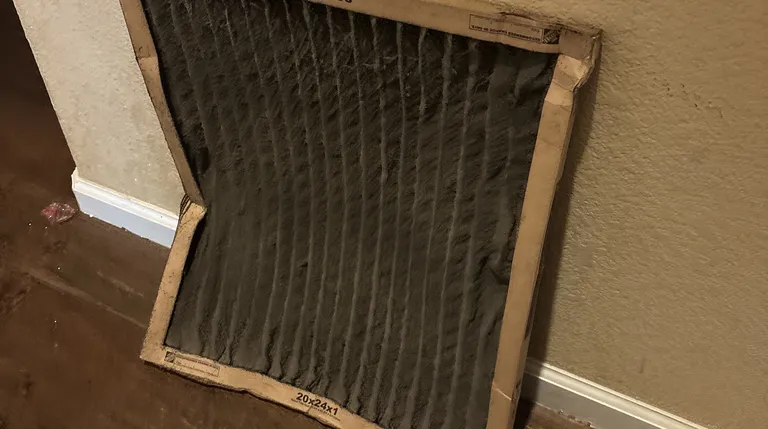
This one came off a recent Sacramento service call: a 20x24x1 filter that went roughly a year without a change. A mat like that doesn't just raise the bill; it starves the coil until the system trips its own safety limits, and the cooling capacity you paid for drops with it.
2. Frozen evaporator coil
Restricted airflow or low refrigerant can turn the indoor coil into a block of ice. An iced coil can't absorb heat, so the system shuts off quickly, thaws slightly, restarts, and repeats. Ice on the copper lines or water pooling around the air handler are the giveaways. Turn the system off and let it thaw fully before restarting, and follow the full walkthrough in our frozen AC coil guide.
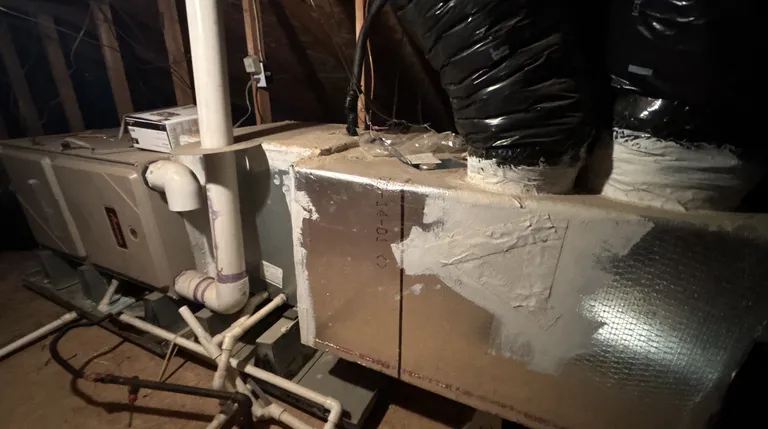
This is the indoor half of the system most Sacramento homeowners never see: the furnace, and to its right the insulated cabinet where the evaporator coil lives, feeding the supply plenum. When a starved coil ices over, this attic cabinet is where the ice forms.
3. Low refrigerant from a leak
Low refrigerant drops the coil pressure, triggers the low-pressure safety switch, and shuts the compressor down mid-cycle. The Department of Energy's Building America Solution Center notes that too much or too little refrigerant reduces the system's efficiency and leads to premature component failures (PNNL BASC). Refrigerant never gets "used up," so low charge always means a leak. Watch for the signs of low AC refrigerant, and leave the repair to an EPA-certified technician.
4. Failing capacitor
The run capacitor gives the compressor motor its starting jolt. As it weakens, the motor starts hard, overheats, and cuts out on thermal overload within minutes. In our experience, this is the number one repair in Sacramento because long, hot summers cook capacitors. A clicking or humming unit that struggles to start points here. If it's specifically the outdoor fan sitting still while the unit hums, start with our outside AC fan guide. See the full guide to bad capacitor symptoms.
5. Thermostat placement or malfunction
A thermostat mounted near a supply vent, a sunny window, or a hot kitchen reads the wrong temperature and shuts the system down early. Dying batteries and loose wiring cause the same erratic cycling. This is the easiest cause to rule out yourself, and it costs nothing to check.
6. Oversized unit
An oversized AC blasts the thermostat cold in a few minutes and shuts down before completing a real cycle, then repeats all day. This is short cycling by design flaw, and no part replacement fixes it. Proper sizing comes from a Manual J load calculation, not a "bigger is safer" guess. If your unit has short cycled since installation day, sizing is the likely culprit.
Safe DIY Checks Before You Call
Basic checks catch a surprising share of short cycling calls. They matter because systems drift: Florida Solar Energy Center field monitoring of 56 homes found cooling performance typically degrades about 5 percent per year (FSEC). Run these five checks in order.
- Replace the filter if it's visibly dirty, then give the system 30 minutes.
- Check the thermostat. Fresh batteries, fan set to AUTO not ON, no sun or vent blowing on it.
- Look for ice on the indoor coil or the copper lines outside. If you find it, switch the system off and let it thaw.
- Clear the outdoor unit. Two feet of clearance, no leaves or cottonwood fluff matted on the coil fins.
- Note the pattern. Time the cycles and write them down. It shortens the diagnostic.
Stop there. Don't open sealed electrical panels: capacitors hold a charge even with the power off, and refrigerant work legally requires EPA Section 608 certification (EPA). A yearly professional tune-up catches the rest before July exposes it.
How Much Does It Cost to Fix a Short Cycling AC?
In Sacramento, a diagnostic visit runs $89 and is applied toward the repair if you proceed. Most short cycling fixes land between $200 and $650 (our 2026 rate card), because the usual culprits are filters, capacitors, contactors, and thermostats rather than major components.
| Repair | Typical Sacramento cost (2026) |
|---|---|
| Diagnostic visit | $89, applied toward the repair if you proceed |
| Capacitor replacement | $250-$400 |
| Contactor replacement | $200-$450 |
| Thermostat replacement | $350+ |
| Refrigerant leak detection + repair | $225-$1,600 |
| Refrigerant recharge (R-410A top-off) | $200-$500 |
| Compressor replacement | $1,800-$2,400 in-warranty / $3,600-$5,600 out-of-warranty |
The spread on refrigerant work depends on where the leak hides. A service-valve leak sits at the low end; an evaporator coil leak sits at the top. Compressor replacement is the outcome we're trying to prevent, which is the whole argument for fixing short cycling early. A service membership at $239 per year includes two seasonal tune-ups and 20 percent off repairs, which usually pays for itself on a single capacitor call. If you're weighing maintenance pricing itself, see what an AC tune-up costs in Sacramento.
Always get a written quote before any work begins. If a quote for a short cycling fix jumps straight to "you need a new system," get a second opinion.
Frequently Asked Questions
How do I stop my AC from short cycling?
Start with the cheapest fix: replace a clogged air filter and make sure supply vents are open. Then check that the thermostat has fresh batteries and sits away from sunlight and vents. If ice appears on the copper lines, or the cycling continues after a filter change, shut the system off and book a professional diagnostic.
How much does it cost to fix a short cycling AC?
In Sacramento, a diagnostic visit runs $89 and is applied toward the repair if you proceed. Most short cycling fixes land between $200 and $650: a capacitor is $250 to $400 and a contactor is $200 to $450. Refrigerant leak detection and repair ranges from $225 to $1,600 depending on where the leak is.
What would cause an AC compressor to short cycle?
The most common triggers are restricted airflow from a dirty filter, a frozen evaporator coil, low refrigerant from a leak, a weak run capacitor, or a thermostat reading the wrong temperature. An oversized system also short cycles by design, because it cools the thermostat too quickly and shuts down before completing a proper cycle.
What is considered short cycling for an AC unit?
An air conditioner is short cycling when it repeatedly runs less than about 10 minutes before shutting off, then restarts within a few minutes. In moderate weather, a healthy system usually runs about 10 to 20 minutes per cycle, with breaks in between. On triple-digit Sacramento afternoons, much longer runtimes are completely normal.
Is AC short cycling an emergency?
It's not usually a same-day emergency, but it is urgent. Every aborted start wears the compressor, the most expensive component in the system at $1,800 to $2,400 in-warranty, or $3,600 to $5,600 out-of-warranty, to replace. If you see ice on the unit, hear rapid clicking with no start, or smell burning, shut the system off and call right away.
Can a dirty filter cause AC short cycling?
Yes, and it's the single most common cause. A clogged filter chokes airflow across the evaporator coil, which can trip a safety limit or freeze the coil, and either one shuts the system down early. During a Sacramento summer, check one-inch filters monthly and replace them as soon as they look gray and matted.
Is it normal for my AC to turn on and off more often on very hot days?
No, the opposite. On 100-degree Sacramento afternoons, a correctly sized system should run long, steady cycles, sometimes nearly continuously, to keep up. Frequent rapid starts in extreme heat point to a stressed component such as a weak capacitor or low refrigerant, and heat accelerates that failure. Get it diagnosed before the next heat wave.
Stop the Cycle Before It Kills the Compressor
Short cycling is a symptom with cheap causes and an expensive endgame. Start with the filter and thermostat today. If the cycling continues, or you spot ice, clicking, or a hard-starting hum, shut the system off and get it diagnosed for $89 before a $250 capacitor becomes a $5,600 compressor. Sacramento's next triple-digit stretch will find the weak link for you; it's cheaper if a technician finds it first. Book an AC repair visit and bring the cycle times you wrote down.
Written by Andrey Yev, PE, the licensed Professional Mechanical Engineer and CSLB contractor who manages AlphaMechanicals in Sacramento, drawing on 25+ years of field and engineering experience.
Sources
- SMUD, Residential Time-of-Day Rates (summer peak $0.3765/kWh weekdays 5-8 p.m., Jun 1-Sep 30): https://www.smud.org/rate-information/residential-rates
- Lennox, "Air Conditioner Short Cycling" (normal cycles about 10-20 minutes): https://www.lennox.com/residential/lennox-life/consumer/air-conditioner-short-cycling
- ENERGY STAR, "How to Keep Your HVAC System Working Efficiently" (dirty-filter impact on cost and equipment life): https://www.energystar.gov/products/ask-the-experts/how-keep-your-hvac-system-working-efficiently
- DOE Building America Solution Center (PNNL), Air Conditioning resource guide (improper refrigerant charge): https://basc.pnnl.gov/resource-guides/air-conditioning
- Florida Solar Energy Center (UCF), Fenaughty & Parker, FSEC-PF-474-18 (56-home field study, ~5%/yr cooling degradation): https://stars.library.ucf.edu/fsec/46/
- EPA, Section 608 Technician Certification: https://www.epa.gov/section608/section-608-technician-certification-0