

Your AC freezes up for one of three reasons: restricted airflow across the indoor coil, low refrigerant from a leak, or running the system when the outdoor air is too cool. Any of the three drops the evaporator coil below 32°F, so the moisture it normally drains away freezes onto the fins instead. Ice in a Sacramento July looks impossible, but it's one of the most common cooling failures we see, and patience plus the right settings do most of the repair.
- Why Is My AC Freezing Up?
- Where's the Ice? Indoor Coil vs. Refrigerant Lines vs. Outside Unit
- How to Unfreeze Your AC Unit Safely
- What Not to Do With a Frozen AC Coil
- Why Does My AC Freeze Up at Night?
- When Ice Means a Refrigerant Leak
- How Do You Stop Your AC From Freezing Up Again?
- Frequently Asked Questions
This guide covers the causes, the safe thaw procedure, and how to keep it from happening again. If your system runs with no ice anywhere and the house just won't cool, start with our AC not cooling diagnostic hub instead.
Key Takeaways
- Ice means the evaporator coil dropped below freezing: dirty filter, weak airflow, low refrigerant, or cool-night operation.
- Shut cooling off and run the fan ON. Thawing takes hours, not minutes.
- Never chip ice off the coil. Fins bend and refrigerant lines puncture.
- A 20% refrigerant undercharge cuts sensible cooling capacity by about 24% at 95°F (DOE Building Technologies Office).
- A freeze-up that comes back after a fresh filter usually means a refrigerant leak.
Why Is My AC Freezing Up?
An air conditioner freezes up when the evaporator coil, the indoor coil that absorbs heat from your air, falls below 32°F. Warm airflow normally holds it around 40°F. Cut the airflow, or cut the refrigerant pressure, and the coil drops below freezing. Condensation stops draining and stacks up as ice, which blocks more airflow and grows the ice faster.
Those three reasons break into four common causes, in the order we find them on Sacramento service calls:
- A clogged air filter or blocked vents. The most common cause. A caked filter starves the coil of warm air, and closed or blocked registers do the same. See where to find your HVAC filter.
- A dirty evaporator coil or weak blower. Dust that slips past the filter insulates the coil. LBNL field research found coils foul enough to roughly double airflow resistance within 7 to 11 years (LBNL). A weak blower motor or capacitor cuts airflow the same way.
- Low refrigerant from a leak. Lower charge means lower coil pressure, and lower pressure means a colder coil. This cause comes back no matter how many times you thaw it.
- Running the AC on a cool night. Air conditioners are built to dump heat into hot outdoor air. When outdoor temperatures fall into the low 60s or below, refrigerant pressure drops, the coil runs colder, and a system left running can ice over. Sacramento's Delta breeze makes this a real local cause; see the night section below.
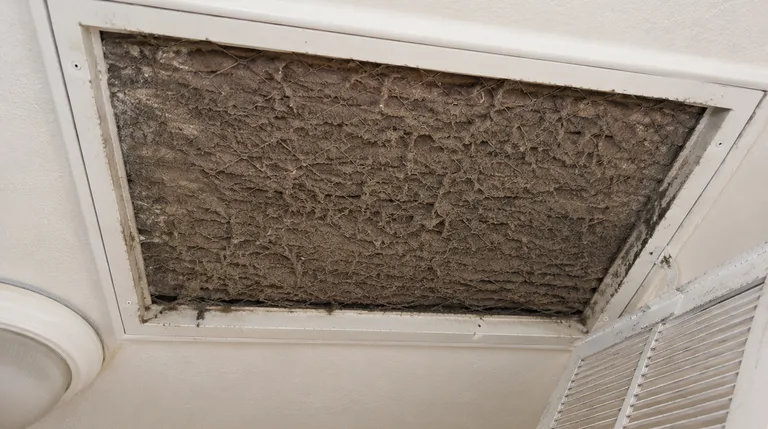
This is what causes #1 and #2 look like in the field. Run long enough with a filter in this state, or with no filter at all, and the dust carpet relocates onto the coil fins themselves; either way the coil is starved of warm airflow, and ice is next.
Here's the Sacramento twist: freeze-ups spike during heat waves. On the roughly 23 days a year Sacramento hits 100°F or hotter (NOAA 1991-2020 Climate Normals, Sacramento Executive Airport), systems run nearly nonstop, and that marathon runtime gives a borderline filter or slight undercharge all day to pull the coil below freezing. A fault that stays hidden in mild weather ices over in week two of a heat wave.
Where's the Ice? Indoor Coil vs. Refrigerant Lines vs. Outside Unit
Where you spot the ice tells you how far it has progressed. All of it traces back to the indoor coil.
- Indoor coil (inside the air handler or above the furnace): ground zero. Look for frost where the refrigerant lines enter the cabinet and for weak airflow at the vents.
- The larger copper line at the outdoor unit: frost or a sleeve of ice on this insulated suction line means the coil has been frozen long enough for cold to travel the whole line set.
- Ice on the outdoor unit itself in summer: usually suction-line ice spreading, and often a low-refrigerant sign. A condenser shouldn't frost on its own in cooling season, and if the outside fan has also stopped spinning, shut the system down completely; that's a second fault stacked on top of the freeze.
Weak, warmish air from the vents while the system runs is the classic frozen-coil signature.
How to Unfreeze Your AC Unit Safely
The safe thaw is mostly patience. Six steps:
- Turn cooling OFF at the thermostat. Set the system to OFF, not COOL. Running the compressor against a frozen coil can slug it with liquid refrigerant and kill it.
- Switch the fan to ON. The blower pushes room-temperature air across the ice and cuts the thaw time dramatically.
- Swap the filter and open every vent. Fix the airflow while the ice melts, or the coil refreezes the moment you restart.
- Protect against meltwater. A fully iced coil can shed more water than the condensate system handles. Lay towels around the air handler and confirm the drain line is flowing. If water shows up where it shouldn't, see what causes an AC to leak water.
- Wait hours, not minutes. In our experience a light frost clears in 2 to 4 hours with the fan running, while a solid block of ice can take a full 24. Don't rush it.
- Restart and monitor. Once the ice is gone and the pan has drained, set the thermostat back to COOL. Check for strong, cold airflow after 30 minutes, and recheck the coil that evening.
If it refreezes after a clean filter and open vents, stop thawing and book a diagnostic. You're treating a symptom.
What Not to Do With a Frozen AC Coil
A frozen coil invites bad improvisation. The don'ts matter as much as the steps:
- Don't chip, pry, or scrape the ice. Fins bend at finger pressure and the tubing behind them punctures easily. One screwdriver slip turns a free thaw into a coil replacement.
- Don't keep running the AC to "power through it." The compressor is the most expensive component in the system, and running it frozen is how compressors die.
- Don't blast the coil with a heat gun or torch. Rapid heat stresses soldered joints, and open flame near an air handler is a fire risk.
- Don't pour hot water on the outdoor unit or coil. It refreezes in the drain pan and overflows the condensate system.
- Don't ignore a repeat. Back-to-back freeze-ups are also a classic trigger for short cycling, which compounds the compressor damage.
Why Does My AC Freeze Up at Night?
Night freeze-ups are a genuinely Sacramento pattern. After a 100°F afternoon, the Delta breeze can pull overnight temperatures down into the low 60s or upper 50s; the July normal low at Sacramento Executive Airport is about 58°F (NOAA 1991-2020 Climate Normals). If the AC keeps running into that cool air, refrigerant pressure falls, the coil runs colder, and a system that was fine at 3 p.m. is iced over by 6 a.m.
The usual accomplice is an aggressive nighttime setpoint. A thermostat driven to 68°F at 10 p.m. keeps the compressor running exactly when outdoor temperatures bottom out. The cheap fix: raise the overnight setpoint a few degrees, or shut the AC off and let the Delta breeze cool the house through open windows. Rainy weather triggers the same physics, cool humid air plus low load, though summer rain is rare enough here that rain-day icing usually traces back to airflow or refrigerant.
When Ice Means a Refrigerant Leak
The honest dividing line: airflow freeze-ups are usually a homeowner fix, refrigerant freeze-ups never are. Refrigerant doesn't get used up. If the charge is low, it leaked, and every thaw you ride out postpones the repair while the compressor absorbs the abuse.
Undercharge also quietly wrecks cooling output. The DOE Building Technologies Office literature review reports a 20% undercharge cuts sensible cooling capacity by about 24% at a 95°F outdoor temperature (DOE BTO). On a heat-wave afternoon, that's the difference between holding setpoint and drifting into the mid 80s.
Telltales that it's a leak, not a filter: freeze-ups that return after a fresh filter, hissing near the coil or line set, and vents that blow cool but never cold. The full symptom list is in our guide to the signs of low AC refrigerant. Finding and repairing the leak, then weighing the charge back in, is EPA-certified work; topping off every June just defers the same repair.
How Do You Stop Your AC From Freezing Up Again?
Prevention is mostly airflow discipline, and it's cheap:
- Check the filter monthly in summer. ENERGY STAR's maintenance checklist says to inspect, clean, or change the filter once a month (ENERGY STAR), and Sacramento's valley dust and wildfire-smoke season load filters faster than the box's "90 day" promise. A 1-inch filter here can go restrictive in 30 days.
- Keep every supply register and return open. Closing vents to "push air elsewhere" raises system pressure and starves the coil.
- Ease the overnight setpoint on Delta-breeze nights, per the section above.
- Get a real tune-up before peak season. A proper AC tune-up checks refrigerant charge, cleans the coil, verifies the blower, and confirms drainage, essentially the whole frozen-coil cause list in one visit. Our guide to what an AC tune-up costs in Sacramento covers current pricing and what has to be included for the visit to count.
If you'd rather not track any of this, our service membership runs $239 a year and includes two seasonal tune-ups plus 20% off repairs, so the coil gets inspected before every cooling season, not after the ice shows up.
Frequently Asked Questions
How do I stop my air conditioner from freezing up?
Keep airflow strong and refrigerant charge correct. Check the filter monthly in summer, keep all vents and returns open, avoid deep overnight setpoints on cool nights, and get an annual tune-up that verifies charge and cleans the coil. If freeze-ups continue after a clean filter, have a technician test for a refrigerant leak.
Should I turn my AC off if it's frozen?
Yes, immediately. Set the thermostat to OFF so the compressor stops, then switch the fan to ON to speed the thaw. Running the compressor with a frozen coil can send liquid refrigerant into it and cause a failure that costs far more than the original problem.
How do you unfreeze an AC unit fast?
The fastest safe method is compressor off, blower fan on. Room-temperature air moving across the coil melts ice much faster than letting it sit. Replace the filter and open all vents while it thaws. Never use a heat gun, torch, hot water, or any tool to chip the ice off.
Why does my AC keep freezing up at night?
Sacramento's Delta breeze drops overnight temperatures into the 60s or below, and cooling systems run colder coils in cool outdoor air. Add a low nighttime thermostat setpoint and the coil can dip below freezing. Raise the overnight setpoint a few degrees or shut the AC off and open windows.
Can I run my AC with a frozen coil?
No. The system isn't cooling anyway, since ice blocks airflow across the coil, and continuing to run it risks liquid refrigerant reaching the compressor. That is the most expensive component in the system. Shut cooling off, run the fan, and let it thaw fully before restarting.
How long does a frozen AC take to thaw?
Plan on hours, not minutes. In our experience a light frost clears in 2 to 4 hours with the blower fan running, and a heavily iced coil can take up to 24 hours. Thicker ice, higher humidity, and leaving the fan off all stretch the timeline.
Why is my AC freezing up when it rains?
Rain itself doesn't freeze a coil, but rainy weather means cool, humid, low-load conditions, which push coil temperatures down while giving the coil more moisture to freeze. In Sacramento's dry summers, a rain-day freeze-up more often signals an existing airflow restriction or low refrigerant charge that mild weather exposed.
Get It Thawed and Fixed Before the Next Heat Wave
A frozen coil has a short cause list: airflow, refrigerant, or cool-night operation. Thaw it with the system off and the fan on, fix the filter, and watch what happens next. One freeze with a dirty filter is a maintenance lesson. A second is a diagnosis waiting to happen, and riding it out through a 100°F stretch is how a flat $89 diagnostic, credited toward the repair, becomes a compressor replacement.
AlphaMechanicals runs frozen-coil diagnostics across Sacramento and Fair Oaks all summer. Call 916-848-5980 or book an AC repair visit, and start the thaw steps before we arrive so the technician can test the system immediately. For every other flavor of "running but not cooling," start at the Sacramento AC diagnostic hub.
Written by Andrey Yev, PE, the licensed Professional Mechanical Engineer and CSLB contractor who manages AlphaMechanicals in Sacramento, drawing on 25+ years of field and engineering experience with cooling and refrigeration systems.
Sources
- DOE Building Technologies Office, "Residential HVAC Literature Review" (undercharge vs. sensible capacity at 95°F): https://www.energy.gov/sites/prod/files/2018/06/f53/bto-ResidentialHVACLitReview-06-2018.pdf
- NOAA 1991-2020 U.S. Climate Normals, Sacramento Executive Airport (days at or above 100°F; July normal low): https://www.ncei.noaa.gov/access/us-climate-normals/
- Lawrence Berkeley National Laboratory, "Dirty Air Conditioners: Energy Implications of Coil Fouling" (airflow resistance doubling in 7 to 11 years): https://eta.lbl.gov/publications/dirty-air-conditioners-energy
- ENERGY STAR, "Maintenance Checklist" (monthly filter inspection): https://www.energystar.gov/saveathome/heating-cooling/maintenance-checklist