
If water is coming from your air conditioner, the cause is almost always one of four things: a clogged condensate drain line, a frozen evaporator coil that is now melting, a cracked or rusted drain pan, or a failed condensate pump. If what you are losing is refrigerant rather than water, that is a different problem with different symptoms, and it is not a repair anyone should attempt themselves.
The first job is telling those two apart, because a water leak is a drainage problem and a refrigerant leak is a sealed-system problem. Everything below works from where the water is showing up, which is the fastest way to a real answer.
Key Takeaways
- Water from an AC is almost always one of four things: a clogged condensate drain, a melting frozen coil, a cracked or rusted drain pan, or a failed condensate pump.
- Water around the furnace while the AC runs is usually the AC's condensate, because the cooling coil and its drain pan sit on top of the furnace.
- A winter leak with the AC off is usually a high-efficiency furnace's own condensate, a different repair.
- Turn the system off if water is actively collecting where it should not be: it keeps making condensate every minute it runs.
Water or refrigerant? Tell them apart first
| Water leak | Refrigerant leak | |
|---|---|---|
| What you see | Clear water, a puddle, a ceiling stain, a wet filter | Usually nothing. Occasionally oily residue at a joint or a line |
| Smell | None, or musty | Faintly sweet or chemical, though most leaks are odorless |
| Cooling | Often still cooling normally | Cooling gets progressively worse, long run times |
| Coil | May be iced if the drain backed up | Frequently iced, and re-ices after thawing |
| Sound | None | Sometimes a hiss or bubbling at the indoor coil |
| Fix | Often a drain clear, sometimes a part | Find the leak, repair it, recover and recharge by an EPA-certified technician |
Refrigerant is regulated. Under EPA Section 608, refrigerant has to be recovered and handled by a technician holding the right EPA certification, so a refrigerant leak is never a homeowner repair. Topping the system up without finding the leak just pays for refrigerant twice.
Where the water is showing up tells you what broke
This is where most national guides go wrong for Sacramento houses. They assume the air handler sits in a basement or a utility closet with a floor drain nearby. Here, the air handler is very often in the attic or the unit is on the roof, which changes the symptom completely.
A stain spreading on the ceiling. The air handler is in the attic, and the primary drain is blocked or the pan has failed. Turn the system off at the thermostat. A ceiling stain means water has already been running for a while, and the drywall damage will cost more than the HVAC repair. Real jobs from our own book make the point. For example, a drain line cleaned in an attic in Folsom and a second-floor unit with a condensate drain issue and a freezing coil both traced back to drainage rather than the equipment.
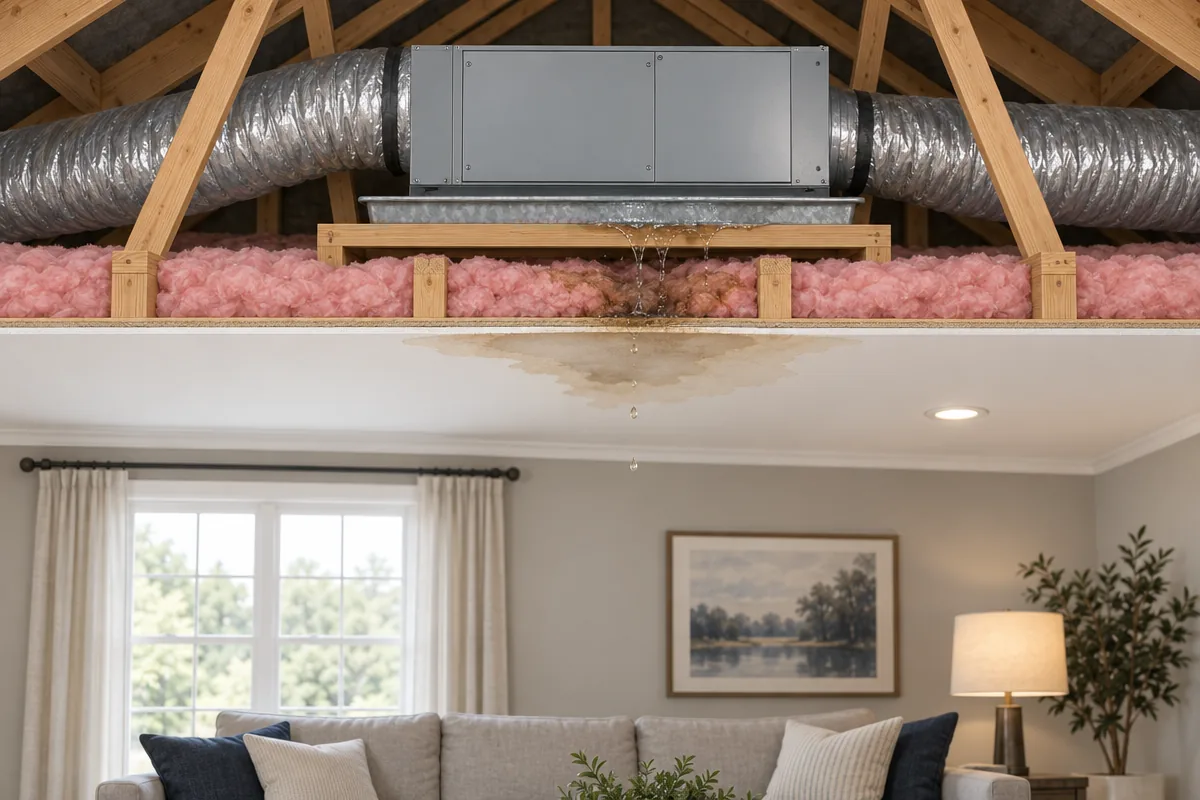 Illustration: when the air handler is in the attic, the first thing you see is a ceiling stain, not a puddle.
Water in or under the filter slot. Classic blocked drain on a closet or garage air handler. One of ours in Carmichael was booked exactly that way: "inside unit is dripping water down into filter, suspect clogged drain line." It was.
Water around the furnace. Two different things live in the same cabinet in most Sacramento homes. In summer the AC coil sits above the furnace and drains through it, so an AC drain problem looks like a furnace leak. In winter, a high-efficiency condensing furnace produces its own condensate and has its own trap, and that trap can fail. We have replaced a furnace drain trap on a Rheem for exactly that reason. If it is leaking in January, it is a heating problem rather than an air conditioning one, and the trap and the furnace drain are where a technician will start.
Water at the outdoor unit. Usually normal. On a humid morning, or when a heat pump runs a defrost cycle in winter, the outdoor unit sheds water by design. Worry only if it is constant and heavy.
Water on the roof. Package units and rooftop heat pumps drain to the roof, and a blocked drain there ends up inside the building. Two of our own calls were logged as exactly that.
The four causes, and which one you have
1. Clogged condensate drain line. The most common by a wide margin, and the one every source on the first page of Google names first. Dust and biological growth turn into a sludge inside the PVC and the water backs up. The full fix, including the vinegar flush you can do yourself, is in what to do when the AC drain line is clogged.
2. A frozen coil that is now melting. Restricted airflow or low refrigerant makes the coil run below freezing. Ice builds, and when the system shuts off the ice melts faster than the pan can drain. The tell is that the leak is intermittent and follows the system cycling. Do not chip the ice. Turn the system to fan only and let it thaw, then look for the cause, which is usually a filter or airflow problem and occasionally charge. Full walkthrough: AC freezing up and frozen coils.
3. Cracked, rusted or misaligned drain pan. Pans rust out on older systems and crack on old plastic. A pan that has simply shifted out of level does the same thing. This is a parts repair, not a flush.
4. Failed condensate pump. Systems that cannot drain by gravity use a small pump. When it fails or loses power, water backs up fast. Some have a safety float that shuts the system down instead of letting it overflow, which is the outcome you want.
Why Is There Water Around the Furnace When the AC Is On?
Water around or under the furnace that appears only while the AC runs is most likely the AC's condensate, not a furnace problem. The cooling coil mounts on the furnace's air outlet, which on an upflow furnace puts the coil and its drain pan directly on top (Trane Technologies coil guide). When that pan cannot drain, water runs onto or around the furnace.
Any of the four causes above can do it: a clogged drain line, a rusted or cracked coil pan, a failed condensate pump, or a frozen coil melting faster than the pan drains. The coil-on-furnace setup adds two more: an unused drain port left unplugged, and a coil that is not level, since the pan needs proper pitch to drain.
A winter leak with the AC off is a different case. A condensing furnace is a high-efficiency furnace that makes its own condensate.
What you can safely check:
- Set the thermostat to off. If water has reached the furnace's wiring or controls, switch off the furnace's power too.
- Replace a dirty air filter, since a clogged filter can freeze the coil (Carrier).
- If the coil pan has a secondary drain line, it should end somewhere visible; water from it means the primary drain is plugged.
- If a condensate pump sits beside the furnace, make sure it is plugged in and running.
- Clear the outdoor end of the drain line with a wet/dry vacuum, as described below.
If the coil pan is rusted or cracked, the water returns within days, or it has reached the furnace's electrical parts, book AC repair. The coil makes water as long as the AC runs, and on a long Sacramento cooling day that adds up fast.
What a leak repair actually costs here
From our own completed Sacramento-area jobs, rounded:
| Job | Invoiced |
|---|---|
| Diagnose a dripping indoor unit, suspected drain clog | about $180 |
| Clean an attic drain line | about $260 |
| Check and repair a water leak at a furnace | about $290 |
| Drain line repair | about $320 |
| Rooftop heat pump leaking water | about $340 |
| Second-floor condensate drain plus a freezing coil | about $980 |
| Dirty indoor coil with a refrigerant restriction and condensate backing up | about $1,265 |
The pattern: a simple clog is an inexpensive visit. What makes it expensive is the thing behind the clog, or the water damage you paid for while waiting.
What we actually see
Across 1,518 Sacramento-area service calls where the booking note describes the problem, 37 mention water leaking or dripping and 13 name the drain line, condensate or the drain pan directly. Ten mention a frozen or iced coil. Notably, very few name a safety float switch, which tells us most of these homes have no secondary protection between a blocked drain and a ceiling.
Should I be worried if my AC is leaking water?
Yes, though not because the air conditioner is about to fail. Worry about the water. Clean condensate running into drywall, insulation or a ceiling causes damage that costs far more than the HVAC repair, and it grows mold in a wall cavity that nobody opens for months. The equipment itself usually survives a drainage problem. The building often does not.
Is an AC leaking water an emergency?
It is urgent rather than an emergency, with one exception. If water is running into a ceiling, into an electrical panel, or onto anything electrical inside the air handler, shut the system off at the thermostat and at the breaker and treat it as urgent. A slow drip into a pan outside in the open air can wait for a normal appointment.
Should I turn the AC off if it is leaking?
Turn it off if water is actively accumulating somewhere it should not be. The system keeps producing condensate every minute it runs, so leaving it on while a drain is blocked simply adds water to the problem. If the coil is frozen, switching the fan to on with cooling off is the fastest safe way to thaw it.
Can I run the AC while it is leaking water?
You can, and you should not for long. Beyond the water damage, a blocked drain often means the coil area stays wet, which is where musty odors start. If the smell has already arrived, that is covered in why your HVAC smells.
How do I fix an AC that is leaking water?
In order: turn the system off, check and change the filter, look in the drain pan, and try clearing the condensate line yourself with a wet/dry vacuum at the outdoor end of the PVC. If the line clears and stays clear, you are done. If the water returns within days, if the pan is cracked, if the coil keeps freezing, or if the leak is in an attic above finished ceilings, stop and call. Those four are the ones that turn into drywall repairs.
What is the 3 minute rule for AC?
Wait at least three minutes before restarting a system you just shut off. Restarting a compressor against high head pressure can damage it. Most modern thermostats and control boards enforce a delay automatically, which is why a system sometimes seems slow to respond after a power blip.
Preventing the next one
A condensate drain is a maintenance item, not a repair item. ENERGY STAR's maintenance checklist calls for checking it in cooling season, because a plugged drain can cause water damage in the house. It gets cleared as part of an AC tune-up before the cooling season, which is exactly when a season of dust and growth has had time to build. If you are on a service membership, it is part of the visit.
If the leak is already running, or it has reached a ceiling, book AC repair rather than waiting for the next tune-up. To know more about us first, see our guarantee and rates, or contact us and describe where the water is showing up.