
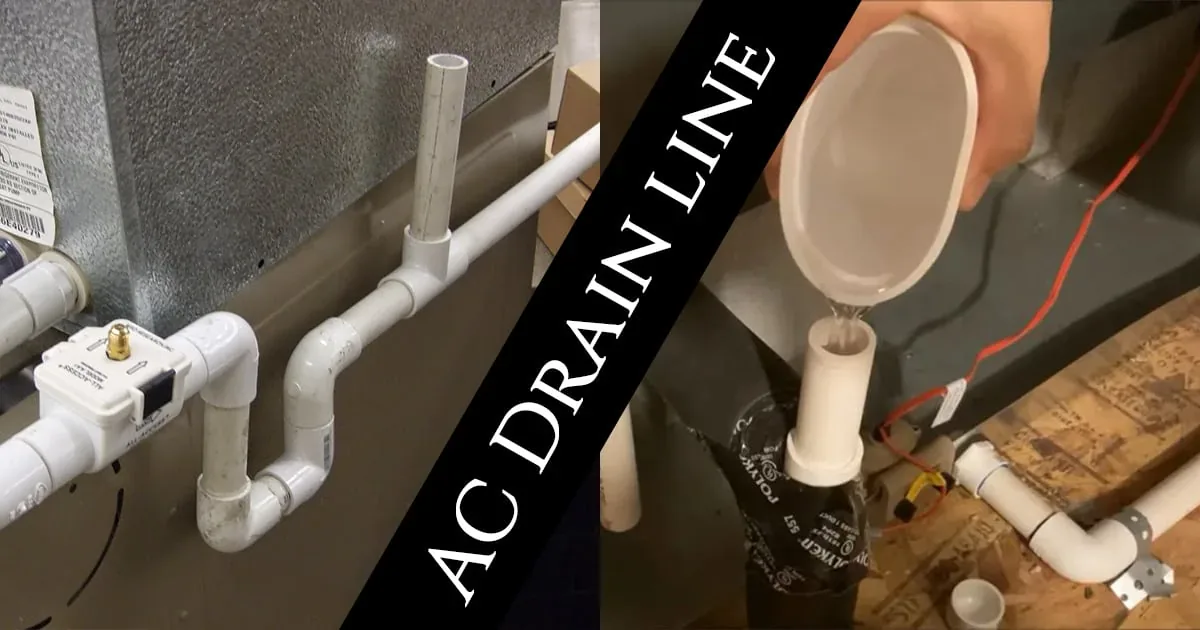
A clogged condensate drain line is the most common reason an air conditioner leaks water, and on most systems you can clear it yourself in about fifteen minutes with a wet/dry vacuum. Turn the system off, find the white PVC pipe outside, seal the vacuum hose over the open end, and run it for two minutes. If sludge comes out and the drip stops, you are done. If water backs up again within a few days, the problem is not the clog.
This page is the fix. If you are not yet sure a blocked drain is what you have, start with why your AC is leaking water, which sorts the four possible causes by where the water is showing up.
What the drain line does
Your air conditioner removes humidity as a side effect of cooling. Warm air passes over a cold evaporator coil, moisture condenses on the fins, drips into a pan under the coil, and leaves through a small PVC pipe, usually to the outside of the house or into a plumbing drain. A system running through a Sacramento July afternoon produces a steady trickle all day. That water has to go somewhere.
Why it clogs
Dust that gets past the filter lands on a wet coil and washes into the pan. Add darkness, standing water and warmth and you get biological growth. Over a season it turns into a soft sludge that narrows the pipe, then blocks it. The line does not usually fail from one big obstruction; it closes gradually, which is why the first symptom is often intermittent.
Sacramento adds two local factors. Summer dust loads the system faster than the filter manufacturer assumes, and a large share of homes here put the air handler in the attic, where nobody sees the early drip until it reaches a ceiling.
Signs your drain line is clogged
- Water around the indoor unit, in the filter slot, or under the furnace cabinet. One of our Carmichael calls was booked in exactly these words: "inside unit is dripping water down into filter, suspect clogged drain line."
- A stain spreading on a ceiling below an attic air handler. This is the expensive version, because by the time drywall shows it, water has been running for a while.
- Standing water in the drain pan. Open the access panel and look. The pan should be wet, not full.
- A musty smell when the system runs. Stagnant water in the pan is a smell source, covered further in why your HVAC smells.
- The system shuts itself off. Some units have a float switch that cuts the system when the pan fills. That is the switch working correctly, and it is protecting your ceiling. If the pan is dry and the system still won't come on, the other no-start causes are the next place to look.
- A frozen coil. Less obvious, but a blocked drain and a freezing coil often show up together, and one can drive the other. See AC freezing up and frozen coils.
How to unclog an AC drain line yourself
1. Turn the system off. At the thermostat, and at the breaker if you will be opening the cabinet. Never work on a system that can start while your hands are in it.
2. Find both ends. The indoor end is at the drain pan under the evaporator coil, usually with a short vertical pipe and a cap. The outdoor end is a stub of white PVC, often near the condenser or coming through an exterior wall, sometimes dripping in normal operation.
3. Vacuum from the outside end. Put a wet/dry vacuum hose over the outdoor stub and seal around it with your hand or a rag. Run it for a minute or two. You are pulling the blockage backward, away from the pan. Expect dirty water and sludge.
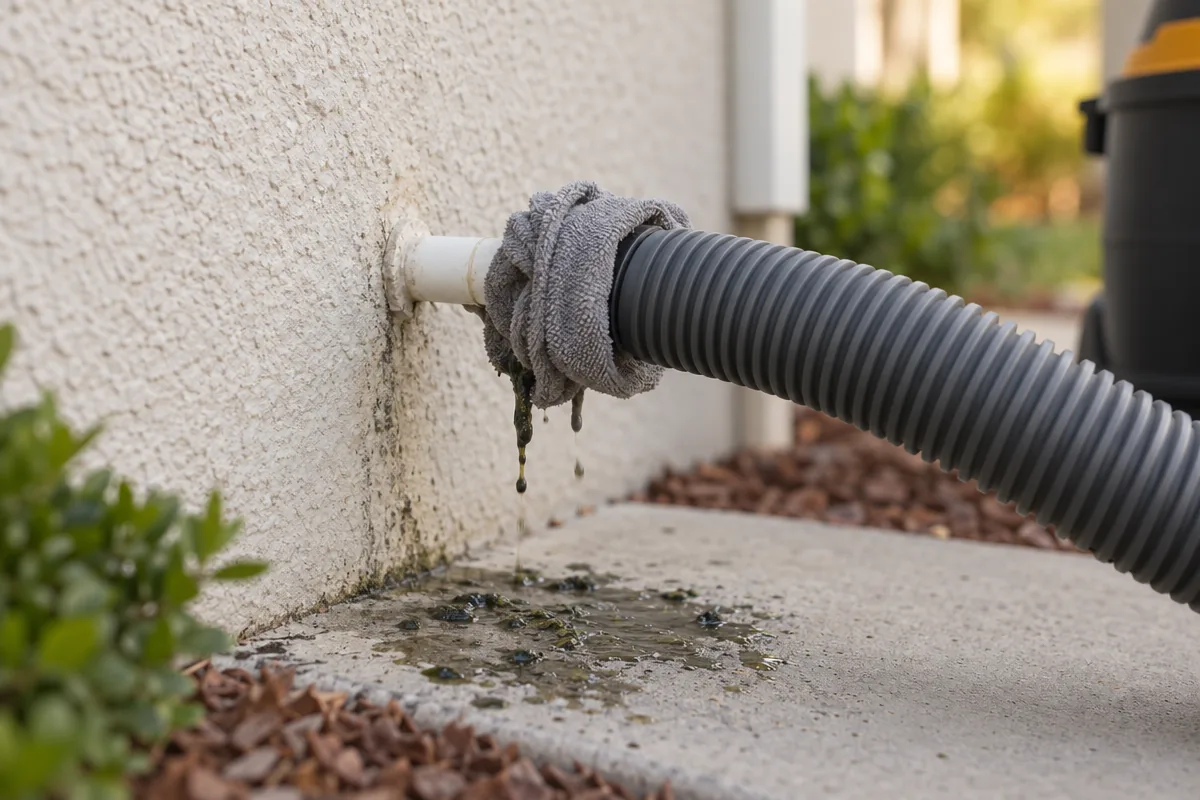 Illustration: the shop vacuum hose is wider than the pipe, so seal the junction with a rag. The line itself is three quarter inch PVC.
4. Check that it is flowing. Pour a cup of water into the drain pan or the indoor access port and watch for it to come out the far end.
5. Flush the line. Once it is clear, pour about a cup of distilled white vinegar into the indoor access port. Vinegar discourages the growth that caused the clog. Leave it thirty minutes, then flush with water.
6. Clear the pan. Wipe out the standing water and debris while you are there.
ENERGY STAR lists checking and inspecting the condensate drain as a standard item on an annual check-up, and is direct about the stakes: a plugged drain can cause water damage in the house and affect indoor humidity levels.
Do not use bleach. It corrodes the metal it touches in the drain pan and the coil, and it is hard on the PVC joints and on a septic system. Vinegar does the same job without the damage. You will find bleach recommended on plenty of other pages; we do not recommend it.
Do not put compressed air down the line. It is an easy way to blow a joint apart inside a wall or an attic.
When to stop and call
- The line clears and then blocks again within days. Something upstream is producing more debris than the line can carry, usually a dirty coil.
- The drain pan is cracked, rusted or sitting out of level. That is a parts repair.
- The air handler is in an attic above finished ceilings. The risk of getting this wrong is drywall, not inconvenience.
- The coil is frozen, or the system is not cooling properly as well as leaking.
- There is a condensate pump and it is not running.
- Water has already reached a ceiling, a wall or anything electrical.
What this costs if we do it
Real invoices from our own completed Sacramento-area jobs, rounded:
| Job | Invoiced |
|---|---|
| Diagnose a dripping indoor unit, suspected drain clog | about $180 |
| Clean an attic drain line | about $260 |
| Drain line repair | about $320 |
| Second-floor condensate drain issue with a freezing coil | about $980 |
The first two are the normal outcome. The last one is what it costs when the drain is a symptom rather than the problem.
How often should I check the drain line?
Once before each cooling season, and again mid-summer if your system runs hard. In practice, most people never check it and find out when it leaks. Clearing the condensate drain is a standard item on an AC tune-up, which is the simplest way to make sure it happens on schedule, and it is included if you are on a service membership.
Can a clogged drain line damage my AC?
The drain itself will not hurt the compressor. What it does is keep the coil area wet, encourage growth, and in systems with a float switch, shut the equipment down. The real damage is to the building: ceilings, insulation, flooring and the mold that follows. Across 1,518 Sacramento service calls with a written booking note, 37 mention water leaking or dripping, and the expensive ones are always the ones that ran for a while.
Will a clogged drain line stop my AC from cooling?
Not directly, but the two often travel together. A blocked drain does not reduce cooling capacity by itself. A dirty coil, which is what produces the sludge in the first place, absolutely does. If the house is not keeping up as well as leaking, treat it as a cooling problem too: AC repair is the right lane, and when the AC runs but the house will not cool covers the diagnosis.
Preventing the next clog
- Change the filter on schedule. Most drain sludge starts as dust that got past a loaded filter.
- Pour a cup of vinegar down the line at the start and middle of cooling season.
- Have the coil and pan cleaned during the annual tune-up, not just the line.
- If your air handler is in the attic and has no float switch, ask about adding one. It is inexpensive protection for a ceiling.
- Keep the coil clean. ENERGY STAR notes that dirty coils make the system run longer, and the debris they shed is what ends up in your drain.
If the line will not clear, or the water has already reached somewhere it should not be, book AC repair or contact us and describe where the water is showing up.