
A musty smell from your air conditioning means moisture is sitting somewhere inside the system and something biological is growing in it, almost always on the evaporator coil, in the drain pan, or in a blocked condensate line. It is the most common HVAC odor there is, and on most systems it is fixable. Where the smell keeps returning after the coil and drain are clean, the question moves to indoor air quality equipment at the system rather than the smell itself.
The bottom line: musty and sour smells are a cleaning job on the coil, pan and drain. Rotten egg and burning smells are stop-now calls. A sweet, chemical smell points to a possible refrigerant leak and needs a technician.
But "musty" is only one of the smells a system can produce, and they do not all mean the same thing. Two of them mean stop using the system and call someone today. This page sorts them.
What each smell means
| What you smell | Most likely cause | How urgent |
|---|---|---|
| Musty, damp, like a basement | Moisture and biological growth on the coil, in the pan, or a blocked drain | Fix it soon. Not dangerous, gets worse |
| Sour, like a gym bag or dirty socks | Bacteria on the evaporator coil, often noticed when the system switches modes | Fix it soon. Needs a real coil cleaning |
| Rotten eggs or sulfur | Possible natural gas leak | Leave now, then call 911 and PG&E |
| Burning, hot metal, electrical | Overheating motor or wiring, or dust burning off | Shut the system off. Same day |
| Chemical, sweet, like a marker | Possible refrigerant leak | Same week, and it is not a DIY repair |
| Sewage | A dry plumbing trap or a sewer gas issue near a return | Plumbing, not HVAC |
| Paint thinner or solvent | Something in the house being drawn into a return | Find the source, ventilate |
That last one is not hypothetical. We have been called out to a Sacramento home for exactly that: a paint thinner smell through the vents, which turned out to be the return pulling fumes from elsewhere in the house rather than anything wrong with the equipment.
Musty is a moisture problem, not an air freshener problem
Your air conditioner pulls humidity out of the air on purpose. Warm air crosses a cold coil, water condenses on the fins, runs into a pan, and leaves through a drain line. That is three places that stay wet all summer, in the dark, at room temperature. Everything that lands there, and plenty gets past a filter, has somewhere to grow.
The EPA puts it in one line: the key to mold control is moisture control. Spraying a deodorizer into a return vent does nothing about the wet surface producing the smell.
So a musty smell points at one of four places:
The evaporator coil. The usual culprit. Dust sticks to wet aluminum fins and stays there. This is behind sheet metal and is not a homeowner cleaning job.
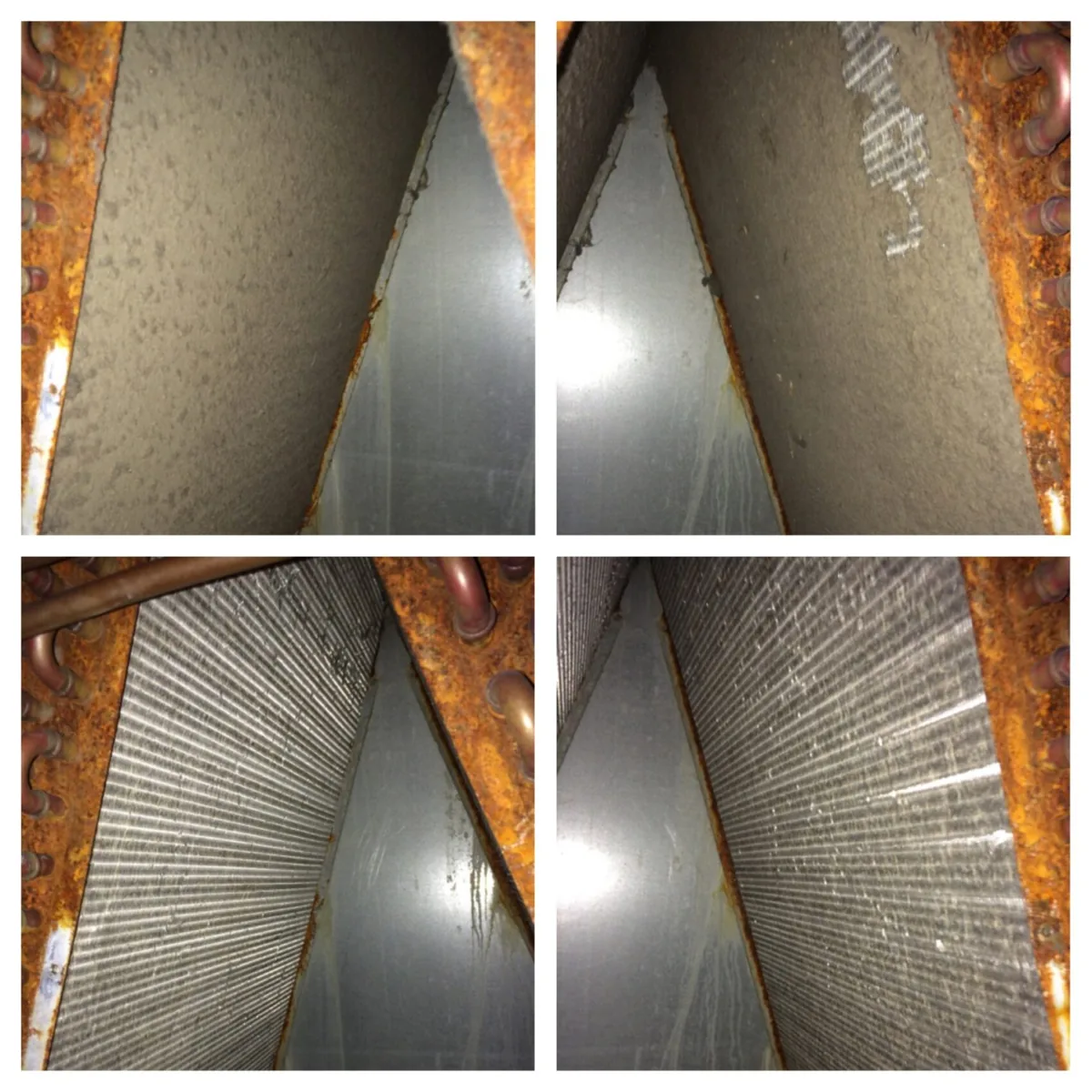 An evaporator coil before and after cleaning. In the top frames the fin faces are matted over completely, which is what produces the smell.
The drain pan. If it is holding standing water rather than draining, it is a small pond inside your air handler.
The condensate drain line. A blocked line backs water up into the pan and keeps everything wet. It is also the easiest of the four to fix yourself: how to unclog an AC drain line walks through it, and clearing it often removes the smell in a day.
The ductwork. Leaky or poorly insulated ducts in a hot Sacramento attic can sweat, and wet duct insulation smells. This is also the one that makes the smell show up in several rooms at once rather than near the air handler.
Dirty sock syndrome, named properly
If the smell is less like a damp basement and more like a gym bag, and it shows up strongest in the first few minutes after the system starts, that is what technicians call dirty sock syndrome. Dirty sock syndrome is bacteria colonizing the evaporator coil. It is common on heat pumps because the coil alternates between heating and cooling and spends a lot of time wet and lukewarm, which is exactly the condition that suits them.
Two things matter about it. First, it is a coil cleaning problem, not a filter problem, so changing the filter alone rarely clears it. Second, it tends to come back if only the surface is treated, which is why some systems end up with UV germicidal treatment at the coil as well as a proper cleaning.
The Sacramento pattern
Odor calls here cluster in two places in the calendar.
The first hot week. The system has not run since October. The coil sat damp, the pan sat still, and the first long run pushes months of that through the house. If your AC smells in May and did not smell in September, this is why.
The first cold night. Dust that settled on a heat exchanger all summer burns off the first time the furnace fires. That version smells like hot dust, lasts a few minutes, and is normal. If it lasts longer than a cycle or smells like burning plastic or electrical, that is the other lane: what a furnace burning smell actually means covers the heating-season smells and the ones that need a same-day response.
The two smells that are not a maintenance call
Rotten eggs or sulfur. Natural gas has no smell of its own, so an odorant is added that smells deliberately awful. If you smell it, do not look for the source, do not flip switches, do not use a phone indoors. Leave with everyone and pets, move a safe distance away, then call 911 and PG&E at 1-800-743-5000. That is the correct response even if it turns out to be nothing.
Burning or electrical. Shut the system off at the thermostat and the breaker. A motor overheating or wiring failing does not get better by being run. We have replaced an indoor fan unit that was booked as "noise and burning smell", and taken a call on a rooftop unit with a burning smell from the vents. Both were real failures, not dust.
Furnace Smells Sweet? What a Sweet Smell From the Furnace Means
A sweet, chemical smell coming from the furnace can point to refrigerant rather than the furnace itself. In a split system the AC or heat pump's indoor coil is installed at the furnace, so a leak there rides the same airflow out of every vent. OSHA notes that many halocarbon refrigerants give off vapors with a faint sweet odor, and one manufacturer compares the smell of R-22 to nail polish remover. Finding and repairing a leak is work for a licensed technician, not a DIY job; our guide to how refrigerant leaks are found explains what that involves.
Rule out the house too. A return vent is the intake that pulls in whatever is in the air near it, from a candle or air freshener to a solvent, and the system sends it back out through the supply registers.
If the smell has any sulfur, rotten-egg or skunk edge, treat it as gas, not refrigerant. PG&E adds a rotten-egg odorant to natural gas so leaks can be detected: leave with everyone, then call 911 and PG&E from a safe distance, exactly as in the rotten-egg steps above.
A smell never tells you anything about carbon monoxide. Carbon monoxide is an odorless, colorless gas (CDC), so neither a sweet smell nor the absence of one is a CO test. A working CO alarm near every sleeping area is.
If a sweet smell comes back whenever the system runs, book a technician to check the coil and the refrigerant lines, and say it smells sweet when you call.
What you can do yourself
- Change the filter. If it is damp as well as dirty, that is a finding in itself.
- Look in the drain pan. Wet is normal. Standing water is not.
- Clear the condensate line with a wet/dry vacuum, then flush with distilled white vinegar. Not bleach, which corrodes the pan and the coil.
- Run the fan for a while after cooling. Circulating air over the coil after the compressor stops helps it dry.
- Check whether the smell is everywhere or in one room. Everywhere points at the equipment. One room points at the duct serving it.
What needs a technician
- Cleaning the evaporator coil properly, which is the fix for most musty and sour smells.
- Anything that comes back within weeks of a cleaning.
- A cracked or rusted drain pan.
- Duct inspection when the smell is in several rooms at once. That is ductwork territory.
- Any burning, electrical or chemical smell.
Coil and pan cleaning is part of what an AC tune-up covers. If the smell has already been there a while, book AC repair instead and say what it smells like when you call, because that changes what the technician brings.
How do I get my AC to stop smelling musty?
Deal with the moisture, in this order: change the filter, clear the condensate drain, then have the coil and pan cleaned. Deodorizers and vent inserts mask the smell while the thing producing it keeps growing. If the smell survives a real coil cleaning, the next suspects are the ducts and a drain pan that is not draining.
Is it normal for an AC to smell musty?
A faint smell for a minute or two on the first start of the season is common. A smell every time the system runs is not normal and it will not clear on its own, because the surface producing it stays wet all summer.
Can I still use my AC if it has mold?
You can run it, and you should get it cleaned rather than living with it. The EPA is measured about this: molds produce allergens and irritants, and inhaling or touching mold or mold spores can cause allergic reactions in sensitive people. Reactions include hay fever type symptoms such as sneezing, runny nose, red eyes and skin rash, and mold can trigger asthma episodes in people with asthma who are allergic to it. If anyone in the house has asthma or mold allergies, treat it as a priority rather than a someday job.
Is it bad to breathe in a musty smell?
Worth keeping in proportion. The EPA states plainly that symptoms other than the allergic and irritant types are not commonly reported as a result of inhaling mold, and that research is ongoing. You will find pages listing dramatic "signs of mold toxicity"; that is not what the EPA says. The sensible reading is that a musty system is an air quality problem worth fixing promptly, particularly for anyone with asthma or allergies, and not a medical emergency.
Stopping it coming back
The smell returns when the moisture does. What keeps it away is unglamorous: change the filter on schedule, keep the condensate drain clear, get the coil and pan cleaned annually rather than every few years, and fix duct problems in the attic instead of living with them. All of it is in the annual maintenance visit, and it is included on a service membership.
If your system already smells, contact us and describe the smell. Musty, sour, burning and chemical send us out with different plans.