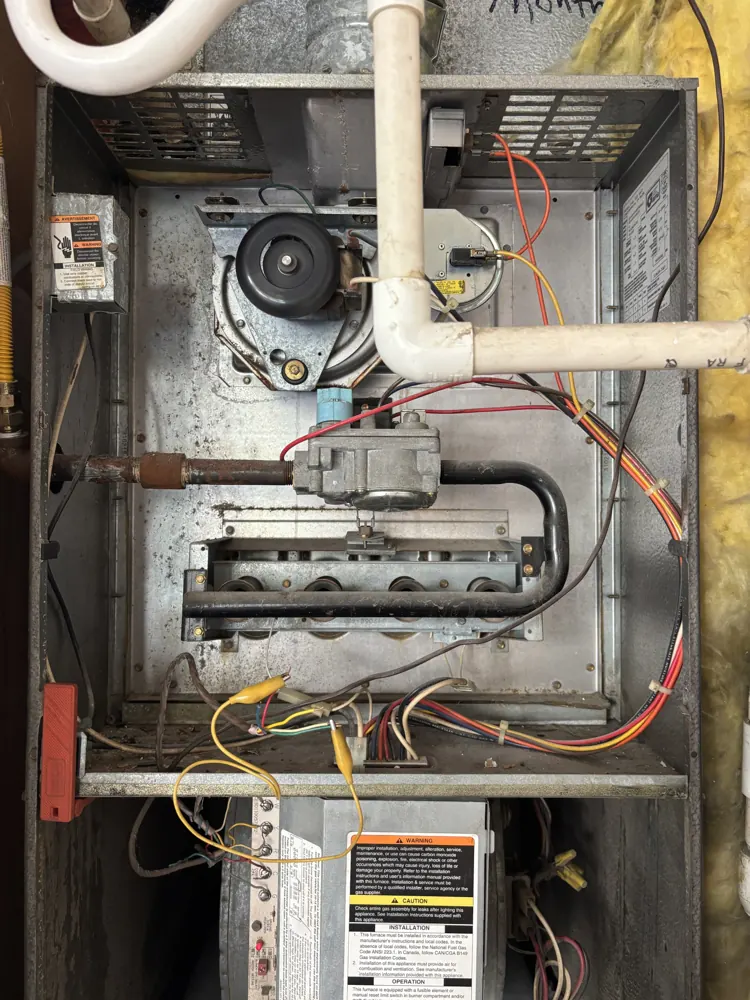
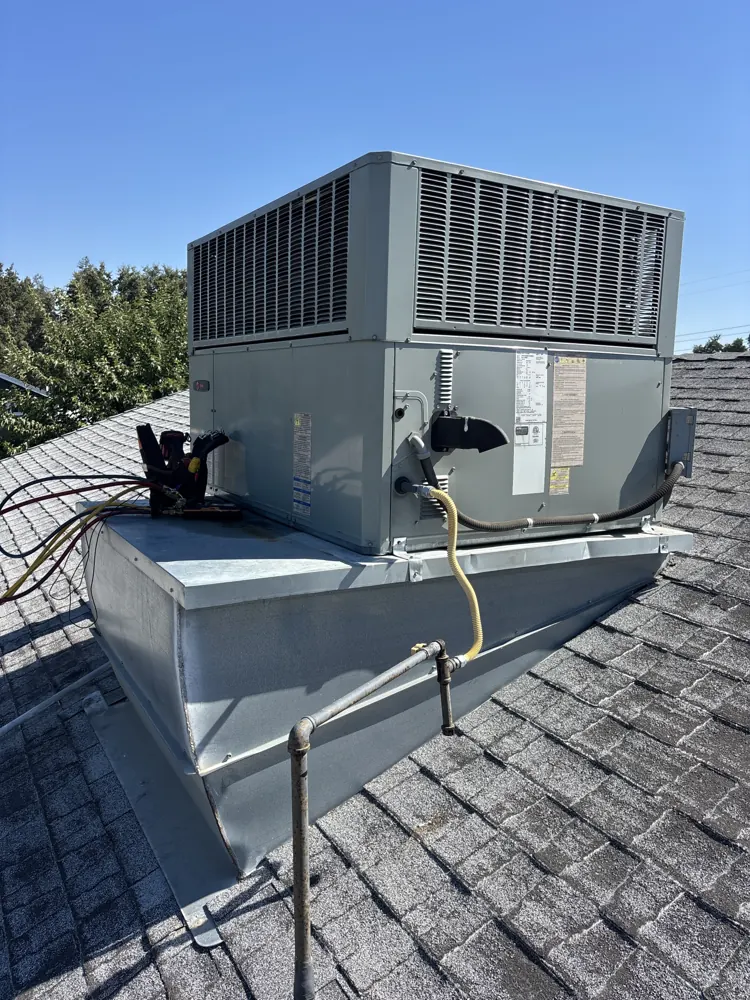
A furnace that cannot complete its startup sequence can leave a house without heat even while the thermostat calls for it. In Citrus Heights, our February 2026 repair offers a useful example: a roughly 25-year-old York furnace showing Code 3, pressure switch open. That code describes a fault to diagnose, not an automatic verdict that the furnace needs replacement.
The Friday York repair: a fault code is the beginning
We diagnosed and repaired that York the same Friday. The distinction matters because a pressure-switch code identifies a condition in the furnace's operating sequence, not necessarily a failed switch. The switch helps confirm that the draft system has established the conditions needed for combustion before the furnace proceeds.
In general, a vent restriction, a problem with the inducer that moves combustion gases, or a fault in the pressure-sensing circuit can prevent that confirmation. Replacing the switch solely because its name appears in the code can leave the original fault unresolved. The code alone does not distinguish between those causes. Our February repair shows why a fault code on an older furnace still merits diagnosis before a replacement decision.
Our heating repair diagnostic is $89, credited toward the repair. That makes diagnosis a separate decision from buying a furnace, with the diagnostic charge applied if repair proceeds. The February York is a concrete example of an old furnace being repairable; another furnace of the same age needs its own diagnosis. When the inducer runs and the burners never light, our Citrus Heights furnace repair page walks through that startup sequence one check at a time.
Citrus Heights' 1970s building wave has no single replacement date
Before using a Citrus Heights home's age to judge a furnace like February's York, separate the equipment's installation date from the building's. Two out of five homes here, 40.0 percent, were built in the 1970s, and 61.9 percent were built before 1980. A 1970s house can have replacement equipment, while its ducts may belong to an earlier installation.
Our roughly 25-year-old York job was not a repair to an original 1970s furnace. For a repair-versus-replacement decision, equipment condition, the diagnosed fault and recurring repair needs carry more weight than the house's birthday. Our replacement guidelines cover the repair-versus-replacement decision, and furnace replacement addresses the heating equipment when repair no longer makes sense.
The same separation applies to airflow: new equipment cannot close a leak in an existing duct. Leaks in ducts outside the conditioned space waste heated or cooled air, and restricted returns can limit airflow through either an old furnace or its replacement. For AC installation and replacement, matching capacity to the home's cooling load matters because an oversized system can short-cycle. A ductless mini-split can condition a separate room without extending the central ducts.
SMUD conversion and the Citrus Heights permit desk
For this city's older homes, heat pump replacement introduces a different heating option: a heat pump moves heat indoors rather than burning gas in a furnace. Our February York repair demonstrates the repair path; a conversion changes the type of system instead. For an owner weighing a repair like our February job against conversion, moving from PG&E gas to electric heating on Citrus Heights' SMUD service puts SMUD's $3,000 gas-to-electric rebate in the replacement budget if the conversion qualifies. Our $89 diagnostic credit instead reduces the cost of proceeding with the repair.
A heat pump can still provide heat below 40°F; its available capacity and efficiency depend on the model and outdoor temperature. When it needs help, the thermostat shows AUX; our guide to emergency heat vs. aux heat covers what that means on a SMUD bill. Low-temperature performance therefore matters alongside the rebate when comparing a conversion with a furnace replacement. If the decision is to convert rather than repair a furnace like the York, the installation's mechanical permit goes through Citrus Heights' own Building and Safety Division, which offers online applications, rather than Sacramento County. A mechanical permit inspection checks the installation against applicable requirements; it does not diagnose the fault in an existing furnace.
Long valley summers on older Citrus Heights AC systems
Citrus Heights sits squarely in the Sacramento Valley's Mediterranean climate. In a city where two out of five homes date to the 1970s, older tract-home AC systems face long, dry summers. They see normal July highs near 93°F and about a dozen 100°F-plus days a year, June through September and only the evening Delta breeze for relief. That sustained load can push a marginal unit into failure. Scheduling a pre-summer AC tune-up for that cooling equipment is an inexpensive maintenance decision, separate from whether a furnace like February's York needs repair or replacement. The February York repair is a reminder that even mild, damp winters call for a dependable furnace or heat pump through foggy mornings in the 40s.
For the Sacramento Executive climate record used here, December and January account for 45 percent of annual heating degree days. Our heating tune-up is a flat $99 and our AC tune-up is a flat $125; a system with an active fault belongs in diagnosis rather than routine maintenance. The York's pressure-switch code was that kind of repair problem. A cooling failure similarly belongs with Citrus Heights AC repair, while service membership covers recurring maintenance.
About 65 jobs in and around Citrus Heights
We have completed about 65 jobs in and around Citrus Heights since January 2024, according to our September 9, 2026 Housecall Pro pull. The February York repair puts a specific furnace, fault code and weekday outcome behind that local job count. Our family-owned company handles this work from our Fair Oaks base under California contractor licence CSL #967727.
For a property outside Citrus Heights itself, the nearby city pages can help you find the relevant service information: Fair Oaks, Orangevale, Antelope and Roseville. Check our service-area page for coverage beyond those neighbours. Our commercial HVAC work is light commercial. For a Citrus Heights heating or cooling fault, call 916-848-5980 or schedule service with Alpha Mechanical; our $89 diagnostic is credited toward the repair.