
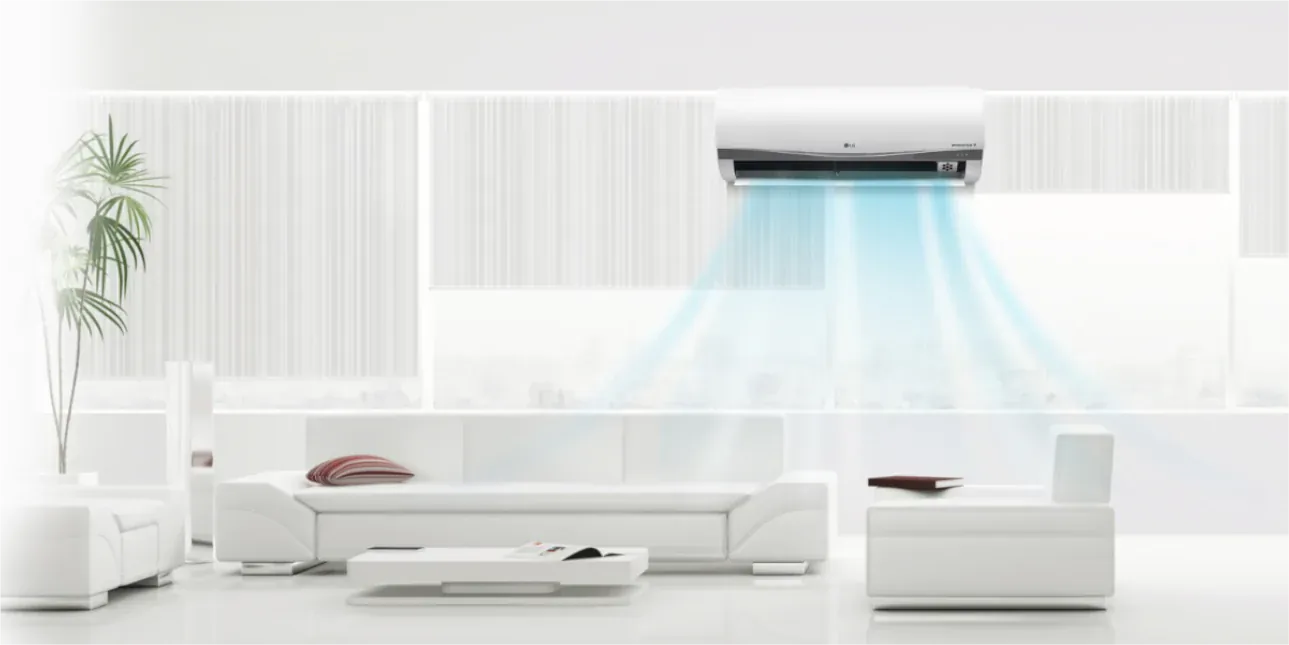
Two things move the needle on air conditioner efficiency in Sacramento, and neither is the advice you usually get. The first is airflow: ENERGY STAR puts the cost of airflow problems at up to 15 percent of system efficiency, and airflow is what a dirty filter, a blocked return, a crushed flex duct and a dirty coil all attack. The second is when you run it: on SMUD's Time-of-Day rate, summer electricity between 5 p.m. and 8 p.m. on a weekday costs $0.3765 per kilowatt hour against $0.1550 before noon. That is the same air conditioner, the same house, and 2.4 times the price.
Everything below is sorted into what you can do yourself this weekend and what needs a technician with gauges. The Sacramento-specific parts are called out, because a tip written for Seattle is worth very little in a climate that runs triple digits for weeks.
The rate table nobody mentions
SMUD's Time-of-Day (5-8 p.m.) Rate, the standard residential rate, priced for 2026:
| Summer period (June 1 to Sept 30) | Hours | Price per kWh |
|---|---|---|
| Off-Peak | Midnight to noon | $0.1550 |
| Mid-Peak | Noon to 5 p.m. | $0.2139 |
| Peak | 5 p.m. to 8 p.m. weekdays | $0.3765 |
| Mid-Peak | 8 p.m. to midnight | $0.2139 |
Weekends and holidays are off-peak all day.
What to do with that. Pre-cool. Let the house run a degree or two cooler than usual through the mid-peak afternoon, then raise the setpoint at about 4:45 p.m. and let the building coast through the three expensive hours. You are buying the same comfort with cheaper kilowatt hours. A programmable or smart thermostat does this without anyone thinking about it, which is the actual reason to own one here.
This single change is worth more on a Sacramento summer bill than most of the tips on the rest of this page, and it costs nothing. If your bill is the thing that brought you here, start with why your summer electric bill is so high, which works the bill itself rather than the equipment.
What we actually get called about
Across 1,493 residential service calls in the Sacramento area where the booking note describes the problem, 204 were some version of "not cooling" or "blowing warm air." That is the most common thing we are called for. Not a dead system: a system that runs and does not keep up.
In the same set, 81 notes mention refrigerant, charge or a leak, 58 mention the filter, 34 mention the blower or a fan motor, and 20 name airflow directly. The pattern behind most "it runs but it will not cool" calls is a system moving less air, or less refrigerant, than it was designed to move.
What you can do yourself
Change the filter, on the right schedule. ENERGY STAR says inspect, clean or change it monthly. In Sacramento, summer dust and wildfire smoke load a filter faster than the box suggests, so check it monthly from June through September even if the packaging claims ninety days. If you are not sure where yours is, here is how to find it.
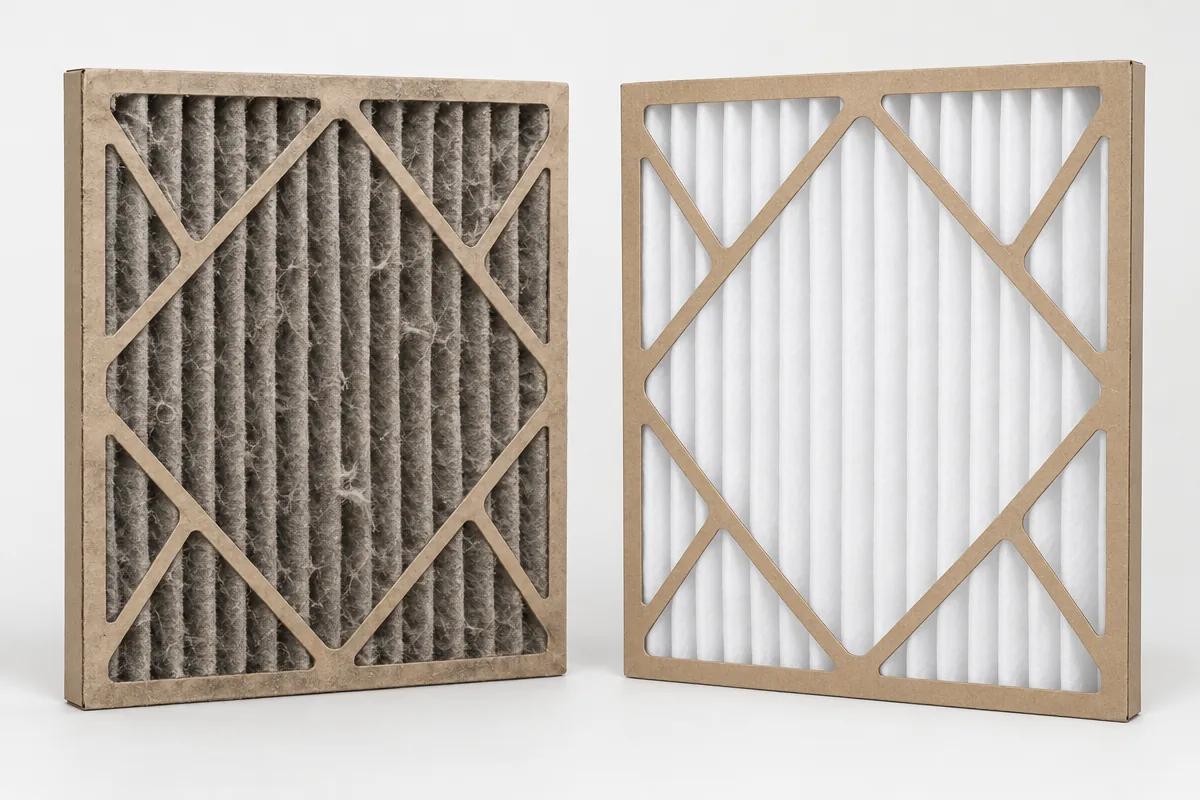 Illustration: a loaded filter next to a new one. ENERGY STAR puts airflow problems at up to 15 percent of system efficiency, and a filter in this state is the most common cause.
Do not over-filter. A very high MERV filter in a system that was not designed for the extra resistance costs you airflow, which costs you the efficiency ENERGY STAR just quantified. Match the filter to the system, not to the highest number on the shelf.
Clear the outdoor unit. Two feet of open space on all sides, no fence panel pressed against it, no shrub grown into it, no patio furniture stacked on it. The condenser rejects heat to the outdoor air; blocking it is the same as asking it to work in a hotter city.
Rinse the outdoor coil. Power off at the disconnect, then a garden hose from the inside out, gently, no pressure washer. Fins bend easily and bent fins are worse than dirty ones.
Open the returns and supplies. Closing vents in unused rooms does not save money on a central system; it raises static pressure and can freeze the coil. Keep furniture and rugs off the returns.
Shade the windows that face the afternoon sun. West and southwest glass is where a Sacramento house gains most of its heat between 3 p.m. and 7 p.m., which is exactly when power is most expensive.
Run ceiling fans in occupied rooms only. They cool people, not rooms. A fan running in an empty room is a small heater.
What needs a technician
Refrigerant charge, measured rather than guessed. ENERGY STAR is blunt about it: too much or too little refrigerant makes the system less efficient and shortens its life. Charge cannot be judged by touching a line. It is measured with gauges against the equipment's own target superheat or subcooling. Worth knowing: California's 2025 Energy Code prescriptively requires refrigerant charge verification in climate zones 2 and 8 through 15 for air conditioners, and Sacramento sits in climate zone 12. Charge is a code item here, not an upsell.
Airflow, measured in CFM per ton. The code's own benchmark for a verified system is 350 CFM per ton. Below that, the coil runs colder than it should, capacity drops and the system runs longer for the same cooling. Measuring it takes instruments.
The evaporator coil. The indoor coil collects what the filter misses. It is behind sheet metal, it is wet all summer, and cleaning it is not a homeowner job. A dirty indoor coil produces exactly the symptom in that 204-call pile: runs constantly, never quite gets there.
The blower. Dirty blower wheels lose a surprising amount of air. ENERGY STAR lists "clean and adjust blower components to provide proper system airflow" as a standard maintenance item for that reason.
Electrical connections and motor amperage. Loose connections and motors drawing above their rated amps waste energy and fail early. Both are measured on a tune-up, not seen by eye.
All of that is the work in an AC tune-up. If the system is already not keeping up rather than just running expensively, that is AC repair territory, and the symptom guide for it is when the AC runs but the house will not cool down.
Ducts: the biggest hidden loss in a Sacramento house
Most Sacramento homes built before 2000 run ducts through the attic, and a July attic runs far hotter than the outdoor air. Every leak and every poorly insulated run is pouring cooled air into the hottest part of the building and pulling attic air back into the return.
California treats this as serious enough to put it in the code. Per the Energy Commission's 2025 single-family HVAC guidance, replacing just the outdoor unit or just the indoor unit of a split system triggers duct sealing and field verification. On that kind of alteration the measured leakage has to come in at 10 percent or less of air handler airflow, or 7 percent or less to outside, or every accessible leak gets sealed and verified by smoke test.
Practical reading: if someone replaced your condenser and nobody tested your ducts, the job was not finished to code. Duct sealing and repair is usually the highest-return efficiency work available on an older Sacramento house.
What is the $5,000 rule?
Multiply the age of the system by the repair estimate. Above $5,000, replacement is usually the better economic call. A 12-year-old system facing a $500 repair scores 6,000, so it is a replacement conversation. It is a rule of thumb, not a law, and it ignores what a failure costs you in August. Use it to frame the decision, then get the numbers.
What temperature should I set in summer?
Comfort is personal, so the useful answer is about the gap rather than the number. The wider the difference between indoor and outdoor temperature, the harder and longer the system runs, and on a 105 degree Sacramento afternoon a low setpoint can mean the system simply never cycles off. Most households land between 76 and 80 when home. The bigger lever, again, is not the number but the timing: pre-cool before 5 p.m., ease off during peak.
Is 77 degrees good for AC in summer?
In this climate, yes, and it is a setting most systems can actually hold on a triple-digit day. Anything much lower asks a correctly sized system to run continuously through the afternoon, which is where high bills and frozen coils come from.
How many hours a day should the AC run?
On a mild day, cycles of roughly 15 to 20 minutes are normal. On a Sacramento afternoon above 100 degrees, near-continuous running is not automatically a fault: a system sized for the design day will run most of it. What matters is whether it is holding the setpoint. Running constantly and still drifting warmer is the symptom worth calling about.
Is it cheaper to run the AC all day or only at night?
On SMUD's Time-of-Day rate this is really a question about the 5 p.m. to 8 p.m. window. Running steadily through cheap hours and coasting through peak beats letting the house heat-soak all day and then pulling it down with the most expensive power of the day. Turning the system off entirely while you are out for a long stretch still saves energy, but do the recovery before 5 p.m. rather than after you get home.
Does turning the AC off actually save money?
Yes, for real absences. For a workday, a setback of a few degrees usually beats a full shutdown, because a house that has heat-soaked all afternoon has to be pulled back down during peak pricing. Program the recovery to start in the mid-peak window and the arithmetic works in your favor.
The honest order of operations
- Change the filter and clear the outdoor unit. Free, today.
- Move your cooling out of the 5 p.m. to 8 p.m. window. Free, and the biggest single line on a Sacramento summer bill.
- Get the charge and airflow measured. This is where systems quietly lose capacity, and both are code items in our climate zone.
- Test and seal the ducts. The biggest fixed loss in most Sacramento houses, and required anyway if the equipment has been replaced.
- Only then talk about new equipment. A high-efficiency system on leaky ducts with a dirty coil delivers a fraction of what it promises.
Book an AC tune-up if you want steps three and four measured rather than estimated, or contact us with what your system is actually doing and we will tell you which step you are on.