

Nearly every outside AC fan that won't spin comes down to one of five problems: a failed run capacitor (the most common), a pitted contactor, a burned-out fan motor, a tripped breaker or pulled disconnect, or debris jamming the blades. The safe checks stop at the thermostat, the breaker, the disconnect and a look for debris with the power off; the capacitor, contactor and motor are routine repairs for a technician.
Is your outside AC fan not spinning? Switch the thermostat to "off" before you read another word. That fan on top of the outdoor unit (the condenser fan) dumps the heat your system pulls out of the house. When it stops, the compressor keeps running against climbing pressure, and an out-of-warranty compressor replacement runs $3,600 to $5,600 in the Sacramento area. Flipping the thermostat off costs nothing and protects the most expensive part you own.
- Why Is Your Outside AC Fan Not Spinning?
- Turn the System Off Before You Troubleshoot
- What Causes a Condenser Fan to Stop Spinning?
- Which Checks Are Safe to Do Yourself?
- The Stick Test Is a Trap
- Condenser Fans Fail on Sacramento's Hottest Afternoons
- Why Does My Condenser Fan Run, Then Shut Off?
- When Should You Call a Pro?
- Outside AC Fan FAQs
- The Bottom Line
The good news: the usual causes (a failed run capacitor, a worn contactor, or a dead fan motor) are routine repairs. This guide covers the outdoor condenser fan only, not the indoor blower. We'll walk through what's safe to check yourself, what to leave alone, and how this fits the bigger picture when your AC is running but the house won't cool down.
Key Takeaways
- Turn the AC off at the thermostat the moment you notice the fan has stopped.
- A failed run capacitor is the most common cause; humming with still blades is the classic sign.
- Never push-start the blades with a stick. Spinning blades and 240-volt wiring don't forgive slips.
- Running the AC without the condenser fan can destroy the compressor, a $3,600-5,600 out-of-warranty repair.
Why Is Your Outside AC Fan Not Spinning?
Five problems cause nearly every stalled condenser fan: a failed run capacitor, a pitted contactor, a burned-out fan motor, lost power at the breaker or disconnect, or debris jamming the blades. In our Sacramento service work the run capacitor leads that list, the same part that tops our overall repair volume, and Carrier's troubleshooting guidance agrees on the signature: a fan that hums but won't spin usually means the capacitor has failed (Carrier).
Match what you see and hear to the likely cause:
| What you notice | Most likely cause | Your next move |
|---|---|---|
| Humming, blades still | Failed run capacitor | System off, have it tested |
| Compressor runs, fan doesn't | Capacitor fan section or fan motor | System off immediately |
| Clicking, then nothing | Contactor or low-voltage issue | System off, check breaker |
| Grinding or screeching | Fan motor bearings | System off, motor test |
| Completely silent outside | Breaker, disconnect, or contactor | Breaker and disconnect check |
| Still dead after a new capacitor | Fan motor or wiring | Professional diagnosis |
Each cause gets a closer look below, in rough order of likelihood.
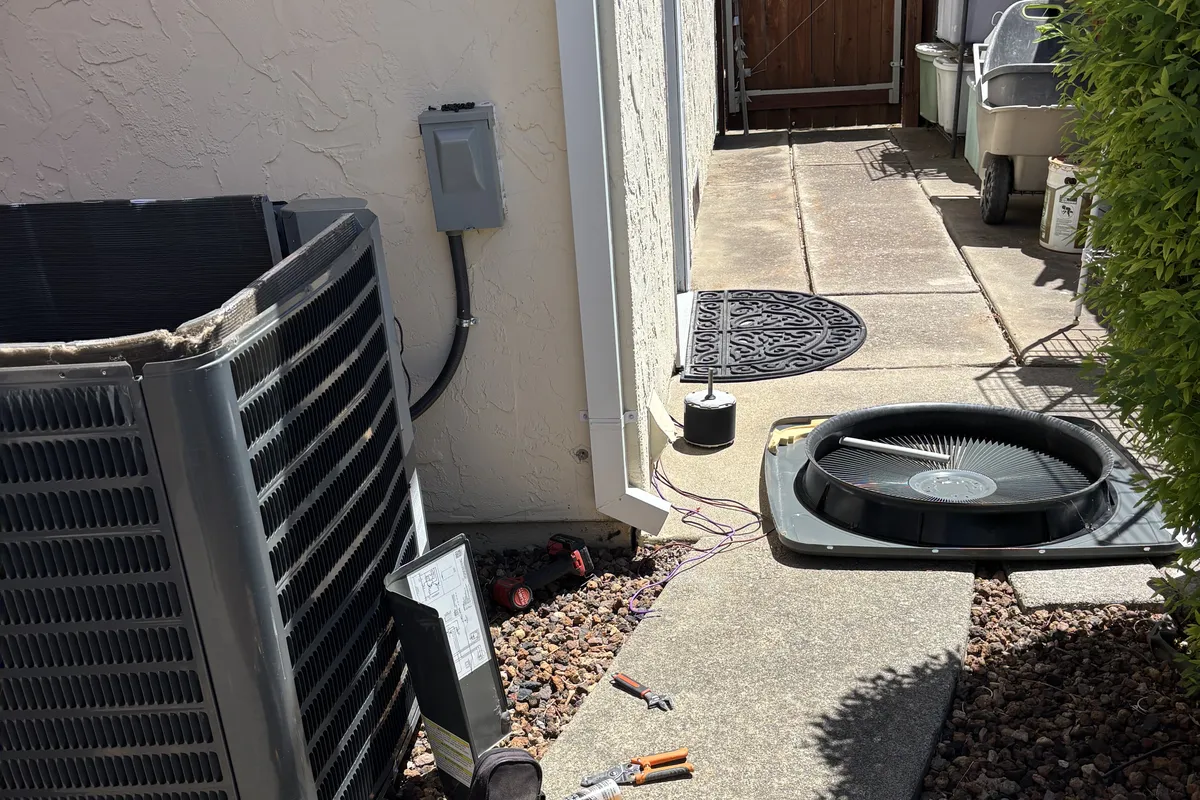
This is what the repair looks like when the motor itself is the culprit: the grille and blade assembly comes off the top of the unit, the old motor comes out, and the replacement gets matched for horsepower, RPM, and rotation before anything goes back together.
Turn the System Off Before You Troubleshoot
Shut the AC down at the thermostat before anything else. The condenser fan carries away the heat your refrigerant absorbs indoors. Without that airflow, head pressure spikes and the compressor overheats fast. Its internal thermal switch becomes the only thing standing between you and a $3,600 to $5,600 out-of-warranty compressor replacement.
That thermal switch will trip and reset, over and over, as long as the thermostat keeps calling for cooling. Every overheat cycle cooks the winding insulation a little more. From the thermostat's side, those repeated thermal trips look like short cycling, and they do the same cumulative damage. A compressor damaged this way rarely gives a warning; it simply doesn't start one afternoon. If yours has already reached that point, see our guide to an AC compressor that won't turn on.
What Causes a Condenser Fan to Stop Spinning?
Most stalled fans trace back to a small electrical part, not the fan itself. The most common failure, the run capacitor, is also the cheapest to fix: replacement typically runs $250 to $400 installed in the Sacramento area. Here's each cause, the sign that points to it, and what the fix involves.
1. Failed run capacitor (the most common cause)
The classic sign is a hum from the outdoor unit while the blades sit still. The run capacitor is the part that gives the fan motor its starting torque and keeps it running efficiently. Heat degrades capacitors, so they tend to die in the middle of a heat wave. A weakening one can also make the fan start slowly or run hot before it quits entirely. Our deeper guide covers how a bad capacitor affects your whole HVAC system.
2. Pitted or stuck contactor
The contactor is the relay that sends 240-volt power to the fan and compressor when your thermostat calls for cooling. Its contact points pit and burn from years of arcing. Rapid clicking, chattering, or a completely dead unit points here. A contactor can also weld shut, which keeps the unit running when it shouldn't.
3. Burned-out fan motor
Grinding, screeching, blades that spin up and then quit, or a motor housing too hot to touch all point at the motor itself. Bearings wear out and windings short. If a new capacitor didn't wake the fan, the motor is the usual suspect. Replacement is a pro job: the blade must be pulled and the new motor matched for horsepower, RPM, and rotation.
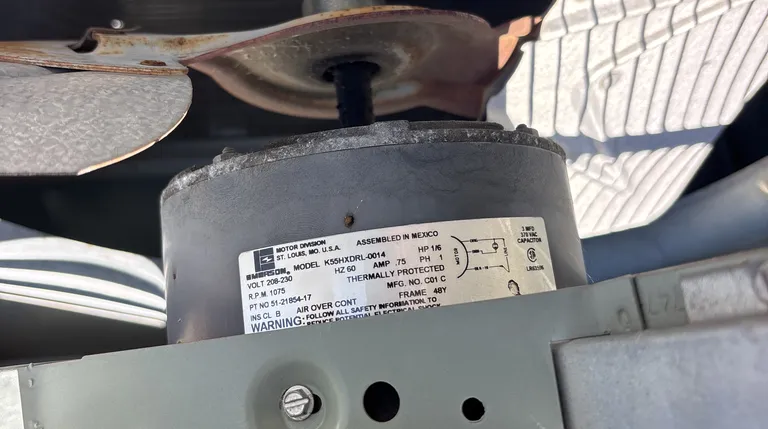
A motor from one of our Sacramento fan calls. The spec label is the whole story of why this is a pro repair: horsepower, voltage, RPM, rotation, and even the exact capacitor rating (this one calls for 3 MFD at 370 VAC) all have to match, or the new motor cooks itself the same way the old one did.
4. Tripped breaker or pulled disconnect
No hum, no click, nothing at all? Check power first. Look for a tripped AC breaker at your main panel, and confirm the pull-out block in the outdoor disconnect box (the small gray box on the wall near the unit) is fully seated. Reset a tripped breaker once, no more. If it trips again, something is shorting; our guide to an AC breaker that keeps tripping explains why. If the indoor fan is silent too, the fault is not in the condenser: start with why the whole AC is not turning on.
5. Debris jamming the blades
Sticks, leaves, and yard debris can wedge through the top grille and physically block the blades. Only inspect with power off at both the disconnect and the breaker. If a blade looks bent, don't bend it back; an unbalanced fan wobbles and chews up the motor bearings.
Which Checks Are Safe to Do Yourself?
Four checks are safe without opening anything: the thermostat, the breaker, the disconnect, and a look-and-listen test. Stop there. Everything beyond involves 240-volt wiring and capacitors that hold a charge even with power off. A professional diagnostic is a flat $89 in the Sacramento area, credited toward the repair, which is cheap insurance against a shock.
- Thermostat. Set it to off for five minutes, then to cool, 3 to 5 degrees below room temperature. Listen at the outdoor unit: hum, click, or silence?
- Breaker. Reset a tripped AC breaker once, maximum. A second trip means call.
- Disconnect. Confirm the pull-out block near the unit is seated the right way.
- Look and listen. With the breaker and disconnect both off, check the top grille for debris. Don't remove any panels.
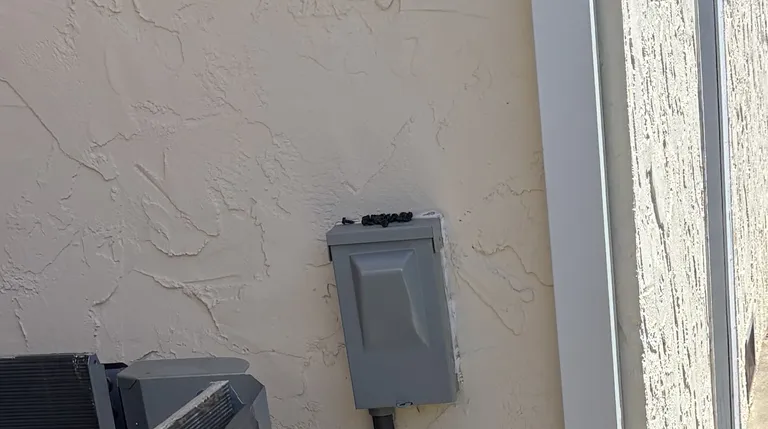
That gray box on the wall is the disconnect. Checking that its pull-out block is fully seated is safe; opening the unit's own panels is not.
Restore power, let the system try once, and if the fan still won't spin, shut it off and book a visit.
The Stick Test Is a Trap
The "stick test" (poking a stick through the grille to spin-start the blades) circulates on every DIY forum, and it's a genuinely bad idea. The blades can snap from zero to full speed the instant the motor gets torque, and 240-volt wiring sits inches away. A slip costs fingers, not just a service call.
Here's why people try it. When the run capacitor fails, the motor still has power but no starting torque, so a manual spin can get it going. If that works, you've confirmed the capacitor is bad. But the motor then runs hot and inefficient on a failed capacitor, still on its way to burnout, and you've risked an injury for information a technician's meter finds in about a minute. A "successful" stick test is a diagnosis, not a repair.
Safety note: Capacitors store a charge after power is cut, and fan blades carry no guard below the grille. Never insert tools, sticks, or fingers into a condenser unit, even one that's switched off.
Condenser Fans Fail on Sacramento's Hottest Afternoons
Fan motors and capacitors fail most often exactly when you need them most: 100°F-plus stretches when the system runs flat out for hours. The motor's own heat stacks on top of ambient heat, aging capacitors drift out of spec, and marginal bearings seize. In our Sacramento and Fair Oaks service work, stalled-fan and capacitor calls cluster during heat waves, when every AC in the neighborhood is working hardest.
You can lower the odds. Keep the area around the condenser clear: Trane's installer guides call for at least 12 inches to shrubs or walls, three feet of unrestricted space on the service side, and five feet of open air above the unit (Trane installer's guide). Rinse the coil gently in spring, and never stack anything on top of the unit. Shade is fine; enclosures are not, because they recirculate hot exhaust air back through the coil. A service membership at $239 a year adds two seasonal tune-ups plus 20% off repairs, so a drifting capacitor gets caught at the spring visit instead of failing on a 105°F afternoon.
Why Does My Condenser Fan Run, Then Shut Off?
A condenser fan that starts normally, runs for a while and then stops is often tripping its internal thermal overload. A thermal overload is a built-in protector: when the motor overheats, it shuts the motor off, and the motor can run again once it cools. HVAC School calls this fairly common in the heat of the day and notes the unit may run fine again once a technician arrives (HVAC School). In Sacramento, that is when a condenser works hardest. Meanwhile, head pressure climbs until the compressor shuts off on its own safety.
The usual causes:
- A weak or wrong-size run capacitor. Both a weak capacitor and an oversized one can make the motor run hot.
- Worn or tight bearings. Failing bearings can get noisy or develop side-to-side shaft play.
- Hot air around the motor. A dirty condenser coil or direct sun raises the temperature the motor works in.
- Voltage problems. Voltage at the motor has to stay in range while it runs under load.
A technician pins it down with meters. With the power off and verified dead, they spin the blade to feel for tight or loose bearings, measure the run capacitor against the rating printed on it, and check the motor windings with an ohmmeter, where a reading of zero or infinite resistance means a failed motor (ACHR News). With the unit running, they compare the motor's amp draw with the nameplate full-load amps, since a motor working past that rating runs hot and wears out early, and check voltage under load.
Capacitors hold a high-voltage charge even with the power off, so all of this is technician work. If your fan quits on hot afternoons and comes back later, set the thermostat to off and book a diagnosis before the compressor takes the damage.
When Should You Call a Pro?
Call once you've confirmed power and checked for visible debris, or immediately if the compressor runs while the fan sits still. A diagnostic visit is a flat $89 in the Sacramento area, credited toward the repair, and a capacitor replacement, the most common fix, typically runs $250 to $400 installed. Both are small money next to a compressor.
A technician will test the capacitor's microfarad rating, inspect the contactor points, and check the motor windings and amp draw. Capacitor and contactor swaps are usually same-visit repairs. If the motor is dead on an older system, weigh the repair against the unit's age: ENERGY STAR advises factoring in replacement once a heat pump or air conditioner is more than 10 years old (ENERGY STAR). And if the stalled fan already froze things up indoors, thaw first: a stalled condenser and a frozen coil are sibling branches of the same "runs but won't cool" family, covered in our frozen AC coil guide. For a stalled fan anywhere in the Sacramento area, you can book AC repair in Sacramento online.
Outside AC Fan FAQs
Should I turn off my AC if the outside fan is not spinning?
Yes, immediately. The condenser fan removes the heat your system collects indoors. Without it, the compressor runs against rising pressure and overheats within minutes. An out-of-warranty compressor replacement runs $3,600 to $5,600 in the Sacramento area, so switching the thermostat to off is the cheapest repair you will ever make.
How do I reset my outside AC fan?
Most residential condensers have no dedicated reset button. Set the thermostat to off, switch the AC breaker off for a few minutes, confirm the outdoor disconnect block is fully seated, then restore power and set the thermostat to cool. If the fan still will not spin, or the breaker trips again, stop and call a technician.
Why is my AC fan not kicking on outside?
The most common causes are a failed run capacitor, a worn contactor, a burned-out fan motor, or no power reaching the unit from a tripped breaker or pulled disconnect. A loud hum with no blade movement usually points to the capacitor. Debris wedged in the blades can also keep the fan from starting.
How can I tell if the outside AC fan motor is bad?
Common signs include a fan that hums but never starts, grinding or screeching sounds, a motor housing too hot to touch, blades that spin briefly and stop, and a fan that still will not run after the capacitor has been replaced. A technician confirms it by testing the windings and amp draw.
Can I push-start my AC fan with a stick?
No. The blades can snap to full speed instantly, and the unit carries 240-volt power, so a slip risks serious injury. Even when a nudge starts the fan, it only confirms the capacitor is failing, and the motor keeps overheating as it runs. Shut the system off and have the capacitor tested instead.
How much does it cost to fix an outside AC fan that will not spin?
In the Sacramento area, a professional diagnostic visit is a flat $89 credited toward the repair, and a capacitor replacement, the most common fix, typically runs $250 to $400 installed. A failed fan motor costs more and is quoted after diagnosis, since the price depends on the motor type your unit requires.
Why is my outside fan not spinning but the compressor is running?
A dual run capacitor has separate sections for the fan and the compressor, so the fan side can fail while the compressor side still works. A dead fan motor causes the same symptom. Either way, shut the system down now. A compressor running with no fan overheats quickly on a hot day.
The Bottom Line
A stalled condenser fan is one of the most fixable AC failures, as long as you shut the system off before the compressor pays the price. The run capacitor is the most common cause and a $250 to $400 repair; the compressor it protects is a $3,600 to $5,600 one. Check the thermostat, breaker, and disconnect, look for debris with the power off, and skip the stick test entirely.
If the fan still won't turn, the AlphaMechanicals team diagnoses condenser fan failures across Sacramento and Fair Oaks. Book AC repair in Sacramento and get the fan spinning before the next triple-digit afternoon. You can read more about us and how we price on our guarantee and rates page.
Written by Andrey Yev, PE, the licensed Professional Mechanical Engineer and CSLB contractor who manages AlphaMechanicals in Sacramento, drawing on 25+ years of field and engineering experience.
Sources
- Carrier, "AC Fan Not Spinning? 8 Causes & How to Fix Them" (hum + still blades points to a failed capacitor): https://www.carrier.com/us/en/residential/hvac-resources/air-conditioners/ac-fan-not-spinning/
- Trane, Installer's Guide, Condensing Units 18-AC94D1-4-EN (12 in. to shrubbery/wall, 3 ft service clearance, 5 ft unrestricted above): https://www.trane.com/content/dam/Trane/Commercial/global/products-systems/equipment/unitary/split-systems/Small%20Splits/Air%20Conditioners/18-AC94D1-4-EN.pdf
- ENERGY STAR, "Replace Your Heating and Cooling Equipment" (consider replacement past 10 years): https://www.energystar.gov/saveathome/heating-cooling/replace
- HVAC School, "Motor Overheating" (condenser fan motors tripping internal thermal overload in the heat of the day): https://www.hvacrschool.com/motor-overheating/
- ACHR News, "Troubleshooting PSC Fan Motors" (capacitor and winding tests with power verified off): https://www.achrnews.com/articles/154849-troubleshooting-psc-fan-motors