
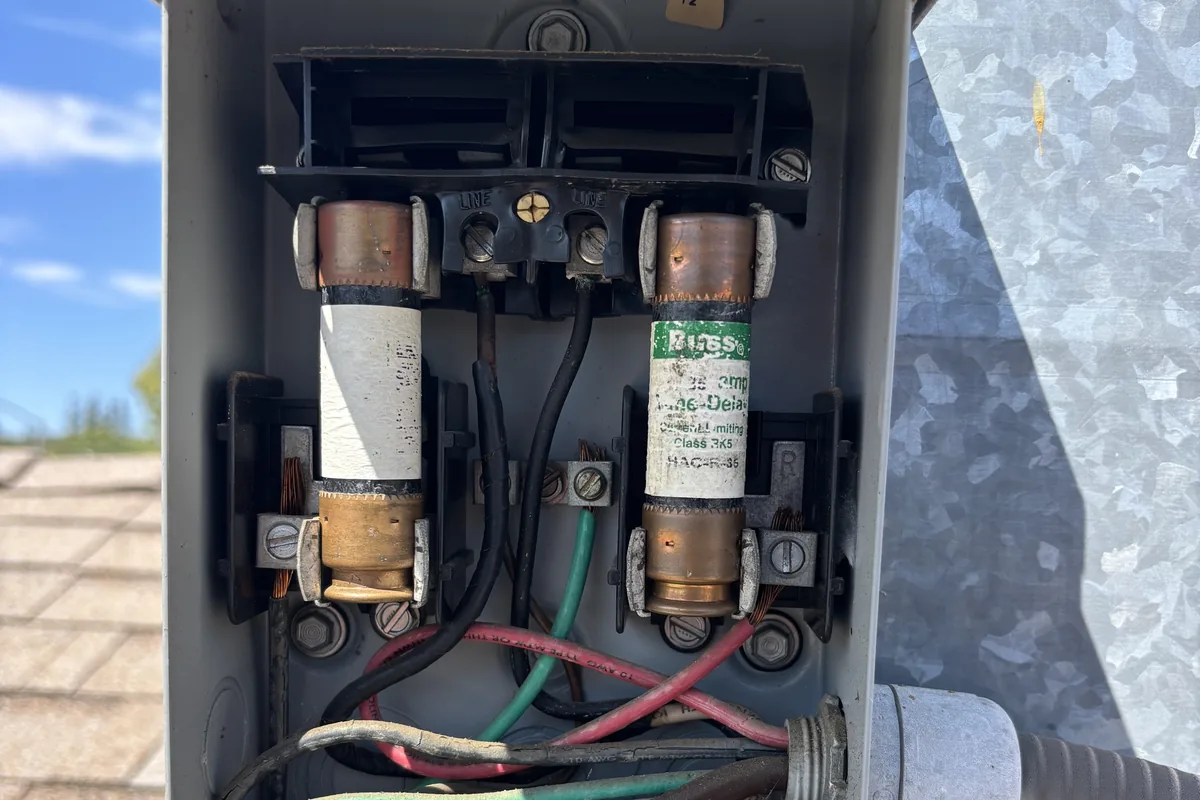
An air conditioner keeps tripping its breaker for one reason: at some moment it pulled more current than that breaker will carry. The useful question is when. A trip the instant the outdoor unit tries to start points to a short or a locked motor. A trip after five, ten or twenty minutes of running points to an overload that builds with heat. Those two timings lead to different parts, different tests and different bills, and they're the first thing Alpha Mechanical asks on every breaker call in the Sacramento area.
- Instant trip or delayed trip? Read the timing first
- The breaker math on your nameplate
- Seven causes, in the order we test them
- Is it safe to reset a tripped AC breaker?
- Why Sacramento summers find the weak link
- What we check on a breaker-trip call
- What you can safely check yourself
- Frequently Asked Questions
Key Takeaways
- Timing is the diagnosis. A trip on start-up is a magnetic trip on inrush current: a short, grounded compressor windings, a seized motor, or a failed breaker. A trip after minutes of running is a thermal trip on sustained overcurrent: a dirty condenser coil, a weak run capacitor, high head pressure, an aging compressor, or a loose, hot connection. Schneider Electric's own breaker troubleshooting FAQ draws exactly that line.
- Reset it once. If it trips again, leave it off. The U.S. Consumer Product Safety Commission tells consumers to investigate why a breaker trips rather than simply reset it, and the Electrical Safety Foundation says frequent trips should be inspected by a qualified electrician.
- The breaker is sized from the nameplate, with headroom. Under NEC 440.22(A) the branch-circuit breaker for a compressor may be rated up to 175 percent of its rated-load current, so a correctly sized breaker is built to ride through a normal start. A trip means real overcurrent until testing proves otherwise.
- Sacramento heat finds the weak link. In 2022 the city broke a 100-degree-day record that had stood since 1988, and every one of those afternoons raises head pressure and compressor amps on a borderline system.
- Our $89 diagnostic is applied to the repair, and nothing gets replaced until start and run amps have been measured against the nameplate.
Instant trip or delayed trip? Read the timing first
Before you call anyone, notice whether the breaker trips the moment the AC starts or only after it has run for a while. That one observation sorts most breaker calls into two piles.
| When it trips | What the breaker is doing | What we usually find |
|---|---|---|
| The moment the outdoor unit tries to start | Magnetic (instantaneous) trip on inrush current | Shorted or grounded compressor windings; a wire shorted at the contactor, the disconnect or the whip; a seized condenser fan or compressor; a start capacitor or hard-start relay that failed shorted; a breaker whose trip point has drifted |
| After minutes of running, usually in the hottest part of the day | Thermal trip on sustained overcurrent | A dirty condenser coil; a weak run capacitor; a clogged filter or blocked return; an overcharge or non-condensables raising head pressure; a compressor drawing above its rated-load amps as it ages; a loose, hot connection; a breaker that is wearing out |
| Only after a power outage, or right after switching it off and on | Inrush against pressure that has not equalized | A compressor restarted before the system pressures settled; a capacitor or contactor damaged by the surge |
Breaker manufacturers troubleshoot the same way. Schneider Electric's FAQ on nuisance trips for its thermal-magnetic breakers, the family that includes the Square D QO and Homeline residential lines, says: "If it trips on startup, it is tripping magnetically; if it trips after a while, it is tripping thermally" (Schneider Electric FAQ FA232232, retrieved 2026-08-26).
Its closing rule is the one that matters for the breaker itself: "If the connections are OK (tight and clean) and there is no overload, the breaker is suspect," and only when every other cause is ruled out should the breaker be replaced.
In plain terms: an instant trip is an electrical fault, and a delayed trip is a system working too hard. The rest of this post follows that split.
The breaker math on your nameplate
Your outdoor unit's data plate already says what breaker it was designed for, and that number has a safety margin built in. Four values on it matter here:
- RLA (rated-load amps): what the compressor draws under its design load.
- LRA (locked-rotor amps): the inrush for the fraction of a second before the motor spins up. On a healthy start it's brief.
- MCA (minimum circuit ampacity): the smallest wire the circuit may use.
- MOCP or "Max Fuse/Breaker": the largest breaker allowed, marked HACR on most residential units.
The National Electrical Code sets the ceiling. NEC 440.22(A) allows the branch-circuit breaker for a motor-compressor to be rated up to 175 percent of the compressor's rated-load current, and up to 225 percent where the lower value will not carry the starting current (NFPA 70-2023 Article 440, as reproduced by UpCodes, retrieved 2026-08-26).
The HACR mark on the nameplate means the breaker was listed for this kind of motor load. Square D's QO and Homeline lines carry it (Schneider Electric FAQ FA230479, retrieved 2026-08-26).
Two things follow. First, a breaker sized to the nameplate has headroom above the compressor's normal running current, so it does not trip on a good start. When it trips, the unit is drawing outside its design, and the breaker is doing its job.
Second, "fixing" a trip by installing a bigger breaker is the dangerous move. The wire was sized to the MCA, and a larger breaker leaves it unprotected. The CPSC's standing advice is to "make sure the wiring and devices used in the circuit are connected to a circuit breaker or fuse of the proper size" (U.S. Consumer Product Safety Commission, retrieved 2026-08-26).
Seven causes, in the order we test them
These are the causes behind almost every breaker call we run, listed in the order we check them, cheapest test first.
1. A dirty condenser coil
The outdoor coil is where the system dumps heat. When it's packed with dust, cottonwood fluff and grass clippings, the compressor has to push against higher pressure to get rid of the same heat, and higher pressure means more amps. ENERGY STAR's maintenance checklist puts it simply: dirty coils "reduce the system's ability to cool your home and cause the system to run longer, increasing energy costs and reducing the life of the equipment," and airflow problems "can reduce your system's efficiency by up to 15 percent" (ENERGY STAR, retrieved 2026-08-26). A coil that hasn't been cleaned in a few Sacramento summers is a common reason a system that ran fine in June trips its breaker in August.
2. A weak run capacitor
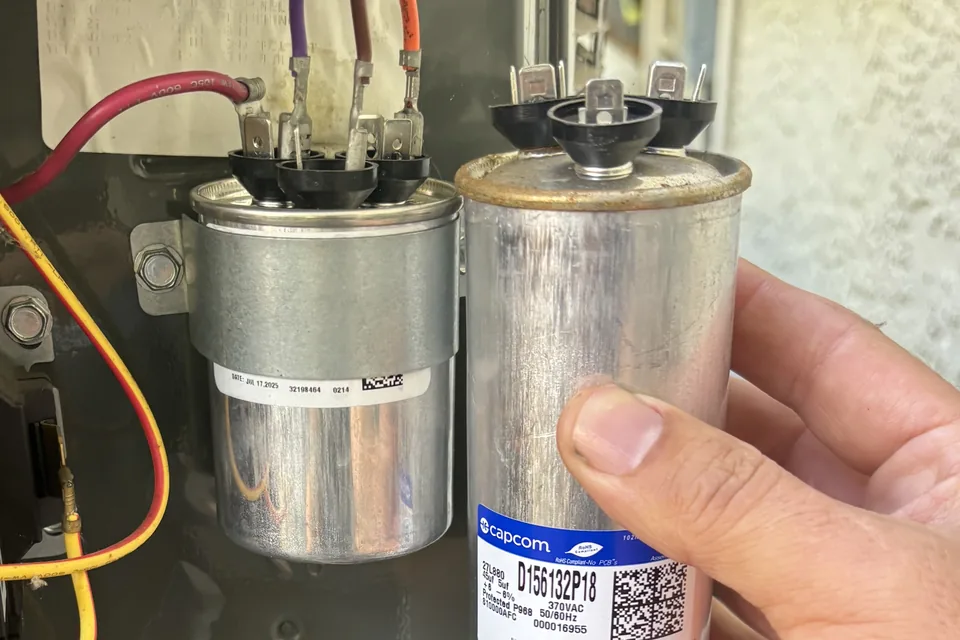
The run capacitor gives the compressor and fan motors their phase shift. As its capacitance falls below the rating on its label, the motors draw more current to do the same work and run hot. On a mild day the breaker tolerates it; on a 105-degree afternoon it doesn't. It's one of the most common parts we replace on a delayed-trip call, and the symptoms, the capacitance test and what the part costs in Sacramento are all in our bad AC capacitor guide.
3. A compressor drawing above its rated-load amps
Compressors wear. Bearings tighten, valves leak, windings lose insulation, and the running current creeps above the RLA on the plate. That produces the classic "trips after 20 minutes on a hot day" pattern. The instant-trip version is worse: windings shorted to the shell, which we confirm with a resistance-to-ground reading, means the compressor is finished. Whether that becomes a compressor replacement or a new system is a separate decision, and we walk through it in AC compressor won't turn on and in the repair-or-replace section at the end of this post.
4. A loose, burnt or pitted connection
A loose lug at the disconnect, a pitted contactor, or a whip with heat-damaged insulation all raise resistance, and resistance under load makes heat. Sometimes it trips the breaker; sometimes it melts first. It's why ENERGY STAR's checklist for a professional tune-up includes "tighten all electrical connections and measure voltage and current on motors," because "faulty electrical connections can cause unsafe operation of your system and reduce the life of major components" (same ENERGY STAR page, retrieved 2026-08-26). A discolored contactor or a warm breaker face is a finding, not a nuisance.
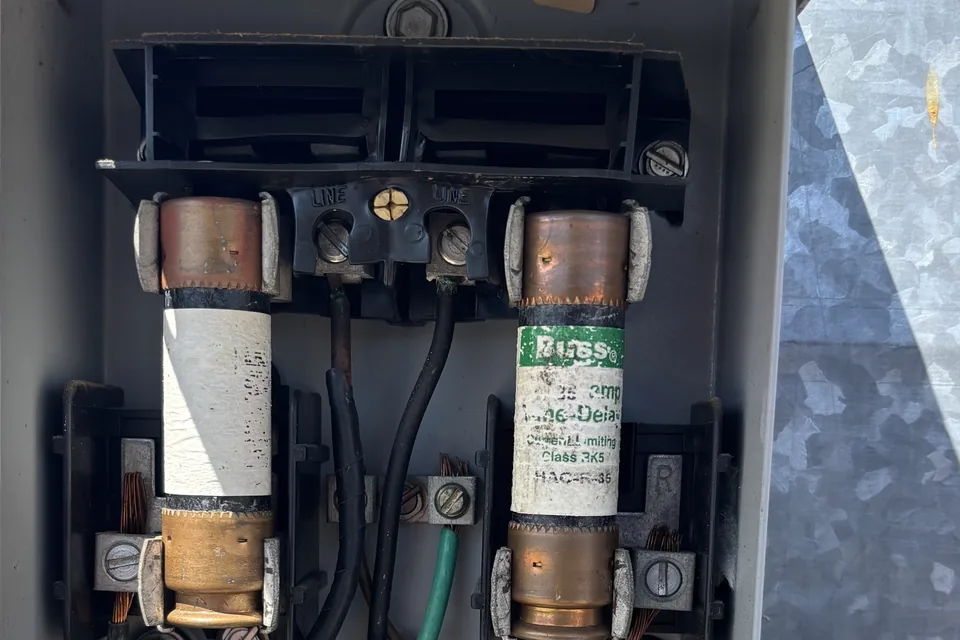
This is what cause 4 looks like in the field. The fuses did their job; the plastic around them did not survive the heat that built up at the loose terminals.
5. The breaker itself
Breakers do wear out, and a breaker that has tripped repeatedly wears faster. Schneider's rule is the one we follow: only when the connections are tight and clean and there is no overload does the breaker become the suspect, and its FAQ adds that if parts are "pitted or discolored, replace the breaker or panel" (Schneider FAQ FA232232, above). Panel work is an electrician's job, not ours. What we do is measure the amps and tell you, with numbers, whether the AC is drawing what it should. If it is and the breaker still trips, the Electrical Safety Foundation International is direct about it: "Frequent trips of a breaker indicate a problem and should be inspected by a qualified electrician" (retrieved 2026-08-26).
6. Refrigerant charge and head pressure
An overcharged system, or one with air or moisture in the lines, runs at higher head pressure, and the compressor pays for that in amps. It looks like a bad compressor and often isn't. This is not a homeowner check: under EPA Section 608, "technicians who maintain, service, repair, or dispose of equipment that could release refrigerants into the atmosphere must be certified," and a residential split system falls under the Type II category (U.S. EPA, page updated 2026-07-15, retrieved 2026-08-26). We read superheat and subcooling with gauges and a thermometer, not by guessing at a pound.
7. Hard-start kits: what they fix and what they hide
A hard-start kit is a start capacitor and a relay that give the compressor extra torque for the first fraction of a second. On the right system it's legitimate: long line sets, systems where pressures don't equalize between cycles, and a compressor that hesitates on hot afternoons. On the wrong one it's a bandage.
Copeland does not approve universal capacitor-and-relay kits on its compressors. The only universal start-assist device it approves is a PTCR (positive temperature coefficient resistor) of 12.5 ohms or higher, and only as a low-voltage start assist in limited applications; everything else has to use the start capacitor and relay specified for that model (Copeland support answer, published 2014-05-16, retrieved 2026-08-26).
In our experience a kit that "cures" an instant trip on a tired compressor buys weeks, not years, and a start capacitor or relay that fails shorted becomes its own instant-trip cause.
Is it safe to reset a tripped AC breaker?
Once. Then stop. Turn the thermostat off first, reset the breaker, wait five minutes so the compressor's pressures can equalize and any built-in delay can clear, then turn the thermostat back on. If it holds, the trip may have been a one-off from a heat spike. If it trips again, leave it off and book the diagnostic.
The reason not to keep resetting is not caution for its own sake. Each trip is a fault-level current through the same wiring and contacts, and each hard restart is the hardest moment in a compressor's life.
The CPSC's standing consumer advice on breakers is to "investigate to determine why a fuse blows or circuit breaker trips. Do not simply replace the fuse or reset the breaker," because a trip "is often a warning that the circuit is overloaded" (CPSC, above). ESFI's version is one line: frequent trips should be inspected by a qualified electrician.
Tripping after a power outage is its own case. When power comes back, the compressor is asked to start against pressures that haven't settled, and a system without a working time delay draws locked-rotor current longer than it should. One trip in that situation is common and usually harmless. A breaker that keeps tripping after the outage points to a capacitor or contactor the surge damaged, and that's a service call, not a reset.
Why Sacramento summers find the weak link
A system that trips only in July is not a mystery; it's a system with no margin left. Every degree of outdoor temperature raises the pressure the compressor has to work against, and the amps follow. Sacramento broke its record for 100-degree days in 2022, passing the 41-day mark set in 1988 on September 7 and reaching 44 by September 9, days after an all-time high of 116 degrees, according to the National Weather Service Sacramento as reported by FOX40 (article dated 2022-09-09, retrieved 2026-08-26). A capacitor that has lost part of its rating, or a coil that hasn't been cleaned, gets away with it in May. It does not in a week like that.
The panel is the other local factor. Much of the housing in Arden-Arcade, Carmichael and the older parts of Sacramento dates from the 1950s through the 1970s, and some of those panels still carry Federal Pacific Electric Stab-Lok breakers.
The CPSC opened an investigation into those breakers in 1980 after the manufacturer's parent company reported that many did not fully comply with UL requirements. The Commission's own testing "confirmed that these breakers fail certain UL calibration test requirements," and it closed the investigation in 1983 "without making a determination as to the safety of FPE circuit breakers," a point the agency restated in a 2011 note on the same release (CPSC, above).
We are not electricians and we don't condemn panels. What we will do is tell you when the AC is drawing normal current and the breaker is the thing that's misbehaving, so the right trade gets the call. ESFI recommends an electrical inspection for any home older than 40 years (ESFI, above).
What we check on a breaker-trip call
The $89 diagnostic is applied to the repair, and it follows a fixed order so we replace the part that's actually pulling the current.
- The breaker and the disconnect. Temperature by touch and by infrared, discoloration, the torque on the lugs. A warm breaker face before the unit runs is a finding.
- The run capacitor. Measured in microfarads against its label, not judged by whether it looks bulged.
- The contactor. Contact faces for pitting, the coil for chatter.
- Start and run amps. A clamp meter on the compressor common lead during start and after ten minutes of running, compared with the LRA and RLA on the nameplate. This is the number that separates a breaker problem from an AC problem.
- Resistance to ground. Compressor windings checked with a megohmmeter. A low reading ends the repair conversation.
- The condenser coil and fan. Condition, airflow, fan amps.
- The indoor side. Filter, return, static pressure, and the evaporator coil where access allows.
- The charge. Superheat and subcooling, read with gauges and a thermometer, before anyone talks about "adding a pound."
You get the readings in writing, and the repair-or-replace conversation, if there is one, uses the $5,000 rule with the real numbers in front of you. Book AC repair in Sacramento online or call 916-848-5980; the same procedure runs on every call, including AC repair in Roseville, where older downtown wiring and builder-grade condensers in the newer subdivisions both show up as repeat breaker trips.
What you can safely check yourself
- The filter. ENERGY STAR says to inspect, clean or change it once a month during the cooling season (ENERGY STAR, above). A collapsed or packed filter starves the indoor coil and drives the whole system's current up.
- The thermostat. Set it to OFF before you reset the breaker, then wait five minutes before COOL.
- The outdoor unit, from the outside. With the system off, clear leaves, fluff and plant growth from around the cabinet. Do not open the disconnect or the electrical panel on the unit; that is where the shock and arc risk lives.
- The one reset. Then, if it trips again, stop and call. A pre-summer tune-up covers the coil cleaning, the capacitor test and the connection torque that prevent most of these calls in the first place.
Not sure whether it's the breaker, the capacitor or the compressor? If the outdoor unit runs but the house never cools, start with why your AC is blowing warm air; if it hums and won't start at all, the compressor guide above is the right page. If nothing runs at all, indoors or out, and the breaker has not tripped, see what to check when the whole system stays off.
Frequently Asked Questions
Why does my AC breaker trip immediately when the unit turns on?
An instant trip is a magnetic trip on inrush current, which means an electrical fault rather than an overload: shorted or grounded compressor windings, a wire shorted at the contactor or disconnect, a seized motor, or a start component that failed shorted. Schneider Electric's breaker FAQ makes the same distinction: a trip on start-up is magnetic, a trip after running is thermal. Do not keep resetting it; this is the pattern most likely to end in a burnt wire or a dead compressor.
Why does my AC trip the breaker after 10 or 15 minutes?
A delayed trip is a thermal trip on sustained overcurrent. The usual causes are a dirty condenser coil, a weak run capacitor, a clogged filter, high head pressure from an overcharge, or a compressor drawing above its rated-load amps as it ages. It shows up first on the hottest afternoons because heat raises the pressure the compressor works against, and the amps follow.
Is it safe to reset a tripped AC breaker?
Once. Turn the thermostat off, reset the breaker, wait five minutes, then turn the thermostat back on. If it trips again, leave it off. The Consumer Product Safety Commission's advice is to investigate why a breaker trips rather than simply reset it, and the Electrical Safety Foundation International says frequent trips should be inspected by a qualified electrician.
Can a bad capacitor make my AC trip the breaker?
Yes. As a run capacitor loses capacitance, the compressor and fan motors draw more current to do the same work and run hotter, which produces the classic trip after minutes of running on a hot day. It is the most common part we replace on delayed-trip calls, and it is confirmed with a microfarad reading, not by looking at it.
Will a hard start kit stop my AC from tripping the breaker?
Sometimes, when the real problem is starting torque: long line sets, systems where pressures don't equalize between cycles, or a compressor that hesitates in the heat. It will not fix a compressor with failing windings, and Copeland does not approve universal capacitor-and-relay kits on its compressors. Measure start and run amps first; if the compressor is over its rated-load current or reads low to ground, the kit only delays the replacement.
How much does it cost to fix an AC that keeps tripping the breaker?
The diagnostic is a flat $89, applied to the repair. The repair cost depends entirely on which part is pulling the current: a coil cleaning and a run capacitor sit at the low end, a compressor at the high end, and a worn panel breaker is an electrician's invoice rather than ours. Our bad capacitor guide has current Sacramento capacitor pricing, and the compressor guide covers the repair-or-replace math.