

When you turn the thermostat down on a 100°F Sacramento afternoon and the vents push out warm, or just not-cold, air, you want the fastest path back to cool. Start with three checks, in this order: the thermostat mode, the air filter, and whether the outdoor unit is actually running. Those three checks take about a minute. The third one splits everything else into two short lists you can work through from the driveway.
This guide walks the full triage the way an Alpha Mechanical technician would, from the checks you can do yourself to the faults that need a licensed tech, and finishes with how to reset the system safely. Alpha Mechanical serves the whole Sacramento, California region.
Key Takeaways
- Check the thermostat first. Mode on COOL, fan on AUTO, not ON. In ON the blower runs between cooling cycles and pushes plain room-temperature air, which reads as warm air at the vent.
- Then the filter. ENERGY STAR says to inspect, clean, or change air filters once a month. A clogged filter starves airflow and freezes the evaporator coil.
- Then go outside and look at the condenser. That one observation splits every remaining cause in two: a dead outdoor unit (breaker, disconnect, capacitor, no control call) versus a running one that can't cool (frozen coil, low charge, dirty coil, compressor).
- A dead outdoor unit can blow air warmer than the room. Where ducts run through a hot attic, the blower keeps pushing air that picks up attic heat on the way to the vents.
- Not every system has a reset button, and refrigerant is never used up. A low charge means a leak, and EPA Section 608 requires a certified technician for any refrigerant work.
Warm air vs. not cold enough vs. not cooling at all: which problem do you have?
Pin the symptom first, because it changes the fix.
- Vents blow genuinely warm or hot air: you're in the right place. Start with the thermostat check below.
- Air is cool but the house never reaches setpoint and the AC runs all day: that's a runtime and capacity issue, not a warm-air fault. See why your AC runs all day but the house won't cool down.
- The outdoor unit seems to blow cold air while inside stays warm: that's normal but easy to misread; see why your AC unit is blowing cold air outside.
- Nothing turns on at all: see why your AC won't turn on.
The 60-second triage: three checks before anything else
Check 1: The thermostat is on COOL, and the fan is on AUTO
This sounds too simple to be the answer, and often it is. Two settings matter:
- Mode must be COOL, with the setpoint at least a few degrees below the current room temperature. On a heat pump, a thermostat left in HEAT or EM HEAT will warm the house in July exactly as instructed. If the thermostat is set to COOL but a heat pump keeps heating anyway, the reversing valve may be stuck in heat mode, and that is a technician repair.
- Fan should be on AUTO, not ON. In AUTO, the blower runs only during a cooling cycle, so everything from the vents is conditioned air. In ON, the blower runs continuously and pushes plain room-temperature air between cycles. If your vents alternate between cold air and mild air, this setting is usually the whole mystery.
If the thermostat screen is dark or unresponsive, the cooling call may never be reaching the system at all. Our guide to a blank thermostat display covers that path, including the control-board fuse that kills the display and the cooling together.
Check 2: The air filter
A clogged filter starves the system of airflow. With too little warm air moving across it, the evaporator coil gets colder and colder, drops below freezing, and ices over. Ice blocks airflow further, and what little air still gets through arrives weak and barely cool. ENERGY STAR's maintenance checklist says to inspect, clean, or change air filters once a month in a central air conditioner, furnace, or heat pump. That monthly check earns its keep in a Sacramento summer, when the system runs hard through dusty, ag-adjacent air.
Pull the filter and hold it up to a light. If you can't see light through it, replace it. If you find ice anywhere on the indoor coil or the copper lines, don't just swap the filter and keep running: the coil has to thaw fully first. Our frozen AC coil guide covers the safe thaw procedure and the causes beyond a dirty filter.
Check 3: Is the outdoor unit actually running?
Walk outside and look at the condenser while the thermostat is calling for cooling. This is the most useful single observation you can make, because it splits every remaining cause into one of two lists:
| What you see at the condenser | What the vents feel like | Likely causes | Who fixes it |
|---|---|---|---|
| Fan spinning, unit humming | Cool but weak, or drifting from cool toward warm | Frozen evaporator coil, low refrigerant charge, dirty condenser coil, failing compressor | Filter change and coil thaw are DIY. Charge, coil cleaning and compressor work need a technician |
| Silent, or humming with the fan still | Room temperature, or warmer than the room | Tripped breaker, pulled disconnect, failed capacitor, no control call reaching the unit | Breaker and disconnect you can check once. Capacitor, contactor and control faults need a technician |
That second row explains a detail that confuses a lot of homeowners: the vents don't just blow room-temperature air, they often blow air that feels warmer than the room. If your ducts run through the attic, as they do in many Sacramento homes, that attic can be far hotter than the living space on a triple-digit day. Air moving through those hot ducts picks up heat on the way to the vents, so a dead condenser plus a running blower feels like a heater.
If the outdoor unit is not running
Tripped breaker or pulled disconnect
Check the breaker panel for a tripped AC breaker (it usually sits mid-position, not fully off). Also check the small disconnect box mounted on the wall near the condenser; a pulled or half-seated disconnect block cuts power to the outdoor unit only, which leaves the indoor blower running and the air warm. Reset a tripped breaker once. If it trips again, stop: repeat trips mean a real electrical fault, and our guide to an AC breaker that keeps tripping explains what a tech looks for. Never hold a breaker closed or upsize it.
Failed capacitor
The run capacitor gives the compressor and condenser fan the phase shift they need to start and run. When it weakens or fails, the classic signs are a hum with no fan movement, a fan that starts only if nudged, or clicking as the unit tries and fails to start. A failed capacitor often shows it on the outside: the top of the can bulges, and in bad cases the seam splits and the dielectric inside leaks out.
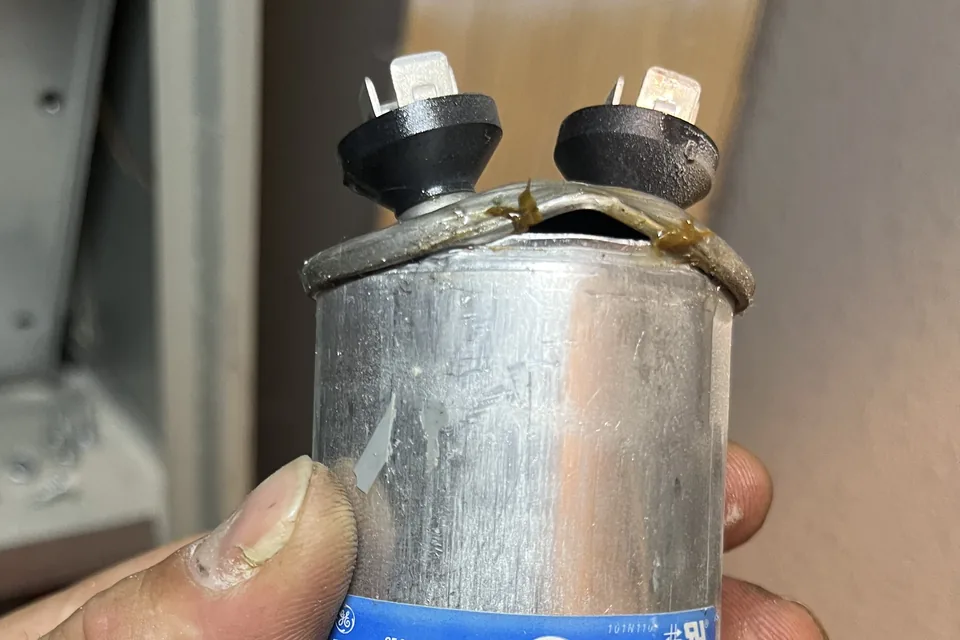
That one came out of a local system on an Alpha Mechanical service call. The bulged, split top is the giveaway, but plenty of capacitors fail with no visible damage at all, which is why the real test is a meter rather than a look. Capacitors degrade with heat and age, so they tend to give out during the first long stretch of triple-digit days rather than in mild weather. The part stores a charge even with power off, so testing and replacement belong to a technician. Our post on how a bad capacitor affects the whole HVAC system covers the symptoms in depth.
No call reaching the unit
The thermostat signals the condenser through a low-voltage control circuit: contactor, control board, float switch, and the thermostat wire itself. A tripped condensate float switch, a chewed or corroded wire, or a failed contactor all produce the same symptom, which is a healthy-looking condenser that never gets told to run. A technician traces this with a meter in minutes; it is not a guess-and-swap job.
Safety note: everything past the breaker and disconnect involves opening panels on live equipment. Shut off power at the disconnect and the breaker before touching anything, and leave capacitor and contactor work to a licensed technician.
If the outdoor unit is running but the air isn't cold
Frozen evaporator coil
Weak airflow at the vents plus ice on the refrigerant line is a frozen coil until proven otherwise. Turn cooling off, switch the fan to ON to speed the thaw, and address the cause before restarting; the frozen coil guide walks the full procedure.
Low refrigerant
Refrigerant is the working fluid that moves heat from inside to outside. When the system is undercharged, usually because of a leak, the coil can't absorb enough heat and the supply air drifts from cold to cool to warm as the charge falls. Hissing or bubbling near the lines and ice on the smaller copper line are the classic accompanying signs; the full symptom picture is in our signs of low AC refrigerant guide, and what causes an AC to leak covers where leaks actually start.
Two things matter before anyone quotes you a recharge. First, refrigerant does not get used up: if the charge is low, it leaked, and a recharge without a leak repair buys you one season at best. Second, refrigerant handling is federally restricted; under EPA Section 608, anyone servicing the refrigerant circuit must be a certified technician. The refrigerant itself is also changing: the EPA's HFC phasedown rules set a January 1, 2025 compliance date for lower-GWP refrigerants in new residential air conditioning and heat pump systems, and R-454B is one of the EPA-listed substitutes that new equipment carries, while most older systems run R-410A or R-22. Which refrigerant your system uses changes the repair math on an older unit, which is part of what a repair cost estimate should spell out.
Dirty condenser coil
The outdoor coil's job is to dump the heat collected from your house into the outdoor air. When its fins are packed with dust, cottonwood fluff, or lawn clippings, the unit runs but can't reject heat, and capacity falls exactly when you need it most: the hotter the day, the harder a dirty coil struggles. With power off at the disconnect, you can gently rinse the fins from outside with a garden hose (no pressure washer, it flattens the fins). Keep the surroundings clear, too: Trane advises keeping plants at least 2 to 3 feet from the unit on all sides, and trimming anything overhead to leave about 5 feet of clearance. Deep cleaning that requires opening the cabinet belongs in a professional tune-up.
Compressor problems
If the charge is correct and airflow is healthy but the system still can't make cold air, the compressor itself, its internal valves, or its windings may be failing. This is meter-and-gauges diagnosis, and on an older unit it is the point where a repair-or-replace conversation is honest, not upsell. Our buying guide for replacing an HVAC system covers how to think about that decision.
Leaky attic ducts: the Sacramento-specific warm-air cause
If your ducts run through an unconditioned attic, as they do in many homes here, this one is worth checking. ENERGY STAR estimates that in a typical house about 20 to 30 percent of the air moving through the duct system is lost to leaks, holes, and poorly connected ducts. In a Sacramento attic in July, a leak works in both directions: cooled air escapes into the attic, and attic air gets pulled into the return side and mixed with your supply air. The result is vents that blow mild air even though the equipment itself is healthy, often worst in the rooms farthest from the air handler.
Telltales: supply air noticeably warmer in some rooms than others, a system that runs constantly on hot afternoons, and dusty rooms despite a fresh filter. Duct repair and sealing is contractor work; our leaky ducts guide covers how leaks are found and fixed, and our ductwork services page covers what we repair and replace. (Owners of manufactured homes have a different duct and equipment layout entirely; see the mobile home HVAC guide.)
When it's capacity, not a fault
On a 105°F+ afternoon, a correctly sized, healthy system may hold the house comfortably yet never hit an aggressive setpoint, because residential equipment is sized for typical peak conditions rather than record heat. If the supply air is genuinely cold and the system simply runs long hours during a heat wave, that is capacity, not failure. If that describes your situation on ordinary hot days too, work through why the AC runs all day but the house won't cool down, which is the full diagnostic for runtime and capacity problems.
How to reset an air conditioner, and when a reset actually helps
A reset clears a control lockout or a scrambled board after a power event. It is the right move after a power outage or brownout, after you've fixed an underlying cause like a clogged filter, or when a heat wave tripped the system into a protective lockout. It is the wrong move on repeat: a system that needs resetting weekly has a real fault, and each reset just restarts the failure.
Level 1, thermostat reset: switch the thermostat to OFF, wait five minutes, then back to COOL with the setpoint below room temperature. Many lockouts clear here.
Level 2, power-cycle reset: turn the thermostat OFF, flip the AC breaker off, and pull or switch off the outdoor disconnect. Wait five minutes; this lets refrigerant pressures equalize so the compressor doesn't try to start against a pressure head. Restore power in reverse order: disconnect, breaker, then thermostat back to COOL. Don't be alarmed if the compressor doesn't start right away. Anti-short-cycle delays are built into modern controls on purpose, and a pause of several minutes is the system protecting itself, not failing.
Level 3, the reset button, if your unit has one: some condensers carry a small red high-pressure lockout reset button, usually near the refrigerant line connections behind the service panel. Press and hold it briefly with the system powered. Plenty of units don't have one at all; on those, the power-cycle above is the reset. If the button pops repeatedly, the high-pressure switch is doing its job and protecting the compressor from a real problem, most often a dirty condenser coil or a failed condenser fan. Stop resetting and get it diagnosed.
Get help from an AC expert in Sacramento
If you've worked the triage above and the vents are still warm, the remaining causes are electrical, refrigerant, or compressor faults that need a meter and gauges. Alpha Mechanical diagnoses and repairs all of them across the Sacramento region: start with AC repair in Sacramento, or catch problems before peak season with an inspection built on our AC tune-up checklist. And if the unit is past ENERGY STAR's consider-replacement age of 10 years and failing in expensive ways, we'll give you a straight answer on AC installation in Sacramento rather than another season of patches.
Frequently Asked Questions
Why does my AC blow hot air?
The most common causes, in the order worth checking: the thermostat set to HEAT or the fan set to ON instead of AUTO, a clogged air filter that froze the evaporator coil, a dead outdoor unit (tripped breaker, pulled disconnect, or failed capacitor) while the indoor blower keeps running, low refrigerant from a leak, or leaky attic ducts mixing hot attic air into the supply.
How do I fix my AC blowing hot air?
Set the thermostat to COOL and the fan to AUTO, replace a dirty filter, check the AC breaker and outdoor disconnect, and make sure the outdoor unit is running and its coil is clear of debris. If the outdoor unit hums without starting, or the air stays warm after these checks, the likely faults are the capacitor, refrigerant, or compressor, and those need a licensed technician.
Where is the reset button on an air conditioner?
If your unit has one, it's a small red button near the refrigerant line connections, often behind the service panel on the outdoor unit; press and hold it briefly. Many air conditioners have no reset button at all. On those, the reset is a power cycle: thermostat off, breaker off, outdoor disconnect off, wait five minutes, then restore power in reverse order.
Why is my AC running but not blowing cold air?
When the outdoor unit runs but the air isn't cold, the usual causes are a clogged filter that froze the evaporator coil, low refrigerant from a leak, or a dirty condenser coil that can't reject heat. Check the filter first and look for ice on the copper lines. If the air is cool but the house just won't reach setpoint, that's a capacity problem rather than a warm-air fault.
Can a dirty filter make my AC blow warm air?
Yes. A clogged filter starves the system of airflow, which lets the evaporator coil freeze over and leaves the vents blowing weak, barely cool air. ENERGY STAR recommends inspecting the filter monthly during heavy use. Replace the filter, let any ice on the coil and lines thaw completely, then restart the system.
Why is my AC blowing cold air outside but warm air inside?
It usually isn't a separate fault. The outdoor unit rejects heat, so the air around it can feel cool while a problem indoors (low refrigerant, a frozen coil, or duct leaks) keeps the house warm. See our guide on the AC unit blowing cold air outside for the full explanation.