
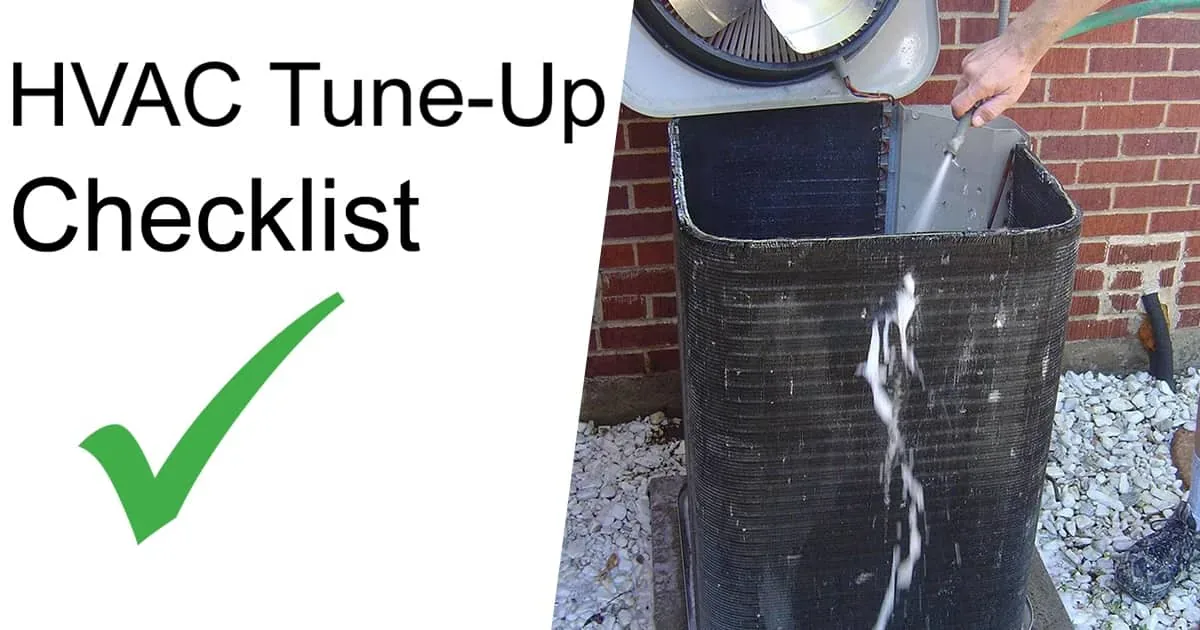
An HVAC tune-up is a pre-season visit where a technician inspects, cleans, tests, and measures your heating and cooling equipment, then records the readings. A real one covers four groups of tasks: core checks on every visit, AC-specific checks, furnace-specific checks, and heat-pump-specific checks. This is the full checklist, so you know what your technician should be doing and what should be on the report when they leave.
Key Takeaways
- The industry standard for tune-up tasks is ANSI/ACCA 4 QM, Maintenance of Residential HVAC Systems, which sets "the minimum tasks that should be performed for HVAC equipment maintenance inspections." ENERGY STAR publishes a shorter homeowner version.
- A tune-up measures things. Voltage and amperage on motors, refrigerant charge, the temperature split, gas pressure, flame-sensor signal. If nothing was measured and recorded, you got a look-around.
- Sacramento timing per ENERGY STAR: cooling system in spring, heating system in fall. Once a year per system, so a home with a furnace and an AC gets two visits.
- The "furnace checklist" in the earlier version of this page was really a heat pump list. Gas furnaces and heat pumps get different checks. Both are below.
What does an HVAC tune-up include?
Two published lists define it. ENERGY STAR's maintenance checklist says a typical check-up should include checking thermostat settings, tightening electrical connections and measuring voltage and current on motors, lubricating moving parts, checking the condensate drain, checking the controls, and checking the starting cycle. Cooling adds cleaning both coils, checking refrigerant charge, and cleaning and adjusting the blower. Heating adds checking gas connections, gas pressure, burner combustion, and the heat exchanger.
The contractor-side document is ANSI/ACCA 4 QM, the Air Conditioning Contractors of America standard for maintenance of residential HVAC systems. ACCA describes it as "a nationally recognized, manufacturer-endorsed set of inspection tasks," and ANSI reaffirmed the 2019 edition in September 2024. It runs to separate checklists for the air distribution system, controls and safeties, gas furnaces, evaporator coils, condensing units, and heat pumps, and the pattern in every one is the same: inspect, test or measure, record, compare to the manufacturer's specification, then recommend a correction if it is out of range.
That last step is what separates a tune-up from an inspection. An inspection tells you the condition of the system. A tune-up adjusts, cleans, and tightens what can be corrected on the spot, and gives you numbers for what cannot. Our own visits follow this structure: the AC tune-up is a 16-point list grouped into eight areas, and the heating tune-up is an eight-item list that starts with a carbon monoxide test. Prices for both, and how a maintenance plan compares, are on the AC tune-up cost guide for Sacramento; this page is about the work, not the bill.
The printable HVAC tune-up checklist
Print this table or keep it on your phone. The last column is what should appear on the paperwork.
| Task | AC visit | Heating visit | What the report should show |
|---|---|---|---|
| Thermostat tested and calibrated | Yes | Yes | Setpoint vs. measured room temperature |
| Electrical connections tightened, line voltage measured | Yes | Yes | Volts at the disconnect or contactor |
| Motor amperage measured against the nameplate | Yes | Yes | Amps per motor, nameplate rating beside it |
| Capacitors tested, contactors inspected | Yes | Blower capacitor | Microfarads vs. rating; contact condition |
| Air filter inspected or replaced | Yes | Yes | Filter size and condition |
| Condensate drain checked and cleared | Yes | Furnace and heat pump drains | Drain flows, pan dry |
| Controls and safety devices tested | Yes | Yes | Each safety cycled and passed |
| Start-up, run, and shut-down cycle observed | Yes | Yes | Sequence normal or fault noted |
| Evaporator and condenser coils cleaned | Yes | Heat pump only | Before and after condition |
| Refrigerant charge checked | Yes | Heat pump only | Pressures plus superheat or subcooling |
| Supply and return temperature split | Yes | Yes | Degrees, with the outdoor temperature |
| Fan blades and blower wheel inspected | Yes | Yes | Damage, balance, clearance |
| Carbon monoxide test | No | Gas furnace | CO reading in ppm |
| Heat exchanger inspection | No | Gas furnace | Corrosion, cracks, flame behavior |
| Flame sensor cleaned, ignition tested | No | Gas furnace | Flame signal in microamps |
| Gas pressure measured | No | Gas furnace | Inlet and manifold pressure |
| Burners, inducer, and venting inspected | No | Gas furnace | Blockage, corrosion, draft |
| Reversing valve, defrost control, auxiliary heat tested | No | Heat pump | Each cycled and passed |
Core checks on every tune-up
These happen whether the visit is for cooling or heating, because they are about the parts both seasons share: the thermostat, the wiring, the motors, the drain, and the safeties.
- Thermostat. Tested in every mode, calibrated, leveled, and, on battery models, batteries replaced. ENERGY STAR puts this first on its list: the settings decide whether the system keeps you comfortable at home and saves energy while you are away.
- Electrical connections and line voltage. Loose connections heat up. ACCA 4 QM has the technician tighten loose connections, replace heat-discolored ones, and measure and record line voltage against the nameplate. Our technicians read voltage at the contactor terminals on the outdoor unit and at the furnace.
- Motor amperage. Every motor draw is measured and written next to the nameplate rating. A motor pulling well over its rating is a motor that is about to fail, and the number is the evidence.
- Moving parts lubricated. Older blower and condenser fan motors have oil ports. Many newer ones are sealed. The technician should know which one you have.
- Condensate drain. Cleared and flow-tested. ENERGY STAR's note is blunt: a plugged drain can cause water damage in the house. If you have had this problem, the clogged AC drain line guide shows where the water goes.
- Controls and safeties. Every safety switch is tested by making it trip: the limit, the drain pan float switch, the pressure switch on a furnace. A safety that has never been tested is a safety you are hoping works.
- Start-up cycle. The system is run through a full call for cooling or heat and watched from the thermostat click to shut-down.
- Filter. Replaced with the filter you supply, or inspected and its condition recorded. ENERGY STAR recommends you inspect, clean, or change it monthly yourself between visits.
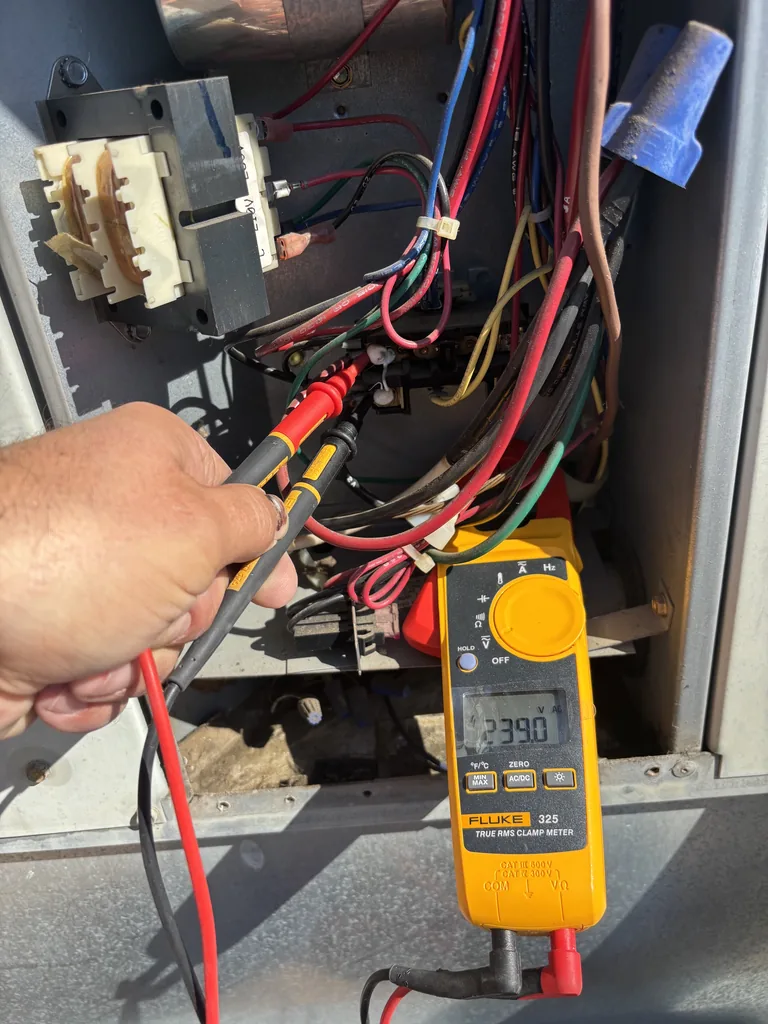
Supply voltage checked at the contactor on an Alpha Mechanical service call. The reading goes on the report next to the nameplate rating.
AC tune-up checklist
Cooling adds the refrigerant circuit and the outdoor unit. Our AC tune-up in Sacramento is built as 16 points in eight groups, and the groups map directly onto the ACCA condensing unit and evaporator coil checklists.
- Air filter and coils. Filter replaced, evaporator coil inspected and cleaned, condenser coil washed, debris cleared from the outdoor unit. ENERGY STAR's reason: dirty coils make the system run longer, and airflow problems alone can cut efficiency by up to 15 percent.
- Bearings and blower motor. Bearings checked for wear and lubricated where the motor allows it; blower amperage and voltage measured.
- Capacitors and contactors. Capacitors tested for microfarads against their rating; ACCA calls for replacing any that are bulged, split, or incorrectly sized. Contactors inspected for burned or pitted contacts. Both parts show their failure early to a meter. Our bad capacitor guide covers what a weak one does to the rest of the system.
- Compressor and electrical. Compressor amperage and voltage recorded against the nameplate, disconnect box and exposed wiring inspected.
- Refrigerant pressures. Suction and liquid pressures read on a manifold and service valves inspected. ACCA 4 QM notes that good field practice is to measure superheat or subcooling to confirm the charge, rather than judging by pressure alone. Ask for those two numbers. If refrigerant needs to be added, that is a repair with a separate quote, and the low refrigerant guide explains why a system that needs it has a leak somewhere.
- Temperature and thermostat. Supply and return temperatures measured and the split recorded with the outdoor temperature, then the thermostat tested.
- Safety devices. Each safety control confirmed working before the technician leaves.
- Fan blades. Inspected for damage, balance, and clearance.
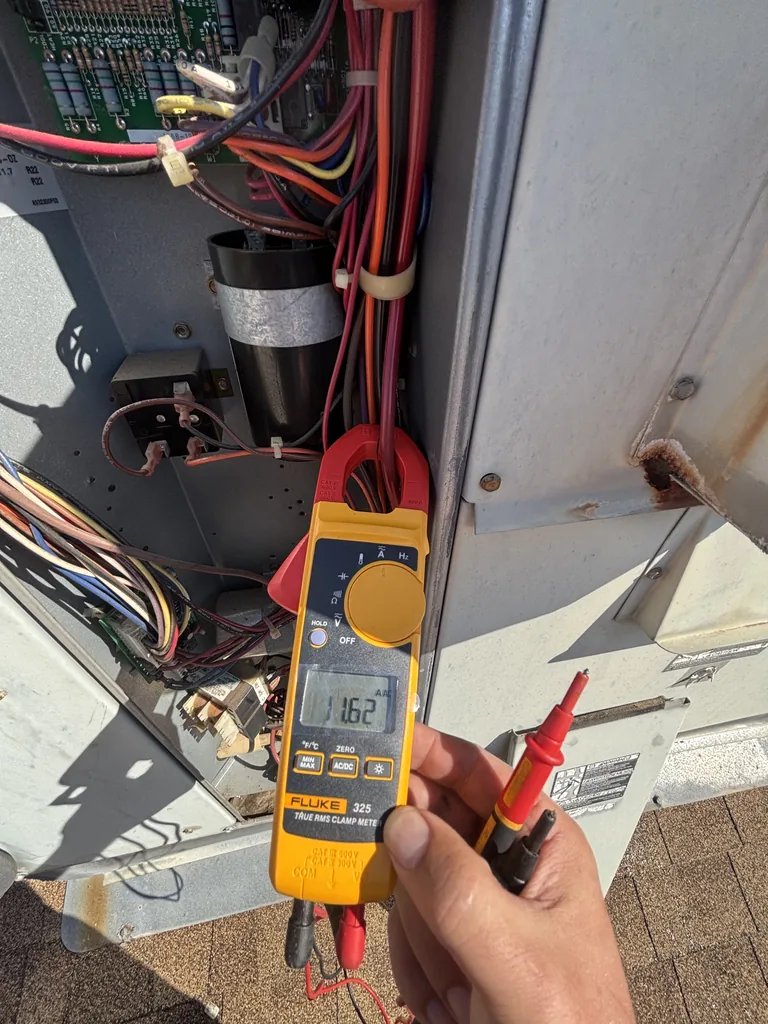
Compressor amp draw measured on a packaged rooftop unit. The number is compared with the nameplate rating, which is why the nameplate has to be legible.
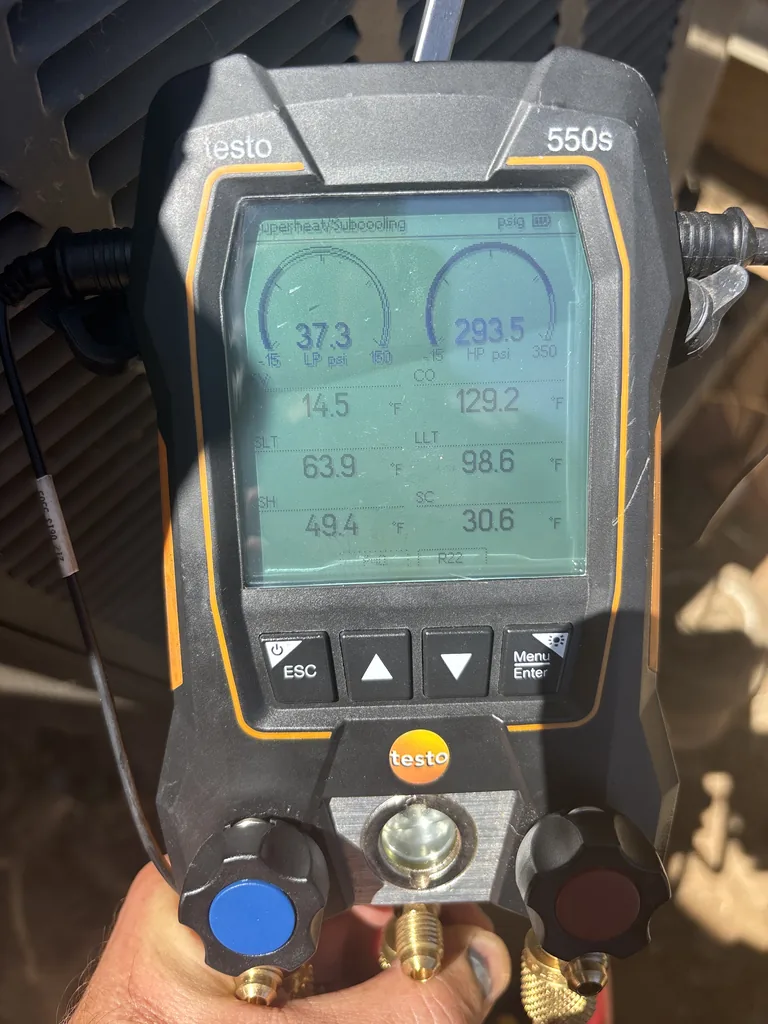
A digital manifold on a running system. Pressures alone do not confirm the charge; the superheat and subcooling figures on the lower half of the screen do. This photo is from a diagnostic call, where the readings pointed to a fault, not from a routine tune-up.
Furnace tune-up checklist
A gas furnace tune-up is a combustion safety check first and a performance check second. Our heating tune-up runs eight items, and the order matters.
- Carbon monoxide test. Every visit, every furnace. The reading is taken at the equipment and written down in parts per million. The test checks the furnace; it does not replace alarms. The CPSC says to install CO alarms on every level of the home and outside sleeping areas.
- Thermostat. Tested, calibrated, and leveled.
- Ignition and flame sensor. Ignition tested for safe operation, and the flame sensor cleaned. ACCA 4 QM has the technician record the flame signal in microamps and compare it to the manufacturer's range. A dirty sensor is the usual reason a furnace lights and then shuts off within seconds; the furnace blowing cold air guide walks through that symptom.
- Exhaust and combustion vents. Exhaust tested for proper draft, combustion vents cleaned and inspected. ACCA's venting task looks for condensation, corrosion, cracks, and blockages in the flue and vent pipes.
- Heat exchanger. Inspected for corrosion, fouling, cracks, and flame movement when the blower starts. This is the item that turns a tune-up into a safety inspection, and the reason it cannot be skipped on an older furnace; our cracked heat exchanger symptoms guide explains what the technician is looking for.
- Gas pressure. Inlet and manifold pressure measured and adjusted at the gas valve, and every connection checked for leaks.
- Electrical and blower. Connections inspected and tightened, blower motor amperage and voltage measured.
- Filter and ductwork. Customer-supplied filter installed, accessible ductwork inspected for visible damage.
ACCA's gas furnace checklist also has the technician test the burners, the inducer motor, and the safety timing of the burner control, and perform a combustion analysis. If your furnace is the kind that trips on the pressure switch, the pressure switch troubleshooting guide shows what that safety is protecting.
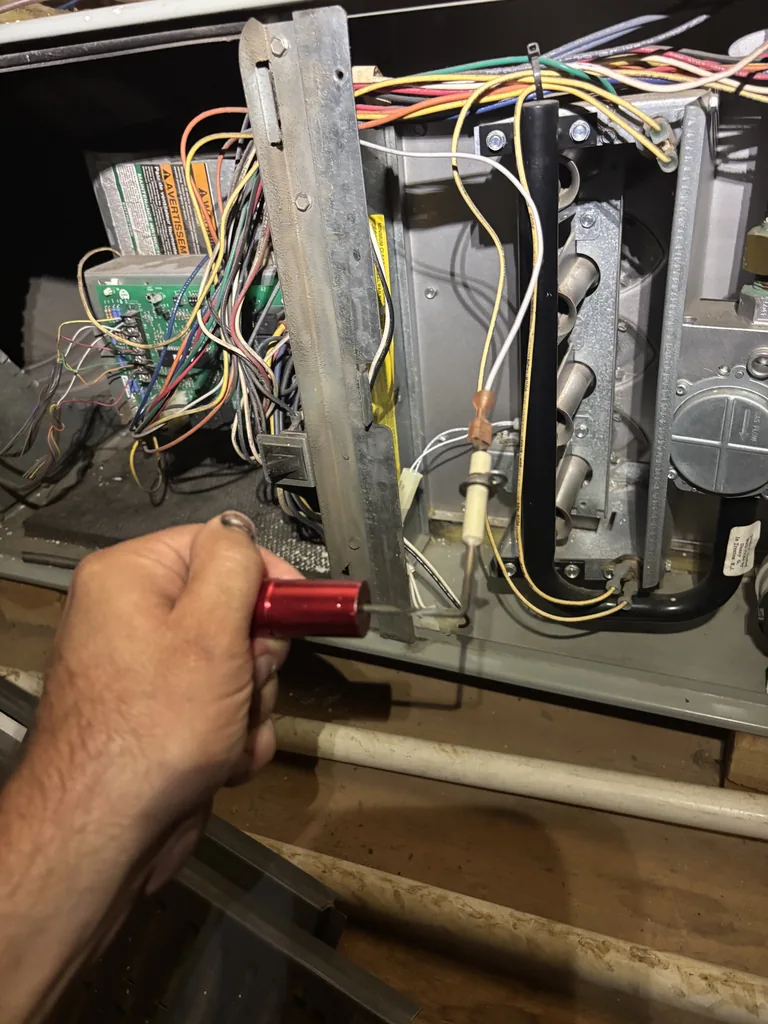
Cleaning the flame sensor on an Alpha Mechanical service call, the same task a heating tune-up includes. The rod sits beside the igniter on its ceramic base; carbon on its surface is what makes a furnace light and then drop out.
Heat pump tune-up checklist
A heat pump is an air conditioner that can run in reverse, so its checklist is the AC list plus the parts that make heating possible. The earlier version of this page filed these items under a furnace heading; they belong here. Our heating-season tune-up covers heat pumps as well as gas furnaces.
- Everything on the AC list. Coils, capacitors, contactors, motor draws, refrigerant charge, temperature split, fan blades.
- Reversing valve. Tested by switching between heating and cooling and confirming the change. ACCA 4 QM lists this first among the additional heat pump tasks.
- Defrost control. The defrost cycle is initiated and watched. A heat pump that cannot defrost ices over on a cold, damp winter morning and stops moving heat.
- Auxiliary electric heat. The heat strips are tested for capacity and sequence of operation. If yours runs on auxiliary or emergency heat more than it should, the emergency heat vs. aux heat guide explains the difference and what it does to the bill.
- Outdoor condensate drain ports. Checked open, because in heating mode the outdoor coil is the one that sweats and defrosts.
- Refrigerant charge in heating mode. Checked by the manufacturer's method, since the target superheat and subcooling figures differ between modes.
What a tune-up does not include
Three things sit outside the visit, and it helps to know them before the technician arrives.
- Repairs. A failing capacitor, a pitted contactor, a leaking coil, or a cracked heat exchanger found during the tune-up is quoted separately before any work is done. The tune-up finds it and documents it; you decide.
- Refrigerant. Checking the charge is part of the visit. Adding refrigerant is a repair, and a system that needs it has a leak that should be found first.
- A guarantee against every breakdown. The visit catches what is measurable that day. ACCA's own language is that a maintenance inspection identifies deficiencies so that corrections can be recommended; it is a snapshot, not insurance.
When to schedule a tune-up in Sacramento
ENERGY STAR recommends annual pre-season check-ups, cooling in spring and heating in fall, because contractors fill up once summer and winter arrive. In Sacramento that means an AC visit before the first heat wave and a heating visit before the first cold nights. Once a year per system is the rule; a home with a gas furnace and a central AC gets two seasonal visits, one for each, and a heat pump gets its heating checks at the fall visit.
Most tune-ups finish in 30 to 60 minutes. Longer usually means the technician found something, which is the point. If your system is already showing a symptom, an AC blowing warm air or a burning or musty smell from the vents, book a diagnostic instead; a tune-up is preventive, and a diagnostic is aimed at the fault.
ACCA 4 QM also notes that regularly scheduled inspections and maintenance are often required to maintain the manufacturer's warranty. Check the warranty terms on your equipment; many ask for a documented annual visit, which is another reason the readings need to be on paper.
How to read the report your technician leaves
A tune-up worth paying for leaves a record you can compare to next year's. Look for these on the invoice or the checklist sheet:
- Numbers, not checkmarks. Amps beside the nameplate rating, capacitor microfarads beside the rating, supply and return temperatures with the outdoor temperature, superheat and subcooling, gas inlet and manifold pressure, flame signal, and a CO reading.
- What was corrected on the spot. Tightened connections, cleaned coils, a cleared drain, a calibrated thermostat.
- What was recommended and why. ACCA's format is a finding, the measurement that supports it, and a recommended corrective action. A recommendation with no measurement behind it deserves a question.
If you got a page of checkmarks and no numbers, you got an inspection. The AC tune-up cost guide linked above covers what the cheapest tune-up specials tend to leave out, and why regular furnace maintenance matters makes the case for doing it at all. This page is only about what a real one contains.
Ready to book? The AC and heating tune-up pages linked in their sections above take you to scheduling, and the Club Membership page shows what the plan bundles. Service area details are on the Sacramento HVAC service page.
Frequently Asked Questions
What does a furnace tune-up include?
A carbon monoxide test, a heat exchanger inspection, flame sensor cleaning with the flame signal measured, an ignition test, inlet and manifold gas pressure measured and adjusted, burner and venting inspection, blower amperage and voltage, thermostat calibration, and a filter change. Those are the items on our heating tune-up page and they match the gas furnace checklist in ANSI/ACCA 4 QM.
How long does an HVAC tune-up take?
Most finish in 30 to 60 minutes per system. Access, how dirty the coils are, and whether the technician finds something that needs a quote can push it longer.
How often does an HVAC system need a tune-up?
Once a year per system: the AC in spring before cooling season and the furnace or heat pump in fall before the first cold nights. A home with a furnace and a central AC therefore gets two seasonal visits a year, which is what a maintenance plan is built around.
Is an HVAC tune-up the same as an inspection?
No. An inspection reports the condition of the system. A tune-up also cleans, adjusts, tightens, and calibrates what can be corrected during the visit, and records measurements such as amperage, refrigerant charge, temperature split, gas pressure, and CO so that anything out of range can be quoted as a repair.