
Light commercial HVAC replacements that Alpha Mechanical completed in the Sacramento area invoiced between about $9,200 and $137,000, depending on how many units the building needed and what had to change around them. A single small package unit swap sits at the bottom of that range. A multi-unit building with new curbs, ductwork and controls sits at the top. Any number quoted without a site visit, including a cost per square foot, is a guess dressed as an estimate.
That is the honest answer, and the rest of this page shows the work behind it: what our own invoices looked like, what actually moves the number, what California code now requires on a Sacramento commercial replacement, and what SMUD's business incentives really are in 2026.
What Alpha's own Sacramento commercial replacements cost
Most commercial HVAC cost pages quote a national average. These are invoices from our own jobs for Sacramento-area businesses, rounded and stripped of anything that identifies a customer.
| Project | What it covered | Invoiced |
|---|---|---|
| Single package unit | One light commercial unit, existing curb and ductwork reused | about $9,200 |
| Small multi-unit building | Replacement across a small commercial building, south Sacramento | about $17,900 |
| Mid-size building | Full replacement, multiple units | about $52,900 |
| Large multi-unit project | Building-wide replacement plus a change order | about $137,200 |
Two things stand out. The spread is more than fourteen to one across four real projects in the same metro, which is why a single average is close to useless for budgeting. And the largest project carried a change order, because commercial replacements uncover conditions that were not visible from the roof on bid day.
The second row above is worth following further. That south Sacramento customer has spent about $209,500 with us across eight jobs since 2022, of which the $17,900 replacement is one line. The rest is repairs, a refrigerant circuit repair on a 7.5 ton split system, and change orders. That is what the cost of owning commercial equipment actually looks like over a few years, rather than on one invoice.
Why cost per square foot is the wrong tool
Every page that ranks for this question leads with a dollars per square foot figure. The honest ones qualify it heavily. National Facility Contractors puts basic office and retail installations at $15 to $30 per square foot, zoned or upgraded projects at $30 to $50, and complex facilities above $50 (January 2026). HomeGuide, a named estimate aggregator rather than a primary source, quotes $15 to $30 per square foot for office buildings (August 2025).
Run those numbers on a real building and the problem shows. A 5,000 square foot Sacramento office at $15 per square foot predicts $75,000. At $30 it predicts $150,000. The same building might actually need two 7.5 ton package units on existing curbs, which is nowhere near either figure.
Square footage tells you almost nothing about the two variables that set the price: how many tons of equipment the building actually needs, and how much work has to happen around the equipment. A warehouse and a medical suite of identical size are different projects.
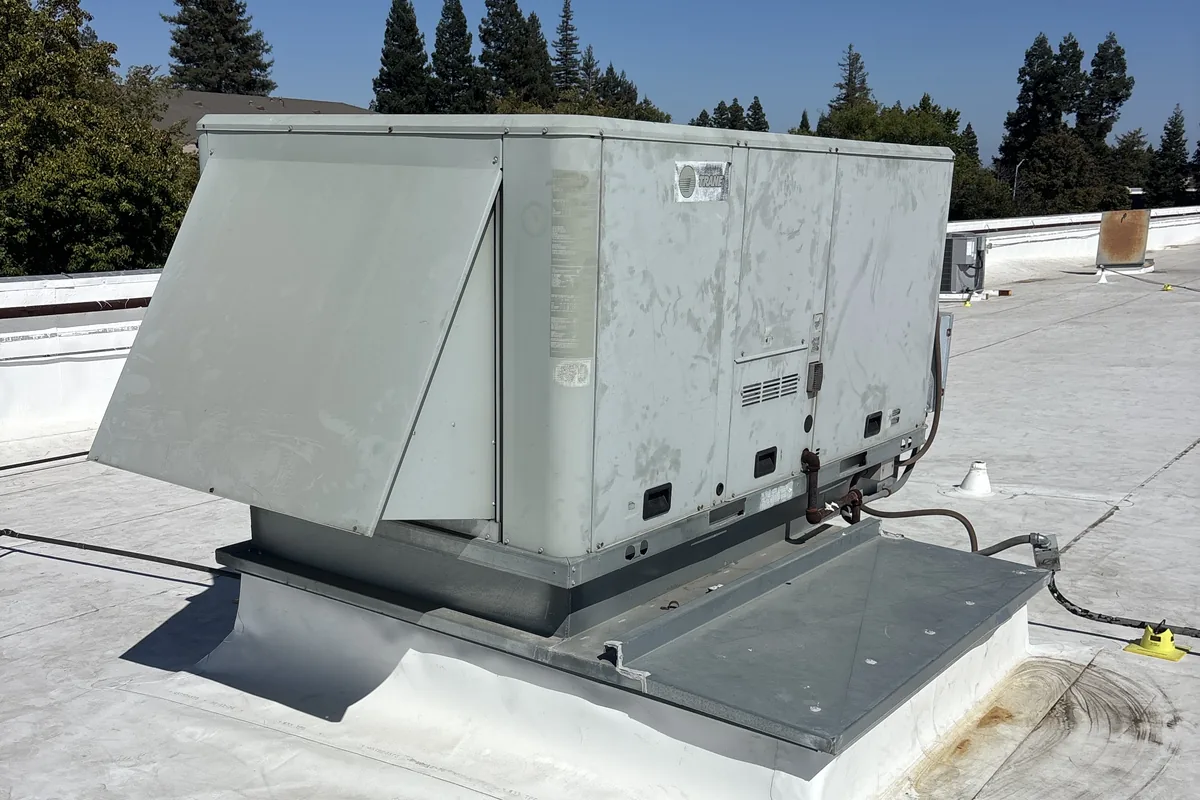 A light commercial package unit on its curb, with the service panel open. Alpha Mechanical job photo.
What actually drives a commercial HVAC replacement price
Tonnage and unit count. Light commercial equipment generally runs 3 to 25 tons. The number of units, not the floor area, is the first line of any real estimate.
Whether the existing curb and ductwork can be reused. Matching a new unit to an existing roof curb is the single biggest swing between a straightforward swap and a project. New curbs mean roofing work, and roofing work means a second trade.
Roof access. A crane pick for a rooftop unit is scheduled, permitted and paid for separately. A ground-mounted split system needs none of that. Our rooftop unit replacement guide walks through the crane, curb and permit steps in order. Our guide to HVAC systems for commercial buildings compares rooftop, split, ductless and VRF systems side by side.
Electrical. Converting gas-fired equipment to heat pumps often means new circuits, a panel evaluation, and sometimes a service upgrade. That work is frequently the surprise line on an electrification project, and it is the reason a commercial electrification quote can land well above a like for like replacement.
Controls and zoning. Every added zone costs equipment, wiring and commissioning time. Skipping zoning to save money usually shows up later as tenant complaints and higher bills. See our thermostats and zoning page for how the light commercial side of that works.
Code compliance and testing. Covered next, because in California it is no longer a footnote.
The Sacramento code reality in 2026
A commercial HVAC replacement in California is a permitted alteration, and permits applied for on or after January 1, 2026 fall under the 2025 Building Energy Efficiency Standards, the current version of Title 24, Part 6.
For nonresidential buildings, the state also runs the Acceptance Test Technician Certification Provider program, which exists to make sure mechanical and lighting control work in commercial buildings actually meets the Energy Code. Acceptance testing on a commercial system is performed and documented by a technician certified under that program, and it is a real line in the schedule and the budget, not paperwork you can skip.
Practical effect for a Sacramento business owner: a commercial bid that carries no permit line, no acceptance testing line and no commissioning line is not a complete bid. It is a lower number that will grow.
What SMUD business incentives actually are in 2026
SMUD publishes per-ton commercial amounts in 2026. Its February 2026 Go Electric business flyer lists $1,500 per ton for packaged and split-system heat pumps and $3,000 per ton for built-up or skid heat pumps, for gas-to-electric conversions only. Complete Energy Solutions shows the same $1,500 per ton. The money runs through three programs:
- Complete Energy Solutions, for small and mid-sized businesses, starting with a free energy assessment.
- Custom Retrofit, for larger or complex projects in existing non-residential buildings. Go Electric incentives there are capped at the lesser of the per-unit amount, 90% of eligible project cost or $250,000 (SMUD Custom Retrofit Procedures Manual, July 2026).
- Integrated Design Solutions, for ground-up commercial new construction.
A gas unit replaced with another gas unit earns no Go Electric money; Custom Retrofit's separate efficiency incentive is calculated from first-year kWh savings. Every program has to see the project before installation, so do not put an incentive figure in a budget until the program confirms it. Our guide to SMUD commercial and multifamily HVAC incentives has the full tables, the transformer and panel incentives, and the application steps. Our current specials page carries whatever is live on the residential side.
What a commercial system costs to run after the install
Replacement is the headline number. These are the recurring figures from our own commercial service book, which almost nobody publishes.
- Quarterly filter service on a rooftop unit, twelve 16x25x2 filters plus an inspection, has invoiced at about $260 per visit for one north Sacramento building over several years.
- A service agreement covering quarterly heating and cooling checks with filter changes has invoiced at about $340 per visit.
- A ceiling air handler fan motor replacement ran about $1,362 on one job and about $969 on another.
- A refrigerant circuit repair on a 7.5 ton Trane split system invoiced at about $1,220.
- Refrigerant top-offs are billed per pound beyond the first, which is why a system with a slow leak gets expensive quietly.
A building that skips filter service and lets a leak run pays for it in compressor life. That is the operating side of the same decision.
How much would a 1,500 square foot commercial space cost?
There is no honest single figure. A 1,500 square foot retail suite with one existing rooftop unit on a reusable curb is a fundamentally different job from a 1,500 square foot medical or food service space with ventilation and exhaust requirements. The square footage sets the load calculation starting point. The building use, the existing infrastructure and the code path set the price. Anyone who quotes that number over the phone has not seen the roof.
How much does a 20 ton commercial AC unit cost?
A 20 ton unit is at the top of the light commercial range and is usually a rooftop package unit. Equipment is only part of it: at that size expect a crane pick, a curb adapter or new curb, structural and roofing coordination, and acceptance testing. For a Sacramento building we would rather walk the roof and give you a number than publish a range that misses your project by tens of thousands of dollars.
How long does it take to replace a commercial HVAC system?
Plan in weeks, not days, and most of it is not installation. Equipment lead times, the permit, crane scheduling and acceptance testing drive the calendar. The physical changeout on a single package unit can be a day. A multi-unit building is staged so the business keeps operating, which lengthens the schedule on purpose.
How often should commercial HVAC units be replaced?
In our experience across Sacramento commercial buildings, rooftop and split equipment usually runs 15 years or more before replacement becomes the better economic call, and maintenance moves that number in both directions. Long cooling seasons and high summer load are hard on compressors. For the signs that a specific rooftop unit is finished, see when to replace a rooftop unit. The buildings on our books that get quarterly filter service and annual inspections run well past 15 years. The ones that run dirty do not.
Does the $5,000 rule apply to commercial equipment?
The $5,000 rule is a residential rule of thumb: multiply the age of the equipment by the repair cost, and if the result exceeds $5,000, replacement is usually the better call. It is a rough guide even for a house, and it does not transfer cleanly to commercial work, where downtime cost, tenant obligations, lease terms and the availability of parts for older equipment usually outweigh the arithmetic. For a commercial building the better question is what an unplanned failure in August costs the business.
Is commercial HVAC different from residential?
Yes, and not only in size. Commercial systems carry more zones, more outside air, more controls and stricter code and testing requirements, and they sit on roofs that need their own access plan. The parts are different, the permitting is different, and the acceptance testing has no residential equivalent. We do both, and we do not treat them the same. Our residential work is on the HVAC residential page.
Getting a real number for your building
We design, value engineer and install light commercial systems across the Sacramento area, and we bid the mechanical portion of commercial projects. If you want a figure you can put in a budget, the path is a site walk, a load calculation and a written scope, not a phone estimate.
See the commercial HVAC page for how we approach design build and plan and spec projects, or contact us to get on the schedule for a walkthrough.