

A rooftop unit (RTU) is a packaged heating and cooling unit that sits on a commercial roof and feeds the ductwork below. Replace one when repairs keep coming back on a unit near the end of its service life. Replace it, too, when a major component fails on old equipment, or when the unit can no longer hold the building through a Sacramento July. The harder part is timing. A rooftop unit replaced on a planned date gets a proper equipment match, a scheduled crane and a permit pulled in advance. One replaced after it dies in a heat wave gets whatever equipment is in stock.
This guide covers the signs that a rooftop unit is finished, how long these units last, the repair-or-replace call, and what happens on replacement day. It uses a rooftop unit Alpha Mechanical replaced on a Sacramento commercial building in July 2026. If you are weighing the budget side, our commercial HVAC replacement cost guide covers the invoices, and our commercial HVAC design-build and service page covers the work we do on light commercial buildings up to 25 tons. Still choosing a system type? Our guide to HVAC systems for commercial buildings compares rooftop units with split, ductless and VRF systems.
Key Takeaways
- ASHRAE lists a 15-year median service life for rooftop air conditioners. The figure comes from 1978 data that ASHRAE says "may be outdated," so treat age as one signal, not a deadline.
- Replace rather than repair when a major component fails on an older unit, when repairs are recurring, or when the unit cannot keep the space comfortable on peak days.
- When the new unit's footprint differs from the old one, a curb adapter lets it sit on the existing roof curb and avoids new roofing work. A crane pick, a permit and acceptance testing are part of a California commercial replacement.
- EPA's May 2026 rule change removed the installation deadline for R-410A equipment built before 2025, but new R-410A rooftop units are no longer being sold. The refrigerant is still available, so the R-410A unit already on your roof can still be repaired.
- Planning the replacement for spring or fall, before a failure, is the single biggest thing an owner controls.
When should a commercial rooftop unit be replaced?
A rooftop unit should be replaced when the cost and risk of keeping it running exceed what a new unit would cost to own. In practice that shows up as a handful of recognizable signs, and one of them on its own rarely settles it. Two or three together usually do.
| Sign | What it looks like on the roof | What it usually means |
|---|---|---|
| Age | The unit is at or past 15 years, the ASHRAE median for rooftop units | Remaining life is uncertain; budget for it now |
| Recurring repairs | Service calls every season, often the same fault | The unit is costing more each year it stays |
| Major component failure | A compressor, heat exchanger or coil failure on an older unit | The repair buys time on a unit already near the end |
| Comfort complaints | Tenants or staff too warm on peak afternoons | The unit is undersized for current use or losing capacity |
| Hard-to-source parts | Parts back-ordered or discontinued | Future repairs will take longer and cost more |
| Rising energy use | Utility bills climbing with no change in use | Worn components, a failed economizer, or both |
The heat exchanger line deserves its own warning. On a gas pack, a cracked heat exchanger is a safety problem, not a comfort one, because it can let combustion gases into the airstream. Our guide to cracked heat exchanger symptoms covers what that finding looks like. On an older unit that finding usually ends the repair conversation.
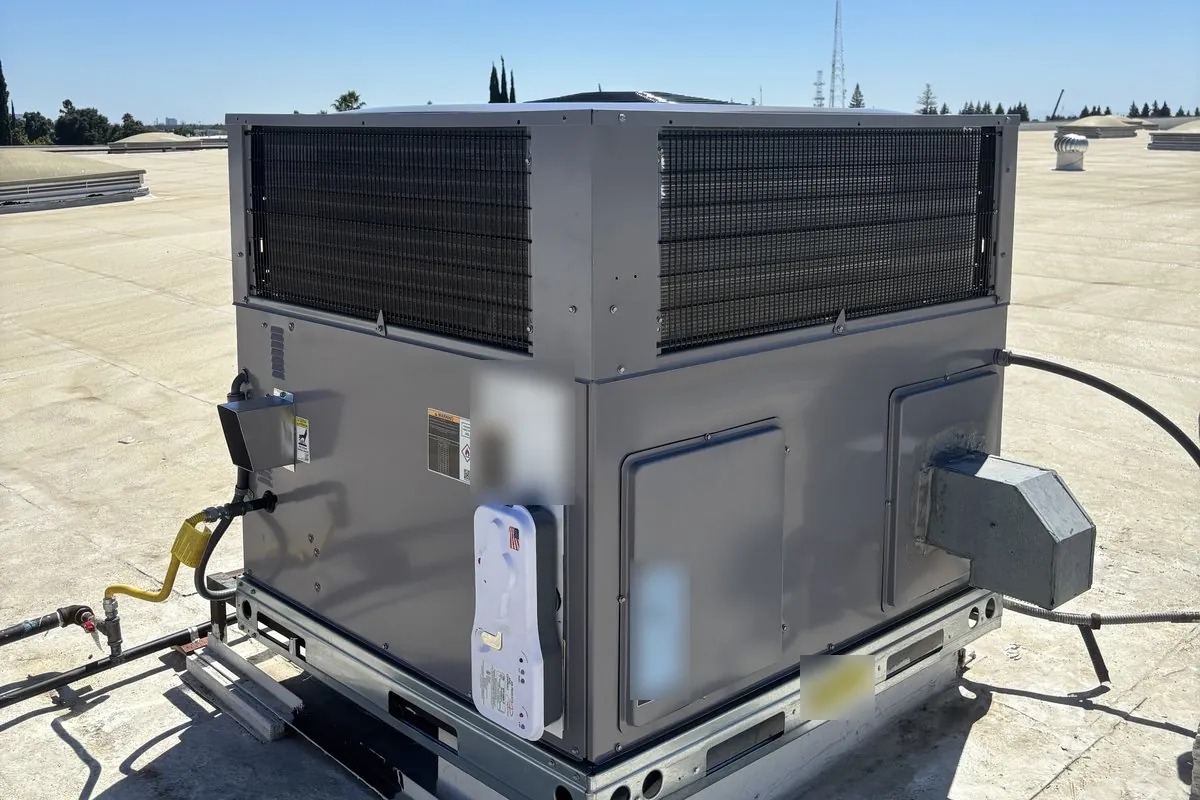 A rooftop package unit on the Sacramento replacement job. Alpha Mechanical job photo, July 2026; identifying labels blurred.
How long does a rooftop unit last?
The rooftop unit life expectancy most often quoted is 15 years. That number is real, but it needs context. ASHRAE's median service life table lists 15 years for both single-zone and multizone rooftop air conditioners. The same table carries a caution. Those categories come from Akalin (1978), and ASHRAE notes that the data "may be outdated and not statistically relevant" (ASHRAE, Principles of HVAC, 9th edition supplemental material). The newer ASHRAE sample in the same document reports a median service life of more than 24 years for "DX air distribution equipment" across 1,907 units. That is a broader category than rooftop units, and the gap shows how much maintenance and duty change the answer.
On the Sacramento roofs we service, a rooftop unit usually reaches replacement at 15 years or older, and how it was maintained decides how far past 15 it gets. A unit that gets its filters, coils and belts looked after on a schedule tends to reach the long end. A unit that is only visited when it stops cooling tends not to.
Sacramento duty matters here. A rooftop unit sits in full sun on a membrane roof through a long, hot cooling season, so its condenser and compressor work harder and longer than the same unit would in a mild coastal city. Age is best read alongside the repair history, not on its own.
Repair or replace a rooftop unit?
Repair when the unit is mid-life and the fault is a component, such as a capacitor, contactor, fan motor or a refrigerant leak that can be found and fixed. Replace when a major component fails on an older unit, when repairs are recurring, or when the repair would be spent on equipment that no longer fits the building. Our repair or replace guide walks through the arithmetic, including the $5,000 rule people search for. That rule of thumb transfers poorly to a commercial roof, where downtime, tenants and lease terms weigh more than the age-times-cost math; our commercial cost guide explains why.
Three commercial-specific factors change the call.
The refrigerant rule changed in 2026. The EPA's Technology Transitions rule sets a 700 GWP limit for light commercial air conditioning and heat pump systems, including unitary systems. Its installation compliance date is January 1, 2025. EPA's current table adds that there is "No installation compliance date for systems where all specified components were manufactured or imported prior to January 1, 2025" (EPA, Technology Transitions restrictions by sector, updated August 28, 2026). The May 2026 final rule removed the earlier January 1, 2026 installation deadline for that pre-2025 equipment (EPA fact sheet). Legal is not the same as available. In practice, new R-410A equipment is no longer being sold, so a replacement rooftop unit today runs a lower-GWP refrigerant. R-410A refrigerant itself is still available, which keeps repair on the table for an R-410A unit that is otherwise sound. Our refrigerant transition guide covers what the change means for the equipment itself.
The economizer may already be broken. An economizer is a set of outside-air dampers and controls that cools the building with outdoor air when it is cool enough outside, so the compressor can stay off. Many light commercial rooftop units carry one. Field studies found them failing often. A 2008 ACEEE paper on rooftop unit field testing cites "operational problems with 64% of outdoor-air economizers (Cowan 2004)." Of 223 economizer-equipped systems in a Puget Sound Energy rooftop program dataset the paper reviewed, "60% had at least one" of the problems it tracked (Robison et al., ACEEE Summer Study 2008). Those studies are older, but the point stands: an old unit's efficiency on paper may not be what it is delivering, and a replacement is the moment to get a working economizer.
The unit may no longer match the building. For example, a tenant change, a new server closet or a kitchen can leave a rooftop unit undersized for the space it serves. Replacement is the one time the tonnage and the zoning can be corrected without extra roof work. If the fight is over one thermostat, zoning may solve more than tonnage will.
What happens on rooftop unit replacement day?
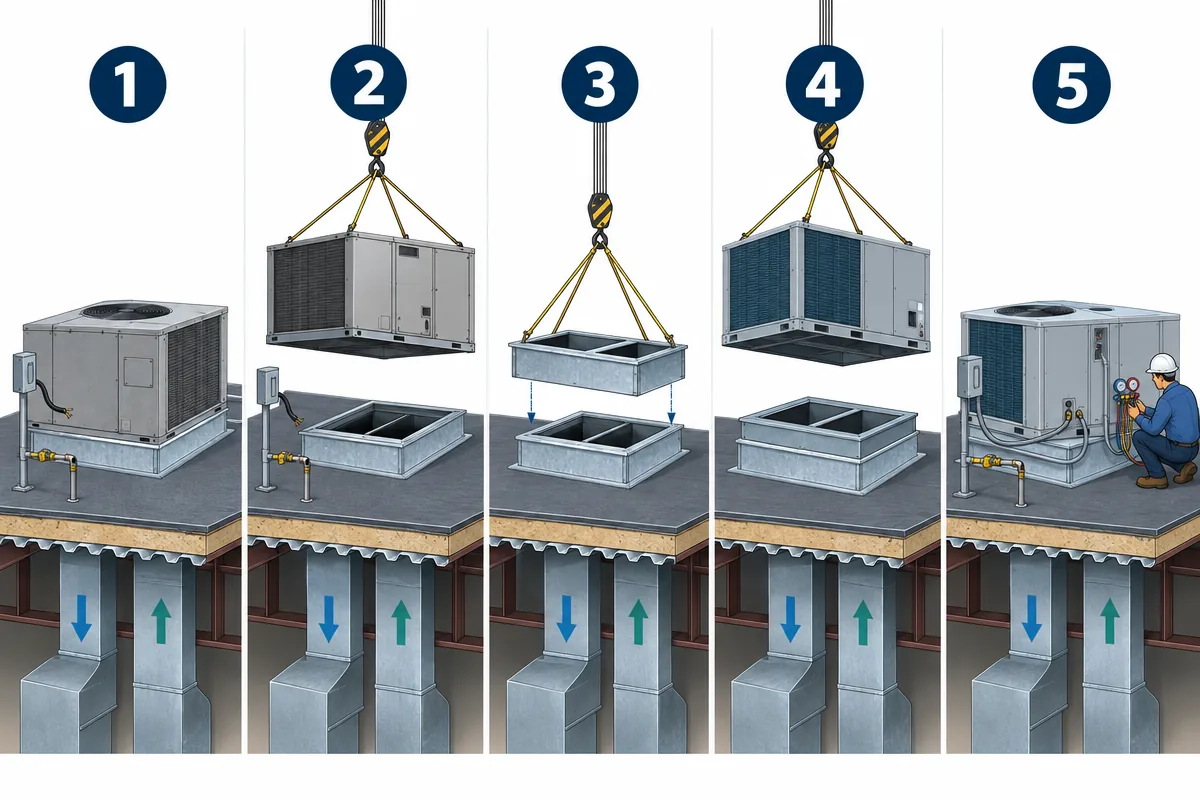 Illustration: the five on-roof stages of a typical rooftop unit swap on an existing curb, steps 3 to 6 below.
Every rooftop unit replacement runs through the same six stages, in this order. The first two happen weeks before anyone is on the roof.
- Survey and match. Before anything is ordered, the new unit is matched to the building: tonnage, gas or heat pump, electrical supply, and the footprint of the existing roof curb. The curb match decides how much roofing work the job needs.
- Permit and compliance documents. In California a rooftop unit replacement is a permitted alteration under the Title 24 energy code. A 2022-cycle BayREN permit guide for nonresidential HVAC notes that HVAC replacements need the mechanical compliance form NRCC-MCH-E under the prescriptive approach. It adds that "Acceptance testing or acceptance criteria verification is also required for HVAC equipment and ductwork" (BayREN 2022 Nonresidential HVAC Permit Guide). The commercial cost guide linked above covers which code cycle applies to a 2026 permit.
- Disconnect and recover. Power and gas are shut off and disconnected, and the refrigerant in the old unit is recovered, not vented.
- Crane pick. The old unit comes off the roof and the new one goes up in the same crane booking, which is booked separately from the HVAC work.
- Curb adapter or new curb. A curb adapter is a sheet-metal transition that lets a new unit sit on an old curb when the footprints differ. A curb manufacturer describes the part as creating "a seamless connection between your new rooftop HVAC unit (RTU) and the existing rooftop curb," which lets the unit change "without reworking the roof" (Curbco, curb adapters). A new curb means roofing work, which is why the curb match matters so much.
- Set, reconnect and start up. The new unit is set, the gas, power, condensate and duct connections are made, and the unit is started, charged and tested, including the acceptance tests the permit calls for.
| Stage | What decides it | Who is involved |
|---|---|---|
| Survey and match | Tonnage, fuel, electrical, curb footprint | HVAC contractor |
| Permit | Title 24 alteration rules, local building department | Contractor and building department |
| Crane pick | Roof access, unit weight, street access | Crane company, contractor |
| Curb | Adapter versus new curb | Contractor, roofer if a new curb |
| Start-up | Commissioning and acceptance tests | Contractor |
A Sacramento rooftop unit replacement, July 2026
In July 2026 Alpha Mechanical replaced a rooftop unit on a commercial building in Sacramento. The job record for that visit reads, in full: "Replace rooftop unit and add one large grille in the supply plenum." The unit it replaced was more than 15 years old, in line with what we see across Sacramento. A grille cut into the supply plenum gives the space nearest the unit an outlet straight off the plenum, in addition to the air that travels out through the ductwork.
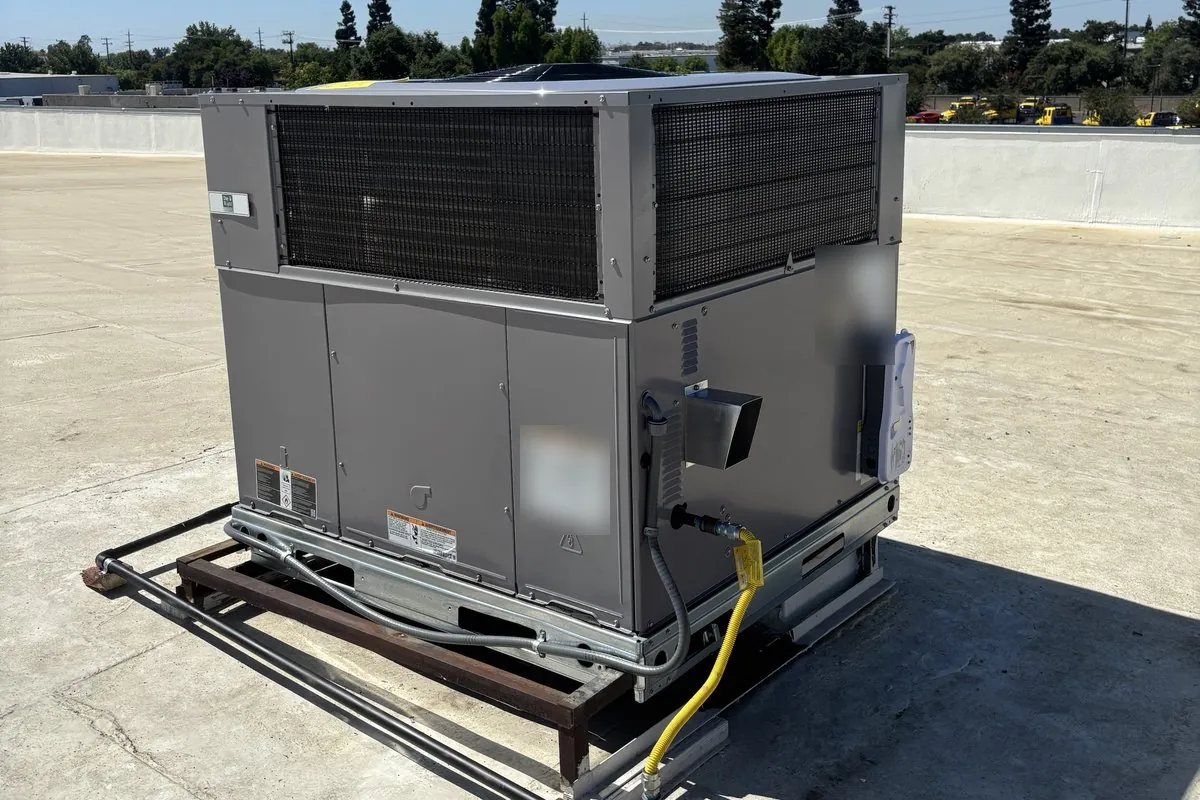 The Sacramento building's roof after the July 2026 replacement. Alpha Mechanical job photo; identifying labels blurred.
The part of that job worth copying is not the swap itself. It is that the replacement was used to change how the space is served: the added plenum grille. Changes like that, an extra supply outlet, a resized unit or a new thermostat location, are cheap while the unit is off and the crew is on the roof. As a separate project later, they are expensive. Before a replacement is ordered, it is worth asking the people who work under the unit what does not work today.
What this post does not do is quote that job's price. Commercial replacement prices depend on the unit count, the curb and the crane, so our commercial HVAC replacement cost guide shows real Sacramento invoices instead of a single number.
How to plan a rooftop unit replacement before it fails
The best time to replace a rooftop unit is before it fails, in spring or fall, when cooling demand is low and a building can run a day with the unit off. An emergency replacement in a Sacramento heat wave compresses the equipment choice, the crane booking and the permit into days.
- Ask for the unit's age and repair history. Two or three of the signs in the table above on the same unit is a reason to budget now.
- Check the curb before you shop. Knowing whether an adapter fits the existing curb changes both the price and the roof work.
- Look at heat pump rooftop units. SMUD's Complete Energy Solutions program lists incentives of "$1,500/ton" for "replacing gas equipment with heat pumps." It also notes that "Incentive funds are finite and are on a first-come, first-served basis" (SMUD Complete Energy Solutions). Check eligibility before the equipment is ordered, not after. Our guide to SMUD commercial HVAC incentives lists the per-ton amounts and the application steps.
- Put the remaining units on a maintenance schedule. A replacement is a good moment to set up planned maintenance on the other units on the roof, which is what stretches their life toward the long end. Much of that work is unglamorous: on one Sacramento building we serviced from 2021 to 2023, each rooftop visit meant twelve 16x25x2 filters changed on the roof plus an inspection of the unit. We cover what a visit includes in the repair and maintenance section of our commercial HVAC page.
- Think about the other equipment decisions at the same time. Our guide to factors when replacing an HVAC system covers efficiency, sizing and controls questions that apply on a roof as much as in a house.
Frequently Asked Questions
How long do commercial HVAC units last?
ASHRAE's median service life table lists 15 years for single-zone and multizone rooftop air conditioners, with a caution that the underlying 1978 data may be outdated. On the Sacramento roofs Alpha Mechanical services, a rooftop unit usually reaches replacement at 15 years or older, and regular maintenance pushes it further.
What are the HVAC units on commercial roofs called?
They are rooftop units, usually shortened to RTU. Most are packaged units, meaning the compressor, coils, fans and, on a gas pack, the furnace section share one cabinet. The cabinet sits on a roof curb and connects to the ductwork below.
How much does a new rooftop unit cost?
It depends on the unit count, the size, the curb and the crane, so a single figure misleads. Our commercial HVAC replacement cost guide shows what real Sacramento light commercial replacements invoiced.
Can a new rooftop unit go on the old curb?
Often, yes. When the new unit's footprint differs from the existing curb, a rooftop unit curb adapter connects the two so the unit can be replaced without reworking the roof. When no adapter fits, a new curb and roofing work are needed.
Do you need a permit to replace a rooftop unit in California?
Yes. A rooftop unit replacement is a permitted alteration under California's Title 24 energy code, with mechanical compliance documents and acceptance testing on the new equipment.
Can R-410A rooftop units still be installed?
Legally, yes, if the equipment was manufactured or imported before January 1, 2025: EPA's current rule sets no installation compliance date for it, after the May 2026 final rule removed the earlier January 1, 2026 deadline. In practice, new R-410A equipment is no longer being sold, so a replacement rooftop unit today runs a lower-GWP refrigerant. R-410A refrigerant itself is still available, so an existing R-410A unit can still be serviced and repaired.
Getting a rooftop unit replacement planned in Sacramento
If a rooftop unit on your building shows two or three of the signs above, the useful next step is a survey before anything fails. It covers the unit's age and repair history, the curb, the electrical and gas supply, and whether a heat pump unit fits. Alpha Mechanical designs, replaces and maintains light commercial HVAC up to 25 tons across the Sacramento region, with a licensed mechanical engineer on staff. You can read more about us and our commercial work on our commercial HVAC services page, or call 916-848-5980.