

A furnace safety switch is a sensor that stops the furnace when something is unsafe. It might be an open blower door, a heat exchanger running too hot, burner flames rolling out where they should not, or exhaust that is not being drawn out. Some reset on their own once the problem clears; others, like the rollout switch, stay open until someone resets them, on purpose. The one homeowners trip most often is the simplest. The blower door switch cuts power to the whole furnace when the front panel is not seated, and because the furnace also powers the thermostat circuit, the air conditioner stops too.
This guide covers what each switch does, what a trip looks like from the hallway, what you can safely check, and where the check ends and a technician starts. It is built around a real no-heat, no-AC call we ran in Sacramento in September 2026.
Key Takeaways
- A furnace has several safety switches: the blower door switch, the high limit, the rollout switch, the pressure switch, and on many systems a condensate float switch. The flame sensor does a related job: it proves the burners lit.
- The blower door switch "interrupts unit voltage when the blower door is opened," and Goodman's manual says "Do not defeat this switch."
- When the door switch opens, the furnace's low-voltage circuit goes dead, so the thermostat cannot start the AC either. Heat and cooling both quitting at once points at the furnace, not the outdoor unit.
- Goodman's manual lists its primary limit as automatic reset and its rollout limits as manual reset. A tripped rollout switch is a reason to call, never to reset and retry.
- On a call in Sacramento 95817 in September 2026, the cause of a dead heat and AC system was a door switch issue in the furnace, fixed as a minor connection repair.
What Is a Furnace Safety Switch?
A furnace safety switch is a sensor wired into the furnace's control circuit. When it reads an unsafe condition, it breaks that circuit so the furnace will not run. Goodman's installation manual for its 80% gas furnaces describes the set: a primary limit that "monitors heat exchanger compartment temperatures," auxiliary limits near the blower, a blower compartment door switch, rollout limits on the burner assembly that "guard against burner flames not being properly drawn into the heat exchanger," and pressure switches that "guard against insufficient airflow (combustion air and flue products) through the heat exchanger" (Goodman installation manual). Other brands use different names and places, but the jobs are the same.
| Switch | What it watches | Resets itself? | What you notice | Your move |
|---|---|---|---|---|
| Blower door switch | Whether the blower door is closed | Yes, when the door is seated | Everything dead: no heat, no AC, no fan, often a blank or unresponsive thermostat | Press the panel flush. Never tape or jumper it |
| High limit (primary) | Heat exchanger temperature | Yes, automatic on Goodman's primary limit | Burners shut off after a few minutes while the blower keeps running | Replace a dirty filter, open registers. Repeats mean a call |
| Auxiliary limit | Blower compartment temperature | Varies: Goodman's manual text and its wiring diagram disagree | No heat after an overheating event | Call. The overheating cause needs finding |
| Rollout switch | Flame outside the burner area | No, manual reset | No heat, often a fault code | Call. Do not reset it yourself |
| Pressure switch | Draft from the inducer through the vent | Yes, when draft is proven | Inducer runs, burners never light, blink code | Read the code, then call |
| Condensate float switch | Water in the drain pan | Usually, once the water is cleared | System stops, water in the pan | Clear the drain. Never bypass the float |
Reset types come from the Goodman manual's safety circuit description and wiring diagram. Both label the primary limit auto reset and the rollout limits manual reset. Other brands vary, so your model's own manual or wiring diagram is the final word.
Why a Furnace Door Switch Stops the AC Too
The blower door switch is the furnace's door interlock. It stops the air conditioner too, because the furnace supplies the 24-volt power the whole system runs on. A transformer inside the furnace or air handler steps household power down to 24 volts, and the thermostat uses that circuit to call for heat and to start the outdoor AC unit. The door switch sits upstream of all of it. Goodman's manual states the furnace "is equipped with a blower door interlock switch which interrupts unit voltage when the blower door is opened for servicing. Do not defeat this switch" (Goodman).
That is why Honeywell's own thermostat troubleshooting starts at the furnace, not the wall: "Verify the furnace / air handler door is closed, the power switch is on, and the breakers are on" (Honeywell Home). A panel that sits a little crooked after a filter change, a switch plunger that no longer gets pressed, or a loose wire on the switch all look the same from the hallway: nothing runs.
For example, Goodman's wiring diagram labels the part the blower compartment door switch, open when the door is open, and shows the 24-volt transformer on the furnace side of the system. If your thermostat screen is blank, our blank thermostat guide walks the whole 24-volt path in order. If only the cooling side is dead, start with why an AC is not turning on, which sorts the symptom by what runs and what does not.
A September Call in Sacramento: Heat and AC Both Dead
This is a real job from our Housecall Pro records, anonymized to the ZIP code. The homeowner in Sacramento 95817 booked on September 14, 2026. They wrote that the AC had stopped the day before, "and the fan and furnace are also not turning on." They had already tried turning the breaker off and replacing the air filter, with no luck, and nothing seemed to be blocking the outdoor unit.
The record shows the request logged that morning and our technician on site that afternoon. The work was finished about 15 minutes after it started. The line item on the invoice reads "Repair connection minor - door switch issue in furnace." The photo at the top of this page is from that visit: the finger points at the door switch, the small push-button at the edge of the blower compartment opening that the panel holds closed.
Three things in that record are worth a homeowner's attention:
- All three halves quit together: cooling, heating and the indoor fan. That pattern points at something they share, which is the furnace's power and control circuit, not the outdoor unit.
- The homeowner had already done the two right first moves, the breaker and the filter. Neither fixed it, because the fault was at the door switch.
- The fix was small. A door switch issue is a connection and a part, not a system. The record does not say whether the filter change disturbed the panel, so we do not claim that it did.
The Other Safety Switches, and What a Trip Looks Like
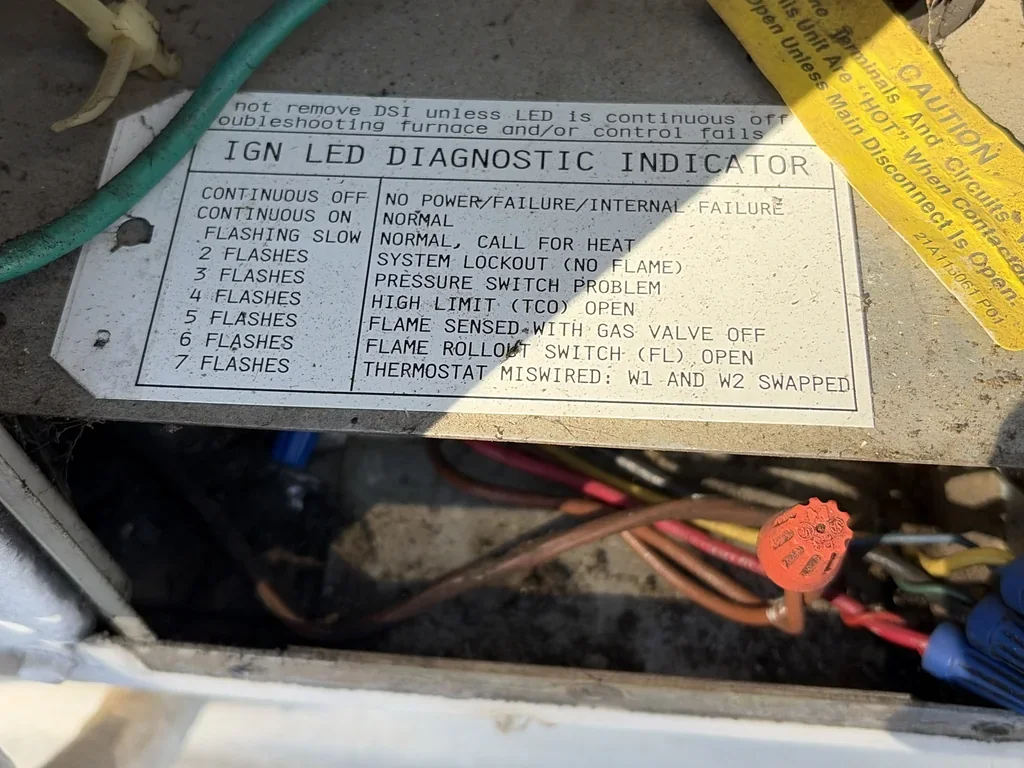
Many control boards report which switch opened with a blink count, and the key is often printed on a label inside the panel. For example, on a gas package unit we tuned up in Fair Oaks 95628 in October 2026, the label reads two flashes for a pressure switch problem, four for the high limit (TCO) open and six for the flame rollout switch open. Codes differ by brand and model, so read the label on your own unit rather than this one.
High limit switch: the furnace is running too hot
A high limit switch is a temperature sensor that shuts the burners off when the heat exchanger gets too hot. The usual reason is too little air moving across it. Trane explains that the limit switch "works to monitor the temperature inside the supply plenum, and if it gets too high, the limit switch shuts off the gas supply to the burners" (Trane). Trane adds that it "also activates the furnace blower fan to cool the furnace down," so from the hallway it looks like heat for a few minutes, then cooler air while the blower keeps running. A clogged filter or closed registers are the first suspects. Our guide to a furnace blowing cold air covers that pattern, and furnace short cycling covers a furnace that keeps shutting off before the house warms.
Rollout switch: flame where it should not be
A rollout switch is a heat sensor on the burner assembly. It opens when burner flame is not drawn into the heat exchanger, and it stays open until someone resets it. Goodman describes its rollout limits as "normally-closed (electrically), manual-reset sensors" (Goodman). Goodman's troubleshooting chart pairs an open rollout switch with checks of gas pressure, burner alignment and burner restriction, all technician work, and flame outside the burners is a combustion problem, which makes it a carbon monoxide question. So a tripped rollout switch is a reason to call, not a button to press. In Fair Oaks 95628 in October 2022, a Goodman furnace job of ours was recorded as "Replace 4 flame roll out switches in the Goodman furnace." That record does not say what tripped them, and we do not guess. If you suspect a heat exchanger problem, read cracked heat exchanger symptoms before running the furnace again.
Pressure switch: the furnace cannot prove draft
A pressure switch is a draft-proving switch. It confirms that the inducer motor is pulling exhaust through the furnace before the burners may light. Goodman's pressure switches are "normally-open (closed during operation) negative air pressure-activated switches" (Goodman). The usual sign is an inducer that runs while the burners never light, plus a blink code.
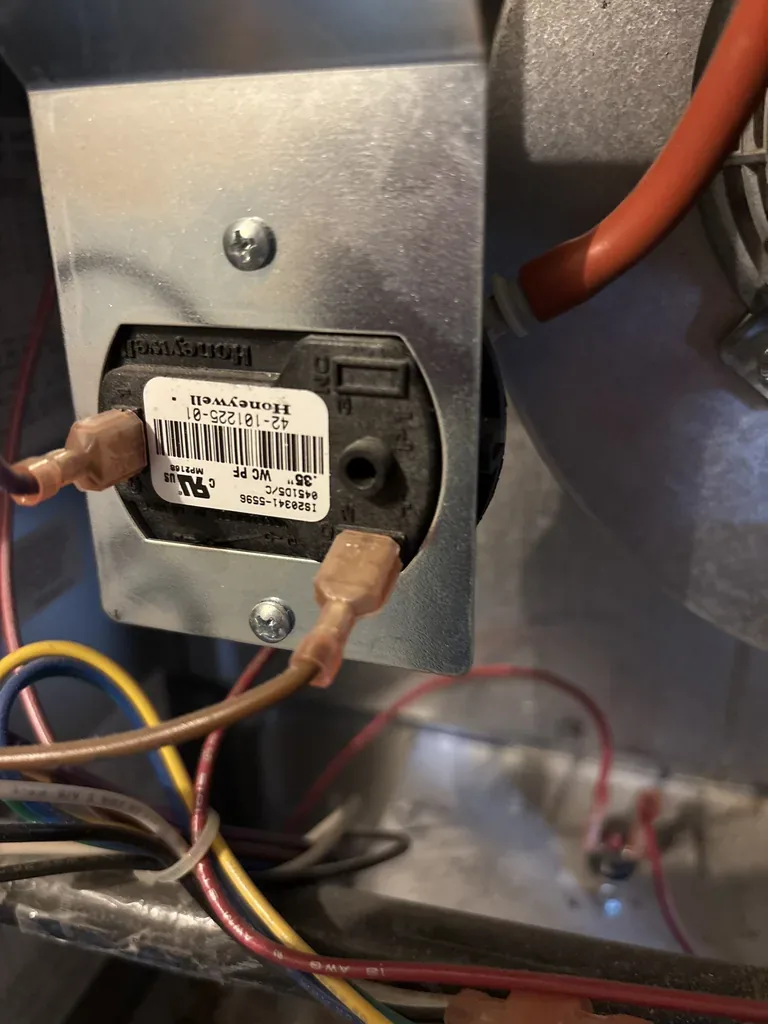
On a Fair Oaks 95628 call in February 2026, the record reads that the system was "idling, then it went on briefly. The temp did not raise," and the board showed "2 blinks - pressure switch open." Our pressure switch troubleshooting guide covers the common causes in the order we find them.
Flame sensor and condensate float switch
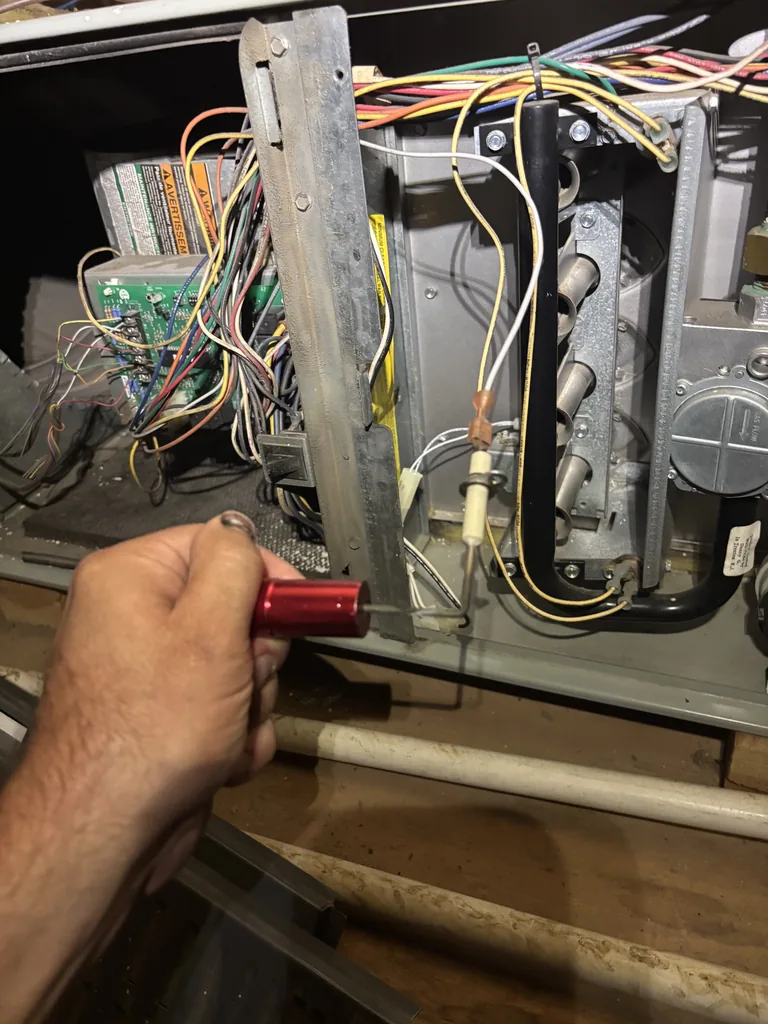
The flame sensor proves the burners lit: Goodman describes a probe that "uses the principle of flame rectification to determine the presence or absence of flame" (Goodman). The usual sign is burners that light and go out within seconds, which the short cycling guide linked above covers. The condensate float switch stops the system when the drain pan fills. Where an overflow could cause damage, California's mechanical code calls for a water-level device that "will shut off the equipment or appliance in the event the primary drain is blocked," or a backup pan or drain line instead (2025 California Mechanical Code §310.2). Our condensate safety switch guide explains how it works and why it is never bypassed.
When Heat and AC Both Quit at Once
When heating and cooling both stop together, look at what they share. That list is the furnace or air handler's power, its service switch and breaker, the blower door switch, the low-voltage circuit and its fuse, a float switch, and the thermostat itself. The outdoor unit is rarely the first suspect in that pattern, because it cannot be the reason the furnace is dead too.
It is not always a switch. For example, on a November 2025 call in Sacramento 95831, the record reads "Heater and AC doesn't work." The work notes list a cleaned flame sensor, a thermostat setting that "should be auto always," and a control board pin connector that "is glitching." On a September 2026 call in Fair Oaks 95628, the complaint was cooling: the outdoor unit ran "but inside nothing happens." The technician's note named the blower motor, which serves heating and cooling alike. Similar symptoms, different parts. That is why a diagnostic starts with the symptom pattern and the board's code, not with a part.
If your furnace is dead but the AC side is not involved, our guide to a furnace that won't turn on works through the common no-start causes in order.
What You Can Check Safely, and Where to Stop
These checks are safe for a homeowner. They involve no tools inside the furnace and no live wiring.
- Thermostat: set it to Heat, set the temperature a few degrees above the room, and give it several minutes.
- Blower door: press the lower front panel firmly into its slots until it sits flush. If your filter slot is behind that panel, check it after every filter change.
- Power: make sure the light-style service switch on or beside the furnace is on, and give the furnace breaker one firm reset, off and then on. A breaker that trips again is the fault itself.
- Drain pan: if water is standing in the pan, the float switch has done its job. Clear the drain; do not bypass the switch.
- Blink code: if your furnace has a sight glass, read the LED pattern before you open anything. Opening the blower door kills the power, and the code with it.
Stop there. Do not tape, wedge or jumper the door switch: Goodman's manual says "Do not defeat this switch." Do not reset a rollout switch or any manual-reset limit, and do not keep resetting a furnace that keeps tripping. If you smell gas or a carbon monoxide alarm sounds, leave the house. PG&E's guidance is to "Call 9-1-1 and seek medical attention if anyone experiences possible carbon monoxide poisoning symptoms" and to contact PG&E "or a qualified professional to have the appliance inspected" (PG&E). The U.S. Consumer Product Safety Commission recommends carbon monoxide alarms "on every level of the home and outside sleeping areas" (CPSC), which matters most in a house with a gas furnace.
How These Job Records Were Selected
Methodology: we analyzed 5,974 Alpha Mechanical job records in Housecall Pro. We searched their descriptions and notes for safety-switch terms (door switch, interlock, rollout, limit switch, float switch, pressure switch, flame sensor). Then we read the full records, line items included, on the September 2026 calls where heat or cooling had stopped. The five jobs above are the records that name the switch or the symptom directly. Each is anonymized to city and ZIP, and each states only what the record says. Invoice amounts are left out.
Getting a Tripped Safety Switch Diagnosed in Sacramento
If the panel is seated, the power is on and the system is still dead, or if any switch keeps tripping, it is time for a diagnostic. Bring what you saw: what stopped, whether the AC quit too, and any blink pattern. Our heating repair service covers furnaces across the Sacramento region, including Sacramento, Fair Oaks and Carmichael. The diagnostic is a flat $89, credited toward the repair if you go ahead. Call 916-848-5980 or contact us online. A yearly furnace tune-up checks the safety controls before the first cold night.
Frequently Asked Questions
What is a safety switch on a furnace?
A furnace safety switch is a sensor that stops the furnace when something is unsafe. The common ones are the blower door switch, the high limit, the rollout switch, the pressure switch and, on many systems, a condensate float switch. Each breaks the control circuit so the furnace will not run until the condition clears or the switch is reset.
Can a furnace door switch stop the AC from working?
Yes. The door switch interrupts power to the furnace, and the furnace supplies the 24-volt circuit the thermostat uses to start the AC. When the door switch is open, heating, cooling and the indoor fan all stop. That is what happened on our September 2026 call in Sacramento 95817.
Is it safe to bypass a furnace door switch?
No. The switch exists so the blower and burners cannot run with the panel off. Goodman's manual says "Do not defeat this switch." If the panel is seated and the switch still will not close, the switch or its wiring needs a technician.
How do I reset a furnace rollout switch?
You should not. A rollout switch trips because burner flame was not being drawn into the heat exchanger, which is a combustion problem. Goodman builds its rollout limits as manual-reset sensors, and its troubleshooting chart sends an open rollout switch to gas pressure and burner checks, which are technician work. Call for a diagnostic.
Why did my furnace stop working after I changed the filter?
Check the blower door first. On many furnaces the filter sits behind or near that panel, and a panel left off its hooks holds the door switch open, which shuts down the whole system. Press it flush. If everything is still dead, check the service switch and breaker, then call.
How much does it cost to diagnose a tripped furnace safety switch?
Our heating diagnostic is a flat $89, credited toward the repair if you go ahead. The repair price depends on which switch tripped and why, so we quote it after the diagnosis.
Written by Andrey Yev, PE, General Manager of Alpha Mechanical (about us) and a California Professional Engineer (#36700), based in the Sacramento region. Editorial note: every quote and figure on this page was checked against the sources listed below, October 2026.
Sources
- Goodman, Installation Instructions for *MVC80 and *CVC80 Gas Furnace (blower door interlock switch; safety circuit description: primary, auxiliary and rollout limits, pressure switches, flame sensor)
- Honeywell Home, "Why Won't My Thermostat Screen Power Up?" (updated September 2, 2025)
- Trane, "Furnace Limit Switch: A Small Part with a Big Job"
- 2025 California Mechanical Code §310.2, Condensate Control
- PG&E, "Carbon Monoxide"
- U.S. Consumer Product Safety Commission, "Carbon Monoxide"
- Alpha Mechanical Housecall Pro job records, October 2022 to September 2026, anonymized to city and ZIP.