
Most HVAC noises point to one part of the system, and the sound usually tells you which. On a gas furnace, a bang or boom as it lights points at delayed ignition. Rattling points at a loose panel or duct connection, whistling at a clogged filter or a gap in the ductwork, and squealing or grinding at a motor. Carrier's furnace troubleshooting guide sorts the first three the same way. In its words, whistling means check for a clogged air filter or gaps in the ductwork, a bang or boom when starting suggests a clogged burner delaying ignition, and rattling means loose connections in the ductwork or panels.
- Start Here: Match the Sound to the Cause
- When a Sound Means Leave the House
- Furnace Sounds When the Heat Comes On
- Banging or Booming When the Furnace Lights
- Popping or Pinging From the Ducts
- Rattling While the System Runs
- Whistling at the Registers or the Return
- Squealing, Screeching or Grinding
- Air Handler Noise
- Clicking or Humming With No Heat
- Buzzing at the Furnace
- Air Conditioner Sounds
- Sounds That Are Normal
- What You Can Check Before You Call
- Getting a Noise Diagnosed in Sacramento
- Frequently Asked Questions
One sound is not a repair question at all. A hiss near a gas furnace, especially with a rotten-egg smell, can be a gas leak. Leave first, then call 911 and PG&E.
This guide starts with heating sounds, because that is the season Sacramento furnaces are starting up again. Match what you hear in the table, read that section, and follow the link where another guide already covers the fix in depth. Timing matters as much as the sound. For example, a single bang as the burners light is a combustion problem, while a rattle that starts halfway through the cycle is usually a loose part.
Key Takeaways:
- Notice when the sound happens: as the system starts, while it runs, or as it shuts off, and whether it comes from the indoor or outdoor unit. American Standard's advice is to pay attention to when the noise happens and what it sounds like, and timing narrows the cause faster than the sound alone.
- A bang or boom when the burners light is a combustion problem. Shut the furnace off and book a repair; it is not a homeowner fix.
- Pinging from the ducts as the heat comes on is usually normal. Trane lists ductwork pinging as it expands and contracts among the everyday sounds of a working system.
- Motor noise (squealing, screeching, grinding) and no-start clicking or humming each have their own guide on this site. This page names the sound and sends you to the right one.
- A hiss near the furnace with a gas smell means leave the house. A CO alarm means get everyone outside and call 911.
Start Here: Match the Sound to the Cause
Find the row that matches what you hear. Heating sounds are listed first, then the air conditioner.
| What you hear | When | Most likely cause | What to do | Where to go |
|---|---|---|---|---|
| Bang or boom | As the furnace lights | Delayed ignition, often a clogged burner | Turn the furnace off and book a repair | Banging or booming |
| Popping or pinging | Heat just came on, or just shut off | Duct metal expanding and contracting | Usually nothing | Popping or pinging |
| Rattling | While running | Loose panel, screw or duct connection | Check the front panel is seated, then call | Rattling |
| Whistling | While running | Clogged filter, blocked return or a duct gap | Change the filter, open the registers | Whistling |
| Squealing, screeching or grinding | At startup or while running | Worn motor bearings or a belt | Book it; do not keep running a grinding motor | Squealing or grinding |
| Clicking or humming, no heat | When the thermostat calls for heat | Ignition fault, or a motor that cannot turn | Work through the no-start checks | Clicking or humming |
| Buzzing | While running | Transformer, capacitor, blower or a loose duct | Call for repair | Buzzing |
| Hissing, rotten-egg smell | Any time | Possible gas leak | Leave, then call 911 and PG&E | Leave the house |
| Humming or buzzing outdoors, fan not spinning | AC running | Capacitor | Turn the AC off and call | AC sounds |
| Hissing at the indoor coil or refrigerant lines | AC running | Large refrigerant leak | Turn the AC off and call | AC sounds |
| Gurgling or bubbling | AC running | Water trapped in the condensate drain line | Check the drain line | AC sounds |
| Grinding or screeching outdoors | AC running | Failing condenser fan motor | Turn the AC off and call | AC sounds |
When a Sound Means Leave the House
Trane is direct about this one: hissing is not a normal sound, and if you hear a hissing sound near your furnace, you may have a gas leak. Natural gas has no smell of its own. The same Trane article notes that gas companies add a chemical to make it smell like sulfur or rotten eggs, so a hiss plus that smell is the combination to act on.
- Gas odor or a hiss at the gas line. Follow PG&E gas safety instructions: do not use anything that could be a source of ignition, including phones and light switches, until you are a safe distance away. For gas odor, leave with everyone and pets, move a safe distance away, then call 911 and PG&E.
- A CO alarm. A CO alarm means get everyone outside and call 911. Carbon monoxide is, in the CDC's words, an odorless, colorless gas that kills without warning. The CDC recommends battery-operated or battery back-up CO detectors near every sleeping area, replaced on the manufacturer's schedule or every 5 years. Our guide to cracked heat exchanger symptoms covers the furnace side of that worry.
Everything else on this page is a repair question, not an emergency. If the furnace smells wrong rather than sounds wrong, our guide to furnace burning smells sorts odors the same way.
Furnace Sounds When the Heat Comes On
Most furnace noises belong to one moment in the heating cycle: the start, the run, or the shutdown. That is why the timing of the sound matters as much as the sound itself, and why each section below says when you would hear it.
Banging or Booming When the Furnace Lights
A single bang or a hollow boom right as the burners light is the furnace sound to take most seriously. Carrier's guide, linked above, says a bang or boom when starting suggests a clogged burner delaying ignition, and that it requires professional diagnosis. Delayed ignition means the gas valve has opened but the flame reaches the gas late, so the burners light with a bang instead of a smooth whoosh.
A clogged burner is the common cause, not the only one. Rheem's technician tech tip on gas furnace delayed or rough ignition lists what a service tech checks:
- Gas pressure and burners: low or high manifold pressure, or poor orifice-to-burner alignment.
- Hot surface ignitor: a weak ignitor, a poorly positioned one, or low line voltage to it.
- Spark ignition: an incorrect spark gap, a cracked ceramic insulator, a grounded ignition wire, or pitted or corroded electrodes.
Every item on that list is gas-pressure or ignition work.
What to do:
- Turn the furnace off at the thermostat and leave it off. Do not cycle it on and off to hear the sound again.
- If you smell gas, stop and follow the leave-the-house steps above.
- Otherwise book a heating repair visit and say "bang on ignition" when you call.
One distinction saves time. A furnace that clicks and never lights is a no-start problem, covered below. A bang means the furnace did light, just late.
Popping or Pinging From the Ducts
Popping, pinging or ticking from the ductwork when the heat first comes on, or just after it shuts off, is usually metal moving with temperature. Trane counts ductwork pinging as it expands and contracts among normal system sounds. American Standard attributes a ping to contracting and expanding ducts and says crackling noises may be the metal parts cooling down after the furnace shuts off.
It is worth a closer look when:
- The pop comes from the furnace cabinet at the moment the burners light, not from the ducts. That is the banging section above.
- It keeps going for the whole cycle rather than settling down once the ducts are warm.
- A duct run visibly moves, or a joint has pulled apart. That is a ductwork repair job, and the whistling section below covers sealing.
Rattling While the System Runs
A rattle usually means something is loose. Carrier's first check for a rattling furnace is loose connections in the ductwork or panels. Trane goes further: a rattling noise can be accompanied by excessive vibration, and this is not normal. Depending on the unit, it names the blower wheel, a fan or fan motor, the compressor, a loose screw or bolt, or an outdoor unit that is not level.
Timing separates the harmless rattle from the one to book. American Standard notes that rattling noises typically happen when the system is cooling down and are not usually cause for alarm. A rattle during the run, with vibration you can feel, is the one to have checked.
Two checks are yours. Make sure the furnace's front access panel is fully seated, and look for anything loose at the vents, such as a register cover or a return grille. If the rattle is inside the blower compartment, that is blower territory, covered under squealing, screeching or grinding below.
Whistling at the Registers or the Return
Whistling is air being forced through a gap that is too small. Carrier's advice for a whistling furnace is to check for a clogged air filter or gaps in the ductwork.
Start with the filter. If you cannot see light through it, replace it; Trane's maintenance advice is to change the HVAC air filter every 30 to 90 days. Then walk the house: open any closed supply registers and clear anything sitting against a return grille.
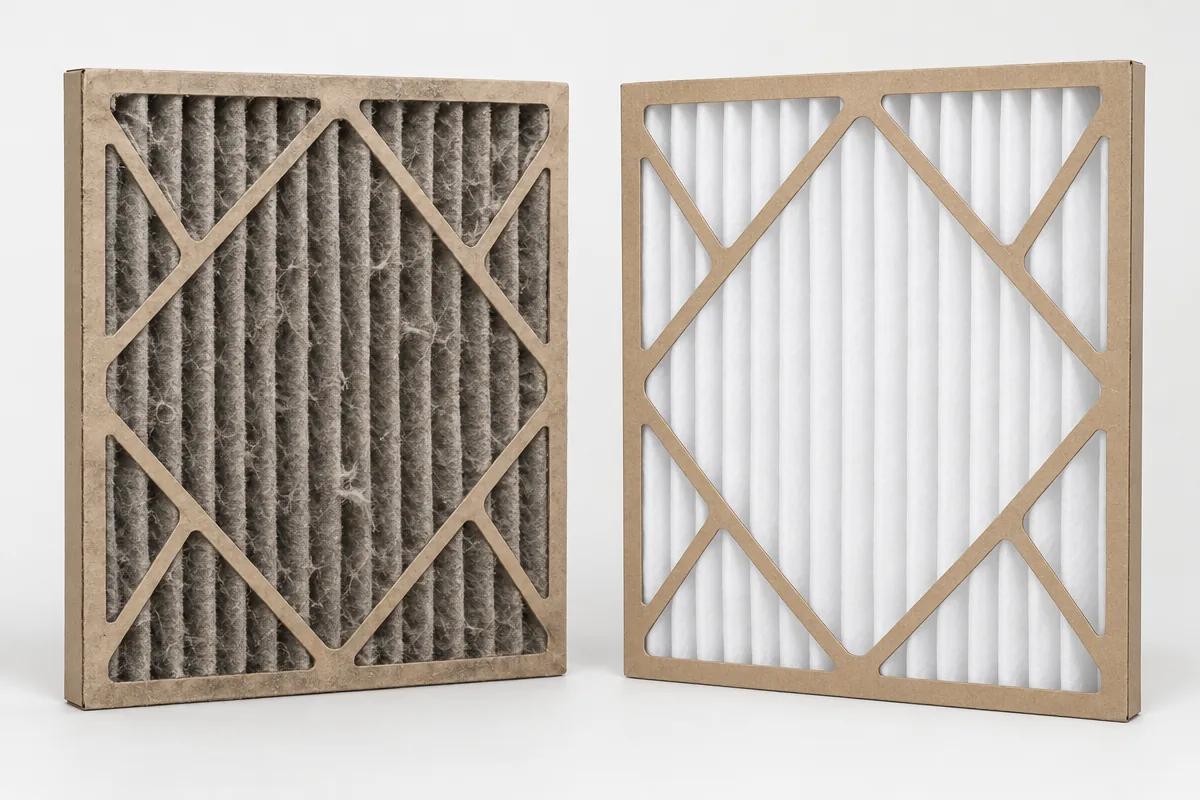
If the whistle survives a new filter and open registers, the gap is usually in the ductwork. ENERGY STAR estimates that in a typical house about 20 to 30 percent of the air that moves through the duct system is lost due to leaks, holes, and poorly connected ducts. Sealing those joints is the fix, and it is part of our ductwork services.
Squealing, Screeching or Grinding
These are motor sounds. Bryant says squealing, grinding, intermittent operation, or weak airflow can indicate worn bearings or a failing motor. Where the blower is belt-driven, American Standard puts a screech down to a problem with your motor or fan belt.
A furnace has two motors that can make these sounds. The draft inducer is the small motor that starts first and pulls combustion gases through the furnace and out the flue. The blower is the larger motor that pushes air through the ducts once the burners are lit. Which one you are hearing, and what the repair involves, is covered in our guide to furnace motor noise and bad inducer motor signs, which has a sound table of its own. The short version: stop running a furnace that grinds, and book the repair.
Air Handler Noise
An air handler is the indoor unit that moves the air. Trane puts it plainly: your air handler is responsible for evenly distributing cool and warm air throughout your house. In a home with a gas furnace and central AC, the furnace cabinet does that job. An all-electric heat pump system usually has a separate air handler in the attic, garage or a closet.
Because one fan serves both seasons, an air handler noise can show up with the heat or with the AC. Carrier's air handler guide says squealing, grinding, or banging sounds often indicate loose parts or motor bearing failure. Your part is the filter and the access panel. Which motor you are hearing, and what the repair involves, is in the motor noise guide linked above.
A loud hum when the heat comes on needs one more question: does the house get warm? A short hum as the burners light is normal, covered under sounds that are normal. A hum with no heat is the no-start case below.
Clicking or Humming With No Heat
A furnace that clicks and never lights, or hums while nothing turns, is a no-start problem rather than a noise problem. The fix depends on how far into its start sequence the furnace got, and why your furnace won't turn on walks through both sounds, plus the silent furnace, step by step.
Trane's general guidance for clicking at the indoor unit points at a faulty control board, a loose connection, or a safety switch. None of those are homeowner repairs.
Buzzing at the Furnace
Trane lists four causes of a buzzing furnace: a loose transformer box, a faulty furnace capacitor, an old or poorly maintained blower motor, and ductwork with loose connections. The first three are live electrical parts or the blower, so they are a service call. For the ductwork buzz, Trane's advice is to consult your HVAC professional about whether duct sealing will fix it.
Air Conditioner Sounds
The outdoor unit makes most of the AC sounds worth worrying about. If the AC is quiet but the house will not cool down, our AC not cooling guide is the better starting point. Trane says a loud hum from the outdoor unit could be an issue with the capacitor, contactor, or fan motor.
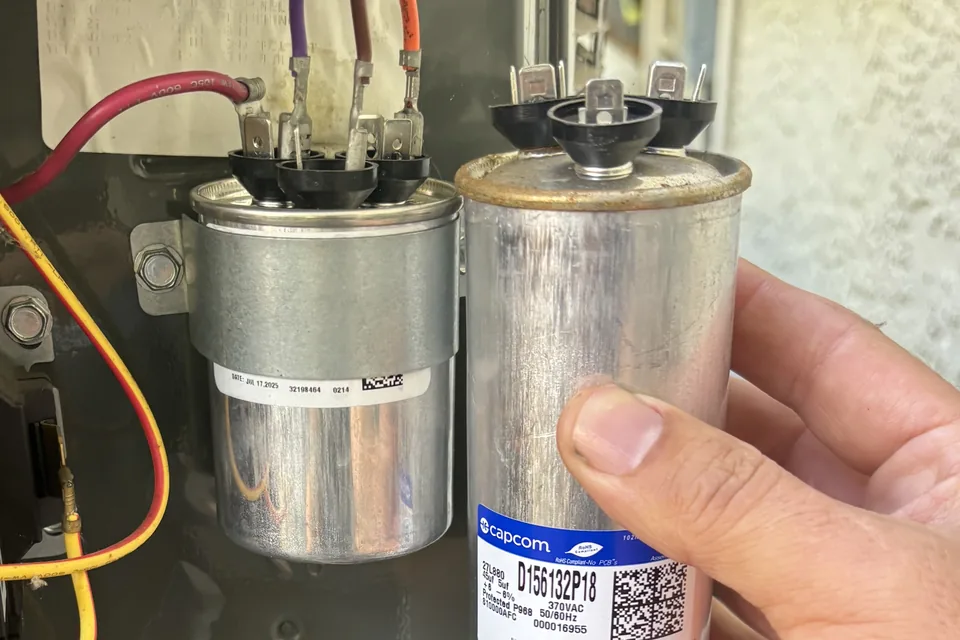
Humming or buzzing with the fan not spinning. Bryant's rule of thumb: if you hear a humming sound but the fan isn't moving, the capacitor is likely the issue. Turn the AC off at the thermostat. Outside AC fan not spinning covers the diagnosis, and what a bad capacitor does to an HVAC system explains the part. If the fan spins but the compressor only hums, see AC compressor not turning on. The run capacitor is the part in the outdoor unit that stores electrical energy, and Bryant describes it delivering a jolt of power to start the fan motor and keep it running efficiently. A dual run capacitor does the same for the compressor. A failed one can swell at the top, like the one in this photo from a service call.
Hissing at the indoor coil or the refrigerant lines. Trane: if you hear a hissing sound near the indoor coil or outdoor refrigerant lines, you may have a large refrigerant leak. Shut off the system and call for HVAC repair. A rotten-egg smell is different: Trane ties that smell to a gas leak, which is the leave-the-house case above. The signs of low AC refrigerant and how a refrigerant leak is found take it from there.
Gurgling or bubbling. Bryant says gurgling or bubbling noises can indicate that water is trapped in the line and struggling to get out. The usual clog is a buildup of debris, algae, mold, or mineral deposits inside the PVC pipe. A clogged AC drain line covers clearing it.
Grinding or screeching outdoors. Bryant warns that if the fan motor is failing, it may feel excessively hot to the touch or make grinding and screeching noises before stopping completely. Turn it off before the motor seizes, and book an AC repair visit.
Rattling outdoors. The same Trane list applies: a loose screw or bolt, the fan, or an outdoor unit that has settled out of level.
Sounds That Are Normal
Not every sound is a fault. Trane's list of normal sounds is short: you may hear the furnace kick in, your ductwork pinging as it expands and contracts, or the whir of the outdoor unit. American Standard adds that chirping sounds are fairly common with furnaces and usually the natural noise of the mechanisms, and that the burner lighting may cause a humming sound. That short hum at ignition is different from a hum with no heat, which is the no-start case above.
The signal is change. Its advice is that if you notice a significant change, you should call your local dealer to schedule an inspection. A sound your system has made quietly for years is rarely news. A new one, or a familiar one that got louder, usually is.
What You Can Check Before You Call
Five checks, no tools, and none of them open a cabinet with gas, line voltage or refrigerant inside:
- Note the timing. Startup, mid-run or shutdown, indoor or outdoor. Write it down; it is the most useful thing you can tell a technician.
- Replace the filter if you cannot see light through it. ENERGY STAR's maintenance checklist says to inspect, clean, or change air filters once a month in your central air conditioner, furnace or heat pump.
- Open the supply registers and clear anything against a return grille.
- Make sure the furnace's front access panel is seated and no grille or register cover is loose.
- Look at the outdoor unit with the system off at the thermostat: sticks, leaves or a loose panel.
Everything past those five checks is a technician's job. Most HVAC noises that survive them come from a part inside the unit, and catching them early is part of what a heating tune-up or an AC tune-up is for.
Getting a Noise Diagnosed in Sacramento
Alpha Mechanical is a family-owned HVAC contractor based in Fair Oaks, licensed under CSL# 967727, and we diagnose furnace and air conditioner noises across the Sacramento area. Service calls run Monday to Friday, 8 AM to 5 PM, and you can book online at any time. When you book or contact us, tell us the sound and when it happens, and match it to the table above first if you can.
- Furnace sounds: heating repair, including furnace repair in Fair Oaks.
- Air conditioner sounds: AC repair in Sacramento, including AC repair in Fair Oaks.
- Anywhere else in the metro: HVAC service across Greater Sacramento.
Frequently Asked Questions
Why is my HVAC system making noise?
A working system has a steady background sound: the furnace lighting, ducts pinging as they warm, the outdoor unit's fan. A new noise usually points to one part. A bang at ignition points to delayed ignition, a rattle to a loose panel or duct connection, a whistle to a clogged filter or duct gap, and a squeal or grind to a motor. A hiss near a gas furnace with a rotten-egg smell can be a gas leak: leave with everyone and pets, move a safe distance away, then call 911 and PG&E.
How do you fix a noisy HVAC system?
Start with the parts you can reach safely. Replace a dirty filter, open closed registers, clear anything against a return grille, and make sure the furnace's front access panel is seated. That settles most whistling and some rattling. A bang at ignition, a squealing or grinding motor, a buzzing electrical part and a refrigerant hiss all need a technician, because each fix is inside a cabinet with gas, line voltage or refrigerant.
Why is my HVAC so loud all of a sudden?
A sudden change usually means something worked loose, loaded up or started to wear: a panel or screw, the filter, or a motor bearing. Note whether it happens at startup, during the run or at shutdown, and whether it comes from the indoor or outdoor unit, then match it in the sound table above. If it is a bang when the furnace lights or a grinding motor, turn the system off until it is checked.
Why does my HVAC make a loud noise when the heat turns on?
The moment it happens tells you most of the answer. A single bang or boom as the burners light is delayed ignition: turn the furnace off and book a repair. Popping or pinging from the ducts in the first few minutes is metal expanding as it warms and is usually normal. A short hum as the burners light is normal too, but a hum or repeated clicking with no heat is a no-start problem.
Why is my air handler making noise?
The air handler is the indoor unit that moves the air for both heating and cooling, so its noises can show up in either season. Replace a dirty filter and make sure the access panel is seated. Carrier ties squealing, grinding or banging to loose parts or motor bearing failure. Those need a technician, because the motor sits next to line voltage.