

Most heat pump problems in a Sacramento winter fall into three groups: normal behavior that looks like a fault (a defrost cycle, or supply air that feels cool), a setting you can fix in five minutes (thermostat mode, fan, filter, breaker), and a real repair (a refrigerant leak, a stuck reversing valve, a failed defrost board, motor, capacitor or contactor). The decision tree below sorts your symptom into one of the three and sends it to its fix.
- Heat Pump Troubleshooting Decision Tree
- Heat Pump Not Heating or Blowing Cold Air
- Frost, Ice and the Defrost Cycle
- When the Heat Pump Will Not Run
- Long Run Times and Backup Heat
- Cooling, Mode Switching, Short-Cycling, Leaks and Smells
- What Five Real Heat Pump Repair Calls Turned Out to Be
- Why Sacramento Winters Change the Diagnosis
- When to Stop Troubleshooting and Call
- Frequently Asked Questions
If the free checks on this page do not clear it, Alpha Mechanical's heat pump repair in Sacramento is the next step, and every symptom row below says which side of that line it sits on. We serve Fair Oaks and the rest of Greater Sacramento from our Fair Oaks office.
Heat pump troubleshooting is the process of matching a symptom (cold air, ice, no run, noise) to its cause before anyone opens the refrigerant circuit. A defrost cycle is the few minutes when a heat pump reverses itself to melt frost off its outdoor coil. A reversing valve is the part that points the refrigerant flow at heating or cooling. Auxiliary heat is the backup heat a heat pump adds when it cannot keep up on its own.
Key Takeaways
- Cool air for a few minutes with steam rising off the outdoor unit is a defrost cycle, not a fault.
- A fan set to ON, a dirty filter or a thermostat not on HEAT explains many cold-air complaints at no cost.
- A solid ice shell, cold air that outlasts a 15-minute defrost window, or a breaker that trips twice is a repair call.
- In five real Alpha Mechanical repair calls, four were electrical or control failures and one involved refrigerant.
Heat Pump Troubleshooting Decision Tree
Find the row that matches what you see, then follow its last column.
| What you see | What it usually means | What to do |
|---|---|---|
| Cool air for a few minutes, steam off the outdoor unit, then warm again | Normal defrost cycle | Nothing. Read the defrost section below |
| Air feels cool, but the house holds its temperature | Normal heat pump supply air, or the fan set to ON | Set the fan to AUTO |
| Cold air longer than a defrost cycle (15 minutes) and the house is losing ground | Low charge from a leak, a stuck reversing valve, or a defrost fault | Repair call |
| Outdoor unit encased in solid ice, top and sides | Defrost or airflow fault | Turn it off and call |
| Nothing runs, indoors or out | Power, breaker, thermostat, fuse or contactor | Run the free checks, then call |
| Indoor fan runs, outdoor unit silent | Outdoor power, contactor or capacitor | Reset the breaker once, then call |
| AUX or EM HEAT showing on the thermostat | Backup heat on duty | See the backup heat section |
| Water under the indoor unit | Clogged condensate drain | Clear the drain, or call |
| Burning smell, or a breaker that trips twice | Electrical fault | Turn it off and call |
Two symptom families have their own guides. Grinding and buzzing sounds are sorted one by one in our HVAC noises guide. The AUX and EM HEAT lights are covered in the backup heat section below.
Heat Pump Not Heating or Blowing Cold Air
A heat pump not heating, or a heat pump blowing cold air with the thermostat on HEAT, has one normal explanation, two settings explanations and four real faults. Work through them in that order, because the first three cost nothing.
Is it a setting?
Fan set to ON instead of AUTO. With the fan on ON, the blower runs between heating cycles, when there is no heat to move, and room-temperature air from a vent feels cool on the hand. Set the fan to AUTO and the blower only runs while the system is heating (Honeywell Home thermostat support).
Expecting furnace-temperature air. A heat pump delivers supply air between about 85 and 93°F. That is warmer than the room but cooler than your skin, since an average body runs at 98.6°F, so working heat pump air can feel cool (Trane, heat pump not heating). If the house holds its setpoint, the system is doing its job.
Also check that the thermostat is in HEAT, the setpoint is above the room reading, and the air filter is clean. ENERGY STAR's maintenance checklist calls for checking the filter every month (ENERGY STAR maintenance checklist), and a starved blower makes every heating problem worse.
The real faults
When cold air lasts past a defrost window and the settings check out, four faults cover most calls:
- Low refrigerant charge. A short charge cuts heating capacity, so the supply air runs lukewarm and the outdoor coil ices up faster. Alpha Mechanical finds the leak before adding refrigerant: on a February 2026 Sacramento call, for example, the technician pressure-tested the system with nitrogen and isolated the indoor and outdoor heat pump sections to find which side was leaking.
- A stuck reversing valve. Stuck in cooling, the system air-conditions the house in December. Air that is truly cold, not just cool, with the outdoor unit running points here.
- A failed defrost board or sensor. The symptoms run both ways: endless defrost cycles with cool air, or no defrost at all and an ice shell outside.
- A failing motor or capacitor. An outdoor unit that hums without starting, or an indoor blower that will not spin, is an electrical repair rather than a refrigerant one.
Frost, Ice and the Defrost Cycle
In heat mode, the outdoor coil runs colder than the air around it. On damp valley mornings, moisture freezes onto it as frost, which blocks airflow. The heat pump clears it by reversing into cooling for a few minutes, sending hot refrigerant through the outdoor coil while the indoor vents blow unheated air.
A normal defrost cycle:
- Lasts 5 to 15 minutes, depending on weather and frost (Lennox); Trane puts its demand-defrost cycles at 3 to 5 minutes.
- Often starts with a whoosh as the reversing valve shifts, and the outdoor fan may stop.
- Can send a cloud of steam off the outdoor unit as the frost melts, which Trane calls a totally normal process.
- Ends on its own, and warm air returns.
Sources: Lennox, heat pump defrost cycle; Trane, what is the heat pump defrost cycle.
What is not normal: defrost cycles that run back to back all day, a cycle that never ends, or a solid ice shell over the top and sides of the unit. Frost that comes and goes is routine; an ice shell means defrost is not running or cannot keep up. Turn the system off before the ice bends the fan blades and coil fins, and do not chip at it.
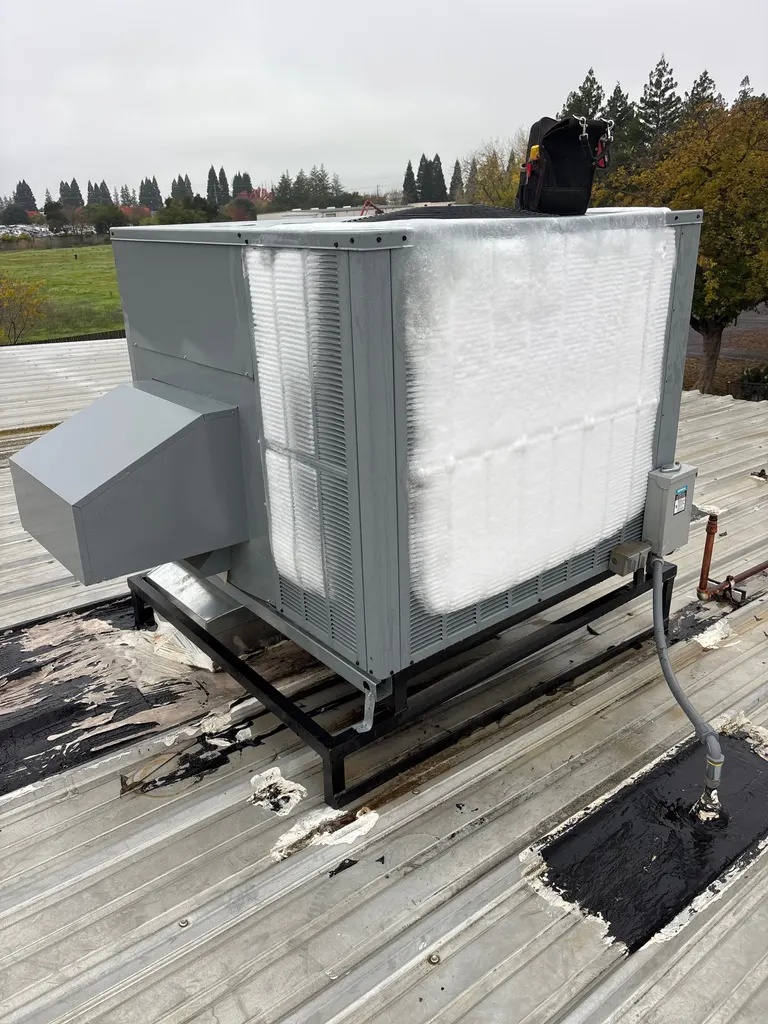
This is the ice shell in the field, on a unit we were called to when it stopped heating. The whole coil face is frozen, which chokes off the airflow the coil needs, and no defrost cycle catches up with ice this deep.
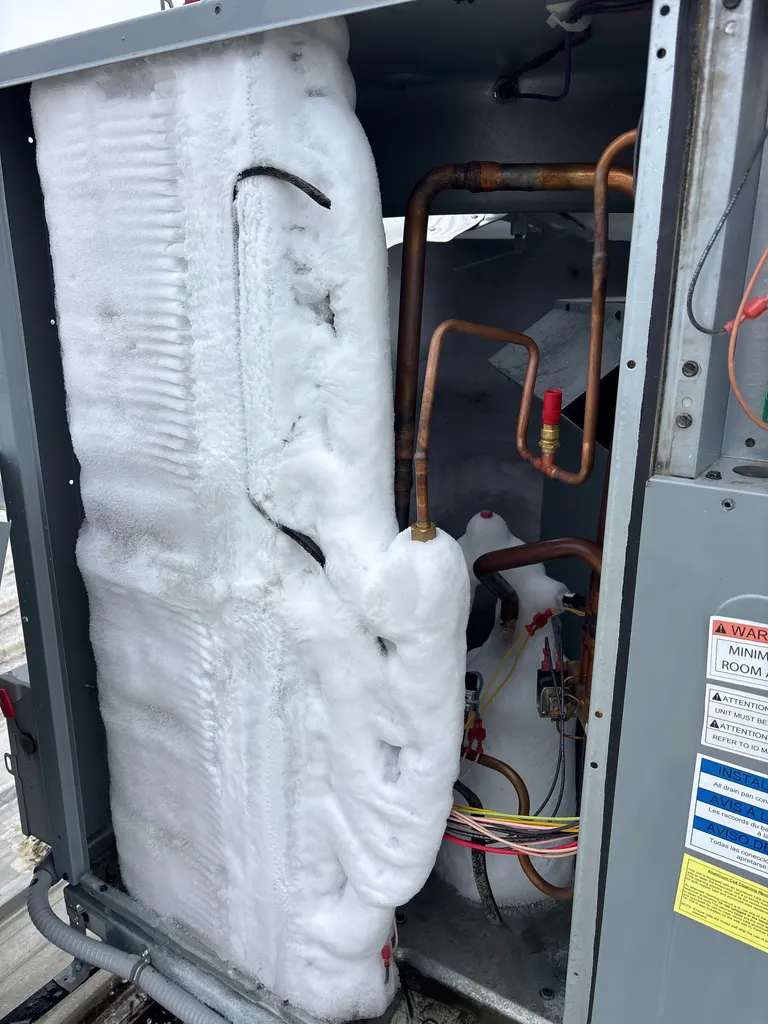
The same unit with its access panel off: the coil and the refrigerant lines are buried in ice. At this stage the system has to be shut down, thawed and diagnosed, because the ice is the symptom of a defrost or charge fault, not the fault itself.
When the Heat Pump Will Not Run
A heat pump that will not run at all usually has a power or control problem. The free checks: the thermostat is in HEAT with fresh batteries if it uses them, the breakers for the outdoor unit and the indoor air handler are on, and the outdoor disconnect box next to the unit is closed. Reset a tripped breaker one time only. A breaker that trips again is telling you about a short, and the next step is a technician with a meter.
To reset a heat pump after a power outage or a trip, turn the thermostat off, switch off both breakers, wait a few minutes, switch them back on and set the thermostat to HEAT. Give it several minutes to start before deciding it failed.
Past those checks, the usual parts are fuses in the air handler, the outdoor contactor, the capacitor and the control board, which is what four of the five calls in the table below found. A ductwork restriction (a crushed or disconnected run) can also starve the system of air until a safety stops it; a technician finds the restriction and repairs it.
Long Run Times and Backup Heat
On a cold Sacramento morning a heat pump runs long cycles by design, because it delivers a steady stream of moderately warm air instead of short hot bursts. Long run times become a problem when the house still does not reach its setpoint, which points back to the airflow and charge faults above.
When the thermostat shows AUX, the system has added its backup heat because the heat pump alone is behind. EM HEAT runs the backup alone. Our guide to emergency heat vs. aux heat covers what each setting does and what each one costs to run. If the heat pump genuinely is not heating, emergency heat can bridge the wait for a repair; switch back once the repair is done.
Cooling, Mode Switching, Short-Cycling, Leaks and Smells
- Not cooling, or not switching between heat and cool: check the thermostat mode first. Past that, the usual causes are a failed reversing valve, loose or damaged thermostat wiring, low charge, or a failing capacitor that stops the compressor from starting. A reversing valve is refrigerant-circuit work for a technician.
- Short-cycling (on and off every few minutes): a clogged filter, dirty coils, blocked vents, a faulty thermostat or a unit sized wrong for the house.
- Leaking water: most often a clogged condensate drain line or a cracked drain pan. Clear the drain if you can reach it; a leak you cannot trace needs a technician.
- Smells: a musty smell usually means moisture on the indoor coil or in the drain, and a dirty filter makes it worse. A burning smell means turn it off and call.
Most of these problems start with the same neglected filter, coil or drain, which is why our heat pump maintenance checklist puts those items on a yearly visit.
What Five Real Heat Pump Repair Calls Turned Out to Be
These are five residential heat pump repair calls from Alpha Mechanical's own Housecall Pro job records, with the symptom the homeowner reported, what the technician found and the invoice total as billed. They are past invoices, not today's prices.
| Year | City | Homeowner's symptom | What we found and fixed | Invoice |
|---|---|---|---|---|
| 2021 | Sacramento | Split heat pump not working, back unit | Failed indoor blower motor and capacitor in the air handler, both replaced | $490 |
| 2022 | Fair Oaks | Second-floor rooftop heat pump did not work | Burned heat strip, shorted control wiring and a bad thermostat; thermostat replaced, wiring repaired, new filter | $470 |
| 2022 | Fair Oaks | Heat pump stopped working | Two blown air handler fuses and a failed outdoor contactor, replaced | $395 |
| 2023 | Orangevale | Rooftop Goodman heat pump not working | Wiring rubbing on a refrigerant pipe had shorted the controls and worn a hole in the pipe; new control board, wiring and pipe repaired, system charged | $620 |
| 2023 | Not recorded | Rooftop heat pump not heating | Failed defrost control board, replaced with the Goodman factory board | $460 |
Source: Alpha Mechanical Housecall Pro job records, read 2026-11-18. Current repair rates are on the heat pump repair page linked at the top of this guide.
Four of the five were electrical or control failures (a motor and capacitor, fuses and a contactor, wiring and a thermostat, a defrost board), and only one involved refrigerant, where a wiring fault caused the leak. Not every call ends in a repair, either: on a 2023 Fair Oaks visit for a heat pump "not working properly", the technician found the two-stage system properly charged and heating, with both zone thermostats working.
Why Sacramento Winters Change the Diagnosis
Many national heat pump guides are written for places with long, deep freezes, where backup heat runs every night. In the Sacramento Valley, the winter condition that matters most for a heat pump is the damp, foggy morning: Trane names cold, humid conditions as the cause of frost on the outdoor coil (Trane, what is the heat pump defrost cycle).
That changes what the symptoms mean here:
- Cold air on a mild day is a fault signal. When it is not especially cold outside and the house still loses ground, look at charge, the reversing valve and the defrost controls before blaming the weather.
- Frost is a morning event. Tule fog after a cold night is the recipe for coil frost, so defrost steam at 7 AM in January is expected.
- All-electric homes feel a fault faster. In a home where the heat pump is the only heat source (our California heat pump rebates guide covers the rebate programs), a real fault is a same-day call.
When to Stop Troubleshooting and Call
The checks worth doing yourself are the free ones: thermostat mode and setpoint, fan on AUTO, the filter, the breakers and a look at the outdoor unit for an ice shell. Every cause past that, charge, valve, board, sensor, motor or capacitor, is refrigerant-circuit or live-electrical work.
Call for service if:
- The outdoor unit is encased in ice, or defrost cycles run back to back.
- Supply air stays cold longer than a defrost cycle (Lennox puts a normal cycle at 5 to 15 minutes) with the settings verified.
- The house is losing temperature with the system running all the time.
- You smell burning, or a breaker trips a second time.
If the unit is old and failing often, our heat pump replacement page lays out the choice. For everything else, schedule a visit and we will diagnose it with gauges and a meter.
Frequently Asked Questions
What are the most common heat pump problems?
Cold air in heat mode, an iced outdoor unit, a unit that will not run, constant running, short-cycling, water leaks and odd smells. In a Sacramento winter, most turn out to be a normal defrost cycle, a setting such as the fan on ON, a dirty filter, or an electrical part like a capacitor, contactor or fuse.
Why is my heat pump blowing cold air when the heat is on?
The most common causes, in order: a normal defrost cycle (cool air for a few minutes, then warm), a thermostat fan set to ON, and heat pump supply air that feels cool against skin even at a working 85 to 93°F. Cold air that persists points to a refrigerant leak, a stuck reversing valve or a failed defrost board.
Is cold air during defrost normal?
Yes. During defrost the system briefly reverses to melt frost off the outdoor coil, so the vents blow unheated air for typically 5 to 15 minutes, often with steam rising from the outdoor unit. Back-to-back cycles, a cycle that never ends, or a solid ice shell are not normal.
How do I troubleshoot a heat pump myself?
Check that the thermostat is on HEAT with the setpoint above room temperature, set the fan to AUTO, replace a dirty filter, confirm both breakers and the outdoor disconnect are on, and look for an ice shell outside. Reset a tripped breaker once. Anything past that is a technician's job.
When should I stop troubleshooting and call?
Call when the outdoor unit is encased in ice, cold air lasts longer than a 15-minute defrost cycle with the settings verified, the house keeps losing temperature, you smell burning, or a breaker trips a second time. Those causes are refrigerant or live electrical work.
Fact check: the figures, quotes and job details on this page were checked against the linked sources and Alpha Mechanical's job records on 2026-11-18.
Sources
- ENERGY STAR, "Maintenance Checklist" (check the air filter every month): https://www.energystar.gov/saveathome/heating-cooling/maintenance-checklist
- Lennox, "What Is the Heat Pump Defrost Cycle?" (5 to 15 minutes, depending on weather and frost): https://www.lennox.com/residential/lennox-life/consumer/heat-pump-defrost-cycle
- Trane, "What Is the Heat Pump Defrost Cycle?" (steam during defrost is normal; demand-defrost cycles of 3 to 5 minutes): https://www.trane.com/residential/en/resources/blog/what-is-heat-pump-defrost-cycle/
- Trane, "Heat Pump Not Heating" (supply air of 85 to 93°F; average body temperature of 98.6°F): https://www.trane.com/residential/en/resources/troubleshooting/heat-pumps/heat-pump-not-heating/
- Honeywell Home, thermostat support (fan ON runs continuously; AUTO runs only during heating or cooling): https://www.honeywellhome.com/blogs/support/7-day-programmable-thermostats-3
- Alpha Mechanical, Housecall Pro job records for the five repair calls, the February 2026 leak search and the 2023 no-repair visit above (read 2026-11-18)