
Emergency heat is a manual thermostat setting on a heat pump system. It shuts the heat pump off and runs only the backup heat, usually electric heat strips in the indoor air handler. Aux heat is different: the thermostat turns it on by itself when the heat pump needs help. Use emergency heat only when the heat pump has stopped working.
- What Emergency Heat Does on a Heat Pump
- Aux Heat vs. Emergency Heat: The Difference in One Table
- Why Your Thermostat Says AUX: Three Normal Triggers
- Emergency Heat Cost per Hour on SMUD Rates
- What Mild Sacramento Winters Mean for Aux Heat
- When to Switch to Emergency Heat, and When Not To
- Dual-Fuel Homes: Your Backup May Be a Gas Furnace
- What We Find on Aux and Emergency Heat Calls
- When Aux Heat Means It Is Time to Call for Service
- Frequently Asked Questions
Key Takeaways
- Aux heat is automatic; emergency heat is manual. Carrier describes aux heat as normal cold-weather operation that runs alongside the heat pump. EM heat shuts the heat pump off.
- Seeing AUX is usually normal. Defrost, a large thermostat increase, or cold outdoor air can all bring it on.
- Backup strips cost more to run. On SMUD's non-summer rate for October to December 2026, a 9.6 kW heat kit costs about $1.23 an hour off-peak and $1.70 in the weekday 5 to 8 p.m. peak, rising to $1.27 and $1.76 in January 2027. Our arithmetic is shown below.
- Sacramento winters are mild. NOAA's normal low is 38.5°F in December, the coldest month. Emergency heat is for a failed heat pump, so needing it often here points to a repair.
- Aux heat running in mild weather can be a service signal. Carrier lists a dirty filter, a refrigerant leak, a malfunctioning sensor, or a thermostat raised too quickly.
What Emergency Heat Does on a Heat Pump
Emergency heat runs your backup heat by itself, with the heat pump turned off. You switch it on at the thermostat. Labels vary: Carrier calls it "EM Heat," and Trane says the display "typically has a flame icon with an 'E.'"
Lennox defines emergency heat as using "your supplemental heat (2nd stage) by itself, without the use of your heat pump (1st stage heat)." It adds that the option does not exist on systems without a heat pump. A gas furnace with a plain AC has no emergency heat setting.
In an all-electric home, the backup is usually a set of electric heating elements inside the air handler. Carrier calls them electric resistance heating strips and compares them to the coils in a toaster. Goodman's AMST air handler spec sheet lists field-installed heater kits (packaged sets of heat strips, called heat kits below) from 3 kW to 25 kW. Its "10" kit is rated 9.6 kW at 240 volts.
Emergency heat can keep a house warm while you wait for a repair. It does that at a higher cost per hour than a working heat pump, as the cost section shows.
Aux Heat vs. Emergency Heat: The Difference in One Table
Aux heat and emergency heat usually use the same backup equipment. The difference is who turns it on and whether the heat pump keeps running. The thermostat controls aux heat. You control emergency heat.
| Question | Aux heat (AUX) | Emergency heat (EM HEAT) |
|---|---|---|
| Who turns it on | Aux: the thermostat, automatically | EM heat: you, manually (Trane systems can also run it on a technician-set lockout) |
| Heat pump during it | Aux: keeps running (electric strips) | EM heat: off |
| What it is for | Aux: extra heat during defrost, fast warm-up, or cold weather | EM heat: a heat pump that has stopped working |
| Can you turn it off | Aux: not directly; its limits live in the thermostat's installer settings | EM heat: yes, switch the thermostat back to Heat |
| Normal to see | Aux: yes, for short periods | EM heat: rarely; only when you select it or a Trane lockout runs it |
Trane's support page says aux heat "cannot be disabled" and that "an HVAC technician is required to configure Aux Heat." It also says emergency heat can be disabled. Google's Nest help draws the line directly: emergency heat must be turned on manually, while Nest thermostats can use aux heat automatically as needed. Trane is the exception. Its support page says emergency heat usually runs "whenever there is a large demand on the system or when the system has a lockout configured," a low outdoor temperature, set by a technician, at which the system skips the heat pump.
One exception matters for dual-fuel homes. Lennox says an electric air handler runs its second stage together with the heat pump. A dual-fuel system turns the heat pump off and runs only the furnace, as the dual-fuel section explains.
Why Your Thermostat Says AUX: Three Normal Triggers
AUX on the display usually means the system is working as designed. American Standard names three triggers: the outdoor temperature is below the aux trigger setting, the heat pump is in defrost, or you raised the setpoint by more than 3 to 4°F. It says aux heat is not a problem unless it stays on above the trigger temperature.
1. Defrost. In cold, damp weather, frost builds on the outdoor coil. The system reverses to melt it. Carrier says aux heat turns on during that short cycle "to keep the air blowing into your home warm." Steam off the outdoor unit on a foggy morning is part of the same process. A coil that stays iced over is not.
2. A big jump in the setpoint. Raise the thermostat several degrees at once and the thermostat calls for help. Carrier puts that point at "3 degrees or more." It also warns that recovering from a deep overnight setback "often forces the auxiliary heat to turn on." American Standard suggests raising the temperature one or two degrees at a time. Our winter thermostat setting guide covers setbacks in more detail.
3. Cold outdoor air. An air-source heat pump has a balance point, the outdoor temperature below which it cannot keep up alone. Carrier puts it "often around 30-35°F." Smart thermostats also use an aux lockout, a set outdoor temperature. Nest's Heat Pump Balance page gives 40°F as its example: aux heat comes on when it is colder than that outside.
Emergency Heat Cost per Hour on SMUD Rates
On SMUD's non-summer Time-of-Day rate, a 9.6 kW heat kit costs about $1.23 an hour off-peak through December 2026 and $1.27 from January 2027. That is for every hour the strips run at full output.
Electric heat strips turn one kilowatt-hour of electricity into one kilowatt-hour of heat. A heat pump moves more heat than that. Carrier describes resistance heaters as operating "at a 1:1 ratio (100% efficiency)." ENERGY STAR says an air-source heat pump "can deliver up to three times more heat energy to a home than the electrical energy it consumes."
That gap shows up on the bill. Google's Nest help puts it plainly: "AUX heat can cost about 2 to 5 times as much as running your heat pump."
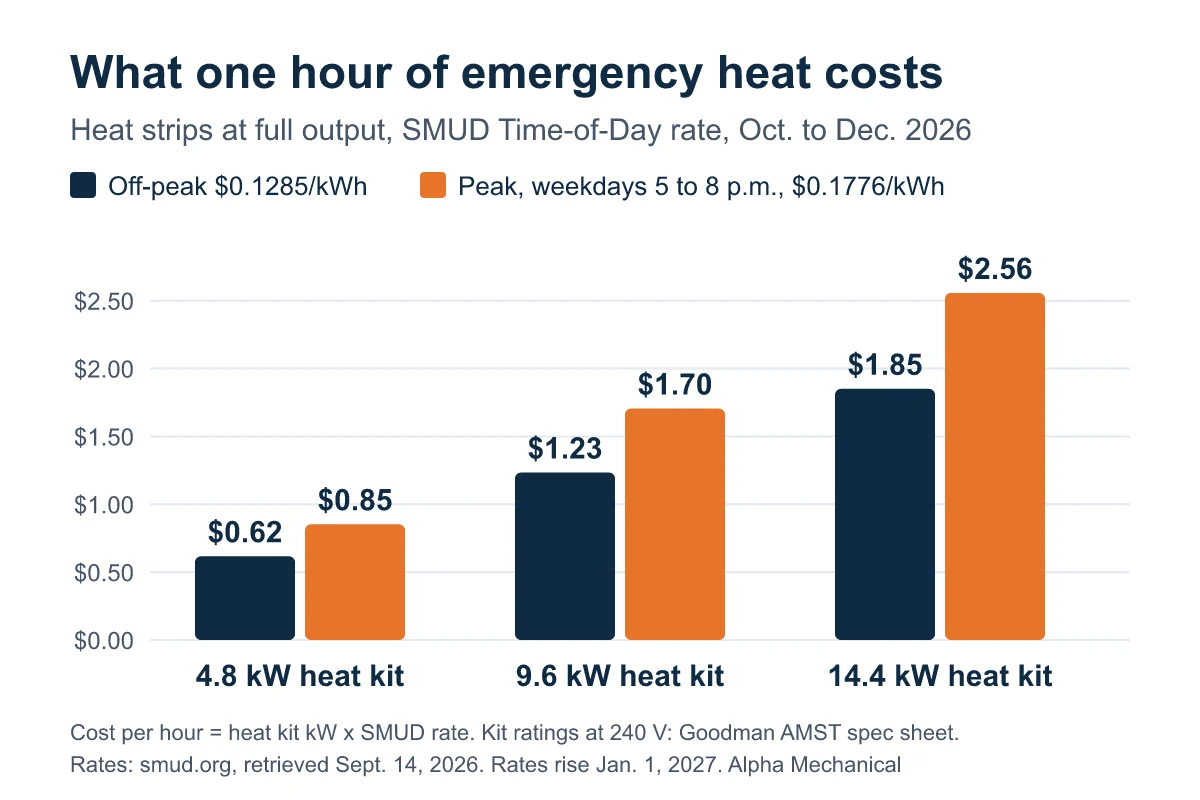
What an hour of backup heat costs on SMUD
To make that local, we multiplied three common Goodman heat kit ratings by SMUD's current Time-of-Day rate. SMUD's non-summer season runs October 1 to May 31. Through December 31, 2026, it bills $0.1285 per kWh off-peak and $0.1776 per kWh from 5 to 8 p.m. on weekdays (SMUD residential rates, retrieved September 14, 2026). SMUD's adopted R-TOD rate schedule raises those to $0.1324 and $0.1829 on January 1, 2027, so January through May bill at the higher rate.
| Heat kit (Goodman rating at 240 V) | Cost per hour, off-peak / peak |
|---|---|
| 4.8 kW ("5" kit) | Off-peak / peak: $0.62 / $0.85 through Dec 2026; $0.64 / $0.88 from Jan 2027 |
| 9.6 kW ("10" kit) | Off-peak / peak: $1.23 / $1.70 through Dec 2026; $1.27 / $1.76 from Jan 2027 |
| 14.4 kW ("15" kit) | Off-peak / peak: $1.85 / $2.56 through Dec 2026; $1.91 / $2.63 from Jan 2027 |
This is our arithmetic: kit rating times the SMUD rate, for each hour the strips run at full output. Kit ratings come from Goodman's AMST spec sheet. Peak means weekdays from 5 to 8 p.m. SMUD's monthly fixed charge ($27.00 in 2026, $27.80 from January 2027) does not change with run time, so it is left out. If another utility supplies your electricity, multiply the kit's kW rating by your own price per kWh.
How a working heat pump compares
For an hour of the same 9.6 kW of heat, a heat pump working at ENERGY STAR's "up to three times" figure would draw about 3.2 kWh. That is roughly $0.41 off-peak, a best case: Carrier notes standard heat pumps begin to lose efficiency below 25 to 30°F. Over a month, the hours add up. For example, on EM heat a 9.6 kW kit running three hours a night for 30 nights uses about 864 kWh, around $111 at the 2026 off-peak rate and $114 at the 2027 rate.
In SMUD territory, a heat pump's whole heating cost lands on the SMUD bill. Our Sacramento heating bill guide walks through both utility bills.
What Mild Sacramento Winters Mean for Aux Heat
NOAA's 1991 to 2020 climate normals for Sacramento Executive Airport put the average daily low at 38.5°F in December and 39.2°F in January (NOAA NCEI data (JSON), retrieved September 14, 2026). No month's normal low falls below freezing.
Two common thermostat defaults sit close to those lows, and the brands handle them differently.
- Nest Learning Thermostat (4th gen): Google's Nest Pro setup guide lists 40°F as the default aux lockout when the installer chooses custom aux heat settings instead of Heat Pump Balance. That default sits just above Sacramento's normal December and January lows, so it can allow aux heat on an ordinary December night.
- ecobee: the default compressor minimum outdoor temperature is 35°F, and below it ecobee says the compressor will not run. That default sits below those normal lows, so on a night at the normal low the heat pump is still allowed to run.
That does not mean you should change the setting yourself. ecobee says threshold changes are made on the thermostat, not in the app, and recommends asking the heat pump manufacturer for the safest setting before changing the compressor minimum outdoor temperature. Trane says a technician configures aux heat. If you want those limits checked, a setup review against your equipment's specs is part of our smart thermostat installation work.
The climate point cuts the other way for backup heat. A working heat pump should not need emergency heat at all, and American Standard notes that on a heat pump sized correctly for its climate, the electric strips "may seldom come into play." If you find yourself on EM heat for days at a time, the heat pump needs repair.
When to Switch to Emergency Heat, and When Not To
Switch to emergency heat when the heat pump has stopped heating and you need warmth until a technician arrives. To check whether your system has it, Google's Nest help says to look for a switch or button labeled "Emergency," or a terminal labeled E with a wire in it. On Nest thermostats, Google's instructions put it in the Settings menu. American Standard says it "should only be used in an emergency," such as when the heat pump "breaks down and stops working altogether."
Use emergency heat when:
- The outdoor unit will not run, and the house is getting cold.
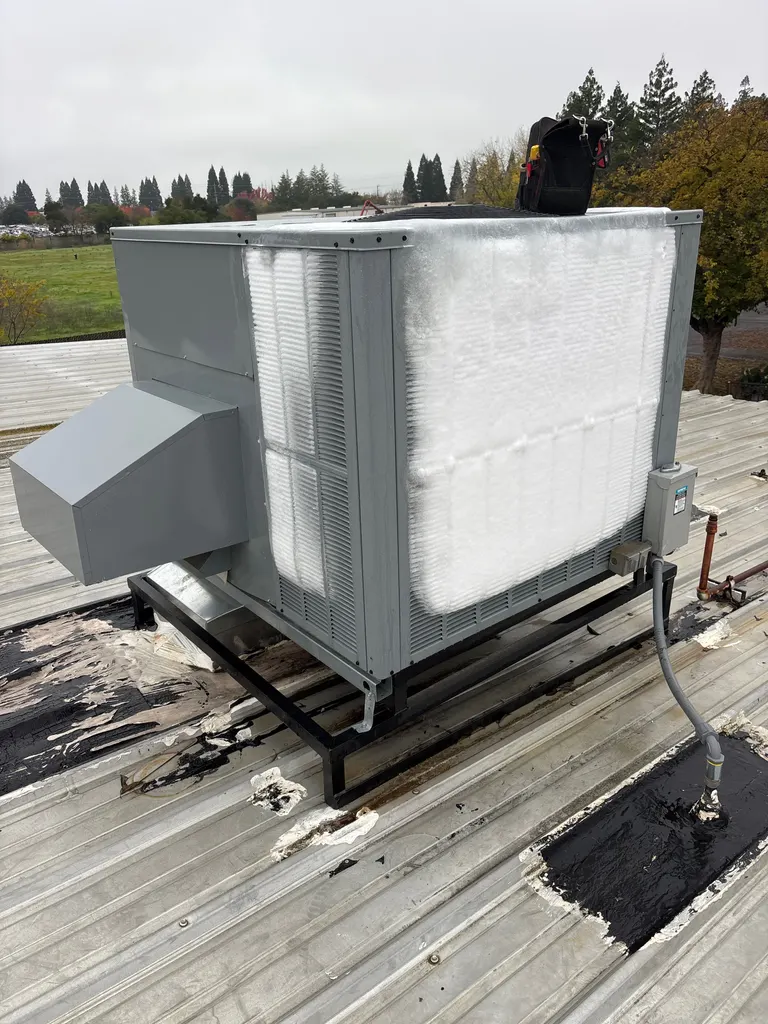
- The outdoor coil is buried in ice that is not clearing through defrost cycles. Carrier gives heavy ice that won't melt as an example.
- A technician tells you to run it until the repair.
Do not use emergency heat when:
- The house is just slow to warm up. Aux heat already helps when it is needed.
- You see steam off the outdoor unit on a cold morning. That is usually defrost.
- You want faster heat. Carrier calls EM heat on a working heat pump "an efficiency killer."
After switching to EM heat, book the heat pump repair and switch back once the heat pump is fixed. Google's Nest help notes the thermostat keeps using emergency heat "until you manually turn it off." Needing it regularly, Nest adds, means the system may need service.
If emergency heat blows cold air too, switch it off and call. The backup circuit has likely failed as well, and that is 240-volt work for a technician. Do not open the air handler.
Dual-Fuel Homes: Your Backup May Be a Gas Furnace
In a dual-fuel system, "aux" or "alt" heat is usually a gas furnace, not electric strips. Carrier notes the aux source in dual-fuel systems "might be a gas furnace or oil furnace." When the furnace runs, the heat pump shuts off, per Lennox.
That changes the cost question. American Standard says furnace backup costs "may or may not be more, depending on the cost of electricity vs natural gas in your area." In SMUD territory, backup gas is billed by PG&E and the heat pump's power by SMUD.
Some thermostats also behave differently on dual fuel. Google's Nest help says a Nest Thermostat E set up for dual fuel shows "Alt heat" and offers no emergency heat option. Heat Pump Balance is not available on dual fuel, per Nest's Heat Pump Balance page; the lockout is set by hand.
If you are weighing a heat pump against keeping gas, our heat pump vs. gas furnace guide for Sacramento compares the options.
What We Find on Aux and Emergency Heat Calls
Four calls from our Housecall Pro records for the 2022 and 2023 winters show three patterns: nothing was wrong, the backup heat lost airflow, or the electrical side needed work. Each is anonymized to the city:
Fair Oaks, February 2023: AUX on the first-floor thermostat. The homeowner called because the thermostat showed an Aux indicator. The technician found nothing to repair. The visit was spent explaining how auxiliary heat works in a heat pump system.
Rancho Cordova, March 2023: a blown backup heat fuse and no airflow. A rooftop heat pump had blown the fuse feeding its auxiliary heat strips. The indoor fan motor was not running and the air filter was plugged. The technician replaced the filter, the aux power fuse, and the indoor motor starter, found overheating damage at the fuse pullout, and noted that the unit's power disconnect would need replacing if the fuse blew again. Heat strips need steady airflow, and a plugged filter cuts it. Our HVAC filter location guide shows where to look.
Citrus Heights, February 2022: a heat strip too large for its circuit. The technician replaced the Goodman heat strip in a rooftop unit and noted that its 50-amp breaker was undersized for a 10 kW strip, which needs 60 amps. Two days later, the crew replaced the 10 kW strip with an 8 kW strip, because the existing circuit was not strong enough for 10 kW. A heat kit's kW rating sets both the heat you get and the electrical load, so the two have to match.
Sacramento, February 2023: no heat from the backup. A rooftop unit was not heating. The technician replaced the heat strip time-delay relay and repaired burned wiring. When emergency heat blows cold, the backup circuit itself is the suspect.
When Aux Heat Means It Is Time to Call for Service
Call for service when aux heat runs in mild weather, stays on above your aux trigger temperature, or you need emergency heat to stay warm. Carrier says aux heat running above 40°F "may indicate a dirty air filter, a refrigerant leak, a malfunctioning sensor, or that the thermostat was raised too quickly."
Check these first:
- The setpoint. Did someone raise it several degrees? Wait for the house to catch up.
- The filter. A clogged filter cuts airflow, as the Rancho Cordova call shows.
- The outdoor unit. Is it running? Is the coil clear, or is it holding solid ice?
Past those checks, the likely causes are refrigerant, sensors, defrost controls, and 240-volt heat strip circuits. Those need a technician. Our heat pump problems guide covers the wider list of symptoms.
If you rent, the repair is the owner's to authorise and pay for, and running on emergency heat in the meantime raises the bill rather than the rent. Heater not working in an apartment or rental sets out who is responsible and how fast the repair is owed.
Alpha Mechanical's diagnostic is a flat $89, credited to the repair. We often book no-heat calls the same weekday, or the next business day in peak weeks, across the Sacramento metro, including Citrus Heights, Rancho Cordova, Fair Oaks, and Sacramento. Book heating repair and tell us what the thermostat shows.
If the heat pump is near the end of its life and runs on strips every winter, heat pump replacement is the conversation to have next.
Frequently Asked Questions
Is it okay to run emergency heat?
Yes, until the heat pump is repaired. It can keep the house warm but costs more per hour, because electric strips make one unit of heat per unit of electricity. Book a repair and switch back to Heat once the heat pump is fixed.
What is the difference between aux heat and emergency heat?
Aux heat turns on automatically and, with electric strips, runs alongside the heat pump. Emergency heat is switched on by you and shuts the heat pump off. Both usually use the same backup heat strips or furnace.
At what temperature should a heat pump switch to aux heat?
It depends on the equipment and the thermostat setup. Carrier puts a typical balance point "often around 30-35°F," and Nest's example lockout is 40°F. In Sacramento, where normal December and January lows are 38.5°F and 39.2°F, have an installer set the lockout from your heat pump's specs.
Does aux heat run up your electric bill?
It can. Google's Nest help says AUX heat "can cost about 2 to 5 times as much as running your heat pump." On SMUD's non-summer rate for October to December 2026, a 9.6 kW heat kit costs about $1.23 an hour off-peak by our arithmetic, and $1.27 from January 2027.
Why is my heat pump on aux heat when it's not cold outside?
Short aux runs during defrost or after a big setpoint change are normal. Long runs above about 40°F with no setpoint change point to a filter, refrigerant or sensor problem, so have it checked.