

A Sacramento heating bill usually lands on two statements, PG&E for the gas the furnace burns and SMUD for the blower, and December and January raise it on their own: they are PG&E's winter on-peak gas season and carry about 45% of the year's heating demand. If the same month is up roughly 20% to 40% year over year in similar weather, check the furnace next, where a restricted filter, leaking ducts, short cycling and a system running below its rating are the usual suspects.
If your heating costs jumped and your SMUD statement looks close to normal, you are not imagining it. If you heat with a gas furnace, that gas is billed by PG&E, not SMUD. The furnace burns fuel on one utility's bill and runs its blower on the other's, so a cold month splits the damage across two statements that arrive at different times.
- Your Heating Bill Is Split Across Two Utilities
- Sacramento Is Gas Baseline Territory S
- December and January Are Both the Coldest and the Most Expensive
- What SMUD's Winter Rate Actually Costs
- Separate the Weather From the Furnace
- Four Furnace Faults That Bill You Instead of Breaking
- In California, a Furnace Replacement Triggers a Duct Test
- Thermostat Settings Are a Smaller Lever Than You Think
- Quick Reference: Where the Money Goes
- What This Looks Like Around Sacramento
- Frequently Asked Questions
That split is the first thing to check, and it is the reason national "high heating bill" articles do not describe what a Sacramento homeowner actually sees.
Key Takeaways
- Sacramento heating usually lands on two bills: PG&E for the gas the furnace burns, SMUD for the electricity the blower and controls use.
- Sacramento County sits in PG&E gas baseline Territory S, and December and January are billed as a separate "winter on-peak" season with their own baseline allowance.
- Those two months are also Sacramento's coldest. December and January carry 1,089.6 of the 2,436.1 annual heating degree days at Sacramento Executive Airport, roughly 45% of the year's heating demand in two billing periods.
- SMUD's 5 to 8 p.m. peak still exists in winter, but at $0.1776 per kWh against a $0.3765 summer peak. Winter bills are driven by run time, not by timing.
- Before assuming the furnace failed, compare the same month year over year. Season boundaries, baseline changes and weather move a bill without any equipment fault.
Your Heating Bill Is Split Across Two Utilities
SMUD provides electric service to approximately 900 square miles, including most of Sacramento County (SMUD service area, retrieved September 4, 2026). Natural gas across that same footprint comes from PG&E, whose gas Schedule G-1 "applies everywhere within PG&E's natural gas Service Territory" (PG&E Gas Schedule G-1, effective September 1, 2026).
If you heat with a gas furnace, the fuel cost lands on PG&E and the electricity to move the air lands on SMUD.
That matters for diagnosis:
- If your SMUD bill looks normal and your costs still went up, read the PG&E statement. For a gas-heated house, that is where winter lives.
- If you have a heat pump, the whole heating cost is on SMUD and there may be no meaningful gas usage at all. Heat pump owners see a completely different bill shape. When the thermostat shows AUX or EM heat, electric backup strips are running, and emergency heat vs. aux heat shows what an hour of that costs on SMUD's rate.
- A dual-fuel system moves the cost between the two bills depending on outdoor temperature, so looking at either statement alone will mislead you.
If you are not sure which you have, how a heat pump works covers the difference, and central heating and cooling systems explained covers how a gas split-system is put together.
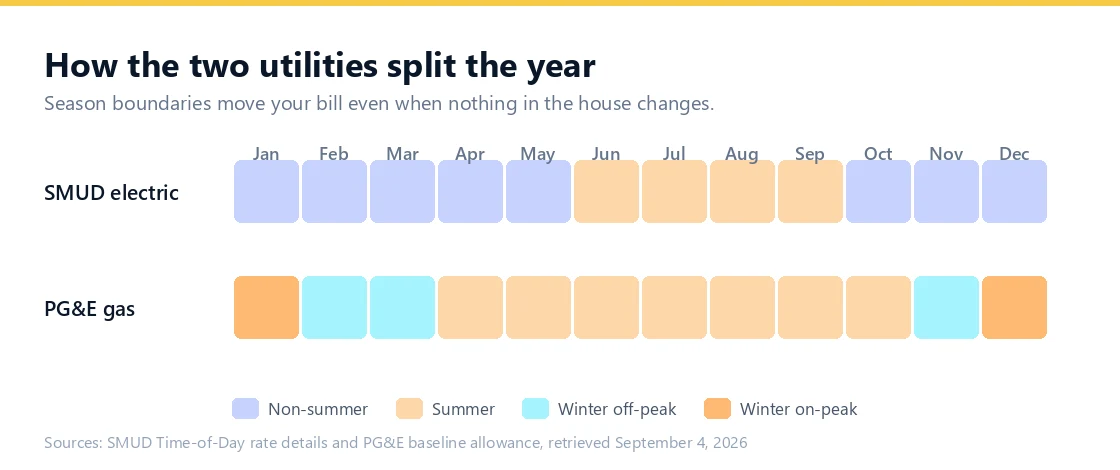
Sacramento Is Gas Baseline Territory S
PG&E divides its territory into baseline zones, and each zone gets a daily allowance of therms billed at the lower baseline rate. PG&E's gas tariff assigns Sacramento County, all elevations, with no split, to Territory S (PG&E Gas Preliminary Statement Part A). Fair Oaks, Citrus Heights and Rancho Cordova are all inside Sacramento County, so they are Territory S too.
PG&E splits the gas year into three seasons, not two, and the Territory S allowance changes with each:
| Season | Months | Baseline allowance (therms/day) |
|---|---|---|
| Summer | April – October | 0.39 |
| Winter off-peak | November, February, March | 1.38 |
| Winter on-peak | December, January | 1.94 |
Allowances published in PG&E Gas Schedule G-1. As of the rate sheet effective September 1, 2026, the residential gas transportation-plus-procurement total is $2.37256 per therm at baseline and $2.87568 per therm above it: a $0.50312 penalty on every therm past the allowance. A Public Purpose Program surcharge is billed separately, so those figures are the tariff rate rather than your all-in bill rate.
This is the part most homeowners never see. A cold December does not raise your bill in a straight line. It pushes you over a threshold, and the slope gets steeper after that.
Worked through on those published rates, for a 31-day December in a house that burns 90 therms:
| Therms | Rate | Cost | |
|---|---|---|---|
| Baseline allowance (1.94 × 31 days) | 60.14 | $2.37256 | $142.68 |
| Everything above it | 29.86 | $2.87568 | $85.87 |
| Total | 90.00 | $228.55 |
Had all 90 therms billed at the baseline rate, the same gas would have cost $213.53. The therms past the allowance add $15.02 purely because of which side of the threshold they fall on. That is our arithmetic on PG&E's published rates, with each line rounded to the cent and the total computed on the unrounded figures. Your statement will not match it to the cent, the tariff also carries a $0.13151 per day minimum transportation charge, a separately billed Public Purpose Program surcharge, taxes, and a $46.26 annual California Climate Credit, but the shape is what matters.
December and January Are Both the Coldest and the Most Expensive
The tariff seasons are not arbitrary. They line up with the weather almost exactly.
NOAA's 1991–2020 climate normals for Sacramento Executive Airport put the average daily minimum at 38.5°F in December and 39.2°F in January, the two coldest months of the year. Measured in heating degree days, the standard index of how much heating a month demands. December carries 550.2 and January 539.4, against an annual normal of 2,436.1 (NOAA NCEI U.S. Climate Normals, 1991–2020 monthly and annual/seasonal datasets, station USW00023232, retrieved September 4, 2026). That is one airport station rather than a county average, but it is the long-run reference the forecasts use.
Dividing those out, our arithmetic on NOAA's published normals, about 45% of the station's entire annual heating demand falls in the two months PG&E bills as winter on-peak. The coldest weather and the tightest billing season arrive together, which is why a December statement can look nothing like a November one even in a house where nothing has changed.
For context on where this sits nationally, the U.S. Energy Information Administration's Winter Fuels Outlook forecast that households in the West heating with natural gas would spend $600 across November through March, against $1,117 for households heating with electricity (EIA Winter Fuels Outlook 2025–26, published October 15, 2025). Those are five-month totals for the full heating season, not monthly figures, and they are the most recent edition, EIA publishes the next one with its October outlook.
What SMUD's Winter Rate Actually Costs
SMUD's Time-of-Day (5 to 8 p.m.) rate divides the year into two seasons. The non-summer season covers January 1 through May 31 and October 1 through December 31, the whole heating season.
| SMUD Time-of-Day (5 to 8 p.m.) | Non-summer (Oct 1 – May 31) | Summer (Jun 1 – Sep 30) |
|---|---|---|
| Peak, 5 to 8 p.m. weekdays | $0.1776 / kWh | $0.3765 / kWh |
| Mid-peak | not applicable | $0.2139 / kWh |
| Off-peak | $0.1285 / kWh | $0.1550 / kWh |
Rates published by SMUD for 2026 (SMUD Time-of-Day rate details, retrieved September 4, 2026). Weekends and holidays bill at the off-peak rate all day.
Two things to check on your own statement before reading anything into those numbers. First, which plan you are on: SMUD offers a Fixed Rate plan alongside Time-of-Day, and the plan name is printed on your bill. Second, both plans carry a $27 monthly System Infrastructure Fixed Charge (SMUD residential rates) that you pay regardless of usage. In a mild month that flat charge is a large share of the bill, and none of it is your furnace.
The peak window still exists in winter, but it costs less than half what it costs in summer. Homeowners who trained themselves to avoid 5 to 8 p.m. in July often assume the same discipline is doing heavy lifting in January. It is not. In winter the size of your bill is driven far more by how many hours the system runs than by which three hours it runs in, and for a gas furnace, most of that cost is not on the SMUD bill at all.
That is the reverse of the summer situation, where the peak rate is the whole story. We cover that case separately in why your electric bill is so high in summer.
Separate the Weather From the Furnace
Before spending money on a diagnosis, do the comparison that actually isolates the equipment.
Compare the same month, year over year. January 2026 against January 2025 holds the season and the baseline period steady, so what is left is weather, rate changes and your equipment. January against November holds nothing steady, it crosses a PG&E season boundary, a baseline change, and about 200 heating degree days (NOAA's November normal at the same station is 335.3 against January's 539.4). Year over year does not control for the price itself, which is the next thing to check.
Then adjust for how cold it actually was. Weather is the single largest source of uncertainty in national heating forecasts. In December 2025, NOAA expected the month to run about 8% colder than the average of the previous ten Decembers, and EIA revised its winter household expenditure forecasts upward on that basis (U.S. Energy Information Administration, December 15, 2025).
Rates move too. Over that same stretch, the wholesale spot price of natural gas at Henry Hub went from near $3.00 per million British thermal units when EIA formed its October forecast to more than $4.00 by late November (EIA, December 15, 2025). A bill can rise without a single thing changing inside your house.
How we triage it. The thresholds below are the ones we act on in our own service calls, not a published standard. Treat them as a starting rule:
- Same month year over year, similar weather, usage up around 10% or less: normal drift. Nothing to chase.
- Usage up roughly 20% to 40% with no change in household size or schedule, worth a maintenance visit. The causes below are the usual suspects.
- Usage up sharply, or a large jump in a mild month: the system is running when it should not be, or running far longer than it needs to. That is a diagnostic call.
Four Furnace Faults That Bill You Instead of Breaking
A furnace rarely announces that it has become expensive. In our experience these four raise run time without ever triggering a no-heat call, which is how they survive whole seasons unnoticed.
A restricted air filter
A clogged filter chokes airflow across the heat exchanger. The furnace makes less usable heat per cycle, so it runs longer to satisfy the same thermostat setting, and the blower works harder the entire time. ENERGY STAR's maintenance guidance is to "inspect, clean, or change air filters once a month in your central air conditioner, furnace, and/or heat pump," noting that "a dirty filter can increase energy costs and damage your equipment, leading to early failure" (ENERGY STAR Maintenance Checklist).
The failure mode is silent until it is not: severe restriction can trip the high-limit switch and shut the furnace down mid-cycle. If you are not sure where yours is, we mapped the common locations in where the HVAC filter is located.
Leaking ducts
This is the big one in Sacramento. In the homes we service across Sacramento County, ductwork routed through an unconditioned attic or crawlspace is the norm rather than the exception. Every supply-side leak dumps heated air into a space you are not trying to heat, and every return-side leak pulls cold attic air into the system.
ENERGY STAR puts the scale of it plainly: "in a typical house, however, about 20 to 30 percent of the air that moves through the duct system is lost due to leaks, holes, and poorly connected ducts" (ENERGY STAR Duct Sealing). The furnace is working correctly. The delivery is not.
We cover the local specifics in leaky ducts in Sacramento homes, and sealing and repair sit on our ductwork services page.
Short cycling
A furnace that starts, runs briefly and shuts off before the house warms burns its least efficient minutes over and over. Startup is the least efficient part of a heating cycle, and short cycling is nothing but startups. Causes range from an oversized system to a dirty flame sensor to a failing limit switch, and the fixes are not interchangeable, which is why the diagnosis matters more than the symptom. Our furnace short cycling guide sorts those causes by how long the furnace runs before it stops.
A system running below its rating
Efficiency ratings describe a furnace in good condition. Soot on a heat exchanger, drifting gas pressure and worn blower components all pull real-world performance below the plate. A system that used to cost what you expected and now does not has usually degraded rather than failed.
If replacement enters the picture, it is worth knowing what the efficiency bar actually is here. Under ENERGY STAR's current criteria, California sits in the U.S. South region, where a certified gas furnace must reach 95.0% AFUE or better (annual fuel utilization efficiency, the share of the fuel's heat that ends up in the house); the U.S. North bar is 97.0% (ENERGY STAR furnace criteria, retrieved September 4, 2026). Separately, the U.S. Department of Energy has finalized a federal minimum of "at least 95 percent" AFUE for residential gas furnaces taking effect in late 2028, the first update to those standards since 2007 (U.S. Department of Energy, September 2023).
Check the AFUE on your own equipment's rating plate and compare. Our replacement guidelines and the furnace replacement page cover what actually drives that decision, and what to consider when replacing an HVAC system covers the sizing questions worth asking before you collect quotes.
In California, a Furnace Replacement Triggers a Duct Test
This is worth knowing before you accept a quote, because it changes what a legitimate replacement costs.
The California Energy Commission states that "installation of a space conditioning appliance (other than a plug-in room appliance) requires a building permit," and that when a space conditioning system is altered, duct sealing requirements are triggered (CEC 2025 Single-Family HVAC). Those requirements come from the 2025 Energy Code, which the Commission says applies to buildings "whose permit applications are applied for on or after January 1, 2026" (CEC 2025 Building Energy Efficiency Standards), so the trigger is the permit application date rather than the day work begins. A duct leakage test verified by a certified ECC-Rater, the state's third-party compliance rater, is required when a space conditioning system is altered, and there are three compliance paths: total leakage at or under 10% of air handler airflow, leakage to outside at or under 7%, or sealing all accessible leaks and proving it with a smoke test and visual inspection.
Two practical consequences. First, a permitted furnace replacement here usually brings a duct leakage test with it, so the duct problem in the section above does not easily stay hidden through a change-out. The standards do carry exemptions, so ask your contractor which apply to your system rather than assuming the test is unavoidable or that it never applies. Second, a quote that skips the permit is skipping the test, and the leaks with it.
Thermostat Settings Are a Smaller Lever Than You Think
Setpoint discipline helps, but in winter it is a second-order effect next to run time and envelope losses. We keep the full treatment in the best temperature for your house in winter.
Two things worth saying here:
- Set the fan to AUTO, not ON. Fan ON runs the blower continuously, which adds SMUD kilowatt-hours around the clock without adding heat.
- A programmable or smart thermostat only saves money if the schedule matches the house. A schedule nobody follows costs more than no schedule, because it heats an empty house on a fixed timetable. Our smart thermostat installation and thermostats and zoning pages cover the setup side, and zoning is the honest answer when one part of the house drives the whole system.
Quick Reference: Where the Money Goes
| What changed | Which bill moves | Is it the furnace? | What to do |
|---|---|---|---|
| Colder-than-normal month | PG&E gas, plus SMUD for the blower | No | Compare same month year over year |
| December or January arrives | PG&E | No | Winter on-peak season and baseline change |
| Usage crosses the baseline allowance | PG&E | No | Every extra therm costs $0.50312 more |
| Restricted filter | Both | Yes | Replace filter; watch for high-limit trips |
| Leaking ducts | Both | Delivery, not the furnace | Duct inspection and sealing |
| Short cycling | Both | Yes | Diagnostic call, cause varies |
| System below its rating | Both | Yes | Tune-up first, then repair-or-replace math |
| Fan set to ON | SMUD only | No | Switch to AUTO |
What This Looks Like Around Sacramento
Housing stock changes the answer. Across the systems we service, older infill neighborhoods skew toward envelope problems, original ducts, thin attic insulation, single-pane windows in places, while newer suburban tracts more often bring a sizing or distribution problem: a two-story house on one thermostat, overheating downstairs to reach the bedrooms. That is our field pattern, not a survey.
All of it bills through the same Territory S allowance, so the same cold snap lands differently depending on the house:
- Furnace repair in Carmichael and Citrus Heights, older stock, where we most often find duct and envelope losses
- Furnace repair in Rancho Cordova and Folsom, mixed ages, where sizing and distribution questions come up more
- HVAC service in Sacramento for the city proper
- Heating service in North Highlands, where 70.4 percent of the housing predates 1980 and the duct layout is usually older than the furnace it serves
If the bill is the only symptom, start with maintenance. Our heating tune-up is a flat $99 as of September 2026, for standard residential systems in our service area, and it is the cheapest way to find out whether you have a fixable efficiency problem or a healthy furnace in a cold month. Why furnace maintenance matters explains what the visit actually catches.
If the furnace is also behaving oddly, noises, uneven heat, cycles that end early. That is a repair question rather than a billing question, and heating repair is the place to start.
Frequently Asked Questions
Why is my heating bill so high in Sacramento?
If you heat with a gas furnace, the answer is split across two utilities: PG&E bills the gas the furnace burns and SMUD bills the electricity the blower uses. A cold month raises both. Before assuming equipment failure, compare the same month year over year rather than against the previous month, because PG&E's winter on-peak gas season (December and January) and SMUD's non-summer electric season (October 1 through May 31) both change the arithmetic independently of your furnace.
What PG&E gas baseline territory is Sacramento in?
Sacramento County is baseline Territory S at all elevations, with no split, per PG&E's gas tariff (PG&E Gas Preliminary Statement Part A). The Territory S daily baseline allowance is 1.94 therms in December and January, 1.38 therms in November, February and March, and 0.39 therms from April through October. Your own territory is also printed on your PG&E statement.
Why did my gas bill jump in December when the weather barely changed?
December and January are PG&E's winter on-peak gas season, a separate billing period from November, February and March, each with its own baseline allowance. Once usage passes that allowance, every additional therm bills at the excess rate, $2.87568 versus $2.37256 as of the September 1, 2026 rate sheet, a difference of $0.50312 per therm. A December statement is not directly comparable to a November one.
Does SMUD's 5 to 8 p.m. peak rate matter in winter?
Less than in summer. SMUD's 2026 non-summer peak is $0.1776 per kWh against a $0.1285 off-peak rate, while the summer peak reaches $0.3765 per kWh (SMUD, retrieved September 4, 2026). Shifting load out of the winter peak window still helps, but total run time drives a winter bill far more than timing does, and if you heat with gas, most of the cost is not on the SMUD bill at all.
Can leaky ducts really raise a heating bill that much?
Yes. ENERGY STAR states that in a typical house "about 20 to 30 percent of the air that moves through the duct system is lost due to leaks, holes, and poorly connected ducts" (ENERGY STAR). In Sacramento that air is usually being lost into an unconditioned attic or crawlspace, so the furnace runs longer to heat rooms that never receive the full airflow.
Should I replace my furnace to lower my winter bill?
Not as a first step. A tune-up costs far less than a replacement and settles whether you have a fixable efficiency problem or a healthy system in a cold month. If the diagnosis does point to replacement, note that California requires a permit for the work, and that a permitted change-out on a ducted system usually brings a third-party verified duct leakage test with it (California Energy Commission). An ENERGY STAR certified gas furnace in California must reach 95.0% AFUE or better.
Get a Straight Answer Before the Next Statement
A high heating bill is a measurement, not a diagnosis. It could be the weather, the rate season, the baseline allowance, the ducts, the filter, or a furnace that has quietly lost a chunk of its efficiency, and those have very different price tags.
The fastest way to separate them is a heating tune-up, flat $99 as of September 2026, which puts eyes on the filter, the ducts at the equipment, the burner, the heat exchanger and the blower in one visit. Book a heating tune-up or contact us and tell us what your bill did. We will tell you whether it is your furnace or your December.