
Set your thermostat to 68°F while you are awake and at home, and set it back while you sleep or leave. That is the U.S. Department of Energy's winter recommendation, and it holds up well in Sacramento, where the heating season is mild and short. In SMUD territory there is one wrinkle worth knowing: weekday evenings from 5 to 8 p.m. bill at the peak rate all winter, and that is exactly when most households turn the heat up.
Key Takeaways
- The DOE recommends 68°F while you're awake, set back while asleep or away, and estimates you save about 1% on your heating bill for each 1°F you drop it over an eight-hour stretch (DOE Guide to Home Heating and Cooling).
- There is a floor. The WHO Housing and Health Guidelines (2018) name 18°C, about 64°F, as the safe minimum indoor temperature for general populations in cold seasons (WHO, via NLM Bookshelf). Setting back below that to save money is not a trade worth making.
- Sacramento Executive Airport records about 2,436 heating degree days a year, and December and January alone carry roughly 45% of them (NOAA NCEI 1991-2020 normals). Two months decide most of your winter heating cost.
If your furnace can't hold whatever setpoint you choose, that's a different problem, and the last section here covers where to start.
What is the best temperature for a house in winter?
68°F while you're awake and at home. The Department of Energy's own guidance is specific: "For winter time, set thermostats to 68°F when you are awake and set it back while you sleep" (DOE Guide to Home Heating and Cooling).
That single number does more work in Sacramento than it does in Minneapolis. Our winters are mild. The normal December high at Sacramento Executive Airport is 56.0°F and the normal low is 38.5°F, with January nearly identical at 56.0°F and 39.2°F (NOAA NCEI 1991-2020 normals). A correctly sized furnace holding 68°F against a 39°F night is not working hard. It cycles, it recovers quickly, and it spends most of the night off.
The same dataset explains why the setpoint argument is worth having at all here, and why it is worth having in November rather than February. Add the twelve monthly heating-degree-day normals for that station and you get 2,436 for the year. December and January alone account for 1,090 of them, about 45%. Sacramento does not have a long heating season. It has a short, concentrated one, and whatever you set in those eight weeks is most of your winter bill.
Two words worth getting straight
Setpoint is the temperature you ask the thermostat to hold right now. Setback is the amount you drop that setpoint for a defined stretch, usually overnight or while the house is empty. Nearly every dollar in this article comes from the second one, not the first.
What is a normal indoor temperature in winter, and how low is too low?
Most comfortable homes sit somewhere between 68 and 72°F during waking hours. That range is a comfort preference, not a standard, and it moves with humidity, clothing, activity, and who lives there.
What is not a preference is the floor. The World Health Organization's Housing and Health Guidelines make a strong recommendation on this. They name 18°C, about 64°F, as "a safe and well-balanced indoor temperature to protect the health of general populations during cold seasons" (WHO Housing and Health Guidelines, 2018). The same guidelines note that older adults, young children, and people with chronic cardiorespiratory illness may need it warmer than that.
So the honest answer to "how low can I go to save money" is: not below about 64°F while anyone is home and awake. A furnace that has to run longer to hold any setpoint is worth checking before the cold sets in, which is what a heating tune-up covers. Deep overnight setbacks are a different case, since bedding does the work your furnace otherwise would.
Is 72 a good temperature for heat in the winter?
It's comfortable, and it costs more than 68°F. Whether that trade is worth it is yours to make, but the DOE guide quoted above gives you the exchange rate: you save roughly 1% on your heating bill for each 1°F you set back over an eight-hour period. Holding 72°F instead of 68°F all winter is not a catastrophe. Holding 72°F around the clock, with no overnight or away setback at all, is where the money goes.
The bigger lever is the setback, not the setpoint. DOE puts the ceiling on it plainly: "You can save as much as 10% a year on heating and cooling by simply turning your thermostat back 7°-10°F for 8 hours a day from its normal setting" (Energy.gov, Home Upgrades).
What does a winter thermostat schedule look like?
Every number below is derived from two published figures and nothing else: DOE's 68°F waking setpoint, and DOE's 7° to 10°F setback band. Subtract the band from the base and you get the setback rows. Pick the one that matches your household, then let a programmable or smart thermostat run it so you aren't doing it by hand.
| Household | Awake and home | Asleep | Away 8+ hours |
|---|---|---|---|
| Empty on weekdays | 68°F | 58-61°F (7-10° setback) | 58-61°F (7-10° setback) |
| Someone home all day | 68°F | 58-61°F (7-10° setback) | n/a |
| Infant, elderly, or medically vulnerable occupant | 68°F held flat | 68°F | 68°F |
Two rules govern that table. First, the asleep and away rows sit below the WHO's 64°F floor on purpose, and that is a choice rather than a recommendation. The guidelines set 18°C as a minimum for occupied living space and carve out no exception for sleep, so an overnight setback below it is a trade you are making yourself, with bedding doing the work the furnace otherwise would. If a household member is vulnerable to cold, the third row abandons the setback entirely and holds 68°F flat. Second, DOE's estimate is an eight-hour figure, so the saving assumes a setback that actually runs about that long, asleep or away. A two-hour errand is not a setback opportunity.
Leaving for a week is the one case where the temptation is to switch the system off entirely. Don't. Pick a holding temperature well below your normal setpoint but above freezing, so the furnace isn't asked to climb twenty-odd degrees the hour you get home, and so nothing in the house that needs heat goes without it.
What does the setback cost you in SMUD territory?
One Sacramento-specific detail changes when you run the heat, not how warm you keep it. SMUD's Time-of-Day rate bills weekday 5 to 8 p.m. at $0.1776 per kWh in the non-summer season against a $0.1285 off-peak rate (SMUD Time-of-Day rate details). That 5 to 8 p.m. window is precisely when a weekday setback ends and a cold house asks for a long recovery run.
A programmable thermostat fixes this for free. Schedule recovery to begin before 5 p.m. so the bulk of the run happens off-peak, rather than letting the house call for heat at 5:30.
The one setting most Sacramento households get wrong Not the setpoint. The recovery time. A weekday setback that ends at 5:30 p.m. puts your longest heating run of the day inside SMUD's most expensive window, and it does that every weekday for the whole heating season. Moving the recovery block to 4:30 p.m. costs nothing and changes nothing about how warm the house is when you walk in.
Two caveats keep this honest. If you heat with a gas furnace, the fuel is billed by PG&E and only the blower shows up on the SMUD statement, so shifting the run time moves the smaller of your two winter bills. And the winter peak premium is modest next to the summer one, where peak reaches $0.3765 per kWh. We work the full rate math, both statements, and the December therm baselines in why your heating bill is so high in Sacramento, and the mirror-image summer version in why your electric bill spikes in summer.
Should every room be the same temperature?
No, and a thermostat only measures one of them. The setpoint you choose is the temperature at the thermostat, usually a hallway, and every other room drifts from it.
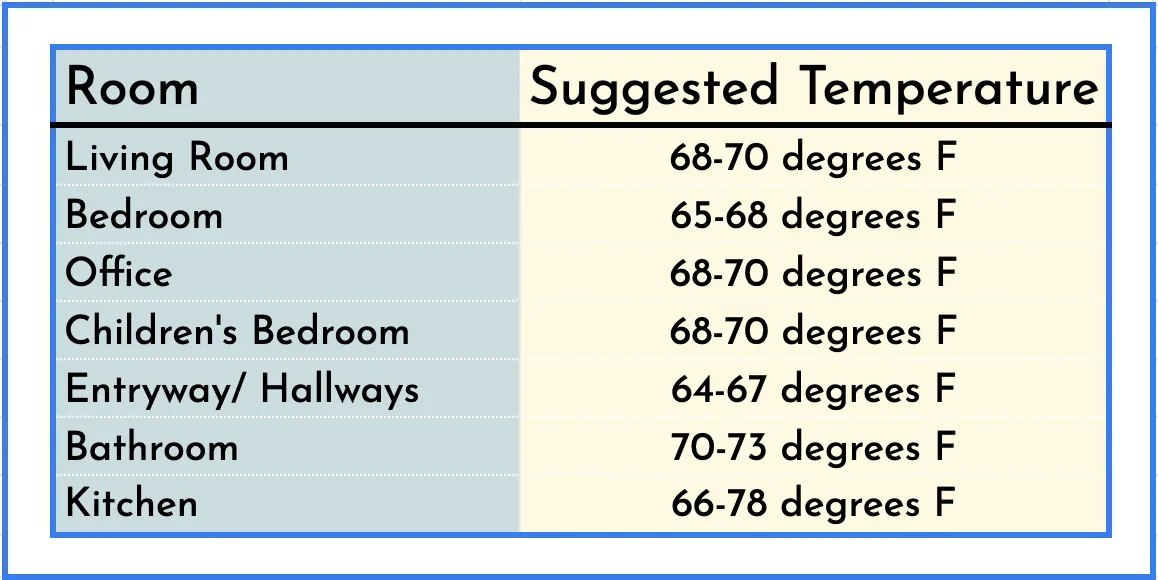
- Hallways, entryways, and storage rooms can run cooler. Nobody sits still in them.
- Bedrooms can run cooler overnight, because bedding is doing the work.
- Bathrooms feel colder than they measure, since you're stepping out of a hot shower with wet skin.
- Rooms with an infant, an elderly resident, or someone unwell should hold the higher end. The WHO guidelines flag exactly these groups as needing more than the 18°C general-population floor.
- The living room, where most waking hours happen, is the room your setpoint should actually be serving.
If the gap between rooms is large enough to argue about, the fix is airflow and control, not a higher number on the thermostat. Zoning splits the house into independently controlled areas, and we cover that under thermostats and zoning in Sacramento.
Three pieces of winter thermostat advice that don't work in Sacramento
Closing vents and doors in unused rooms. This is the most common one, and the DOE's own best-practice list says the opposite of the folk advice: "Keep air vents clean and unobstructed" (DOE). The same list names duct problems as a reason heated air "never reaches its intended destination," which is the outcome you're deliberately creating when you shut a register. If you want a room to run cooler, zone it, don't choke it.
Shopping for a cheaper electricity company. In SMUD territory the lever is the plan, not the supplier. SMUD describes itself as "your community-owned, not-for-profit electric service" and publishes four residential plans: Time-of-Day (5 to 8 p.m.) as the standard, plus optional Critical Peak Pricing, Fixed Rate, and Time-of-Day (Low Use) (SMUD residential rates). Read which one you're on before you read anything into your bill.
Radiator valves. This one is imported from colder, older housing markets. If your heat arrives through supply registers rather than through hydronic radiators, thermostatic radiator valves have nothing to attach to, and the advice is noise. The local equivalent is a zoning damper, or a ductless head in the room that never gets comfortable.
Why your house won't hold the setpoint
A thermostat is a request, not a guarantee. When a Sacramento home can't hold 68°F on a 39°F night, the cause is usually one of four things, and only one of them is the thermostat.
- The furnace is short-cycling or not completing a call. That's a diagnostic, not a settings problem. Start with our furnace troubleshooting guide.
- A dirty filter or blocked return. DOE recommends cleaning or replacing filters monthly during peak-use seasons, and notes that regular maintenance can cut heating and cooling costs by 5% to 10% (DOE).
- Duct leakage. Air that never reaches the room can't heat it. Sealing and repairing ducts is in scope for us, and we look at supply and return balance before touching the equipment.
- The system is the wrong size or at the end of its life. The same DOE guide puts it plainly: the size of a heating or cooling system determines "not only its ability to heat or cool your home, but also the size of your energy bills." Our heating repair team will tell you which of the four it is before recommending furnace replacement, and we handle heat pump repair on all-electric systems.
Making the schedule automatic
Every number in this article is easier to hold with a thermostat that runs the schedule for you. Programmable and smart models let you set the away, asleep, and recovery blocks once, which is the difference between a setback that saves up to 10% and one you forget to make on a cold Tuesday. Wi-Fi models add the ability to move the recovery time out of the 5 to 8 p.m. peak from your phone.
Alpha Mechanical installs and configures them across the Sacramento region. See smart thermostat installation in Sacramento for what's involved.
Summary
- 68°F awake, set back while asleep or away. That is DOE's winter recommendation, worth about 1% off the heating bill per 1°F over an eight-hour setback.
- Don't go below about 64°F while the house is occupied and awake. The WHO's 18°C floor is a health threshold, not a comfort preference.
- Move the recovery out of 5 to 8 p.m. if you're on SMUD's Time-of-Day plan, which is the standard residential plan. Check which of SMUD's four plans your statement names first.
- Leave the vents open. Closing registers raises static pressure; it does not save fuel.
- If the house won't hold the number, the thermostat usually isn't the problem. Filter, ducts, and equipment condition come first.
Frequently Asked Questions
What is a normal house temperature in winter?
Most households sit between 68 and 72 degrees Fahrenheit while awake, adjusted for humidity, clothing, activity, and who lives there. The floor matters more than the average: the WHO Housing and Health Guidelines name 18 degrees Celsius, about 64 degrees Fahrenheit, as the safe minimum for general populations in cold seasons.
What is the best temperature for a house in winter?
The U.S. Department of Energy recommends 68 degrees Fahrenheit while you are awake and at home, set back while you sleep or leave. In Sacramento's mild winters, where the normal December low is 38.5 degrees, a correctly sized furnace holds that setpoint without strain.
Is 72 degrees too warm for winter?
It is comfortable, and it costs more. The DOE estimates you save about 1% on your heating bill for each 1 degree Fahrenheit you set back over an eight-hour period, so the difference between 72 and 68 is real but small. Skipping the overnight and away setback entirely costs far more than the four degrees.
How low can I set the thermostat at night?
Lower than you can during the day, because bedding replaces what the furnace was doing. Applying the DOE's 7 to 10 degree setback to its own 68 degree base puts an overnight setpoint at roughly 58 to 61 degrees. If an infant, an elderly resident, or someone with a cardiorespiratory condition sleeps in the house, skip the setback and hold at least the WHO minimum of about 64 degrees instead.