
For most Sacramento homes replacing equipment in 2026, a heat pump beats a gas furnace on running cost and on net installed price once SMUD's gas-to-electric rebates are in the math. The climate is the reason: Sacramento's normal January low is 39.2°F at Sacramento Executive Airport (NOAA 1991-2020 normals), far above the 5°F point where ENERGY STAR tests cold-climate heat pumps. One heat pump also replaces two boxes, the furnace and the AC. Gas still wins in a few specific situations, and a dual-fuel setup is the answer for a home with a healthy furnace and a dying AC. This guide is written for the replacement decision, not for a system that just needs a repair.
- Quick Answer: Heat Pump vs. Gas Furnace in Sacramento
- Which Box Is Failing? The Replacement-Season Decision
- What's the Difference Between a Heat Pump and a Gas Furnace?
- What Are the Pros and Cons of a Heat Pump vs. a Gas Furnace?
- Operating Costs: Which Is Cheaper to Run in Sacramento?
- Do Heat Pumps Work in Sacramento's Cold Mornings?
- What Does a Heat Pump Conversion Cost in Sacramento?
- Worked Example: The Net Price After SMUD's Rebate
- Case Study: The "Expensive" Heat Pump That Cost $2,200 Less
- The Dual-Fuel Option: Keep the Furnace, Add the Heat Pump
- Case Study: Dual-Fuel Hybrid in Rancho Cordova
- When Should You Choose a Heat Pump vs. a Gas Furnace?
- What Does 2026 Mean for Your Heat Pump Decision?
- How Alpha Mechanical Can Help
- Frequently Asked Questions
Key Takeaways
- Heat pumps move heat, furnaces make it. An ENERGY STAR heat pump delivers roughly 2.3 units of heat per unit of electricity over a heating season (ENERGY STAR key product criteria, retrieved 2026-09-03). The best gas furnace never passes 100% because it burns fuel instead of multiplying it.
- Sacramento's winters are mild by heat pump standards. NOAA's normal January low at Sacramento Executive Airport is 39.2°F and the December normal low is 38.5°F (NOAA NCEI 1991-2020 normals, station USW00023232, retrieved 2026-09-03). ENERGY STAR's cold-climate designation requires a COP of at least 1.75 at 5°F, a temperature Sacramento does not see.
- SMUD publishes what conversions actually cost. The median gas-to-electric heat pump installation in SMUD's program is $18,804 before rebates (SMUD heating and cooling rebates, retrieved 2026-09-03). Alpha Mechanical's own ducted heat pump installs run $9,500 to $20,000 on 2026 job data; ductless systems run $4,300 to $14,300.
- The rebate is utility-led now. SMUD pays $3,000 for a variable-stage gas-to-electric conversion (SMUD heating and cooling rebates). The federal 25C credit expired December 31, 2025 (IRS). Tier details and dates live in our California heat pump rebates guide.
- Gas furnace still wins when the electrical panel is full and an upgrade is impractical, when the home has no ductwork and no appetite for a ductless system, or when the household simply wants the hottest supply air. Dual-fuel covers the case where the furnace is fine and only the AC is done.
Quick Answer: Heat Pump vs. Gas Furnace in Sacramento
| Factor | Air-Source Heat Pump | Gas Furnace + AC |
|---|---|---|
| Heating efficiency | ENERGY STAR minimum 7.8 HSPF2 (about 2.3 seasonal COP) | 80-98% AFUE; cannot exceed 100% |
| Provides cooling? | Yes, one system | No, needs a separate AC |
| Installed cost, Sacramento, before rebates | SMUD program median $18,804; Alpha's 2026 ducted range $9,500-$20,000 | No published Sacramento median; get both quotes |
| SMUD rebate (2026) | $3,000 variable-stage or $2,000 two-stage | None for a furnace |
| Federal 25C tax credit | Expired 12/31/2025 | Expired 12/31/2025 |
| Coldest-weather behavior | Cold-climate models are tested at 5°F; Sacramento's normal January low is 39.2°F | Full output at any outdoor temperature |
| Combustion in the home | None | Yes; heat exchanger inspection every heating season |
| Lifespan | Similar potential lifespans, per Carrier, driven by install quality and maintenance | Same |
If your AC is the box that failed, the cheapest 2026 path is usually a heat pump: you replace one piece of equipment, not two, and SMUD's largest rebate only applies in the gas-to-electric direction. If a working furnace is the only thing you would be swapping, the math tightens, and the operating-cost section below is where the decision gets made.
Which Box Is Failing? The Replacement-Season Decision
Replacement season in Sacramento starts with the question of which piece of equipment actually failed, because the answer changes the whole comparison.
The AC died and the furnace is old too. This is the clearest heat pump case. A furnace-plus-AC replacement means two boxes, two warranties and two installs. A heat pump is one outdoor unit, one indoor air handler, and it qualifies for the gas-to-electric rebate tier. This is the scenario the rest of this guide is built around.
The AC died and the furnace has years left. You do not have to retire a healthy furnace. A heat pump can replace the AC and take over heating on mild days while the furnace stays wired in as backup. That is a dual-fuel system, covered below. It does not earn SMUD's gas-to-electric rebate because the gas appliance stays.
The furnace died in December and the AC is fine. The temptation is a like-for-like furnace swap. Before you sign, price the heat pump anyway: if the AC went in at the same time as the furnace it is the same age, and the two-boxes-versus-one math from the first scenario applies a little later. If cash is the constraint, a furnace swap now is a legitimate choice, and the furnace replacement page covers what that involves.
The home has no ductwork. None of the ducted options apply. A ductless heat pump is its own decision with its own SMUD rule (mini-splits must serve the entire home to qualify), covered in our mini split installation cost guide and on the ductless mini-split install page.
What's the Difference Between a Heat Pump and a Gas Furnace?
A gas furnace makes heat by burning fuel. Natural gas flows into a burner assembly, ignites, and heats a metal heat exchanger. A blower pushes house air across that exchanger and into your ducts. The system is purely a heater; you need a separate AC for cooling.
A heat pump moves heat with refrigerant. The same refrigerant cycle a central AC uses runs in reverse in winter: the outdoor coil absorbs heat from outside air, the compressor concentrates it, and the indoor coil releases it into your ducts. In summer the cycle reverses and the unit cools the house like a standard AC. The Department of Energy puts the consequence plainly: modern air-source heat pumps can reduce your electricity use by 50% compared to electric furnaces and baseboard heaters (DOE, "Pump Up Your Savings with Heat Pumps", retrieved 2026-09-03).
Moving heat instead of creating it is why a heat pump's seasonal rating can exceed 100%. HSPF2 is heat delivered in Btu divided by electricity consumed in watt-hours over a test heating season; ENERGY STAR's 7.8 HSPF2 minimum for split systems divides out to about 2.3 Btu of heat per Btu of electricity. A 98% AFUE furnace, the best on the market, converts 98% of the fuel's energy into heat and stops there. That does not make a furnace bad. It means a heat pump has a structural physics advantage in any climate where it does not have to fight deep cold.
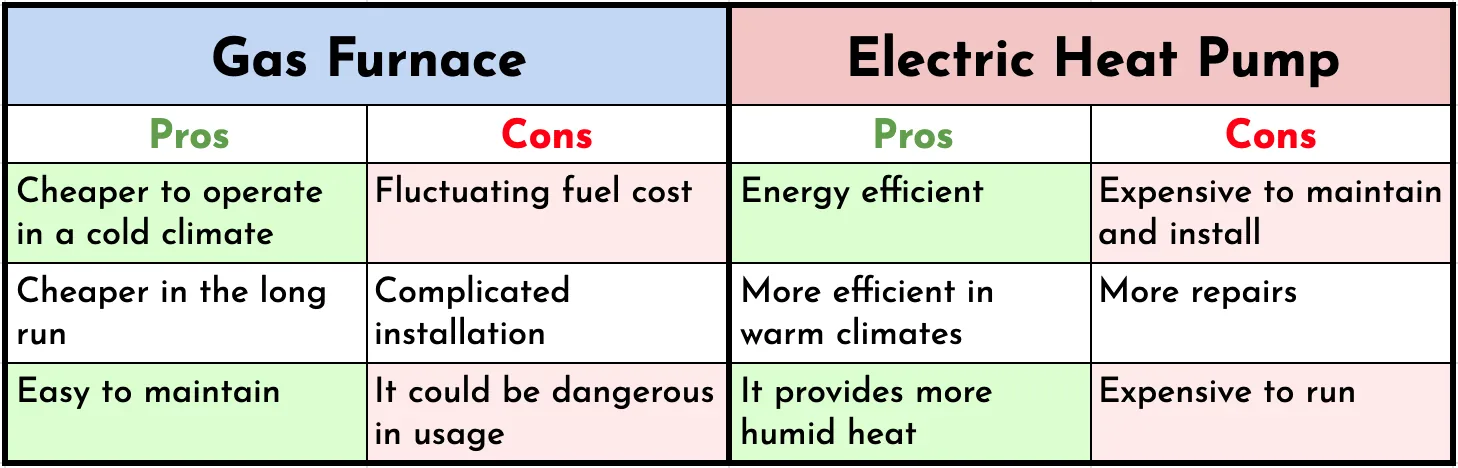
What Are the Pros and Cons of a Heat Pump vs. a Gas Furnace?
Gas Furnace: Pros
- Hot, fast supply air. Trane's own comparison describes furnace heat as "intense and dry" and heat pump air as "warm, but not as toasty," with lower temperature and gentler airflow (Trane, furnace heat vs heat pump heat, retrieved 2026-09-03). Some households prefer the furnace feel.
- Full output in any weather. A furnace does not care what the outdoor temperature is. Carrier calls gas furnaces optimal for regions with prolonged, severe cold (Carrier, heat pump vs furnace, retrieved 2026-09-03). Sacramento is not one of those regions.
- No electrical panel work. A furnace swap rarely touches the panel. A heat pump conversion sometimes does, and that is a separate electrician's job: Alpha Mechanical does not do panel upgrades.
- Lower standalone price. A furnace alone is usually cheaper than a heat pump alone. You still need an AC for Sacramento summers, which is where the comparison turns.
Gas Furnace: Cons
- Combustion in the house. A cracked heat exchanger can leak carbon monoxide into the home, and the crack is not visible from the outside. See our guide on cracked heat exchanger symptoms. When a furnace stops working, the thermostat or control board is often the real cause; the furnace won't turn on walkthrough covers the common ones.
- Gas price has climbed. The EIA's California residential natural gas price averaged about $12.9 per thousand cubic feet in 2019 and about $22.0 in 2025; the 2026 months published so far run $20.33 to $22.96 (EIA, California natural gas residential price, retrieved 2026-09-03).
- Two boxes, two maintenance schedules. Furnace plus AC means two pieces of equipment, two service visits and two sets of failure points.
- No rebate direction. SMUD's heat pump rebates only pay when a heat pump goes in. A new furnace earns nothing from the utility.
Air-Source Heat Pump: Pros
- One system, two seasons. Heating and cooling from one outdoor unit and one indoor air handler.
- Efficiency that fits the climate. Carrier's guidance is that in mild to moderate climates a heat pump is often cheaper to run because of its energy-transfer efficiency (Carrier, same page). Sacramento's normal winter lows sit in the high 30s (NOAA).
- The rebates point this way. $3,000 or $2,000 from SMUD for a gas-to-electric conversion.
- No combustion in the home. No CO risk, no flue, no gas appliance in the closet.
- Pairs with rooftop solar. Heating runs on the same electricity the panels make. SMUD publishes a solar-and-battery-storage rate component on its residential rate page, so check your rate plan before assuming the arithmetic.
Air-Source Heat Pump: Cons
- Output drops as it gets colder. Carrier notes that older heat pumps often struggled below 25-30°F and that modern cold-climate units are designed to heat down to -22°F (Carrier, same page). Sacramento's normal lows never approach those numbers, but a standard unit will lean on electric resistance strips on the rare hard-freeze morning.
- More moving parts than a furnace. Reversing valve, defrost control, outdoor fan and compressor all run year-round. A lost refrigerant charge stops heat production entirely. See top heat pump problems for what tends to go wrong.
- Higher unsubsidized sticker. Refrigerant piping, a 240 V circuit and sometimes a panel upgrade make the install more involved than a like-for-like furnace swap. The rebates exist because the sticker is higher.
- Install quality matters more. Correct refrigerant charge, airflow and duct sizing decide whether a heat pump delivers its rated efficiency. A bad heat pump install is more punishing than a bad furnace install.
Operating Costs: Which Is Cheaper to Run in Sacramento?
The honest way to answer this is per unit of heat delivered, on the rates Sacramento households actually pay, with the assumptions shown.
The electricity side. SMUD's published residential Fixed Rate is $0.1371 per kWh in the non-summer period (October 1 to May 31) and $0.2189 in summer. On the Time-of-Day rate the non-summer prices are $0.1285 off-peak and $0.1776 during the weekday 5 to 8 PM peak. Both plans carry a $27 monthly System Infrastructure Fixed Charge (SMUD residential rates, retrieved 2026-09-03).
The gas side. EIA's California residential price for the 2026 months published so far is $20.33 to $22.96 per thousand cubic feet (EIA, California natural gas residential price). EIA's own heat content figure is 1,036 Btu per cubic foot (EIA, units and calculators), so a thousand cubic feet is about 10.36 therms and that is roughly $1.96 to $2.22 per therm at the meter, before any fixed charge on the gas bill.
Cost to deliver one therm of heat into the ducts (100,000 Btu, the same amount of warmth either way). Gas priced at the $2.09 midpoint; heat pump electricity at 29.3 kWh of heat per therm divided by the COP.
| System | Assumption | Cost per therm of heat delivered |
|---|---|---|
| Gas furnace, 80% AFUE | $2.09 per therm of gas | $2.61 |
| Gas furnace, 95% AFUE | $2.09 per therm of gas | $2.20 |
| Heat pump at seasonal COP 2.3 (ENERGY STAR minimum, colder test region) | SMUD Fixed Rate, non-summer $0.1371 | $1.75 |
| Heat pump at seasonal COP 2.3 | SMUD Time-of-Day off-peak $0.1285 | $1.64 |
| Heat pump at seasonal COP 2.3 | SMUD Time-of-Day peak $0.1776 (weekdays 5-8 PM) | $2.26 |
| Heat pump at COP 3.0 (a variable-speed unit in mild weather; assumption, not a rating) | SMUD Fixed Rate, non-summer $0.1371 | $1.34 |
What the table says. At SMUD's non-summer Fixed Rate of $0.1371 per kWh, a heat pump at a seasonal COP of 2.3 delivers one therm of heat for about $1.75, against about $2.20 for a 95% AFUE gas furnace and $2.61 for an 80% furnace at the $2.09 midpoint gas price. Put another way, the heat pump only has to average a COP above about 1.8 to beat a 95% furnace on fuel cost per unit of heat, and above about 1.5 to beat an 80% furnace. ENERGY STAR's floor for a cold-climate unit at 5°F is 1.75, and Sacramento's coldest normal month, December, averages 47.3°F (NOAA). The one place gas wins on this table is the 5 to 8 PM weekday peak on the Time-of-Day plan, which is an argument for a thermostat schedule that pre-warms the house before 5 PM, not an argument for a furnace.
What the table leaves out. It excludes both utilities' fixed monthly charges; if a conversion lets you close the gas account, the gas fixed charge disappears too, and we have not quantified that here. It also assumes the same duct losses either way. Your own numbers depend on the home's heat loss and on the specific unit's rated performance, which a contractor should model for both options before quoting.
Three caveats that survive any table:
- Stay length matters. Higher-efficiency equipment has a longer payback. Under five years in the home, the spread shrinks.
- Heat pumps accumulate hours faster. They work in both seasons. A labor warranty changes the lifetime cost equation, so ask what the quote includes.
- Geothermal is more efficient still, and far more expensive up front. Air-source is the practical residential choice in Sacramento.
Do Heat Pumps Work in Sacramento's Cold Mornings?
Yes. The numbers, not the folklore: NOAA's 1991-2020 normals for Sacramento Executive Airport put the January normal low at 39.2°F, the December normal low at 38.5°F, and the January mean at 47.6°F (NOAA NCEI 1991-2020 normals, station USW00023232). ENERGY STAR's cold-climate designation is tested at 5°F, where a qualifying unit must still hold 70% of its 47°F capacity at a COP of at least 1.75. Sacramento never asks that of the equipment.
The concept that matters is the balance point: the outdoor temperature at which the heat pump's output exactly matches the home's heat loss. Above it the heat pump carries the house alone. Below it, one of two things happens:
- All-electric heat pump: electric resistance strips engage as backup. They cost more to run per hour, and on a correctly sized system they only run when the outdoor temperature falls below the balance point, which Sacramento's normal winter lows rarely reach.
- Dual-fuel hybrid: the gas furnace is wired as the backup. Trane describes the hand-off directly: the heat pump handles cooling in summer and heating in fall, part of winter and spring, and when temperatures drop below the heat pump's capability the gas furnace takes over (Trane, furnace heat vs heat pump heat).
Sizing is the practical point. A heat pump chosen to carry the house at the December normal low, not at a record cold night, will spend almost the entire winter above its balance point. Oversizing to cover a night that comes once a decade costs comfort and efficiency every other night. For Sacramento, the fair comparison is heat pump versus gas furnace; a heat pump beats an electric furnace anywhere, because both run on kilowatt-hours and only one multiplies them.
What Does a Heat Pump Conversion Cost in Sacramento?
SMUD publishes the installed prices its rebate customers actually paid, refreshed from real projects and stated before any SMUD, statewide or federal incentive is applied (SMUD heating and cooling rebates, retrieved 2026-09-03):
| SMUD program installation type | Median | Minimum | Maximum |
|---|---|---|---|
| Heat pump HVAC, gas-to-electric conversion (all types) | $18,804 | $3,500 | $65,620 |
| Split system, gas-to-electric | $18,646 | $3,500 | $65,620 |
| Package unit, gas-to-electric | $19,218 | $10,000 | $49,051 |
| Ducted mini-split, gas-to-electric | $21,296 | $9,550 | $39,045 |
| Ductless mini-split, gas-to-electric | $15,980 | $3,500 | $51,814 |
| Heat pump HVAC, electric-to-electric upgrade (all types) | $17,336 | $7,250 | $44,763 |
For calibration against those program medians: our own ducted heat pump installs, the kind that replace a furnace and central AC, run $9,500 to $20,000 on Alpha Mechanical's 2026 job data, and ductless systems run $4,300 to $14,300. Both ranges are stated the same way on our heat pump replacement page. Equipment tier, installation scope, warranty terms and any duct work move a job inside those ranges.
SMUD's 2026 rebate tiers (same page). Program rules govern; the tier amounts, the dates they took effect, and the stacking rules are kept current in our California heat pump rebates guide, linked in the Key Takeaways above.
| Measure | SMUD rebate |
|---|---|
| Variable-stage heat pump system, gas to electric | $3,000 |
| Two-stage heat pump (15.2 SEER2 minimum), gas to electric | $2,000 |
| Multi-stage heat pump upgrade, electric to electric | $1,000 |
Eligibility rules that decide whether you get paid. SMUD's condensed requirements: a variable-stage or two-stage compressor at 15.2 SEER2 or better, a Title 24 pass via a HERS CF3R, new ductwork insulated to R8 or better, a connected Wi-Fi 7-day programmable thermostat, and a mini-split that serves the entire home.
The installer matters as much as the equipment. The job must be done by a contractor in the SMUD Contractor Network, who files the application for you. SMUD also notes the contractor may front the rebate and collect it from SMUD after the job. Rebates are subject to funding availability. What happens after install day is its own step: the program can send a verifier to inspect the work. Our Fair Oaks SMUD inspection job story shows one attic furnace conversion that passed.
What a gas furnace + AC costs by comparison. No published Sacramento median exists for that pairing, and Alpha Mechanical does not print a number it cannot source. The practical move is to get both quotes from the same contractor on the same visit, with the rebate math run on the heat pump quote.
Worked Example: The Net Price After SMUD's Rebate
This is arithmetic on SMUD's published figures, not a customer story. Take the program median for a gas-to-electric conversion and apply SMUD's 2026 rebate for a variable-stage system:
| Line | Amount |
|---|---|
| SMUD program median, gas-to-electric heat pump HVAC | $18,804 |
| SMUD variable-stage gas-to-electric rebate | -$3,000 |
| Net to the homeowner | $15,804 |
Against Alpha Mechanical's own 2026 ducted heat pump range of $9,500 to $20,000, the same $3,000 tier takes a $9,500 install to $6,500 before financing, and a $20,000 install to $17,000. A furnace-plus-AC quote has no utility rebate to subtract, so compare its full price against the net heat pump figure, not the sticker. Confirm with any contractor before you count on this math that the equipment tier is variable-stage, not two-stage. Financing for either path is on our financing page.
Case Study: The "Expensive" Heat Pump That Cost $2,200 Less
This is a real Alpha Mechanical job in Elk Grove, and it is a dated one: it ran while the federal 25C credit and a state heat pump incentive were both still available. The rebate lines below are the ones that applied that year, not the 2026 tiers in the worked example above.
The situation. A homeowner in Elk Grove had a 20-year-old gas furnace and AC. The AC compressor died during a July heatwave. They called for a replacement quote, assuming they would swap just the AC and keep the old furnace to save money.
The two quotes.
- Option A (Traditional): Replace the AC, keep the furnace. $14,500.
- Option B (Heat Pump): High-efficiency variable-speed heat pump system, retire the furnace. $17,800.
On sticker, Option B looked like a $3,300 splurge. They almost signed Option A.
The rebate math. Our technician ran the incentives that applied to a gas-to-electric switch in SMUD territory that year:
- SMUD gas-to-heat-pump rebate: -$2,500
- Federal 25C tax credit, still active that year: -$2,000
- A state heat pump incentive available that year and since suspended: -$1,000
The final numbers.
- Option A (Gas/AC): $14,500, no major rebates.
- Option B (Heat Pump): $17,800 - $5,500 = $12,300.
The outcome. The "expensive" heat pump ended up costing $2,200 less than the traditional system. The homeowner switched. Six months later their winter heating bills were down roughly 20%, they were no longer buying natural gas, and their rooftop solar offset much of the new electric heating load.
The lesson. Look at net price, not sticker price. In Sacramento the rebates often make the better technology the cheaper one, so ask the contractor to run the rebate math before you sign. In 2026 the federal credit is expired and the state program is suspended, so SMUD's rebate, now $3,000 for a variable-stage system, is the piece of this math that still applies.
The Dual-Fuel Option: Keep the Furnace, Add the Heat Pump
A dual-fuel (hybrid) system replaces the AC with a heat pump and leaves the existing gas furnace in place as the backup heat source. The heat pump cools in summer and heats through the mild part of the season; when the outdoor temperature falls below the heat pump's capability, the thermostat switches heating to the furnace (Trane, furnace heat vs heat pump heat). On the thermostat, that handoff can show up as aux or alt heat; emergency heat vs. aux heat explains what each setting does.
Who it fits. A home with a furnace that still has real life in it and an AC that is done. You get heat pump efficiency for most of the winter without scrapping working equipment, and you keep full furnace output for the coldest mornings.
Case Study: Dual-Fuel Hybrid in Rancho Cordova
A real Alpha Mechanical job in Rancho Cordova.
The situation. Older ducted home, working gas furnace, working AC reaching end of life. The owners wanted lower bills but did not want to rip out a furnace that still had years on it.
The choice. Replaced the AC with an air-source heat pump and wired the existing gas furnace as backup heat, a dual-fuel hybrid. The system runs as a heat pump above the balance point and hands off to gas only on the coldest mornings.
The outcome. Lower bills than the old gas-only setup, plus full furnace redundancy on the rare cold snap. For a home with a furnace that still has meaningful life left, this is often the best move: most of the heat pump efficiency without scrapping working equipment.
Why you do not see many of these in Sacramento. A hybrid keeps the gas appliance, so it earns no SMUD gas-to-electric rebate. That is the main reason dual-fuel stays uncommon here even where it fits the house well.
What it gives up. SMUD's gas-to-electric rebate, because the gas appliance stays. The electric-to-electric upgrade tier does not apply either, since the outgoing unit was an AC, not a heat pump. Confirm the current program rules with the contractor before assuming any rebate on a hybrid.
What to specify. A thermostat that supports a dual-fuel changeover temperature, and a changeover setpoint chosen from the home's balance point rather than left at a factory default. That setpoint is the whole point of the system.
When Should You Choose a Heat Pump vs. a Gas Furnace?
Choose a heat pump when:
- The AC and the furnace are both near the end, and you want one system instead of two.
- You want SMUD's gas-to-electric rebate, which pays only in this direction.
- Indoor air quality or getting combustion out of the house matters to you.
- You have or plan rooftop solar.
- The electrical panel can take a 240 V circuit, or an electrician can upgrade it at a price that still works.
Choose a gas furnace when:
- The panel is full and a service upgrade is impractical or too expensive.
- The furnace is the only failed box, the AC is fine, and cash is the constraint this year.
- The household wants the hottest possible supply air and operating cost is not the deciding factor.
Choose a dual-fuel hybrid when:
- The furnace is healthy and only the AC is dying.
- You want heat pump running costs on the mild days and gas certainty on the coldest nights.
- You cannot or will not close the gas account, but you do want a lower heating bill.
What Does 2026 Mean for Your Heat Pump Decision?
Three rule changes shape the choice this year:
- California's 2025 Energy Code applies to permit applications filed on or after January 1, 2026. The California Energy Commission describes it as expanding the use of heat pumps in newly constructed residential buildings and encouraging electric-readiness (CEC, 2025 Building Energy Efficiency Standards, retrieved 2026-09-03). New construction is being steered toward heat pumps; a replacement in an existing home is not forced, but the permit and HERS steps SMUD requires for its rebate follow the same code.
- The federal Section 25C credit expired December 31, 2025 (IRS, above). The incentives that remain for a Sacramento conversion are utility-led. GoGreen financing is a state program that connects homeowners with participating lenders; it is financing, not a rebate.
- A2L refrigerants. 2026 equipment ships on R-454B or R-32 instead of R-410A, with different service procedures. See our 2025 refrigerant mandate explainer.
For a Sacramento homeowner the net effect is simple: the heat pump remains the favored direction, and the financial case now rests on SMUD's tiers and on running cost, not on a federal credit.
How Alpha Mechanical Can Help
Whether you land on a heat pump, a high-efficiency furnace, or a dual-fuel hybrid, install quality is what decides whether the system delivers its rated efficiency. We are a Sacramento HVAC contractor, and we model both options for every replacement quote so you can see the rebate math, the running-cost math and the comfort tradeoffs side by side, on your home's numbers rather than a generic estimate.
- Current specials and rebates
- AC installation, if cooling is the only box you are replacing this year
- Heat pump installation and replacement, if one system for heating and cooling is the plan
- The furnace replacement, ductless and financing pages are linked in the sections above and in the related links below
Or contact us and we will walk you through the math for your specific home. We serve Sacramento and the surrounding communities.
Frequently Asked Questions
Is a heat pump better than a gas furnace in Sacramento?
For most Sacramento homes replacing equipment, yes. NOAA's normal January low at Sacramento Executive Airport is 39.2°F, far above the 5°F point where ENERGY STAR tests cold-climate heat pumps, and SMUD pays $3,000 for a variable-stage gas-to-electric conversion ($2,000 for two-stage). Gas still wins when the panel cannot be upgraded, when only the furnace failed and cash is tight, or when the household wants the hottest supply air.
What is cheaper to run, a heat pump or a gas furnace?
On SMUD's published non-summer Fixed Rate of $0.1371 per kWh and EIA's 2026 California residential gas price of roughly $1.96 to $2.22 per therm, a heat pump running at a seasonal COP of 2.3 delivers a therm of heat for about $1.75, against about $2.20 for a 95% AFUE furnace and $2.61 for an 80% furnace. The heat pump only needs a COP above about 1.8 to win at that rate. The exception is the weekday 5 to 8 PM peak on SMUD's Time-of-Day plan, where gas edges ahead.
Does a heat pump work in cold weather?
Yes. ENERGY STAR's cold-climate designation requires a heat pump to hold at least 70% of its 47°F capacity at 5°F at a COP of at least 1.75, and Carrier says modern cold-climate units are designed to heat at temperatures as low as -22°F. Sacramento's normal December and January lows are 38.5°F and 39.2°F. Below a unit's balance point an all-electric system uses resistance strips as backup, and a dual-fuel system hands off to the gas furnace.
How long does a heat pump last compared to a gas furnace?
Carrier's guidance is that both systems have similar potential lifespans, heavily dependent on usage, installation quality and maintenance. A heat pump runs in both seasons, so it accumulates hours faster; a labor warranty changes the lifetime cost equation. Both benefit from annual professional maintenance.
How much does it cost to replace a gas furnace with a heat pump in Sacramento?
SMUD's published median for a gas-to-electric heat pump HVAC installation in its rebate program is $18,804 before rebates, with projects from $3,500 to $65,620. Alpha Mechanical's own ducted heat pump installs run $9,500 to $20,000 on 2026 job data, with ductless systems from $4,300 to $14,300. After SMUD's $3,000 variable-stage rebate, the program median nets to $15,804. The federal 25C credit expired December 31, 2025.
Are heat pumps louder than gas furnaces?
A heat pump has an outdoor unit that runs in winter, so there is outdoor noise a furnace does not make; indoors, the air handler's blower is comparable to a furnace blower. Variable-speed models run at lower compressor speeds most of the time, which SMUD cites as a comfort and longevity benefit. If outdoor noise is a concern, ask about variable-speed models and condenser placement.
Can I keep my existing ductwork when switching from a furnace to a heat pump?
Usually yes. Heat pump supply air is warmer than the room but not as hot as furnace air, so duct sealing and insulation matter more. If new ductwork is installed as part of a SMUD-rebated job, SMUD requires it to be insulated to R8 or better, and the job must pass Title 24 through a HERS CF3R. A conversion is a sensible time to test and seal the ducts.