

A SMUD field quality control inspection is an on-site check of a finished heat pump job submitted for a SMUD rebate. The program calls it an FQC. SMUD's program administrator, Efficiency First California, sends a verifier to the house, who walks the checklist and photographs the work. On September 15, 2026, a verifier inspected one of our jobs in Fair Oaks: a gas furnace in the attic that we had replaced with a heat pump. The checklist came back 11 of 11 with the summary "NO ISSUES," and the project passed on September 28.
This post walks through that job from the first service call to the passed inspection. You will see what the house had, what we installed, the start-up numbers we recorded, and every item the verifier checked. If you are weighing a SMUD rebate for your own conversion, it shows what the program looks at after the installer leaves.
Methodology: every date, reading and checklist result below comes from our own paperwork. That means our two job records for this house, the SMUD program notices, and the verifier's exported checklist. The homeowner's name and street address are withheld.
- What Is a SMUD Field Quality Control Inspection?
- The Fair Oaks House Before: An Attic Gas Furnace
- What We Installed: A Bosch Inverter Heat Pump
- The Start-Up Numbers We Recorded
- What the SMUD Verifier Checked: All 11 Items
- Timeline: From Service Call to Passed Inspection
- What to Ask Before Your Own SMUD Heat Pump Conversion
- Frequently Asked Questions
- Planning a Heat Pump Conversion in Fair Oaks
Key Takeaways
- A field quality control inspection (FQC) is SMUD's own field check of a heat pump job submitted for a rebate. Efficiency First California, SMUD's program administrator, runs the FQC team.
- Our Fair Oaks job was selected on September 4, 2026, inspected on September 15, and passed on September 28 with all 11 checklist items complete.
- The verifier checked work a homeowner rarely sees, such as the capped gas line, the disconnect label, the line set, the condensate drain and the duct seal.
- The house kept its two-zone damper system. We replaced the attic gas furnace with a Bosch R-454B inverter heat pump and a matching attic air handler.
- SMUD pays rebates only through contractors in the SMUD Contractor Network. Handbook language announced in June 2026 bars contractors from charging for FQC corrective work.
What Is a SMUD Field Quality Control Inspection?
A SMUD field quality control inspection is a site visit that checks a heat pump installation against the program's standards after the job is submitted. It is separate from your city or county permit inspection. The permit inspection enforces the building code; the FQC checks the job against SMUD's rebate program.
SMUD's heat pump rebates come only through participating contractors. SMUD's rebate page says a qualifying system must be "installed by a participating contractor in the SMUD Contractor Network" (SMUD, Heating and Cooling Rebates, retrieved September 28, 2026). The same page sends questions about "your Field Quality Control (FQC) check" to the FQC team at Efficiency First California. We are one of those contractors, listed in the SMUD Contractor Network directory.
Here is how the check reached us. The program selects projects after they are submitted. Our notice for this job read "selected for a field quality control inspection" and said the verifier would contact the SMUD customer to schedule it. The rebate application itself says "final payment may be subject to an on-site verification by a SMUD representative."
What happens when an inspection finds a problem is covered in the program rules we work under. On an earlier job, the notice listed one corrective action and said: "You have 10 business days to address the Corrective Action." In June 2026, Efficiency First California added handbook language for network contractors: "Contractors cannot charge for FQC corrective action work."
For the rebate side of the program, including the tiers and who qualifies, our SMUD heat pump rebate guide covers the details this job story skips.
The Fair Oaks House Before: An Attic Gas Furnace
The house is in Fair Oaks, ZIP 95628, and the first visit was a service call, not a sales call. On June 15, 2026, the air conditioner needed refrigerant. We added R-410A, and the homeowner asked us for a quote on a future replacement.
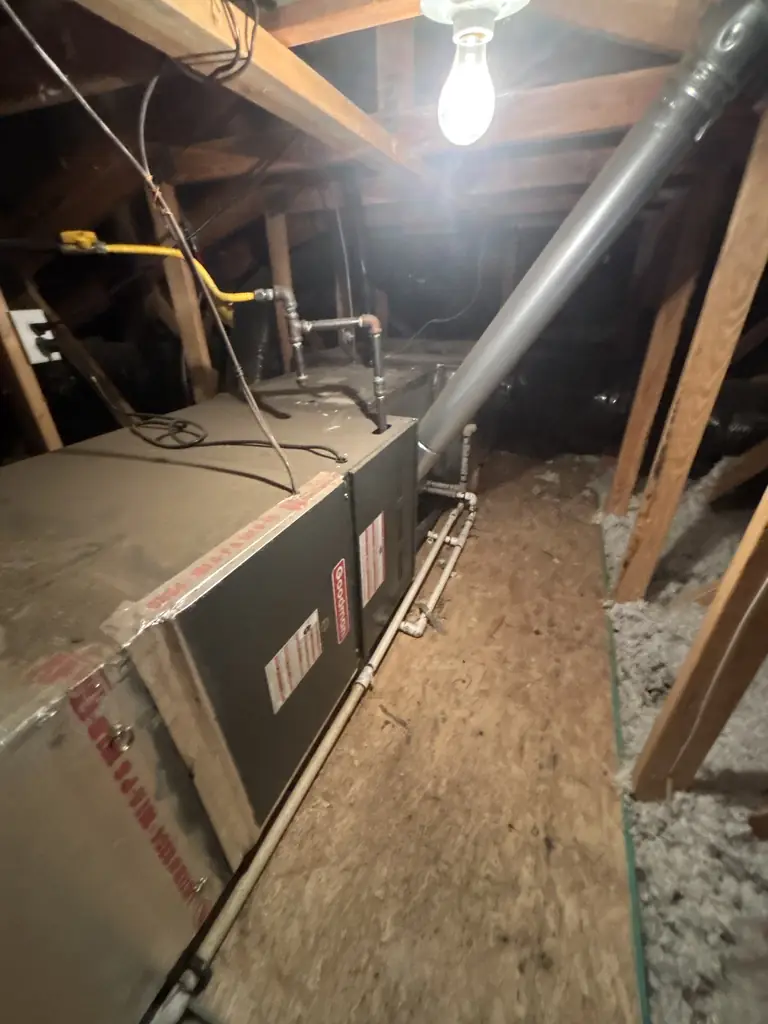
Before: the original Goodman gas furnace in the attic, June 15, 2026. The yellow line is the gas supply and the metal pipe is the flue.
Three things about the old system shaped the new one:
- Heating was a gas furnace in the attic. It lay on its side on a plywood deck. A metal flue ran up through the roof and a gas line fed the burners. Converting it meant removing the flue and capping that gas line.
- Cooling was a Goodman R-410A condenser built in 2015, going by its serial number. Its nameplate lists a 121-ounce factory charge of R-410A. New split systems cannot use that refrigerant anymore, which we explain in the next section.
- The house was zoned. A ZTech two-zone control in the attic ran motorized dampers, so two parts of the house each had a thermostat. The homeowner wanted to keep that.
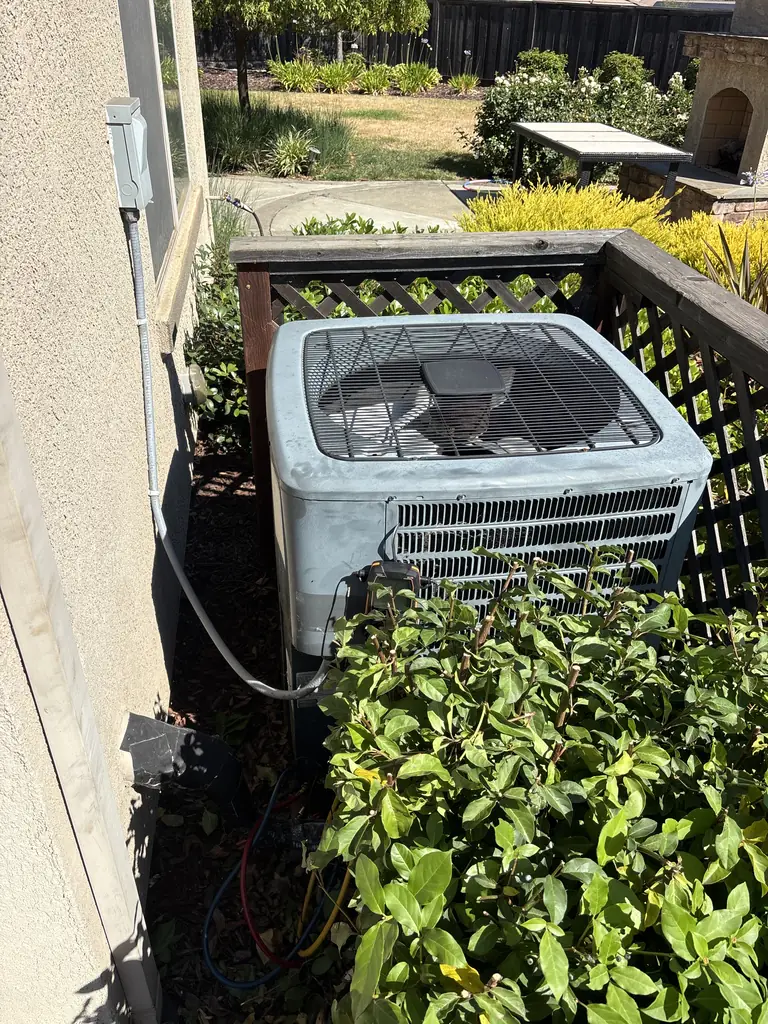
Before: the old Goodman condenser, with our gauges connected during the June 2026 service call.
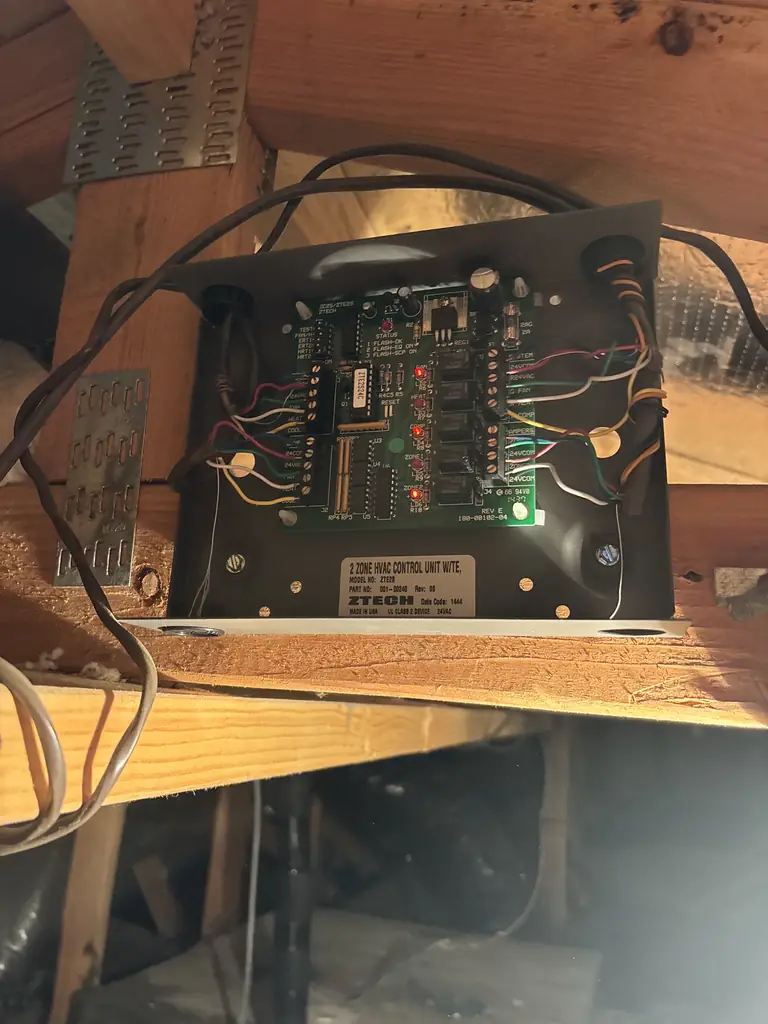
The existing two-zone control. The new heat pump reused the home's zone dampers and control, per the install order.
If you are still deciding between the two fuels, our heat pump vs. gas furnace guide for Sacramento compares them. This homeowner had decided: the next system would be electric.
What We Installed: A Bosch Inverter Heat Pump
On July 15, 2026, our crew replaced the gas furnace and the air conditioner with one heat pump system. It is a Bosch inverter outdoor unit, model BOVB-60RTB-M15S, matched to a Bosch BIVA-60RCB-M20X air handler. The air handler sits in the attic where the furnace was, so the existing ducts and zone dampers connect to it.
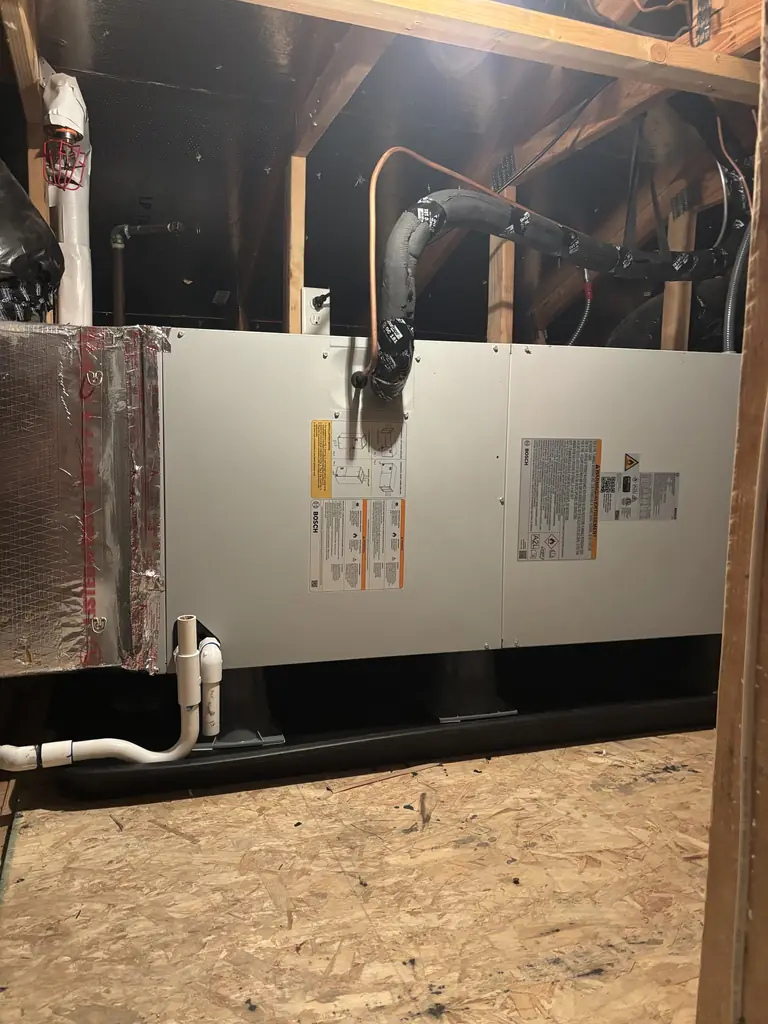
After: the Bosch air handler in the same attic spot. The flue and the gas connection are gone.
Supply house listings place model BOVB-60RTB-M15S in Bosch's IDS Light series, an inverter ducted split heat pump. Bosch describes the R-454B IDS Light as having a "Fully-modulating inverter drive" (Bosch Home Comfort, Inverter Ducted Split Heat Pump, retrieved September 28, 2026). An inverter compressor changes speed instead of switching fully on and off. SMUD calls that class "variable-stage."
We are not quoting a single SEER2 figure here. Efficiency depends on the matched indoor unit, and published listings for this condenser disagree. What we can say is that SMUD's minimum requirements include "≥ 15.2 SEER2," and the pass notice says the project "met all program qualifications and standards."
The refrigerant changed too. The EPA's Technology Transitions rule sets a 700 GWP limit for new residential split systems (EPA, Technology Transitions restrictions by sector). GWP is global warming potential. Equipment built or imported before January 1, 2025 can still be installed, since a May 2026 final rule removed the earlier January 1, 2026 installation deadline (EPA fact sheet), but new R-410A equipment is no longer sold. R-410A does not meet the 700 limit, so the Bosch runs on R-454B. Our 2025 refrigerant mandate explainer covers what that change means for existing systems.
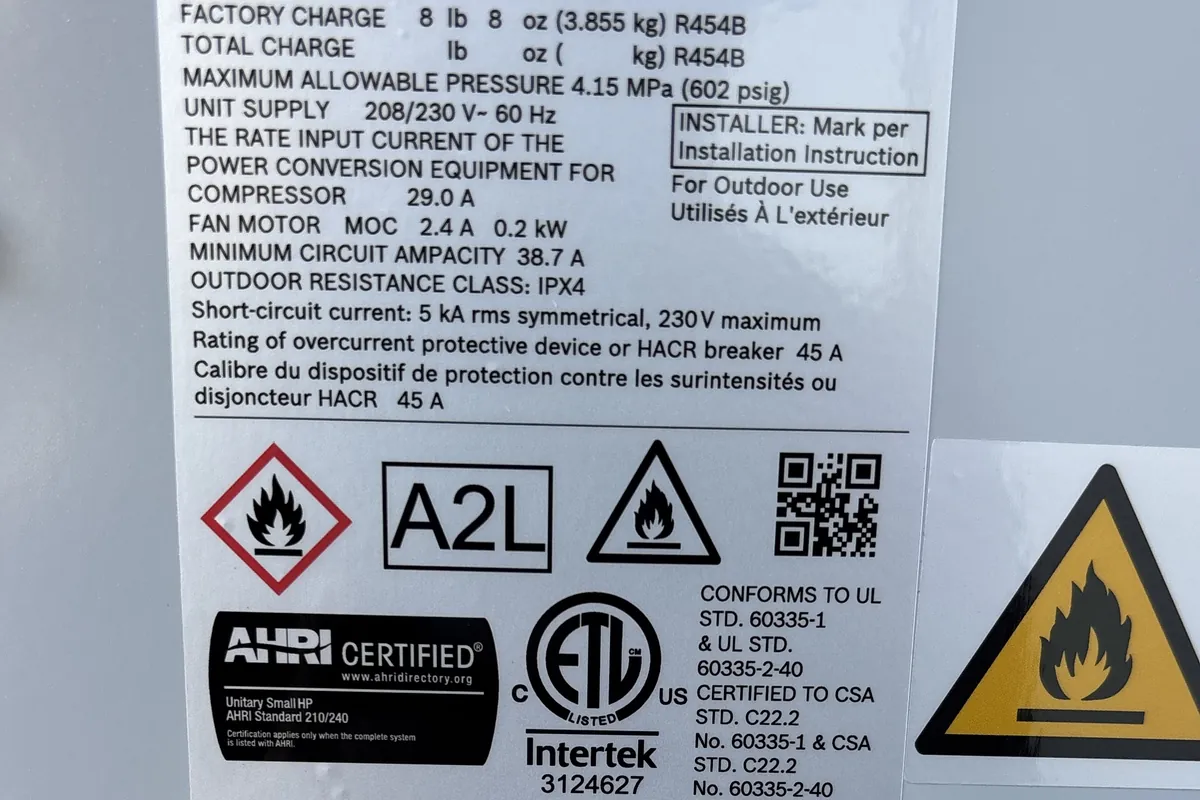
The outdoor unit's nameplate: 8 pounds 8 ounces of R-454B from the factory, with the A2L class mark and flammability symbols.
R-454B is an A2L refrigerant. A2L is the safety class for refrigerants with lower toxicity and lower flammability (EPA, Analysis of the U.S. Hydrofluorocarbon Reclamation Market, October 2024). That is why the nameplate above carries flame symbols beside the A2L mark. The air handler label carries its own flammable-refrigerant warning as well.
The job order also called for the home's existing zoning. We kept the zone dampers and the two-zone control and connected Wi-Fi thermostats. SMUD's minimum requirements include a "Connected thermostat (Wi-Fi enabled, 7-day programmable)." Our thermostats and zoning page explains how zoned systems split one house into areas.
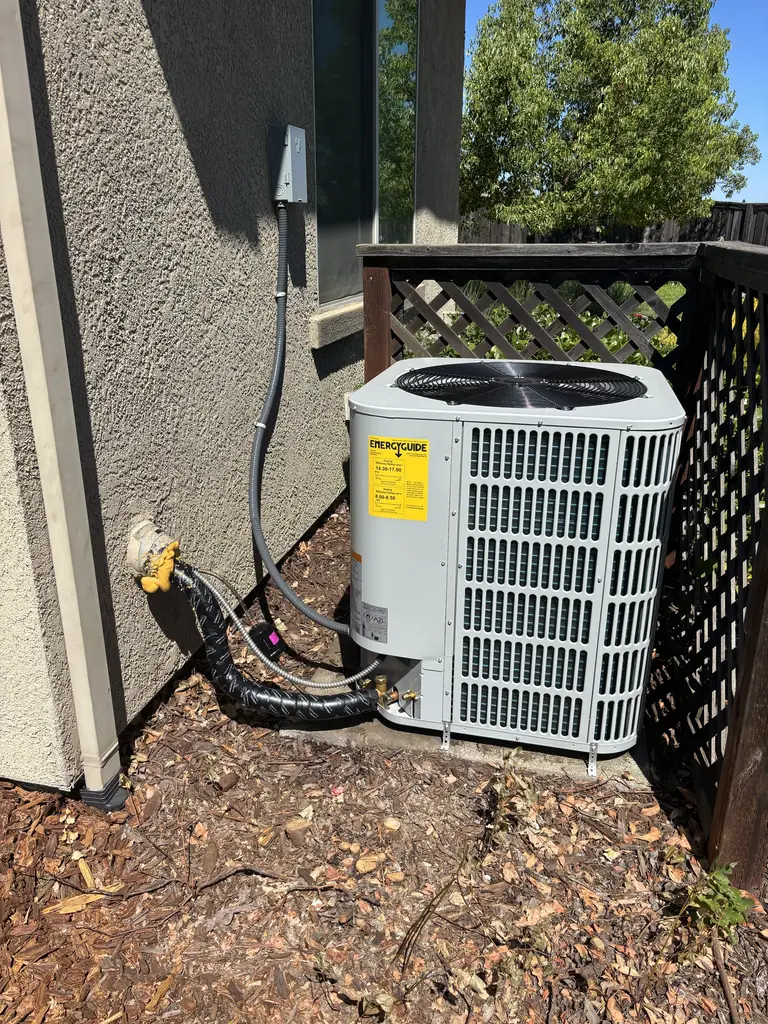
After: the Bosch outdoor unit in the old condenser's spot, with its disconnect on the wall.
The Start-Up Numbers We Recorded
After the system was charged, we measured its operating numbers in cooling mode on July 15, 2026, with a digital refrigerant analyzer. Superheat and subcooling are the two readings technicians use to judge the refrigerant charge. Superheat is how many degrees the suction line runs above the refrigerant's boiling point in the indoor coil. Subcooling is how many degrees the liquid line runs below the condensing temperature. The table shows the inputs beside both results.
| Reading, cooling mode, July 15, 2026 | Value |
|---|---|
| Suction (low side) pressure | 122.0 psig |
| Liquid (high side) pressure | 354.5 psig |
| Evaporator saturation temperature | 46.9°F |
| Suction line temperature | 64.9°F |
| Superheat (64.9 minus 46.9) | 18.0°F |
| Condensing saturation temperature | 111.8°F |
| Liquid line temperature | 102.2°F |
| Subcooling (111.8 minus 102.2) | 9.6°F |
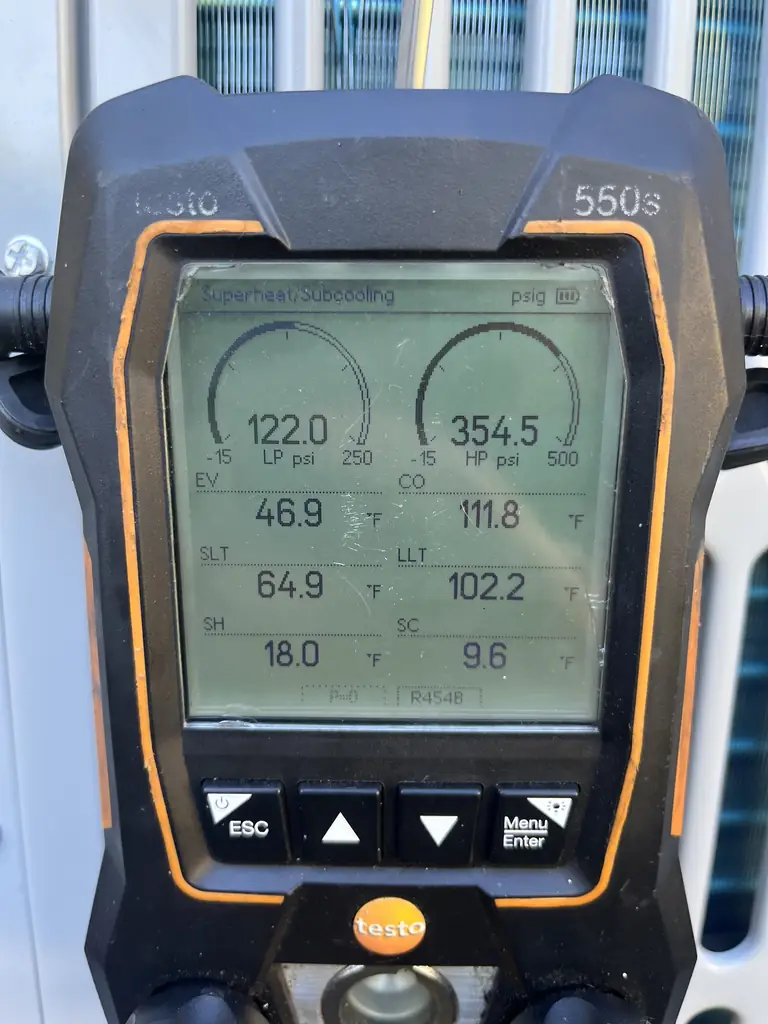
The start-up reading on the analyzer, set to R-454B.
These numbers belong to one afternoon. Outdoor temperature, indoor load and compressor speed all move them, so they are a record of this start-up, not a target for your system. The point is that they were measured and kept. SMUD's checklist does not cover refrigerant charge, so these are our own start-up records, not the verifier's.
What the SMUD Verifier Checked: All 11 Items
The verifier spent about 40 minutes at the house on September 15, 2026, by the photo timestamps on the report. The exported checklist reads "11/11 Tasks Completed." Here is each item and what the verifier recorded.
| Checklist item | What the verifier recorded | Result |
|---|---|---|
| Summary | "NO ISSUES." Notes: gas furnace in the attic converted to a split heat pump; condensate drains into wood chips over dirt | Complete |
| Type of system | Split HP | Complete |
| Upgrade or gas-to-electric conversion | Gas to electric conversion | Complete |
| Photo of capped gas line | Yes | Complete |
| System location | Attic | Complete |
| Is the condenser secured to the pad? | Yes | Complete |
| Is the service disconnect labeled? | Yes | Complete |
| Is the line set secured? | Yes | Complete |
| Location of the condensate drain | Wood chips over dirt | Complete |
| Location of the ducts | Attic | Complete |
| Are the ducts and plenum adequately sealed? | Yes | Complete |
The pass notice followed on September 28: the inspection "is complete and passed review. The project met all program qualifications and standards." The verifier's review note was one line: "Great job, this FQC is complete."
Most of these items sit where a homeowner never looks. That is the value of a third-party check.
- The capped gas line proves the furnace is gone and not left as a hidden second heat source. It is also why the verifier photographs it.
- The pad, the disconnect label and the line set are the outdoor details that loosen or get skipped. A secured line set does not rub or sag.
- The condensate drain location is recorded on the checklist. Here it drains into wood chips over soil.
- Duct and plenum sealing decides whether the new system's air reaches the rooms. Our leaky ducts guide shows what unsealed attic ducts cost in a Sacramento summer.
Timeline: From Service Call to Passed Inspection
The whole job ran about three and a half months from first call to passed inspection. Most of that was waiting, not work at the house.
| Date (2026) | Step |
|---|---|
| June 15 | Service call: the old air conditioner needs refrigerant; the homeowner asks for a replacement quote |
| July 15 | Install day: gas furnace and condenser out, Bosch heat pump and air handler in, start-up readings recorded |
| August 21 and 22 | SMUD rebate application signed by the contractor and the customer |
| September 4 | SMUD's program selects the project for a field quality control inspection |
| September 15 | The verifier inspects the house |
| September 21 | The 11-item checklist is exported |
| September 28 | Pass notice: "complete and passed review" |
Selection can come after the paperwork looks finished, so a homeowner may hear from the verifier weeks after install day. Our notice gave no reason for the selection.
What to Ask Before Your Own SMUD Heat Pump Conversion
Ask any installer five questions before you sign. Most come from what SMUD requires and what its verifier checks.
- Are you in the SMUD Contractor Network? SMUD says rebates "must be submitted by a qualified participating contractor." You can look up any company in the SMUD Contractor Network directory.
- Which rebate tier does this system qualify for? On a gas-to-electric conversion, SMUD lists $3,000 for a variable-stage heat pump. A two-stage system of at least 15.2 SEER2 is listed at $2,000 (SMUD, retrieved September 28, 2026). Rebates are "subject to availability of funding."
- How will the job pass Title 24? SMUD's requirements read: "Must pass Title 24 via HERS CF3R and/or if new ductwork installed, it must be insulated to ≥ R8." Ask which applies to your job.
- Where will the condensate drain, and how will the line set be secured? Those are checklist items, and a clear answer is a good sign.
- Can my existing zoning or thermostats stay? Sometimes they can, as they did here. Ask the installer to confirm the zone control works with a heat pump.
On price, a whole-home ducted heat pump replacement runs $9,500 to $20,000 on our jobs. System type, installation scope and warranty terms move a bid inside that range, and the service page linked below breaks down what goes into a quote.
Frequently Asked Questions
Does every SMUD rebate job get a field quality control inspection?
No. SMUD's program selects projects for inspection, and our notice for this job said it had been "selected." The rebate application also warns that final payment "may be subject to an on-site verification by a SMUD representative."
Who performs a SMUD field quality control inspection?
A verifier working for Efficiency First California, SMUD's program administrator. SMUD's rebate page sends FQC questions to the FQC team at Efficiency First California, at FQC@efficiencyfirstca.org.
Do I need to be home for the SMUD inspection?
Plan on it. The verifier contacts the SMUD customer to schedule the visit, and the checklist includes the attic, the ducts and the outdoor unit. On this job the visit took about 40 minutes by the report's photo timestamps.
What happens if a heat pump job fails the SMUD inspection?
The contractor gets a corrective action to fix. On an earlier job, our notice gave us 10 business days to address it. Since June 2026, the program handbook says "Contractors cannot charge for FQC corrective action work."
Is the SMUD inspection the same as the county permit inspection?
No. The city or county inspection enforces the building code. The FQC checks the job against SMUD's rebate program standards. SMUD's rebate is also contingent on the project complying with permit requirements, including inspections.
Can a heat pump work with an existing zoning system?
It can. This Fair Oaks house kept its two-zone dampers and control with the new heat pump. Compatibility depends on the zone control, so the installer should confirm it before the quote.
Planning a Heat Pump Conversion in Fair Oaks
We are based in Fair Oaks and install heat pumps in the neighboring towns too: Carmichael, Orangevale, Citrus Heights and Gold River. You can read more about us, and the local details, on our Fair Oaks HVAC service page. We handle the SMUD rebate paperwork as a network contractor.
If an attic gas furnace like this one is near the end of its life, we can quote the conversion, including zoning and the rebate tier. Start with our heat pump installation and replacement service, or call us to schedule a visit.