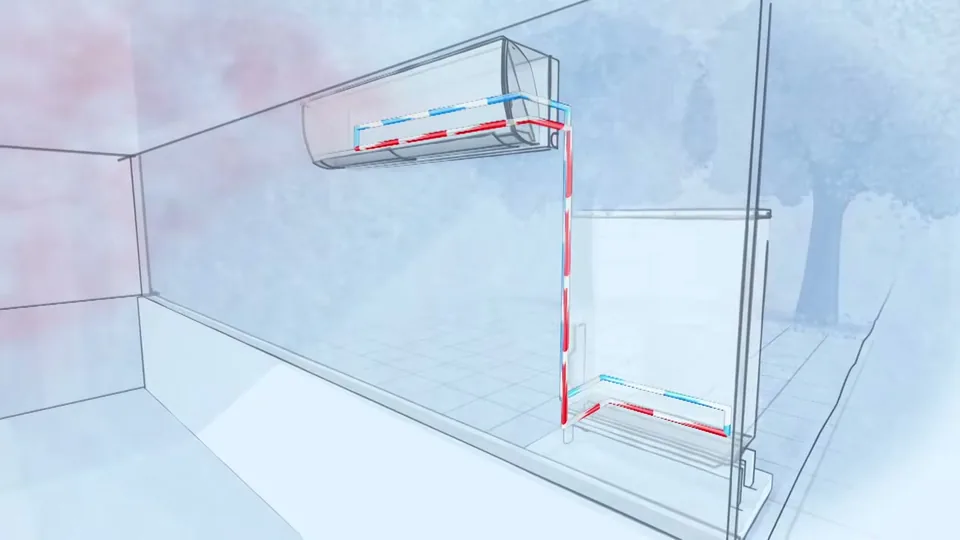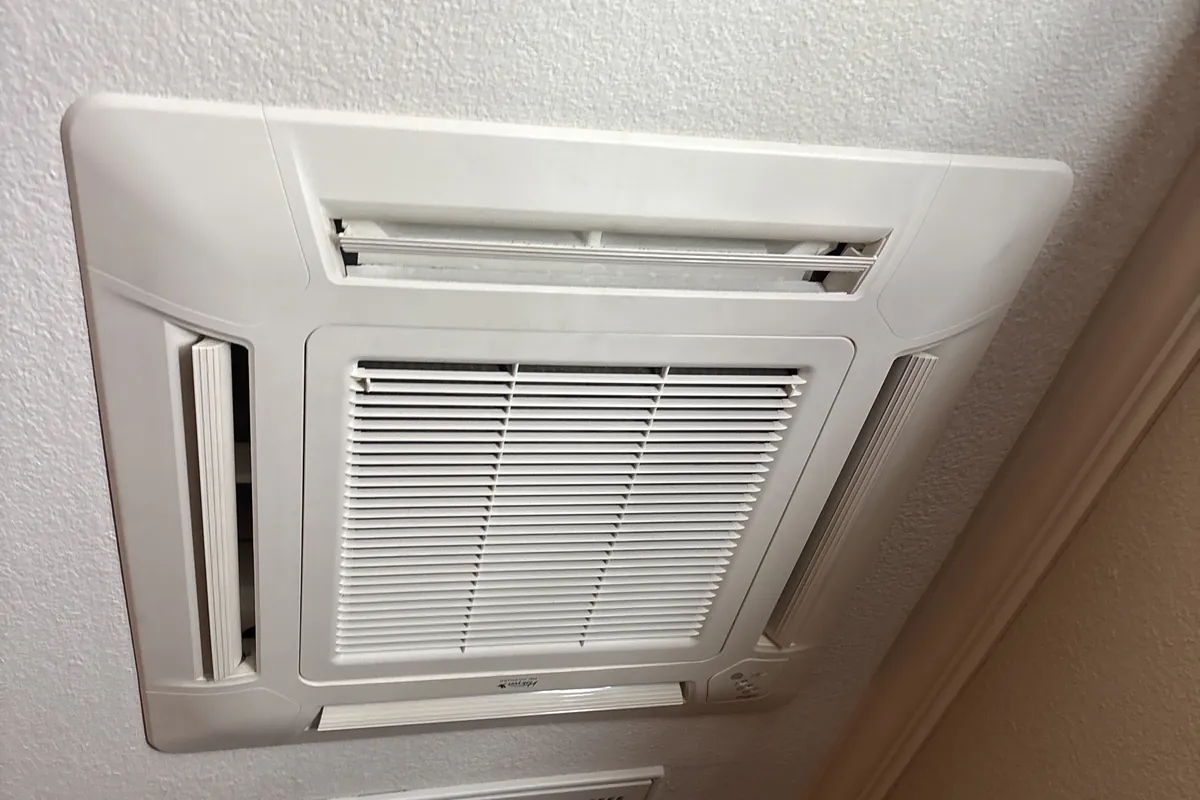
A professionally installed single-zone ductless mini split runs $2,500 to $6,000 by HomeGuide's October 2025 estimate, and a five-zone whole-home system runs $10,000 to $15,000 (HomeGuide, retrieved 2026-08-27). Forbes Home's survey of eight cost databases lands in the same band for one zone and lower for five; the table below reconciles both with This Old House (Forbes Home, updated July 2025). Those are estimate ranges, not quotes. In Sacramento, five things decide where inside them your house lands. Zone count and line-set routing come first. Then your electrical panel's spare capacity, the permit and Title 24 testing every installation triggers, and whether SMUD's rebate applies at all.
- What a Mini Split Costs to Install, by Zone Count
- Why a House With No Ductwork Changes the Question
- The Five Things That Move a Sacramento Mini Split Quote
- SMUD Rebates: The Whole-Home Rule Most Cost Guides Miss
- Buying in 2026: Ask Which Refrigerant Is in the Box
- How to Read a Mini Split Quote
- Frequently Asked Questions
That last point is the one national cost guides get wrong for this metro. SMUD pays up to $3,000 on a qualifying heat pump conversion, but only when the mini split system serves the entire home. A single head in a garage or an ADU does not qualify. The rest of this guide walks through each of the five, with the source and date behind every figure.
Key Takeaways
- Single zone: $2,500 to $6,000 installed. Five zones: $10,000 to $15,000 (HomeGuide, Oct 2025). Forbes Home and This Old House publish lower floors; the table below reconciles all three. Read them as estimate bands, not a Sacramento quote.
- In a house with no ductwork, the alternative is not "central AC." It is a duct system plus central equipment, two projects in one. That is why 1920s to 1940s Land Park, Curtis Park and East Sacramento homes so often end up ductless.
- SMUD's $3,000, $2,000 and $1,000 heat pump tiers require that "mini-splits must service entire home" (SMUD, retrieved 2026-08-27). A single-zone ADU or garage head earns nothing.
- Every mini split installation needs a building permit in California, and permitted work triggers Title 24 verification (California Energy Commission). A quote that skips both is a quote for unpermitted work.
- Since January 1, 2025 new mini split systems must use a refrigerant under 700 GWP (EPA). Ask which refrigerant is in the quote before you sign.
What a Mini Split Costs to Install, by Zone Count
Zone count moves a mini split price more than any other single factor. Each zone is one indoor head, and each head adds equipment, refrigerant line, condensate routing and labor. Three published estimate sources, each with its own method and date, land in the same neighborhood for one zone and spread apart at five.
| Zones | HomeGuide (Oct 8, 2025) | Forbes Home (updated Jul 1, 2025) | This Old House (updated Mar 27, 2026) |
|---|---|---|---|
| 1 | $2,500 to $6,000 | $2,400 to $5,500 | $500 to $5,000 (average $2,750) |
| 2 | $4,500 to $8,000 | $3,100 to $7,800 | $1,400 to $7,700 |
| 3 | $6,500 to $11,000 | $3,800 to $10,100 | $1,800 to $9,100 |
| 4 | not listed | $4,500 to $12,400 | $2,600 to $10,700 |
| 5 | $10,000 to $15,000 | $5,200 to $14,700 | $4,400 to $12,000 (average $8,200) |
Sources: HomeGuide ("proprietary cost database, in-depth research, and collaboration with industry experts"); Forbes Home ("we surveyed eight local and national cost databases"); This Old House ("based on estimates from Angi, HomeGuide, and Homewyse"). All retrieved 2026-08-27.
Two things stand out in that table. The low ends diverge because This Old House's single-zone floor of $500 is close to an equipment-only number, while HomeGuide's $2,500 floor assumes professional installation. The high ends converge: every source puts a five-zone system in the low-to-mid teens. Forbes Home adds a useful increment for planning: after the first zone, each additional zone adds $700 to $2,300, depending on the head style (Forbes Home). Bryant, a manufacturer, publishes a wider per-zone band of $2,000 to $7,000 that bakes in premium equipment (Bryant, retrieved 2026-08-27).
Equipment capacity also matters, but less than people expect. HomeGuide prices a standard 1-ton (12,000 BTU) system at $3,500 to $5,000 installed and a 3-ton (36,000 BTU) system at $8,000 to $11,000 (HomeGuide). Capacity comes out of a load calculation for your rooms, not a square-footage rule. In a Sacramento house, the west-facing rooms and the room over the garage usually drive it.
One number you will not find here is Alpha Mechanical's own price. We price ductless work from a site walkthrough because the walkthrough is what tells us how many of the five factors below apply to your house. If you want that number, the installation service section at the end of this guide explains what the visit covers.
Why a House With No Ductwork Changes the Question
If your house has no ducts, "mini split versus central AC" is the wrong comparison. Central equipment needs a distribution system. The real alternative is a new duct system plus a central air handler and condenser: two projects, two permits, and a lot of ceiling and wall opened up. In a 1920s Tudor with lath-and-plaster walls, that duct project is the expensive half. A ductless system skips it entirely. That is why the Land Park, Curtis Park and East Sacramento bungalows we work in so often end up with heads on the wall instead of registers in the ceiling.
Skipping ducts also removes a permanent operating cost. ENERGY STAR puts typical duct losses at about 20 to 30 percent of the air that moves through the duct system (ENERGY STAR, retrieved 2026-08-27). That air is lost to leaks, holes and poorly connected ducts. In Sacramento that duct system would live in an attic that bakes all summer. A ductless system moves refrigerant through a small wall penetration and delivers conditioned air inside the room, so that loss never happens.
The same logic applies to the three spaces where ductless shows up most in this metro:
- Detached ADUs and backyard studios. No connection to the main system and usually no room for one. A single-zone head is the standard answer.
- Garage conversions and additions. Extending the existing duct system means a new branch, a bigger blower and a permit; a single head conditions the space on its own.
- The one room that never cools. A head in the problem room fixes delivery instead of fighting the duct layout. Our guide to why one room runs hot covers how to tell a delivery problem from a capacity problem.
If your house does have serviceable ducts, the comparison is a real one, and our ductless mini split versus central AC guide is the right place to make it. A ductwork inspection settles the question of whether those ducts are an asset or a liability before you price either system.
The Five Things That Move a Sacramento Mini Split Quote
Zone count sets the band; these five decide where in the band a Sacramento house lands. Two of them are Sacramento-specific, and two are California-specific.
1. Zone count and head style
The wall-mounted head is the cheapest and the most common. HomeGuide's installed prices per zone: wall-mounted $2,500 to $5,000, floor-mounted $3,000 to $5,000, ceiling cassette $3,500 to $6,000, and concealed ducted $4,000 to $7,500 (HomeGuide). Floor units earn their place in older homes with tall windows and little upper-wall space. Ceiling cassettes suit open plans but need attic or ceiling access that a plaster ceiling makes harder.
2. Line-set length and routing
Every head connects to the outdoor unit through an insulated refrigerant line set, a condensate drain and a control cable. HomeGuide notes that most quotes include "standard line set length (about 15 feet) with higher costs for longer runs" (HomeGuide). In a stucco ranch the run is short and the wall is easy. In a two-story 1930s house with the outdoor unit on the far side, the run is long and the routing goes through finished walls. That routing is labor, and labor is what you are mostly paying for.
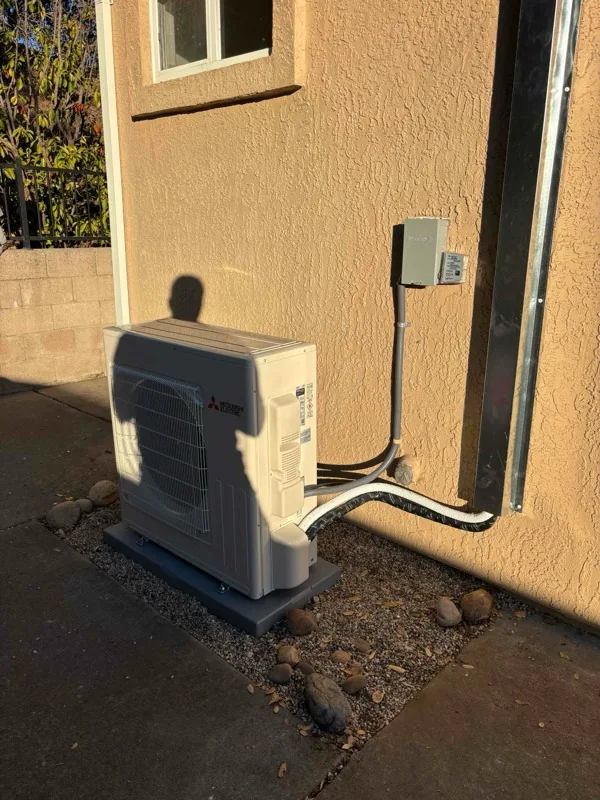
This is the layout that stays inside the base allowance: pad, a few feet of bundled line set, one wall penetration, the disconnect within reach. The same head on a second floor at the far end of the house needs the run fished through finished walls, and that difference lands on the quote as labor.
3. Electrical panel capacity
A mini split needs a dedicated circuit. Whether your panel can take one is the most common surprise on an older Sacramento house. A full panel or a service upgrade is an electrical project priced on its own. Alpha Mechanical does not do panel upgrades; a licensed electrician quotes that work separately.
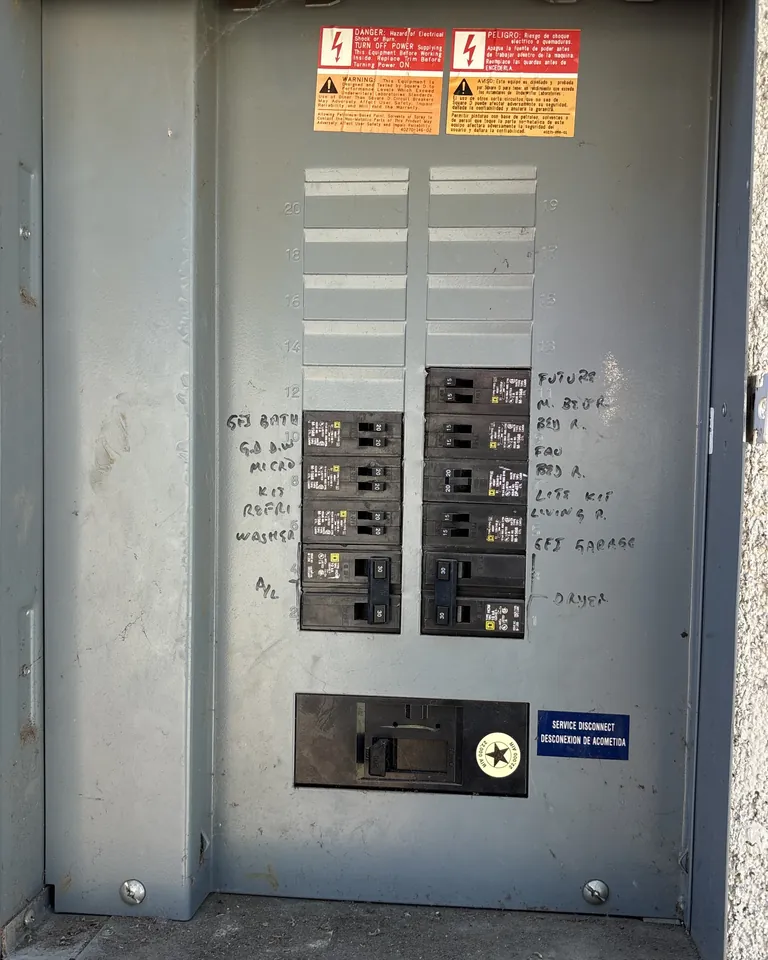
The panel in the photo has open slots above the loaded rows, so the dedicated circuit is a breaker and a run of wire. A panel with every slot filled turns the same line item into a subpanel or a service upgrade, priced as electrical work rather than as part of the mini split.
4. Permit and Title 24 verification
The California Energy Commission is explicit: "Installation of a space conditioning appliance (other than a plug-in room appliance) requires a building permit" (California Energy Commission, 2025 Single-Family HVAC, retrieved 2026-08-27). Under the 2025 code, heat pumps carry prescriptive refrigerant charge verification in every climate zone. Fan airflow and watt-draw testing is mandatory in every climate zone, per the same page. Properly permitted work is what triggers that HERS testing. It is the homeowner's right to hire the rater, though contractors may offer to take that responsibility (CEC HERS Program).
In Sacramento County, "Residential heating and cooling (new install or replacement)" is on the list of permits issued automatically online once the fee is paid. That list sits in the county's Building Permits & Inspection FAQ (retrieved 2026-08-27). Forbes Home's national estimate for a mini split permit is $250 to $400 (Forbes Home). The county's actual fee is set by its schedule and shows on the permit. A quote that lists no permit and no HERS line is a quote for unpermitted work. That gap tends to surface later, at a buyer's inspection or a warranty claim.
5. Equipment tier and brand
Brand moves the equipment line, not the labor line. HomeGuide's system-only prices for a single-zone system run from $1,000 to $3,800 for GREE up to $2,400 to $6,000 for Carrier, with Mitsubishi and Trane at $1,400 to $4,800 (HomeGuide). Efficiency tier matters more than the badge. Rebate eligibility is tied to the exact model's SEER2 rating, so ask for the model number, not the series name.
SMUD Rebates: The Whole-Home Rule Most Cost Guides Miss
SMUD's heat pump rebates apply to a mini split only when the system serves the whole house. SMUD's Heating and Cooling Rebates page lists three tiers (SMUD, retrieved 2026-08-27):
- $3,000 for a variable-stage heat pump system replacing gas equipment
- $2,000 for a two-stage heat pump system at 15.2 SEER2 or better replacing gas equipment
- $1,000 for a multi-stage heat pump upgrade, electric to electric
The same page carries the sentence national guides leave out: "Mini-splits must service entire home and meet minimum HVAC system requirements."
In plain terms: a multi-zone ductless system that replaces a gas furnace and central AC can earn the $3,000 tier. A single head added to a garage, an ADU or one hot bedroom earns nothing from SMUD, because the house still heats with gas. Two more conditions apply to every tier. The equipment must be installed by a participating contractor in the SMUD Contractor Network. The system also needs a connected thermostat, described on the page as Wi-Fi enabled and 7-day programmable.
The federal credit SMUD's page references covered systems installed between January 1, 2023 and December 31, 2025. It does not apply to a 2026 installation, so do not build a budget on it. If the net price after SMUD still needs spreading out, GoGreen is California's state financing program for energy upgrades. It is financing, not a rebate, and our financing page explains how it applies. The full incentive picture, including what changed this year, is in our heat pump rebates in California guide.
Buying in 2026: Ask Which Refrigerant Is in the Box
A mini split quoted in 2026 should use a refrigerant with a global warming potential under 700. The EPA's Technology Transitions rule sets that limit for "residential and light commercial air conditioning and heat pump systems (e.g., mini-splits, unitary systems)" (EPA, retrieved 2026-08-27). The installation compliance date was January 1, 2025. The same table notes there is no installation compliance date for systems whose components were all manufactured or imported before January 1, 2025. That is how older-refrigerant stock is still legally installed.
What that means for a quote: the equipment line should name the refrigerant. R-32 is one refrigerant the EPA's own phasedown FAQ describes as below the 700 GWP limit (EPA, retrieved 2026-08-27). Current mini split lines are built around it and similar low-GWP blends. An R-410A system is legal to install only as pre-2025 stock, and it ties you to a refrigerant that is being phased down for the life of the equipment. That is not automatically a bad deal on a small single-zone head, but it should be priced like the older product it is, and you should know before you sign.
How to Read a Mini Split Quote
A complete mini split quote itemizes eight things. If any of them is missing, the number on the bottom line is not comparable to anyone else's.
- Equipment by model number, with the SEER2 and HSPF2 rating for that model, not the series.
- Zone count and head style for each room, with the capacity in BTUs per head.
- Line-set length and where it runs, including any wall or ceiling that gets opened and closed.
- Electrical scope: the dedicated circuit, and whether a panel change is included, excluded or quoted separately.
- Permit and Title 24 verification, including who hires the HERS rater.
- Refrigerant type in the equipment being installed.
- Warranty terms for parts, compressor and labor, and what registration the manufacturer requires.
- Rebate paperwork: which SMUD tier the system qualifies for, or a plain statement that it qualifies for none.
Bring that list to every estimate and the spread between quotes usually explains itself. The lowest bid is often the one that left out items four, five and eight.
Ready to price a ductless system for your house? Our mini split installation service walks through the site visit, and you can book online or call 916-848-5980. If a whole-home conversion is on the table, our heat pump replacement page covers the full-system version of this decision.
Frequently Asked Questions
How much does it cost to have someone install a mini split? Published estimate ranges for a professionally installed single-zone system are $2,500 to $6,000 from HomeGuide (October 2025) and $2,400 to $5,500 from Forbes Home (July 2025). HomeGuide notes a typical quote includes the outdoor unit, the indoor head, labor and basic electrical connections, refrigerant line, and brackets or pads. It also assumes a standard line set of about 15 feet. Longer runs, extra zones, a panel change and the permit sit on top of that.
Is it worth repairing an old system instead of installing a mini split? Run the $5,000 rule first: multiply the repair cost by the system's age in years, and if the result passes $5,000, replacement usually wins. It is a screening tool, not a verdict, and it says nothing about whether a mini split is the right replacement. Our AC repair cost guide explains where the rule works and where it misfires.
Can I install a mini split myself? California requires a building permit for any space conditioning appliance other than a plug-in room unit, per the California Energy Commission. The refrigerant work involves vacuuming, charging and leak testing that HomeGuide notes only licensed professionals can safely perform, and HomeGuide adds that improper installation can void the manufacturer's warranty. For a whole-home conversion in SMUD territory it also forfeits the rebate, which requires a SMUD Contractor Network installer.
How much does a mini split cost for a 2,000 square foot house? Zone count, not square footage, sets the price. Serving every room in a 2,000 square foot house means a multi-zone system. The published five-zone estimates run $10,000 to $15,000 (HomeGuide, October 2025), $5,200 to $14,700 (Forbes Home, July 2025) and $4,400 to $12,000 (This Old House, March 2026). The head count comes out of a load calculation for your floor plan, not a rule of thumb.
Does a single-zone mini split qualify for the SMUD rebate? No. SMUD's Heating and Cooling Rebates require that "mini-splits must service entire home and meet minimum HVAC system requirements." A single head in a garage, an ADU or one bedroom leaves the house heating with gas, so no tier applies. A multi-zone system that replaces the gas furnace and central AC can qualify for the $3,000 variable-stage tier, installed by a SMUD Contractor Network contractor.
Do I need a permit to install a mini split in Sacramento? Yes. The California Energy Commission states that installation of a space conditioning appliance requires a building permit. Permitted work then triggers the Title 24 verification the 2025 code requires for heat pumps. In Sacramento County, residential heating and cooling installs and replacements are on the list of permits issued automatically online once the fee is paid. Your installer should pull it and list it on the quote.
Sources
- HomeGuide, "How Much Does a Mini Split Installation Cost? (2026)", October 8, 2025 (single-zone $2,500 to $6,000; zone, size, style and brand tables; ~15 ft standard line set; permit note): https://homeguide.com/costs/ductless-mini-split-ac-cost
- Forbes Home, "How Much Does It Cost To Install A Mini Split AC System?", updated July 1, 2025 (average $4,500; zone table; $700 to $2,300 per added zone; permit $250 to $400; eight-database survey): https://www.forbes.com/home-improvement/hvac/mini-split-installation-cost/
- This Old House, "How Much Does a Split AC Installation Cost? (2026 Pricing)", updated March 27, 2026 (zone table; based on Angi, HomeGuide and Homewyse): https://www.thisoldhouse.com/heating-cooling/split-ac-installation-cost
- Bryant, "Mini Split Cost (2026)" ($2,000 to $7,000 per zone): https://www.bryant.com/en/us/products/ductless-systems/mini-split-cost/
- SMUD, "Heating and Cooling Rebates" ($3,000 / $2,000 / $1,000 tiers; whole-home mini split clause; Contractor Network; connected thermostat; federal credit window 2023 to 2025): https://www.smud.org/Rebates-and-Savings-Tips/Rebates-for-My-Home/Heating-and-Cooling-Rebates
- ENERGY STAR, "Duct Sealing" (about 20 to 30 percent of the air moving through the duct system is lost): https://www.energystar.gov/saveathome/heating-cooling/duct-sealing
- U.S. EPA, "Technology Transitions HFC Restrictions by Sector" (700 GWP limit, mini-splits named, January 1, 2025 installation date, pre-2025 component sell-through): https://www.epa.gov/hfcs/technology-transitions-hfc-restrictions-sector
- U.S. EPA, "Frequent Questions on the Phasedown of Hydrofluorocarbons" (R-32 is below the 700 GWP limit): https://www.epa.gov/hfcs/frequent-questions-phasedown-hydrofluorocarbons
- California Energy Commission, "2025 Single-Family Heating, Ventilation, and Air Conditioning (HVAC)" (permit requirement; refrigerant charge verification; fan airflow and watt-draw testing): https://www.energy.ca.gov/programs-and-topics/programs/building-energy-efficiency-standards/energy-code-support-center/hvac-0
- California Energy Commission, "Home Energy Rating System Program - HERS" (permitted work triggers HERS testing; homeowner's right to hire the rater): https://www.energy.ca.gov/programs-and-topics/programs/home-energy-rating-system-hers-program
- Sacramento County Building Permits & Inspection, "Frequently Asked Questions" (residential heating and cooling permits issued automatically online): https://development.saccounty.gov/content/cd/us/en/building-permits-inspection/frequently-asked-questions.html