

One room that stays hot while the rest of the house is comfortable almost always means one of two things: conditioned air isn't reaching that room (a duct or airflow problem), or heat is entering the room faster than your AC can remove it (a sun and insulation problem). Where there is no usable duct to that room at all, a ductless mini-split conditions it without extending the duct system. Often it's both at once. The hot room isn't broken on its own; it's the room where your system's weakest duct run meets the house's biggest heat load.
- Why Is One Room in Your House So Hot?
- What Causes Uneven Cooling in a House?
- Quick Fixes You Can Try This Week
- System Fixes That Actually Solve Uneven Cooling
- Will a Bigger AC Fix a Hot Room?
- Uneven Cooling FAQs
- The Bottom Line
That's a different problem from a whole house that won't cool, which we cover in our hub guide on an AC that's running but the house won't cool down. This post is the diagnostic for the one stubborn room: the west-facing bedroom, the upstairs at 9 p.m., the bonus room over the garage. We'll walk through each cause, the free fixes worth trying first, and the system fixes that actually end the problem.
Key Takeaways
- One hot room means a delivery problem (air isn't getting there), a heat-gain problem (sun, attic, thin insulation), or both.
- Free first steps: open every supply register, pull furniture off vents, keep interior doors open, and block west-facing afternoon sun.
- Leaky or crushed ducts in a Sacramento attic can dump cooled air before it ever reaches the far rooms; ENERGY STAR estimates typical duct systems lose about 20 to 30 percent of the air moving through them.
- Lasting fixes are duct sealing and balancing, added return air, zoning for two-story homes, or a ductless mini-split for one chronic problem room.
- A bigger AC will not fix uneven cooling. Oversizing causes short cycling and worse comfort.
Why Is One Room in Your House So Hot?
Match what you notice about the room to the most likely cause before you spend anything:
| What you notice | Most likely cause | Your next move |
|---|---|---|
| Weak airflow from the register | Long, undersized, or unbalanced duct run | Open all registers, then a duct inspection |
| Barely any air, even with vents open | Leaky, crushed, or disconnected duct | Professional duct inspection and sealing |
| Room farthest from the AC unit | Duct run losing air and pressure along the way | Duct sealing and balancing dampers |
| Hot only in late afternoon | West-facing windows and solar gain | Blackout curtains or cellular shades first |
| Entire upstairs hotter than downstairs | Stack effect plus attic heat | Zoning, or a mini-split for the worst room |
| Room over the garage or an addition | Ductwork never properly extended | Ductless mini-split is often the clean fix |
| Hot with the door closed | Starved return air | Keep the door open or undercut it |
Every row in that table comes down to the same two-sided equation: how much cool air the room receives versus how much heat the room gains. Fix the side that's losing.
What Causes Uneven Cooling in a House?
Long, undersized, or unbalanced duct runs
The room farthest from your air handler gets whatever air is left after every other register has taken its share. Long runs lose pressure to friction, undersized branches choke flow, and a system that was never balanced sends too much air to the nearest rooms and too little to the far ones. The telltale sign is a supply register that's blowing cool air, just not much of it, while a hallway register nearby is blasting.
Leaky or crushed ducts in a hot attic
Most Sacramento ductwork runs through the attic, and on a 100°F afternoon that attic runs far hotter than the outdoor air. Every leak on the supply side dumps cooled air into that oven instead of your room, and every gap on the return side pulls superheated attic air into the system. ENERGY STAR estimates a typical house loses about 20 to 30 percent of the air moving through the duct system to leaks, holes, and poor connections (ENERGY STAR). A flex duct that's been stepped on or kinked during an attic project can cut one room's airflow to nearly nothing. If your far rooms are weak and your energy bills are high, start with our guide to leaky ducts in Sacramento homes.
Blocked registers and starved return air
A supply register behind a bed, under a dresser, or closed "to save energy" strangles that room directly. Closed interior doors do quieter damage: if the room has a supply vent but no return path, shutting the door pressurizes the room, and airflow into it drops. Closing too many registers also raises pressure across the whole duct system and can starve the indoor coil of airflow, which is one of the paths to a frozen evaporator coil. Registers are not a zoning system. Keep them open.
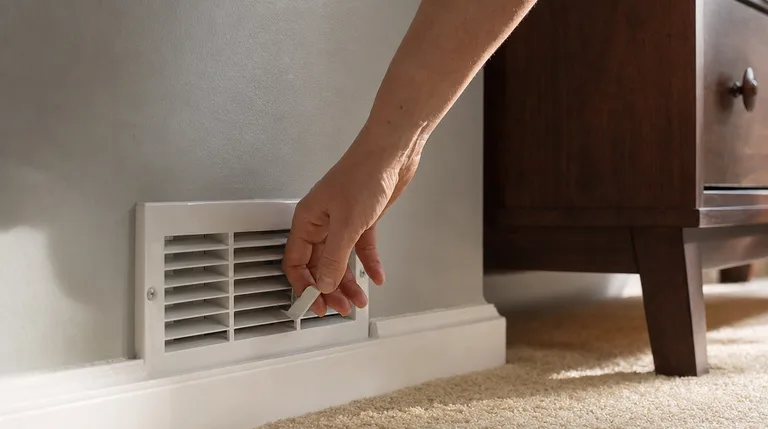
Opening a closed supply register and clearing the furniture in front of it is the first free move on a hot room, and it tells you a lot: if the room improves, the problem is on the delivery side.
West-facing windows and afternoon solar gain
Sacramento's summer pattern is brutal on west rooms: July afternoons routinely sit in the 90s and push past 100°F, and the sun is pounding west glass at exactly the hour of peak heat. A west bedroom can gain heat through its windows faster than a single duct run can remove it, which is why it's fine at noon and miserable at 6 p.m. The evening Delta breeze eventually cools the outdoors, but a heat-soaked room with poor airflow stays hot well into the night.
Upstairs hotter than downstairs: the stack effect
Heat rises, so warm air accumulates upstairs while cool supply air tends to settle and serve the downstairs thermostat first. Add an attic radiating heat directly into second-floor ceilings and you get the classic complaint: the thermostat downstairs reads 75°F and satisfied while the upstairs bedrooms sit at 80°F or more. A single system with one thermostat physically cannot hold both floors at the same temperature on a 100°F day without help. This is the textbook case for zoning, covered below.
Rooms over garages, bonus rooms, and additions
Sacramento is full of ranch homes that grew: a converted garage, a bonus room over the garage, an addition off the back. These rooms fail on both sides of the equation. They sit over or beside unconditioned space, they were often insulated to the older code of their build year, and the "ductwork" serving them is frequently one long flex run teed off the original trunk as an afterthought, if it exists at all. The original system was never sized or balanced to serve them.
In our Sacramento and Fair Oaks service work this is one of the most predictable hot-room calls we take. When a space becomes an addition and its temperature never behaves, the cause is almost always that it was never designed to be conditioned: the airflow serving it was not properly sized, and the addition's envelope does not match the thermal resistance of the main structure. That mismatch is why the room loses the fight every afternoon no matter how well the rest of the house performs. Additions and conversions need to be designed and installed by a professional, with the load calculation, the duct sizing, and the insulation treated as one job instead of three afterthoughts.
Thin attic insulation and minor internal gains
Older Sacramento homes often carry far less attic insulation than current California standards call for, so the ceiling itself radiates attic heat into the rooms below all afternoon. And while electronics matter less than people think, a gaming PC, a large TV, or an always-on desktop setup does add steady heat to a small closed bedroom. Insulation is the bigger lever; unplugging a phone charger is not going to cool the room.
Quick Fixes You Can Try This Week
Start with the free and cheap moves. They won't fix a crushed duct, but they routinely knock a few degrees off a problem room and they tell you a lot about the cause:
- Open every supply register in the house, including rooms you don't use. Closing vents doesn't redirect air to the hot room; it unbalances the system.
- Pull furniture, rugs, and curtains off vents. A bed skirt over a floor register can swallow most of that room's airflow.
- Keep interior doors open, especially bedroom doors during the afternoon. If a door must stay closed, an undercut of about an inch helps air find its way back to the return.
- Block the afternoon sun on west and southwest windows. Blackout curtains or cellular shades installed tight to the frame cut solar gain at the source, hours before the room would normally peak.
- Check the filter. A clogged filter starves airflow everywhere, and the weakest room feels it first.
If the room improves noticeably, you've confirmed an airflow or heat-gain cause and can decide how far to take the permanent fix. For more low-cost gains across the whole system, see our 9 ways to improve air conditioner efficiency.
System Fixes That Actually Solve Uneven Cooling
When the quick fixes help but don't finish the job, the room has a delivery problem that needs a real repair. These are the four fixes we reach for, in rough order of invasiveness.
Duct inspection, sealing, and balancing. A technician measures airflow at each register, finds the leaks and kinks, seals the system, and sets balancing dampers so the far rooms get their designed share of air. This is the highest-value starting point because it fixes the delivery side for the whole house, not just one room. California's Title 24 energy code requires duct sealing and verified leakage testing when you change out heating or cooling equipment in the Sacramento climate zone (California Energy Commission), so duct work done during a system change-out here isn't optional anyway. It might as well be done in a way that solves your hot room.
Adding a return. Many uneven homes have exactly one central return. Adding a return (or a jumper duct) to a starved bedroom lets air actually circulate through it with the door closed, instead of pressurizing and stalling.
Zoning for two-story homes. Motorized dampers plus a second thermostat let the upstairs call for cooling independently of the downstairs (how an HVAC zoning system is installed). This directly attacks the stack-effect problem: the system serves whichever floor needs it, instead of averaging both floors around one downstairs thermostat.
A ductless mini-split for the chronic problem room. (Mini split vs. central AC covers how the two compare if you're weighing a whole-system change instead.) For the converted garage, the addition, or the one bonus room that has never been comfortable, a single-zone mini-split is the surgical option. You condition the problem room with its own dedicated equipment and its own thermostat, without touching, unbalancing, or re-ducting the rest of the system.
Not sure which fix fits your house? A diagnostic visit answers it with measurements instead of guesses. You can book AC repair in Sacramento online, and if the root cause turns out to be maintenance-level (dirty filter, matted coil, drifting airflow), a service membership covers the seasonal tune-ups that keep the delivery side honest. Our AC tune-up cost guide breaks down what those visits include.
Will a Bigger AC Fix a Hot Room?
No, and it usually makes the house less comfortable. An oversized system satisfies the thermostat quickly and shuts off before air has time to mix and reach the far rooms, so the hot room gets shorter blasts of air, not more of it. Rapid on-off operation also means worse humidity removal and more wear; that failure pattern has its own guide on AC short cycling. Capacity was never the problem. If the duct run to the hot room leaks or chokes, a bigger blower just pushes more air out of the same holes.
Homeowners usually frame this as "my AC can't keep up" and start shopping for a bigger system. The reframe that saves money: the house doesn't have a capacity problem, it has a distribution problem plus one high-load room. Distribution fixes are cheaper than tonnage, and a mini-split isolates the one room whose load will never match the rest of the house.
Uneven Cooling FAQs
Why is my upstairs hotter than downstairs?
Heat rises and collects on the upper floor, the attic radiates heat directly into upstairs ceilings, and the thermostat controlling the system usually sits downstairs where it is satisfied first. On hot days a single system with one thermostat cannot hold both floors at the same temperature. Zoning with dampers and a second thermostat, or a mini-split for the worst upstairs room, addresses the cause directly.
Will a bigger AC fix uneven cooling?
No. An oversized air conditioner cools the area near the thermostat quickly and shuts off before conditioned air reaches the far rooms, so the hot room actually gets less runtime. Oversizing also causes short cycling, worse humidity control, and extra wear. Uneven cooling is a distribution problem, fixed with duct sealing, balancing, added return air, zoning, or a dedicated mini-split.
Why is it so hot in my room only?
One hot room means cool air is not reaching it, heat is entering it faster than the system can remove it, or both. Common causes are a long or leaky duct run, a blocked or closed supply register, a closed door starving return airflow, west-facing windows taking afternoon sun, thin insulation above the room, or an addition whose ductwork was never properly extended.
How do I stop my room from being so hot?
Start free: open every supply register in the house, move furniture off vents, keep the door open or undercut it, put blackout curtains or cellular shades on west-facing windows, and replace a dirty filter. If the room is still hot, have the ducts inspected, sealed, and balanced, add a return if the room is starved, or install a ductless mini-split to give the room its own cooling.
Is it unhealthy to sleep in a hot room?
A hot room mainly hurts sleep quality. The Sleep Foundation points to roughly 65 to 68°F as the ideal bedroom range, and a room that runs warmer interferes with the body's thermoregulation and cuts into restorative deep sleep. Healthy adults mostly face discomfort, but infants, older adults, and people with health conditions are more vulnerable to heat, so persistent overnight heat in a bedroom is worth fixing.
The Bottom Line
A chronically hot room is a solvable problem with a findable cause: air that never arrives, heat that pours in, or both. Run the free fixes first (registers open, vents clear, doors open, west windows shaded, clean filter) and see how far they get you. If the room is still fighting you, the fix is on the delivery side: seal and balance the ducts, add a return, zone the second floor, or give the problem room its own mini-split.
The Alpha Mechanical team, managed by Andrey Yev, PE, diagnoses uneven cooling across Sacramento and Fair Oaks with airflow measurements, not guesswork. Book AC repair in Sacramento and make the hot room the same temperature as the rest of the house before the next 100°F stretch.
Written by Andrey Yev, PE, the licensed Professional Mechanical Engineer and CSLB contractor who manages Alpha Mechanical in Sacramento, drawing on 25+ years of field and engineering experience.
Sources
- ENERGY STAR, "Duct Sealing" (about 20 to 30 percent of the air moving through the duct system is lost to leaks, holes, and poorly connected ducts): https://www.energystar.gov/saveathome/heating-cooling/duct-sealing
- California Energy Commission, Building Energy Efficiency Standards, Title 24 Part 6 (duct sealing and HERS-verified leakage testing required on qualifying HVAC alterations and equipment change-outs; Sacramento is Climate Zone 12): https://www.energy.ca.gov/programs-and-topics/programs/building-energy-efficiency-standards
- NOAA NCEI, U.S. Climate Normals 1991-2020, Sacramento Executive Airport station USW00023232 (July normal high 92.6°F, with about a dozen 100°F-plus days a year, nearly all of them June through September): https://www.ncei.noaa.gov/data/normals-monthly/1991-2020/access/USW00023232.csv
- Sleep Foundation, "Best Temperature for Sleep" (65 to 68°F recommended; a too-warm bedroom impairs thermoregulation and reduces restorative slow-wave sleep): https://www.sleepfoundation.org/bedroom-environment/best-temperature-for-sleep