

Heat pump maintenance is two jobs: quick checks you do yourself, and a professional check-up before each season the system works hard. A heat pump is one machine that heats your house in winter and cools it in summer. In a Sacramento house it rarely gets a season off. So the filter, the space around the outdoor unit and the condensate drain matter all year. And the system earns a technician's visit in spring and again in fall.
This guide is the homeowner's half of the job, with the technician's half laid out so you know what you are paying for. When a check turns up a fault rather than routine wear, our heat pump repair service for Sacramento homes is where the diagnosis starts. Below you will find what maintenance includes, why a mild winter still keeps a heat pump busy, and a simple checklist. You will also see what a yearly visit covers, what it costs, and what one real Alpha Mechanical visit found on an 11-year-old system in Sacramento.
- What Does Heat Pump Maintenance Include?
- Why Does a Sacramento Heat Pump Need a Check Before Both Seasons?
- Your Heat Pump Maintenance Checklist
- What a Yearly Service Visit Covers
- What One Real Maintenance Visit Found
- What Heat Pump Maintenance Costs at Alpha Mechanical
- When It Is a Repair, Not Maintenance
- Maintenance, Rebates and Replacement
Key Takeaways
- Inspect, clean or change the filter once a month. It is the one item on ENERGY STAR's do-it-yourself list, and ENERGY STAR warns that a dirty filter raises energy costs and can damage the equipment.
- Book a contractor check-up before each season: cooling in spring, heating in fall, as ENERGY STAR advises. A heat pump does both jobs, so both visits apply to it.
- Keep shrubs and plants at least two feet from the outdoor unit and never cover a heat pump that is running. Both are manufacturer guidance from Trane and Lennox.
- Steam rising from the outdoor unit on a cold, damp morning is usually the normal defrost cycle. Trane notes it can start when it is in the low 40s outside, well above Sacramento County's 29°F heating design temperature in ENERGY STAR's 2019 guide, which draws on ACCA Manual J design data.
- Alpha Mechanical's heating tune-up is a flat $99, and during the winter season that price covers a heat pump.
What Does Heat Pump Maintenance Include?
Heat pump maintenance includes owner tasks you can do in minutes and contractor tasks that need meters and training. The split matters, because the owner tasks keep air moving between visits and the contractor tasks find the electrical and refrigerant faults that end in a breakdown.
| Who | Task | How often |
|---|---|---|
| You | Inspect, clean or change the air filter | Once a month |
| You | Clear leaves, plants and stored items from around the outdoor unit | Each season, and after storms |
| You | Look at the condensate drain and the insulation on the copper lines | Each season |
| You | Check the thermostat mode and schedule | At each season change |
| Technician | Electrical connections, motor current, controls, coils, refrigerant level, blower, drain | Before cooling season and before heating season |
| Technician | Reversing valve, defrost control, backup heat, refrigerant charge in heating mode | Before heating season |
ENERGY STAR's maintenance checklist puts it plainly. Its "Actions To Do Yourself" list has one item: "Inspect, clean, or change air filters once a month in your central air conditioner, furnace, and/or heat pump." Everything else on its list is contractor work. A heat pump uses the same refrigeration cycle as an air conditioner, run in either direction; our explainer on how a heat pump moves heat in both directions covers the parts involved.
Why Does a Sacramento Heat Pump Need a Check Before Both Seasons?
Because a heat pump is the air conditioner and the heater in one machine, it works hard in two seasons, and each season stresses different parts. ENERGY STAR advises "annual pre-season check-ups." It says to check the cooling system in the spring and the heating system in the fall, because contractors get busy once summer and winter arrive (ENERGY STAR). A furnace and air conditioner split those two visits between two machines. A heat pump takes both.
Sacramento's climate is the reason both visits matter. ACCA's Manual J design conditions (8th Edition), from a Rocklin weather station, put Sacramento County's design temperatures at 103°F for cooling and 29°F for heating. ENERGY STAR compiles them in its 2019 Design Temperature Limit Reference Guide. A summer that reaches triple digits loads the compressor and outdoor fan for months, and a winter that rarely freezes still runs the heat pump every cool morning and evening.
A mild winter does not mean a quiet winter for the outdoor unit. Trane notes that in winter the outdoor coil typically runs 10 to 20°F colder than the outdoor air. So a heat pump "could easily enter the defrost cycle when it's in the low 40s outside" (Trane). That is a common Sacramento winter morning. The defrost cycle is the heat pump running in reverse for a few minutes to warm its own outdoor coil and melt the frost. Trane describes the cloud of steam that can rise from the unit as "perfectly normal." If you see it, you are usually watching maintenance happen automatically, not a fault. Trane adds that backup electric heat strips, on systems that have them, keep the house warm during defrost. Our guide to emergency heat and auxiliary heat on a heat pump explains how that backup heat works and what it does to the bill.
Your Heat Pump Maintenance Checklist
The homeowner checklist is short: filter, clearance, drain, line insulation and thermostat. None of it needs tools beyond a flashlight and a broom, and none of it opens an electrical panel or touches refrigerant.
Every month: the filter
Pull the filter and hold it to the light. If light barely passes through, replace it, or wash it if your system uses a washable filter. For example, a ducted system usually has a disposable filter at the return grille or in the air handler. Our guide to where to find your HVAC filter walks through the usual locations in Sacramento houses. A ductless indoor unit usually has a washable mesh filter behind the front panel. Your manufacturer's manual gives the cleaning interval for your model. ENERGY STAR warns that a dirty filter can increase energy costs and damage the equipment.
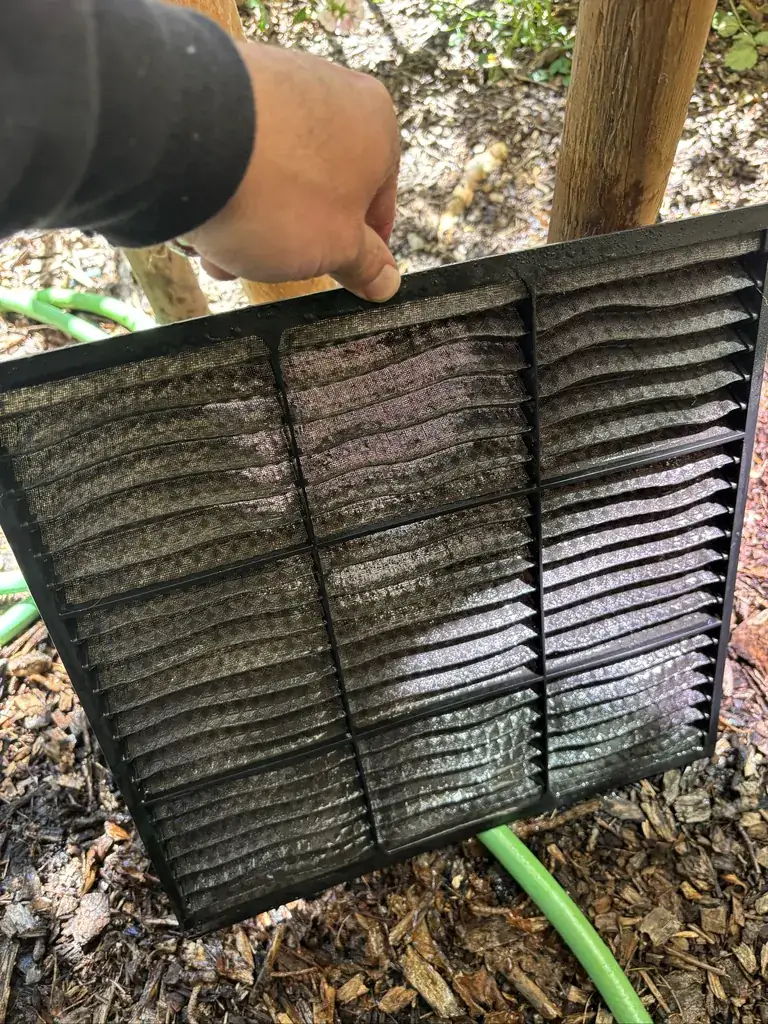
A washable filter from one of the recessed ceiling units, pulled during a 2026 Alpha Mechanical visit in Sacramento. It was washed before it went back in.
Each season: clearance around the outdoor unit
Trane's guidance is to "keep flowers, shrubs, and vines at least two feet away from the outdoor unit" (Trane). In Sacramento that also means raking leaves out of the base in fall. It means moving things such as patio chairs and trash cans that drift against the unit over summer. The coil pulls air through its sides, so anything that blocks the sides starves it in both seasons.
To rinse a dusty outdoor coil yourself, Lennox says to shut off power at the disconnect switch, then use a garden hose on a gentle stream, never high-pressure water, rinsing from the inside of the coil outward (Lennox). Follow your unit's manual first, and leave the rinse to the technician if it means opening the unit.
Lennox's advice for winter is direct: "Heat pumps that run year-round should never be covered" (Lennox). Lennox adds that full covers trap moisture and invite rust or pests. A heat pump that is running in winter needs open air moving through its outdoor coil to make heat.
Each season: the drain and the copper lines
Find the condensate drain line where it ends, outside or at the indoor unit. Clear any debris from the opening. Trane lists keeping the drain line free of debris right beside the two-foot clearance (Trane). Water dripping from the outdoor unit in winter is usually normal: Trane notes that condensation is a natural byproduct and that the unit defrosts any ice that forms.
Then look at the line set. The line set is the pair of copper pipes that carries refrigerant between the outdoor unit and the house, and the larger pipe wears a foam sleeve of insulation. Cracked, crumbling or missing insulation is easy to spot and is one of the findings in the real visit described below. Report it at your next service visit; do not cut into the line or disturb the fittings.
At each season change: the thermostat
Switch the mode from cool to heat in fall and back in spring, and check the schedule. If your thermostat shows auxiliary or emergency heat running for long stretches on mild days, note it for the technician.
Where your part stops
Refrigerant, wiring, capacitors and the inside of the outdoor unit are technician work. If the breaker trips, the unit hums without starting or you smell burning, turn the system off at the thermostat and call. That is the safe line for any electrical fault.
What a Yearly Service Visit Covers
A professional visit measures what you cannot see: electrical connections, motor current, refrigerant level, airflow and the controls that switch the heat pump between modes. ENERGY STAR's contractor list starts with the thermostat settings and the electrical side: tightening electrical connections and measuring voltage and current on motors. It adds lubricating moving parts, inspecting the condensate drain, and checking the controls and the starting cycle. On the cooling side it lists cleaning the coils, checking the refrigerant level, and cleaning and adjusting the blower (ENERGY STAR). On that blower item, ENERGY STAR notes that airflow problems "can reduce your system's efficiency by up to 15 percent."
A heat pump adds heating-mode work on top of that list. Our HVAC tune-up checklist lists the heat pump items we check. They include the reversing valve, tested by switching between heating and cooling, and the defrost control. They also include the backup electric heat, the outdoor drain ports and the refrigerant charge in heating mode. A fall visit is the time for those, so a weak defrost control or backup heat strip is found before the coldest weeks rather than during them.
If you also have a gas furnace, its check is a different visit with combustion and heat exchanger tests; our furnace cleaning and maintenance service covers that one.
What One Real Maintenance Visit Found
In 2026, a Sacramento homeowner in ZIP 95818 asked Alpha Mechanical for an inspection and maintenance visit on their mini-split heat pump system. Where these details come from: every detail below comes from the Housecall Pro job record and the written inspection report for this visit. We state only what those records say, and the homeowner's name and address are withheld.
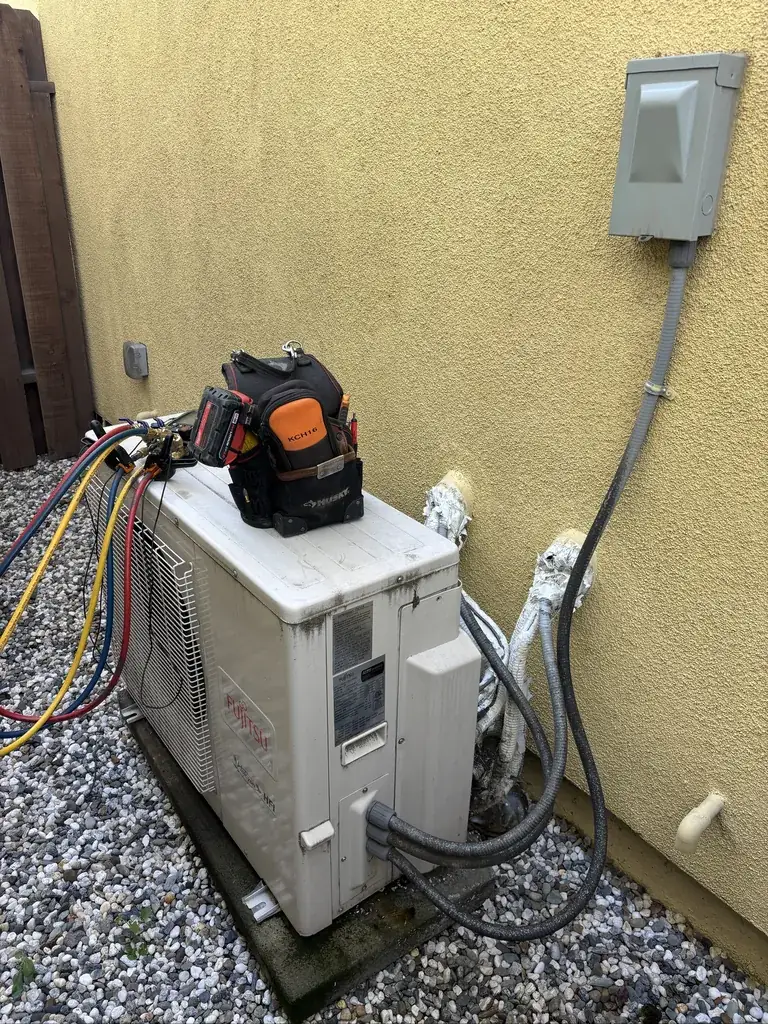
The outdoor unit on the 2026 Sacramento visit, with gauge hoses connected during the check.
- The system: an 11-year-old, 2-ton Fujitsu multi-zone outdoor heat pump on R-410A. It serves four indoor units. Two 0.75-ton recessed ceiling units serve the first floor, and two 1-ton slim duct units in the attic serve the second floor.
- How it ran: the report records that the system ran in heating and cooling without problems and that the wired wall thermostat responded in both modes.
- The measurements: a 20°F difference between return and supply air in cooling, with the refrigerant charge recorded as proper for the indoor units. In heating mode the difference was 30°F, recorded as normal efficiency for a unit of that age.
- The filters: a washable filter in each recessed ceiling unit and two 20x20x1 return filters in the second-floor ceiling.
- The work done: the technician washed the outdoor coil and the washable filters in the ceiling units.
- The one defect: the insulation on the outdoor line set was deteriorating, and the technician taped it.
- The paperwork: the report notes that the manufacturer's warranty on the compressor and parts had expired.
Three things in that record are worth knowing for your own system. Most of the visit was measuring and cleaning, which is what keeps a working system working. The only defect was one a homeowner can see from the yard: the line-set insulation from the checklist above. And an 11-year-old system out of warranty is where a pre-season visit matters most, because the manufacturer no longer covers the parts for any repair.
What Heat Pump Maintenance Costs at Alpha Mechanical
Alpha Mechanical's heating tune-up is a flat $99, and during the winter season that same price covers a heat pump. For any seasonal offer running now, see our current specials. The fall visit is the one that checks the defrost control, reversing valve and backup heat before December.
Want both seasons covered? Our Club Membership includes 2 tune-ups a year, a spring AC visit and a fall heating visit. It costs $239 a year or $19.99 a month, with 20% off repairs. For a heat pump, that matches ENERGY STAR's spring-and-fall advice with one plan.
When It Is a Repair, Not Maintenance
Maintenance keeps a working heat pump working. These signs mean something has already failed, and a tune-up will not fix them:
- Cold air from the vents in heat mode that lasts longer than a defrost cycle. Our guide to a heat pump blowing cold air in winter separates the normal causes from the broken ones.
- Ice that covers the outdoor coil and does not clear. Lennox notes that occasional defrosting is normal, but "frequent or prolonged cycles may signal an issue" (Lennox).
- Short cycling, grinding or buzzing noises, a tripping breaker or water inside the house. Our list of the most common heat pump problems covers each one.
For any of those, book a repair diagnosis rather than a maintenance visit, so the technician arrives expecting a fault.
Maintenance, Rebates and Replacement
Good maintenance extends a heat pump's working life, but it does not make an old system new, and in Sacramento the replacement math runs through SMUD. If your system is aging out, start with the SMUD heat pump rebates available to Sacramento homeowners. SMUD is the rebate program; GoGreen is state financing, not a rebate. A heat pump job submitted for a SMUD rebate can get an on-site field quality control inspection. Our write-up of a SMUD field quality control inspection in Fair Oaks shows what the inspector checks.
Still deciding between electric and gas heat? Our comparison of a heat pump versus a gas furnace in Sacramento works through running costs. Our heat pump myths and facts answers the common worries about cold-weather performance. When the system is due, our heat pump installation and replacement service handles the quote.
We serve heat pump owners across the region. Our Sacramento HVAC service page covers the city, including the 95818 home in this guide. Our page on heat pump installation in Folsom shows the systems we have put into Folsom homes and what SMUD pays toward them.
The Short Version
- Check the filter monthly and keep two feet of clear space around the outdoor unit.
- Never cover a heat pump that is running; expect steam on damp winter mornings.
- Book a technician before cooling season and before heating season. In Sacramento the heat pump works hard in both.
- Look at the drain and the line-set insulation each season, and leave refrigerant and wiring to a technician.
Ready to book your fall visit? Contact our heat pump service team, which schedules heat pump tune-ups and repairs across the Sacramento area on weekdays. To learn more about us, read about Alpha Mechanical.