
A blinking red light on a gas furnace is the control board reporting a fault by flash count. Count the flashes between pauses through the little window in the lower door, if your furnace has one, and write the number down. Then match it to the code label inside the furnace door or to your brand's table below. Do not open the blower door first: on many furnaces that cuts power and the code goes dark. If the code points at a safety switch or the burners, the next step is a heating repair visit, not repeated resets. We wrote this guide at Alpha Mechanical, a heating contractor serving the Sacramento area, from the makers' own tables.
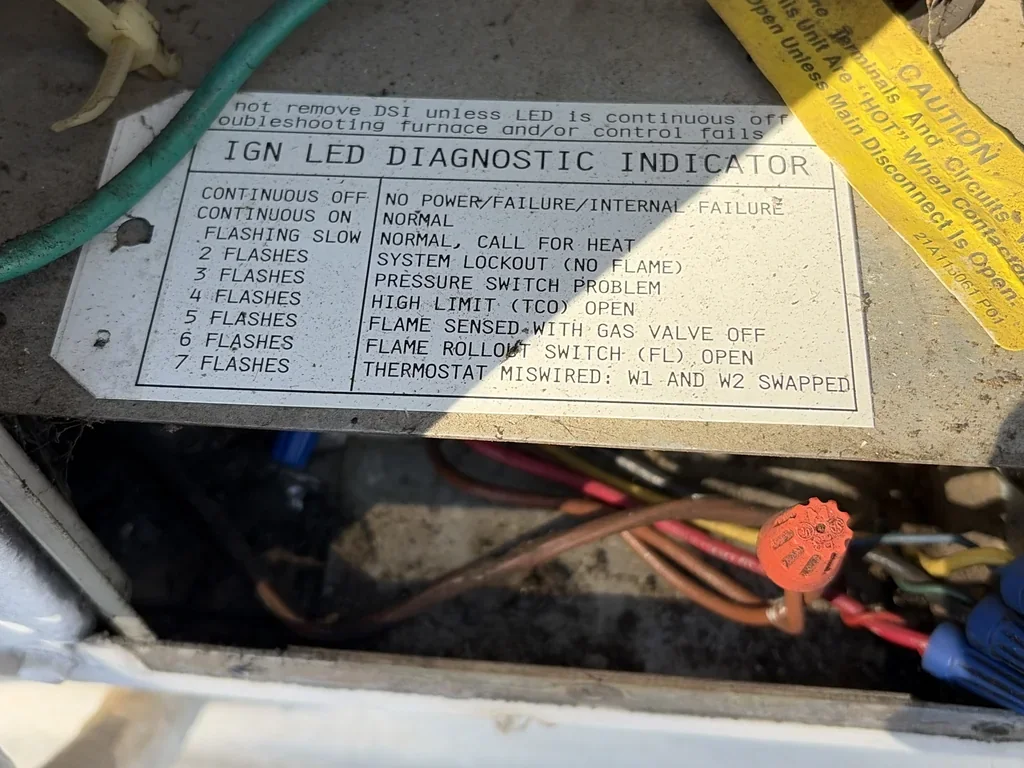
This guide reads the code tables straight from Goodman, Carrier and Rheem documents, and Trane's own help page, because the same flash count means different things on different brands. Two flashes is a pressure switch stuck closed on a Goodman and a pressure switch open on a Rheem. On the gas package unit label in the photo at the top of this page, from a Fair Oaks tune-up in October 2026, 2 flashes is a system lockout and 3 is a pressure switch problem. This guide is built around a real call we ran in Fair Oaks in February 2026, where the board showed two blinks. For the wider no-heat checklist, start with why a furnace won't turn on.
Key Takeaways
- A blinking or flashing red light is a fault code. Count the flashes between pauses, and count two or three cycles to be sure.
- Read it before you open the blower door. Carrier's troubleshooting guide tells technicians not to remove the blower door because "it will erase status codes stored in memory."
- There is no universal chart. On Goodman, 2 flashes means a pressure switch stuck closed; on Rheem, 2 flashes means the pressure switch is open with the inducer running.
- Carrier furnaces use two-digit status codes: short flashes give the first digit, long flashes the second. Bryant and Payne codes are not covered here, so check your own door label.
- On a February 2026 call in Fair Oaks 95628, a Rheem furnace showed "2 blinks - pressure switch open," which matches Rheem's own table.
How to Read a Blinking Furnace Light
A flash code, also called a blink code, is the number of blinks between pauses, and each number stands for one fault the control board detected. A furnace with an electronic control board usually has an LED that reports what the board saw. On some furnaces you can see it through a small sight window in the lower door. A safe order to follow:
- Look before you touch anything. Do not pull the blower door yet. On many furnaces a door switch cuts power when the panel comes off, and the live code goes dark with it. Carrier's guide is explicit: remove the control door first and not the blower door, because it "will erase status codes stored in memory" (Carrier's 58-3T troubleshooting guide).
- Count the flashes between pauses. A code repeats: a burst of flashes, a pause, the same burst. Count two or three cycles. For example, three flashes, a pause and three flashes again on a Goodman GMS8 is code 3, a pressure switch stuck open. On Carrier boards you also need to tell short flashes from long ones (see below).
- Note the color and whether it is steady. A steady light usually means normal operation or power on. A light that is off can mean no power or a failed control, depending on the brand.
- Find the label on the door. The key to your board's codes is usually printed inside the furnace door or on the wiring diagram. That label beats any chart online, including ours.
- Write it down, then call if it is a safety code. The code is what the technician needs first. It shortens the visit.
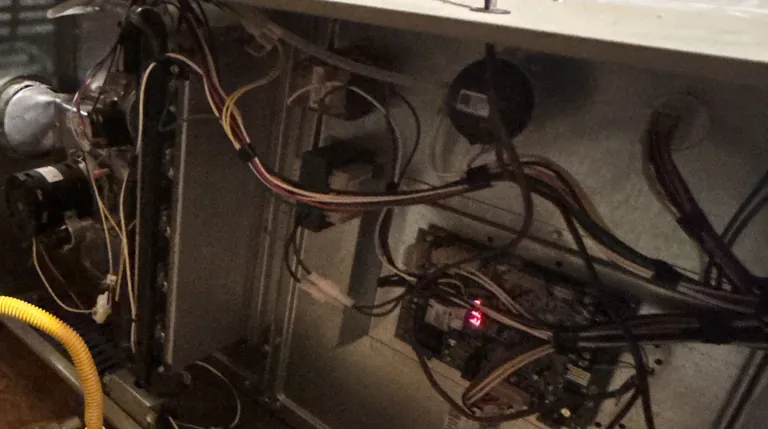
The status light on a control board from one of our attic service calls. Your board may sit in a different spot, but it is usually near the low-voltage wiring.
Green, slow or steady lights
Not every blink is a fault, and brands disagree on what a slow blink means. Trane's help page says a slow green blink may mean there is no call for heat, while a faster one may mean the furnace is heating (Trane). The label in the photo at the top of this page lists slow flashing as normal, with a call for heat. On the Goodman and Rheem tables below, a steady light means normal operation or power on. So a slow green blink or a steady light can be a normal status report; your own label says which.
Codes You Should Not Reset
Do not reset a rollout, flame-sensed or gas valve code. If you smell gas, do not touch the thermostat or any switch; leave and follow the gas steps below. Otherwise, turn the furnace off at the thermostat and call. Repeated resets on a safety code can mean repeated ignition attempts on a furnace that is telling you something is wrong. When a reset is reasonable for other codes, and what a lockout means, is covered in our short cycling guide.
Goodman Furnace Codes (GMS8 and GMH8)
Goodman prints a flash code legend on the wiring diagrams of its GMS8 and GMH8 80% furnaces. These two common lines, the single-stage GMS8 and the two-stage GMH8, use nearly the same legend:
| Light | GMS8 (single-stage) | GMH8 (two-stage) |
|---|---|---|
| Steady on | Normal operation | Normal operation |
| Off | Control failure | Control failure |
| 1 flash | System lockout (retries or recycles exceeded) | System lockout (retries or recycles exceeded) |
| 2 flashes | Pressure switch stuck closed | Pressure switch stuck closed |
| 3 flashes | Pressure switch stuck open | Pressure switch stuck open |
| 4 flashes | Open high limit | Open high limit switch |
| 5 flashes | Flame sensed without gas valve | Flame sensed without gas valve |
| 6 flashes | Open rollout | Open rollout or open fuse |
| 7 flashes | Low flame signal | Low flame signal |
| 8 flashes | Not listed | Check igniter or improper ground |
| Rapid flashes | 115 VAC polarity reversed, verify ground | 115 VAC polarity reversed, verify ground |
Sources: a Goodman-hosted, Franklin-branded spec sheet for the GMS8 family (wiring diagram 0140F00119) and Goodman's GMH8/GDH8 spec sheet (wiring diagram 0140F00662). Other models can differ, and we did not have Amana manuals; Goodman's diagnostic code lookup covers Goodman and Amana models by model number.
Generic charts may not match your board. Google's AI summary for "furnace blinking red light" on October 21, 2026 listed 5 blinks as a flame rollout warning. On these Goodman boards, 5 flashes is flame sensed without the gas valve, and 6 is the rollout.
Goodman's GMH8 sheet also describes a "self-diagnostic control board with constant memory fault code," and notes that holding the board's switch in standby recalls the last five faults. That recall is a technician step, not a homeowner one.
Carrier Furnace Codes
A status code is Carrier's name for the two-digit number its boards flash. Carrier's 58-3T troubleshooting guide describes the pattern: "the first digit determined by the number of short flashes and the second digit by the number of long flashes." For example, one short flash followed by three long flashes is code 13. Bryant and Payne codes are not covered here; we only had Carrier's own guides, so check the label on your door.
These names come from Carrier's troubleshooting guides for its two-stage 80% furnaces (58-3T, covering models such as 58TUA and 58UHV) and its 58CVA variable-speed furnace (TG-GFC80-02):
| Code | Name in Carrier's guide | What it usually means for you |
|---|---|---|
| 11 | No previous code | No stored fault |
| 12 | Blower on after power up | Normal after power returns mid-call |
| 13 | Limit or flame rollout switch lockout (58-3T); limit circuit lockout (TG-GFC80-02) | Safety lockout. Call |
| 14 | Ignition lockout | Burners failed to light after several tries |
| 21 | Gas heating lockout | The board locked out gas heat. Call |
| 22 | Abnormal flame-proving signal | Flame sensed when it should not be. Call |
| 23 | Pressure switch did not open | Draft switch stuck closed |
| 24 | Secondary voltage fuse is open | The low-voltage fuse on the board blew. Call |
| 31 | High-heat pressure switch or relay did not close or reopened | Draft problem on high fire |
| 32 | Low-heat pressure switch did not close or reopened | Draft problem on low fire |
| 33 | Limit or flame rollout switch is open (58-3T); limit circuit fault (TG-GFC80-02) | Overheating or rollout. Call |
| 34 | Ignition-proving fault | Flame not proven after ignition |
| 43 | Low-heat pressure switch open while high-heat pressure switch is closed | Draft switch mismatch |
| 45 | Replace control (58-3T) or control circuitry lockout (TG-GFC80-02) | Board fault |
Sources: Carrier 58-3T troubleshooting guide and Carrier TG-GFC80-02 troubleshooting guide, index pages. Single-stage models word some codes differently, so check the label on your door.
Three Carrier codes worth knowing are 13, 31 and 33. Code 33 and code 13 are the same family of fault: a limit or rollout switch opened. Code 33 reports the open switch; code 13 is the lockout version of the same fault. Both are calls, not resets. Code 31 is a draft problem; our pressure switch troubleshooting guide walks through the usual causes.
Rheem Furnace Codes
Rheem prints a two-light table on the wiring diagram of its 80% and 90% furnaces: a red status light for faults and a yellow light for the flame signal.
| Red status light | Fault |
|---|---|
| On | Power on |
| 1 flash | Limit circuit open, or external load on "W" |
| 2 flashes | Pressure switch is open with inducer on |
| 3 flashes | Pressure switch is closed with inducer off |
| 4 flashes | Ignition failure (check ground) |
| 5 flashes | 115 VAC and neutral reversed, or no ground |
| Continuous | False flame or gas valve relay shorted |
| Off | Power off |
| Yellow flame light | Meaning |
|---|---|
| Continuous flash | Low flame sensor signal |
| On | Flame present |
Source: Rheem wiring diagram for 80+ and 90+ model furnaces. The sheet does not name model series, and we did not have Ruud manuals, so read the label in your own furnace.
A Fair Oaks Call: Two Blinks on a Rheem
This is a real job from our Housecall Pro records, anonymized to the ZIP code. In February 2026, a homeowner in Fair Oaks 95628 called because the system kept idling: it came on briefly and the house temperature did not rise. Our technician's note reads: "2 blinks - pressure switch open." The furnace was a Rheem.
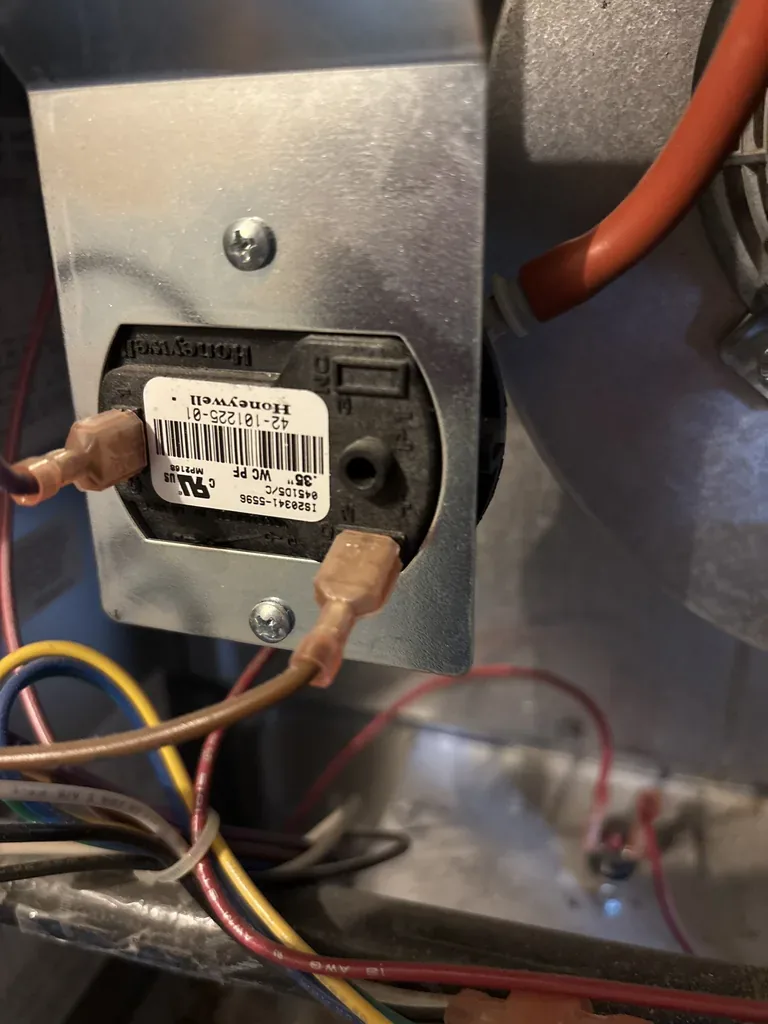
That reading lines up with Rheem's own table: two flashes is "pressure switch is open with inducer on." A pressure switch is the switch that proves the exhaust is moving before the board may open the gas valve. In plain terms, the inducer motor ran, but that switch never closed, so the board would not open the gas valve. That is why the furnace kept starting and quitting without heat.
Three things in that record are useful for anyone looking at a blinking light:
- The code narrowed the visit. Two flashes on a Rheem points at the draft side, not the thermostat or the gas supply; our pressure switch guide covers the usual causes.
- The same two flashes would mean something else on a Goodman, where 2 flashes is a switch stuck closed. Reading the brand's own table matters.
- The record is a diagnostic visit. It names the fault, and we do not claim more about the repair than it says.
Methodology: on October 21, 2026 we searched the descriptions and notes of the 492 Housecall Pro jobs scheduled since September 1, 2025 for furnace or heating calls that mention a code, flash, blink, LED, error, fault or lockout. Two matched. One was this completed visit; the other was a canceled request about a blower that would not run.
Trane Furnace Blinking Red Light
Trane's own furnace help page says red blinking lights "generally signal a problem," and that what the lights mean depends on "your furnace's make and model" (Trane). Trane's page does not list flash counts, and we had only search excerpts of Trane installer-guide tables, not a complete table to check against, so we do not print a Trane chart here. The same goes for American Standard. Read the label inside the furnace door; it is written for the exact board in your furnace.
Codes That Mean Turn It Off and Call
If you smell gas, do not touch the thermostat or any switch. PG&E's instruction is to "leave the area now and call 9-1-1. Then call PG&E at 1-800-743-5000" (PG&E).
Some codes are information. Others mean the furnace protected itself from something unsafe. With no gas smell, turn the furnace off at the thermostat and call if you see any of these:
- A rollout code (Goodman 6 flashes, Carrier 13 or 33). A rollout switch is a heat sensor that trips when burner flame is not being drawn into the heat exchanger. Our furnace safety switch guide explains why it is a manual-reset switch.
- Flame sensed when there should be none (Goodman 5 flashes, Carrier 22, Rheem continuous red). That is a call-now code.
- A gas valve relay fault (Rheem continuous red, which Rheem lists as false flame or a shorted gas valve relay). Our gas valve troubleshooting guide covers what a technician checks.
Do not jumper a pressure switch, reset a rollout switch or remove a limit to get heat back. Those switches help keep a fault from turning into a fire or carbon monoxide hazard. The U.S. Consumer Product Safety Commission also advises: "Install battery-operated CO alarms or CO alarms with battery backup on every level of the home and outside sleeping areas" (CPSC).
Where Each Code Leads
| Code points at | Read next |
|---|---|
| Pressure switch, draft, inducer (Goodman 2 or 3, Carrier 23, 31, 32 or 43, Rheem 2 or 3) | Pressure switch troubleshooting and inducer motor signs |
| Ignition or flame (Goodman 1 or 7, Carrier 14 or 34, Rheem 4 or yellow flashing) | Gas valve troubleshooting and, on older furnaces, pilot light troubleshooting |
| Limit or rollout (Goodman 4 or 6, Carrier 13 or 33, Rheem 1) | Furnace safety switches |
| Repeated lockouts after resets | Furnace short cycling |
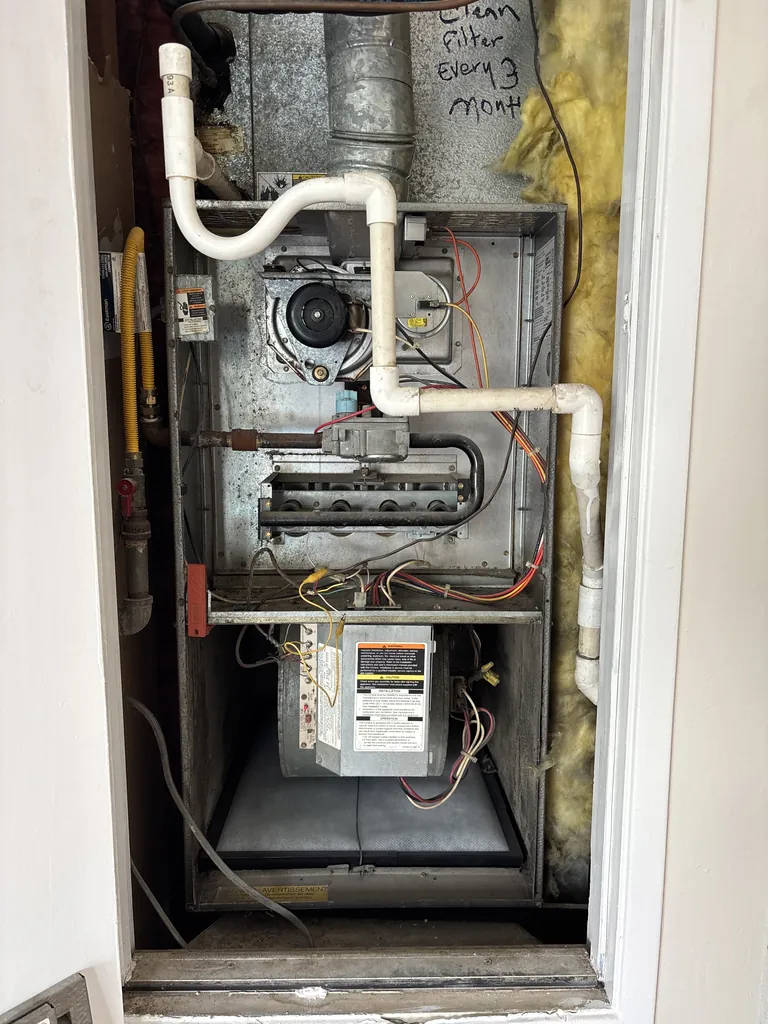
A 1993 furnace from a Citrus Heights call. Some furnaces of this age have no status light at all; when there is no light to read, the symptom guide in why a furnace won't turn on is the place to start.
When to Call Alpha Mechanical
Call when the code is a safety code, when the same code keeps coming back, or when you are not sure what you are reading. Tell us the brand, the flash count and the color, and send a photo of the door label if you can. You can call us or contact us online. Our diagnostic visit is $89, applied toward the repair if you go ahead. We serve the Sacramento area from Fair Oaks; see furnace repair in Fair Oaks and furnace repair in Citrus Heights for the nearby service pages.
Frequently Asked Questions
How do you fix a blinking red light on a furnace?
You fix the fault the light is reporting, not the light. Count the flashes and match them to the label in your furnace door. If the code points at a safety switch or keeps coming back, call a technician.
What does 3 blinking red lights on a furnace mean?
It depends on the brand. On Goodman GMS8 and GMH8 furnaces, 3 flashes means the pressure switch is stuck open. On Rheem furnaces covered by Rheem's 80+ and 90+ wiring diagram, 3 flashes means the pressure switch is closed with the inducer off. Check your door label.
Why is my furnace blinking red 5 times?
On a Goodman GMS8 or GMH8, 5 flashes means flame was sensed without a gas valve signal, which is a call-now code. On a Rheem 80+ or 90+ furnace, 5 flashes means line voltage and neutral are reversed or there is no ground. Both need a technician.
What does a single flashing red light mean?
It depends on the board. On Goodman GMS8 and GMH8 furnaces, 1 flash is a system lockout: retries or recycles were exceeded. On Rheem's 80+ and 90+ table, 1 flash means the limit circuit is open or there is an external load on W. Read the label in your furnace door.
What do 4 flashes mean on a furnace?
On Goodman GMS8 and GMH8 furnaces, 4 flashes means the high limit switch is open. On Rheem's 80+ and 90+ table, 4 flashes means ignition failure (check ground). If either keeps coming back, call a technician.
What does a solid red light on a furnace mean?
On the Goodman GMS8 and GMH8 legends, a steady light means normal operation, and on Rheem's 80+ and 90+ table a steady red light means power on. A steady light is not a fault code by itself; a blinking one is.
Does turning off the power clear the furnace code?
It stops the live flash, and on many furnaces so does opening the blower door. Carrier's guide warns that removing the blower door will erase status codes stored in memory. Other boards, such as Goodman's GMH8, keep the last five faults for a technician to recall. Count the flashes first.
How much does it cost to diagnose a blinking furnace light?
Our diagnostic visit is $89, applied toward the repair if you go ahead. The repair price depends on what the code points at, so we quote it after the diagnosis.
Written by Andrey Yev, PE, General Manager of Alpha Mechanical (about us), based in the Sacramento region. Editorial note: every code name in the tables was checked against the manufacturer documents listed below on October 21, 2026; the plain-language column is our reading of them, and the job story comes from our own Housecall Pro records.
Sources
- Goodman-hosted SS-FGMS8 specification sheet (Franklin brand, GMS8 family), wiring diagram 0140F00119
- Goodman SS-GMH8 specification sheet, wiring diagram 0140F00662
- Goodman Diagnostic Code Identification System
- Carrier 58-3T troubleshooting guide, two-stage 80% furnaces
- Carrier TG-GFC80-02 troubleshooting guide, 58CVA furnaces
- Rheem wiring diagram for 80+ and 90+ model furnaces, 7103550
- Trane: Furnace Light Blinking, What It Means
- U.S. Consumer Product Safety Commission: Carbon Monoxide
- PG&E: Gas Safety
- Alpha Mechanical service records in Housecall Pro, read October 2026 and anonymized to city, ZIP and month.