

Evaporator coil replacement cost is a number most homeowners first hear on the hottest week of the year, from a technician standing in the garage. Here is what it actually was on one of our jobs: in July 2026, a Folsom homeowner paid Alpha Mechanical $3,782 to replace a leaking evaporator coil, plus $2,184 for the variable-speed blower motor replaced in the same visit. That is a real invoice from a real job in the 95630 ZIP, not a national estimate. Most cost guides put evaporator coil replacement somewhere between $627 and $2,700 (This Old House) and "up to $5,000+" out of warranty (Trane). The gap between those numbers and what a Sacramento-area coil job actually costs is the reason this post exists.
- What the Folsom Job Cost, Line by Line
- How We Confirmed the Leak Was in the Coil
- Why the Invoice Sits Above the National Cost Guides
- The Nine-Day Wait: Why a Coil Is a Special Order
- Repair the Coil or Replace the System?
- Two Invoices, One Visit: The Blower Motor
- What to Ask Before You Approve a Coil Replacement
- Frequently Asked Questions
Key Takeaways
- A Folsom evaporator coil replacement invoiced at $3,782 on July 10, 2026; the blower motor replaced in the same visit added $2,184, for $5,966 across two invoices.
- National estimates bracket that number: This Old House puts most coil replacements at $627–$2,700 (updated April 2026), while Trane says an out-of-warranty job can reach $5,000+ (April 2026).
- The coil was a special order: nine days from the first visit on July 1 to the install on July 10, in the first week of a Sacramento July.
- The 2025 refrigerant rules do not block this repair. EPA states that components used to repair existing systems are not subject to the new GWP restrictions, so an R-410A coil for an existing system is still a legal fix.
- Past roughly $4,000 in repairs, the decision stops being about the coil and becomes a system question: warranty status, the health of the outdoor unit, and what a replacement costs after SMUD's rebate.
What the Folsom Job Cost, Line by Line
The coil replacement was one flat-rate invoice: $3,782, with no separate lines for labor or refrigerant. Here is the job as it sits in our records, with the customer's identity left out.
| Item | Invoice | Date |
|---|---|---|
| Evaporator (indoor) coil replacement, special order, installed | $3,782 | July 10, 2026 |
| Variable-speed blower motor, special order, same visit | $2,184 | July 10, 2026 |
| Two invoices, one system | $5,966 |
The timeline matters as much as the price:
- June 26: the homeowner booked with us as a Trane referral. The booking note reads, in full, "Looking for the replacing evaporator coil on an AC unit." They already knew the coil was the problem.
- July 1: first visit. This is the nitrogen pressure test described in the next section, the test that confirms the leak is in the indoor coil and not the line set or the outdoor unit, along with the model numbers the replacement coil has to match. We do not order a coil on a phoned-in diagnosis.
- July 10: the coil arrived and went in. The crew was on site into the afternoon, and the blower motor was replaced on the same visit under its own invoice.
The $89 diagnostic we charge on every call applies toward the repair, so it is not an extra line on top of these numbers.
How We Confirmed the Leak Was in the Coil
A refrigerant leak is not diagnosed by looking at a coil. It is diagnosed by isolating the system, pressurizing it with dry nitrogen, and watching whether that pressure holds. That test is what the July 1 visit was for, and it is what justifies ordering a part at this price.
The sequence we run on a suspected coil leak:
- Isolate the outdoor unit. The service valves are closed so the condenser and the indoor side can be held and tested as separate volumes instead of as one system.
- Recover the refrigerant. Whatever charge is left comes out into a recovery machine and cylinder before anything is opened. It is never vented.
- Pressurize with dry nitrogen and wait. Nitrogen is dry and inert, so it can sit at test pressure without pushing moisture into the system. The system is left under that pressure for a set hold period.
- Spray the joints while it holds. Every brazed connection gets sprayed and watched for bubbles. On a coil, that is a lot of connections.
- Read the pressure again at the end of the hold. A drop means the system is leaking, and what held against what did not tells us which side to open.
Only after that test do we order a coil. The test is what separates "the system is low on refrigerant" from "the leak is in the indoor coil," and those two findings lead to very different quotes.
In more than 25 years in this trade, over 90% of the leaks we chase turn out to be in the evaporator coil. A coil is built from hundreds of brazed joints, and it expands and contracts through every cooling cycle for its whole life. Given enough years, that movement opens pinhole leaks small enough to be effectively impossible to find by eye, and a sniffer alone will not always land on them either. The nitrogen hold test is what turns "probably the coil" into "the coil."
One part that is never optional: the liquid-line filter drier. Any time the sealed system is opened, the filter drier at the outdoor unit gets replaced. Its desiccant has already taken up whatever moisture the system absorbed, and leaving a saturated drier in place puts that moisture straight back into a system you just spent hours evacuating.
After the new coil goes in, the same test runs in reverse: pressurize and confirm it holds, pull a deep vacuum to boil off any remaining moisture, then weigh in the refrigerant charge to the manufacturer's specification. A coil job that skips the vacuum is a callback waiting to happen.
Why the Invoice Sits Above the National Cost Guides
A Sacramento-area coil job lands above the national midpoint because the coil is matched to the system, the labor is California labor, and the refrigerant charge is part of the bill. The national guides are still worth reading for the shape of the range.
This Old House, in a guide updated April 6, 2026, says "replacing an evaporator coil costs $627–$2,700 in most cases," with most homeowners paying around $1,350, and puts a 4-ton coil at $800–$2,600 and a 5-ton coil at $900–$2,700 (This Old House, retrieved 2026-08-20). Treat those as estimates from a publisher, not a quote.
Trane's own guide, published April 16, 2026, is closer to what we see in the field. It says a homeowner whose coil is under warranty should still expect to "pay $2,000+" for labor, refrigerant, taxes, and removal and installation, and that an out-of-warranty replacement can run "up to $5,000+" once the coil itself is included (Trane, retrieved 2026-08-20).
Our $3,782 Folsom invoice sits between the This Old House ceiling and the Trane ceiling. That is where most out-of-warranty coil replacements we do in Sacramento County land: a matched coil for the existing outdoor unit rather than a generic slab, a full refrigerant recovery and recharge, and the labor to open the air handler or furnace cabinet, braze the new coil in, pull a vacuum, and verify the charge.
If you want to understand why coils fail in the first place, Trane notes that older coils are "more susceptible to corrosion and pinhole leaks." We cover the causes separately in what causes an AC to leak refrigerant, and the warning signs that usually bring a homeowner to this page in the signs of low AC refrigerant.
The Nine-Day Wait: Why a Coil Is a Special Order
Evaporator coils are not truck stock. They are matched to the outdoor unit's capacity, refrigerant, and cabinet width, which is why the Folsom coil took nine days to arrive in early July. A capacitor or a contactor comes off the truck the same day. A coil comes from a distributor, and in the first week of July distributors are working through their peak-season backlog.
Two things shaped the lead time on this job and will shape yours:
- The match. An indoor coil has to be rated with the outdoor unit it pairs with. Swapping in a coil that is the wrong capacity or the wrong cabinet width costs efficiency at best and creates a second failure at worst. Getting the right part is worth more than getting a part tomorrow.
- The refrigerant rules. Since January 1, 2025, new residential air conditioning systems have had to use refrigerants under a 700 GWP limit, which is why new equipment is shipping with R-454B instead of R-410A. That rule covers new systems. EPA's sector table states plainly that "components used to repair existing systems are not subject to these restrictions" (EPA Technology Transitions, retrieved 2026-08-20). A replacement R-410A coil for a system that already runs R-410A is a legal, supported repair. The transition changes the replacement-system conversation, not the repair conversation; we walk through it in the 2025 refrigerant mandate explained.
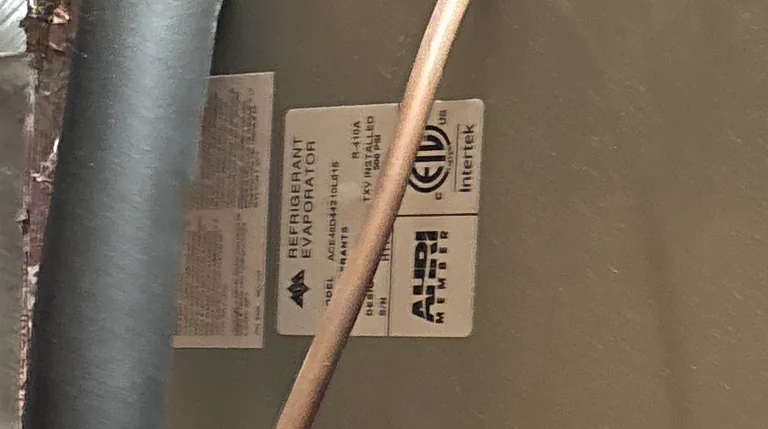
The plate on this cabinet reads R-410A with a TXV installed. That is the detail the EPA carve-out turns on: the system already runs R-410A, so the part that repairs it is an R-410A coil, and the 2025 GWP limit on new systems does not reach it. The plate is also why the first visit matters, because the model and refrigerant printed on it are what the distributor needs before a coil can be ordered.
While you wait for a coil in July, the system is usually still running on a low charge. That is the stretch where a coil ices over; a frozen evaporator coil is a symptom of the same leak, and running it iced puts the compressor at risk.
Repair the Coil or Replace the System?
At $5,966 in repairs, the usual rule of thumb says "replace" on almost any system, which is exactly why the rule of thumb is the wrong tool for a coil decision. The $5,000 rule multiplies the repair quote by the system's age and flags anything over $5,000; a $3,782 coil on a two-year-old system clears that bar, and nobody should scrap a two-year-old system over a coil that is probably still under its parts warranty. The rule and its limits are covered in full in our Sacramento AC repair cost guide.
Here is what actually decides a coil job, in the order we check it:
- Warranty status. If the system was registered at install, the coil may still be inside its manufacturer parts warranty. Under warranty the coil itself is covered but labor, refrigerant, and taxes are not, which is why Trane still quotes "$2,000+" for a warranty coil job. Ask for the install date and whether the system was registered before anyone quotes you.
- The outdoor unit. A coil leak on a system with a healthy compressor and condenser is a repair. A coil leak on a system whose outdoor unit is also tired is the first of two large bills, and the second one is usually the compressor.
- Age against lifespan. This Old House puts coil life at 10–15 years with maintenance; Trane puts the system at roughly 15 years. A coil failing at year 12 on a 15-year system is a different decision than a coil failing at year 4. This Old House's alternative test is useful here: under 10 years old and the repair under 30% of a full replacement, repair usually wins.
- What the replacement actually costs you. Folsom is SMUD territory. If the replacement is a heat pump that retires a gas furnace, SMUD's Home Performance Program currently pays $3,000 for a variable-stage heat pump HVAC system and $2,000 for a two-stage system at 15.2 SEER2 or better, submitted through a participating contractor (SMUD, retrieved 2026-08-20). That rebate can close the gap between a $6,000 repair and a new system faster than most homeowners expect. Our heat pump rebate guide walks through the application, and AC installation in Sacramento covers what a replacement involves.
On the Folsom job the homeowner chose to keep the system and replace the coil and blower. That is the right call more often than the $5,000 rule suggests, and it is the wrong call when the outdoor unit is on borrowed time. Either way, you should see both numbers side by side before any work begins, which is how we run every repair-or-replace conversation.
Two Invoices, One Visit: The Blower Motor
The second invoice, $2,184 for a variable-speed blower motor, is the part of this job most homeowners would not have budgeted for. A variable-speed (ECM) blower is an expensive part, and it sits inside the same cabinet the coil swap opens up.
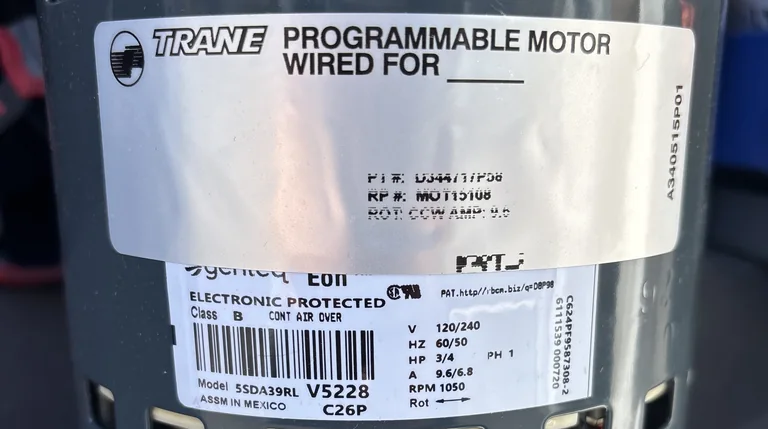
The motor from this job: a Trane-programmed Genteq ECM rated 3/4 HP at 1050 RPM. The line reading "PROGRAMMABLE MOTOR, WIRED FOR" is the difference between this and the single-speed PSC motor in an older air handler, and it is most of the reason the second invoice reads $2,184 rather than a few hundred dollars. A programmed ECM is also matched to the specific system, which is why it carries the same special-order wait as the coil instead of coming off the truck.
The honest reason to mention it is not the price. It is that a coil replacement is the one day the indoor unit is fully open with a technician's hands already inside it. If the blower motor, the control board, or the drain pan is marginal, that is the day it is cheapest to address, because the cabinet labor is already paid for. It is also the day a dishonest contractor can pad an invoice, which is why the second item should always be its own line with its own justification, as it was here.
For the blower side of the equation, including what separates a capacitor problem from a dead motor, see furnace motor troubleshooting and replacement cost. The motor is shared between heating and cooling, so a blower replaced in July carries you into the heating season too.
What to Ask Before You Approve a Coil Replacement
Five questions turn a coil quote from a number into a decision. We would rather you ask them of us than approve a quote you do not understand.
- Is the leak confirmed in the indoor coil? A refrigerant leak can be in the line set, the outdoor coil, or a fitting. A coil replacement that does not fix the leak is the worst outcome in this trade.
- Is the coil under a parts warranty? Give the contractor the install date and the model and serial numbers. If the system was registered, the coil may be covered and the invoice changes by the cost of the part.
- What does the total include? Refrigerant recovery and recharge, the vacuum and leak check, taxes, and disposal should all be inside the number. Our Folsom invoice was one line because everything was in it.
- What is the lead time? Nine days in early July is what this job took. A contractor who can install a matched coil tomorrow in peak season either has an unusual stock position or is not matching the coil.
- What does replacement cost after the SMUD rebate? You cannot judge a $3,782 repair without the other number on the table.
If the leaking coil is in Folsom, our Folsom AC repair team runs the same diagnostic described above, with the $89 fee applied toward the repair. Elsewhere in the metro, start with AC repair in Sacramento. Alpha Mechanical is a family-owned contractor based in nearby Fair Oaks, and the numbers in this post come straight from our own job records.
Frequently Asked Questions
How much does it cost to replace an AC evaporator coil?
A real Alpha Mechanical job in Folsom invoiced at $3,782 for an out-of-warranty evaporator coil replacement in July 2026, refrigerant and labor included. National estimates run lower and higher: This Old House puts most replacements at $627–$2,700 (April 2026), and Trane says an out-of-warranty job can reach $5,000+ (April 2026). A coil still under its parts warranty costs less because the part is covered, but labor and refrigerant are not.
Is it worth replacing an evaporator coil?
It depends on three things more than on the price: whether the coil is under its parts warranty, whether the outdoor unit is healthy, and how old the system is against a 10–15 year coil life. A coil failure on a young, registered system is almost always a repair. A coil failure on a 12-year-old system with a tired condenser is usually the first of two large bills, and the replacement math, including SMUD's heat pump rebate, deserves a real look.
How long does an evaporator coil last?
This Old House puts evaporator coil life at 10–15 years with proper maintenance, and Trane puts the typical air conditioner or heat pump at about 15 years. Trane also notes that older coils are more susceptible to corrosion and pinhole leaks.
Can I still get an R-410A coil after the 2025 refrigerant rules?
Yes. EPA's Technology Transitions rule sets a 700 GWP limit that applies to new residential air conditioning systems installed from January 1, 2025, but states that components used to repair existing systems are not subject to those restrictions. A replacement R-410A coil for an existing R-410A system is a legal, supported repair.
Why did the replacement coil take nine days to arrive?
Evaporator coils are matched to the outdoor unit's capacity, refrigerant, and cabinet width, so they are ordered from a distributor rather than carried on the truck. In the first week of July, Sacramento-area distributors are working through peak-season backlogs. On this job, nine days passed between the first visit and the install.
What are the symptoms of a leaking evaporator coil?
Weak cooling with the system running constantly, ice on the indoor coil or the larger copper line, and a hissing sound near the air handler are the common ones. They are the same symptoms as any refrigerant leak, so the diagnostic work is confirming the leak is in the coil. Our guide to the signs of low AC refrigerant covers what a technician checks.