

A gas furnace lasts about 20 years. The U.S. Department of Energy's 2023 furnace rule puts the average lifetime of a typical indoor gas furnace at 21.5 years nationally, 22.5 years in the cold North and 20.2 years in the rest of the country. The same analysis gives heat pumps an average of 19 years. Age tells you when to start planning. It does not, on its own, tell you to replace.
If your furnace is in that range and you are pricing a new one, our furnace replacement service for Sacramento-area homes covers how we size and quote the job. This guide covers the step before that: how long each part of a heating system lasts and why a Sacramento furnace ages differently from one in Detroit. It also covers the signs of a dying furnace and real service records from Alpha Mechanical, the Fair Oaks HVAC company behind this guide, three of them on furnaces or systems 19 to 38 years old.
Key Takeaways
- DOE estimates an average lifetime of 21.5 years for indoor gas furnaces: 22.5 years in the North and 20.2 years in the rest of the country. A literature review DOE cites ranged from 16 to 23.6 years.
- Heat pumps average 19 years in DOE's furnace analysis. A Home Innovation Research Labs report for NAHB gives a median of 20 years for a gas furnace and 15 for a heat pump.
- Sacramento's winter asks for about 40 percent of Detroit's heating demand: 2,436 heating degree days a year at Sacramento Executive Airport against 6,067 at Detroit Metro, per NOAA climate normals.
- In a Sacramento split system, the furnace blower also moves the air for the AC all summer, and DOE notes that outside the North, furnace replacements are more likely to be tied to the air conditioner.
- ENERGY STAR suggests considering replacement once a furnace passes 15 years or a heat pump or AC passes 10, along with frequent repairs, rising bills or uneven rooms. Condition and safety decide; age starts the conversation.
How Long Does a Furnace Last?
Most gas furnaces last 15 to 25 years, and about 20 years is the typical furnace lifespan. The most thorough public estimate comes from the Department of Energy's 2023 furnace rule. DOE built it from appliance age data in national housing surveys plus historical furnace shipments, then fitted a survival curve to the data. The table compares DOE with three other published figures.
| Source | Gas furnace | Heat pump | Central AC |
|---|---|---|---|
| U.S. DOE, 2023 consumer furnace rule | 21.5 years average (20.2 outside the North) | 19 years average | Not covered |
| Home Innovation Research Labs report for NAHB, 2021 | 20 years median | 15 years median | 16 years median |
| InterNACHI life expectancy chart | 15 to 25 years | 10 to 15 years | 7 to 15 years |
| ENERGY STAR, when to consider replacing | Past 15 years | Past 10 years | Past 10 years |
DOE: Federal Register, December 18, 2023, Energy Conservation Standards for Consumer Furnaces. Figures apply to non-weatherized (indoor) gas furnaces; DOE estimates electric furnaces at the same 21.5 years. ENERGY STAR's numbers are replacement prompts, not lifetimes.
The spread is real. DOE says its 21.5-year estimate "is consistent with the range of values identified in a literature review, which included values from 16 years to 23.6 years." InterNACHI's chart, written for home inspectors, gives a furnace 15 to 25 years. The honest answer to "how long does a furnace last" is a range. Where a furnace's life expectancy lands in it depends on how many hours it runs, how it was installed and how it was kept up.
Why a Sacramento Furnace Ages Differently
A Sacramento furnace faces far less heating demand than one in a cold climate. Heating degree days are a measure of how much heating a climate demands. NOAA's 1991 to 2020 climate normals give Sacramento Executive Airport 2,436 heating degree days a year and Detroit Metro Airport 6,067. By that measure, Sacramento's winter asks for about 40 percent of Detroit's heating demand. Demand is not the same as run hours, and DOE's analysis shows why.
DOE built operating hours into its lifetime model. It "assumed that equipment operated for fewer hours will have a longer service lifetime," then set separate averages for the North (22.5 years) and the rest of the country (20.2 years). The North comes out longer, not shorter, and DOE gives two reasons. Northern furnaces "are generally higher capacity to meet the higher heating load, and, thus, can have lower operating hours." And "furnace replacements in the rest of country are more likely to be linked to a paired central air conditioner." Because northern furnaces are sized larger, DOE adds that "burner operating hours are not necessarily higher in the North than the rest of country."
That second reason describes Sacramento well. Compared with Detroit, our climate leans toward cooling: the same NOAA normals give Sacramento 1,292 cooling degree days a year against Detroit's 847. In the split systems we service, the air conditioner's indoor coil sits on the furnace, and the furnace blower moves the cooled air through the ducts. DOE says as much: furnaces in the rest of the country "are more likely to be paired with an air conditioner, and, thus, the air handler can have significantly higher operating hours than in the North." So a Sacramento furnace's fan motor and controls work through the summer, not only the winter.
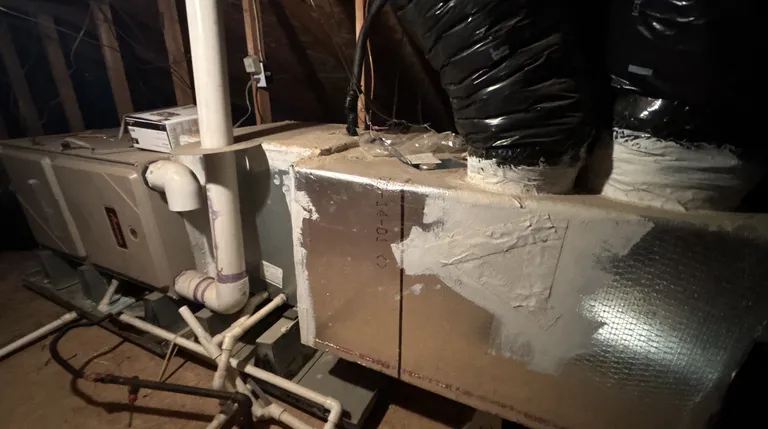
The furnace and the AC's indoor coil sit side by side and share one blower. When the outdoor unit fails, the furnace is part of the same decision.
The replacement conversation often starts with the air conditioner too, because a new outdoor unit has to match the indoor coil and the furnace blower that moves its air. Our own records point the same way: in Folsom since January 2024, 8 of 9 furnace replacements came with a new air conditioner at the same visit, as our Folsom furnace replacement page details. Our guide to repair or replace decisions walks through how to weigh that when both pieces are old.
How Long Do Heat Pumps and Whole HVAC Systems Last?
A heat pump lasts a little less than a gas furnace: 15 to 19 years in the DOE and NAHB figures, and 10 to 15 on InterNACHI's chart. DOE's furnace rule gives heat pumps "an estimated average lifetime of 19 years." The Home Innovation Research Labs report gives a 15-year median, and InterNACHI's chart says 10 to 15 years. A heat pump is both the heater and the air conditioner, so its compressor runs in both seasons. In Sacramento that means summer cooling plus winter heating on one machine.
On a Sacramento service call in March 2026 (ZIP 95828), the job notes record a "10 year old split heat pump (York and ADP air handler)," and the job was logged as coil warranty work. A heat pump at 10 years is about halfway through DOE's 19-year average, but it has reached the low end of InterNACHI's 10 to 15 years and ENERGY STAR's 10-year replacement prompt. For a heat pump that age, warranty coverage is worth checking before anything else. Deciding between a heat pump and a new gas furnace? Our heat pump vs gas furnace guide for Sacramento compares the two side by side. Our heat pump installation page covers how we quote a heat pump system.
A whole HVAC system is only as young as its oldest working part. A central air conditioner gets 7 to 15 years on InterNACHI's chart, so in a split system the AC and the furnace can wear out on different clocks. A furnace installed with a new AC in the same year ages together with it. A furnace that kept running through two outdoor units does not. For the system as a whole, ENERGY STAR's replacement prompts are the useful ones. They begin once a heat pump or AC passes 10 years and a furnace passes 15. They also include equipment that "needs frequent repairs and your energy bills are going up," and rooms that are "too hot or too cold."
How Can You Tell How Old Your Furnace Is?
The rating plate is the label inside the furnace cabinet, usually on the inside of the burner or blower compartment door, with the model and serial number. It is the fastest way to find a furnace's age. Many plates print a manufacture date. When the plate does not, the serial number often encodes the year, and the manufacturer's customer support or your contractor can decode it.
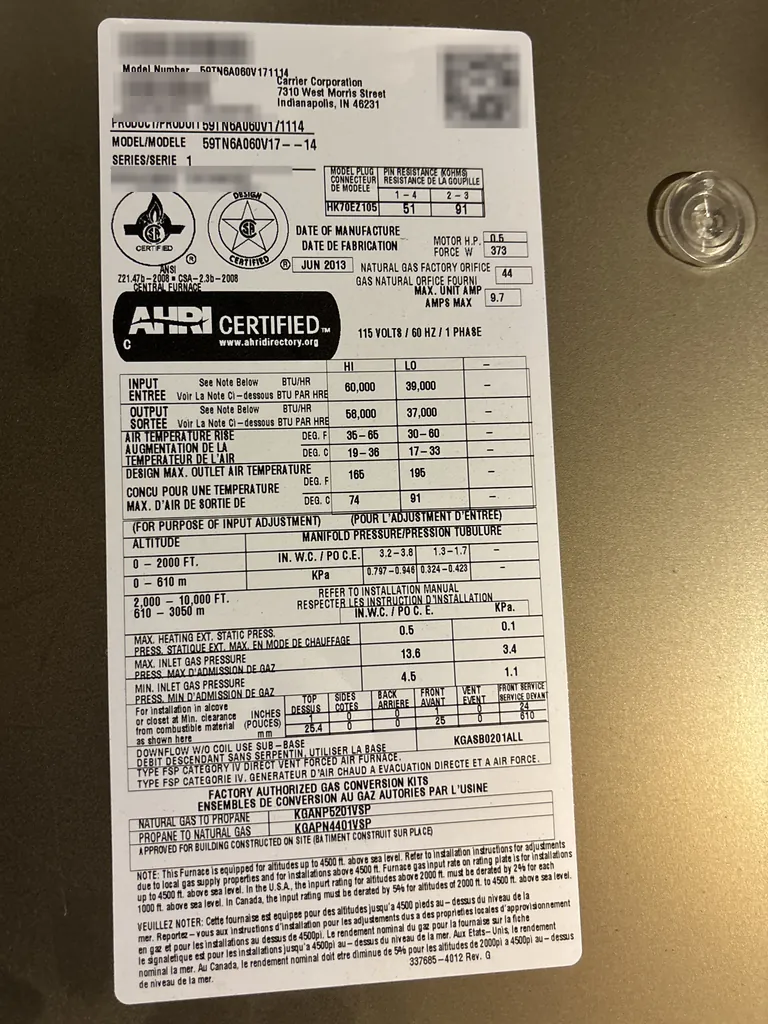
This Carrier furnace's rating plate, photographed on an August 2026 service call in Rancho Cordova, prints its date of manufacture outright: June 2013. We blurred the serial number.
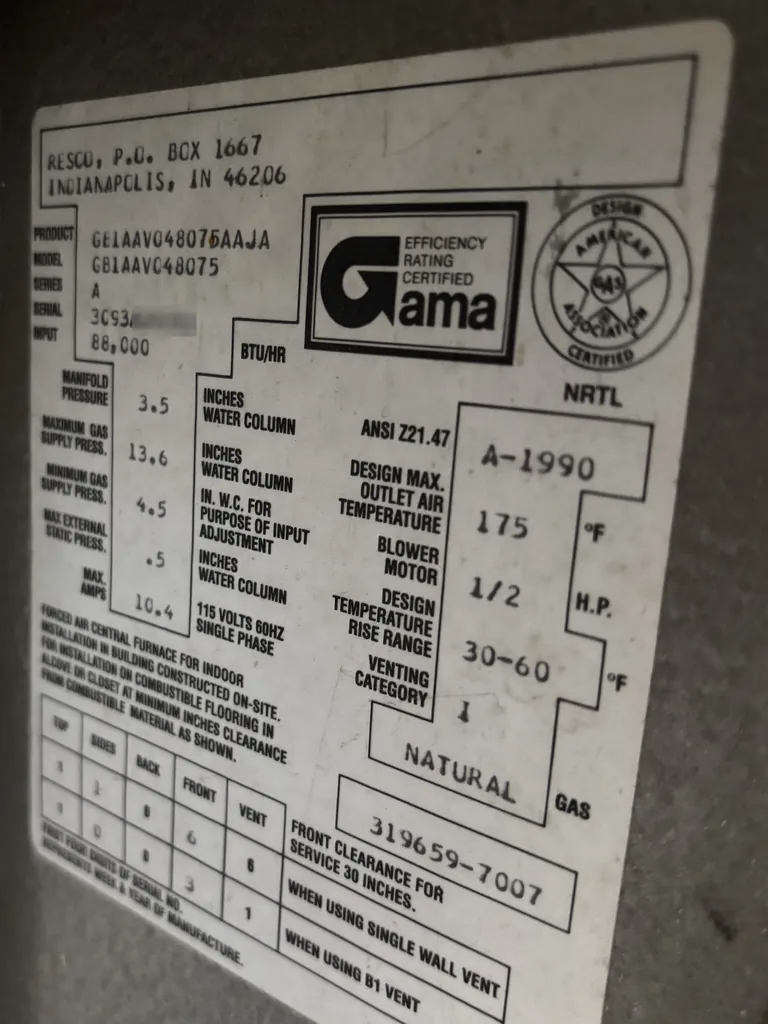
This plate prints no manufacture date. Its fine print says the first four digits of the serial give the week and year of manufacture, and they end in 93: this furnace was built in 1993. Photographed on a Citrus Heights service call in March 2026; we blurred the rest of the serial.
Turn the furnace off at its service switch before you open a panel, and leave the burner area alone. You can also check:
- Installation paperwork or a contractor sticker on the cabinet or the return duct.
- Your home inspection report, which often lists the equipment's age.
- The building permit history. In California, installing a space conditioning appliance requires a building permit, according to the California Energy Commission, so a permitted replacement leaves a record with your city or county.
Write the age down once you find it. It is the first thing a technician will ask when you call about a problem on an older furnace.
Signs You Need a New Furnace
The signs of a dying furnace are repeat repairs, rising bills, uneven heat and safety faults, not age alone. ENERGY STAR's list of reasons to consider replacing equipment reads like this, adapted to a furnace:
- It is past 15 years old. ENERGY STAR's line for furnaces and boilers.
- It "needs frequent repairs and your energy bills are going up." The equipment may have become less efficient.
- Some rooms are "too hot or too cold." ENERGY STAR notes that improper equipment operation, duct problems or inadequate insulation can cause it, so this one can point at your ducts instead of the furnace.
- Humidity, dust or noise problems. ENERGY STAR ties excess dust to leaky ducts and noise to an undersized duct system or an indoor coil problem. These can point to the ducts as well as the furnace.
If the furnace keeps starting and stopping, read our furnace short cycling guide before you reset it again.
Some signs end the age question on the spot. A cracked heat exchanger, scorch marks or flame rolling out of the burner area are safety faults, and a furnace with a suspected heat exchanger crack stays off until a technician checks it. Our cracked heat exchanger symptoms guide covers what that looks like and what the technician's test involves. If you suspect carbon monoxide, PG&E's guidance is to "Get out of the building" and to "Call 9-1-1 and seek medical attention if anyone experiences possible carbon monoxide poisoning symptoms."
What Real Service Records Show About Old Furnaces
In these three records on old equipment, the fix was a thermostat or one switch, or the visit found no blower motor fault at all. We searched 5,979 Alpha Mechanical job records in Housecall Pro for calls where the request or the job notes recorded the equipment's age. These three involve furnaces or systems 19 to 38 years old. Each is anonymized to city, ZIP and month, and says only what the record says.
- Sacramento, ZIP 95864, December 2024: a 24-year-old system. The request read "Thermostat is not working. System is 24 years old." The technician's line item reads "Bad existing thermostat. Installed Honeywell Pro WiFi thermostat." The fix was at the wall: a new thermostat, not new equipment.
- A 1987 Payne furnace, February 2025 (the record lists no city). The request said the furnace "stopped working," the Nest thermostat showed "a power error code," and the pilot light was not lighting. The technician recorded "Furnace had a bad fan limit switch" and replaced it. That furnace was 38 years old.
- Orangevale, ZIP 95662, November 2022: a Trane furnace "installed 2003." The request said the blower motor was not turning. The technician's line item reads "Checked the Trane furnace and did not find issues with the indoor fan motor," and the visit closed with no repair.
What these records show: age is a reason to inspect, not a verdict. In each case a homeowner with old equipment had a reason to expect bad news, and the visit found a thermostat, a single safety switch or no fault in the blower motor. If you live in Orangevale, our Orangevale furnace repair page covers local service; inside Sacramento, see our Sacramento HVAC service page.
That does not make a 38-year-old furnace a safe bet for another decade. At that age, the heat exchanger's condition is what matters most, and only a technician's inspection can check it. ENERGY STAR's maintenance checklist calls for a contractor to check "gas (or oil) connections, gas pressure, burner combustion and heat exchanger" at a heating check-up, and adds: "A dirty burner or cracked heat exchanger causes improper burner operation."
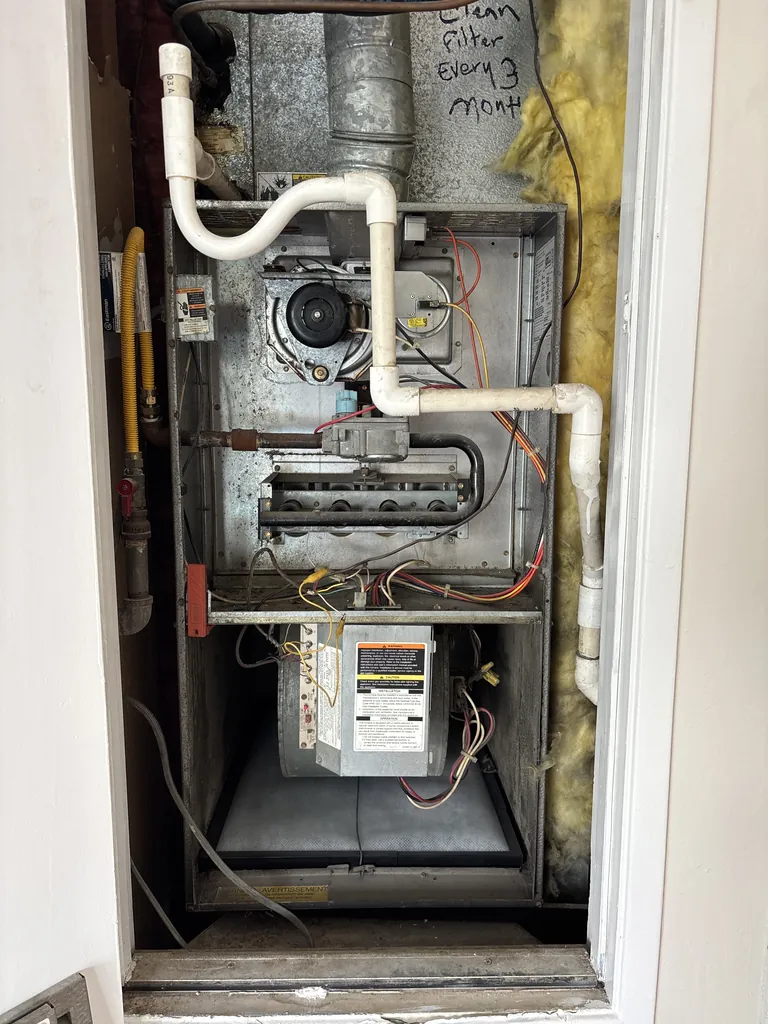
A separate service call, not one of the three records above: the 1993 furnace behind the second rating plate shown earlier, in a Citrus Heights closet with its doors off in March 2026.
Replacing an Old Furnace in Sacramento
Whether to repair or replace is a decision about the furnace's condition, not its age alone. The repair or replace guide linked above covers that decision, and our HVAC replacement guidelines set out how we judge a system's condition. One California rule is worth knowing before any quote.
Under California's 2025 Energy Code, the California Energy Commission says: "When a space conditioning system is altered, duct sealing requirements are triggered." Ducts that stay must, with some exceptions, test at no more than 10% total leakage or 7% leakage to outside, verified by an ECC-Rater, per Section 150.2(b)1E (CEC Energy Code Support Center). If that cannot be met, an ECC-Rater can verify by smoke test and inspection that all accessible ducts have been sealed.
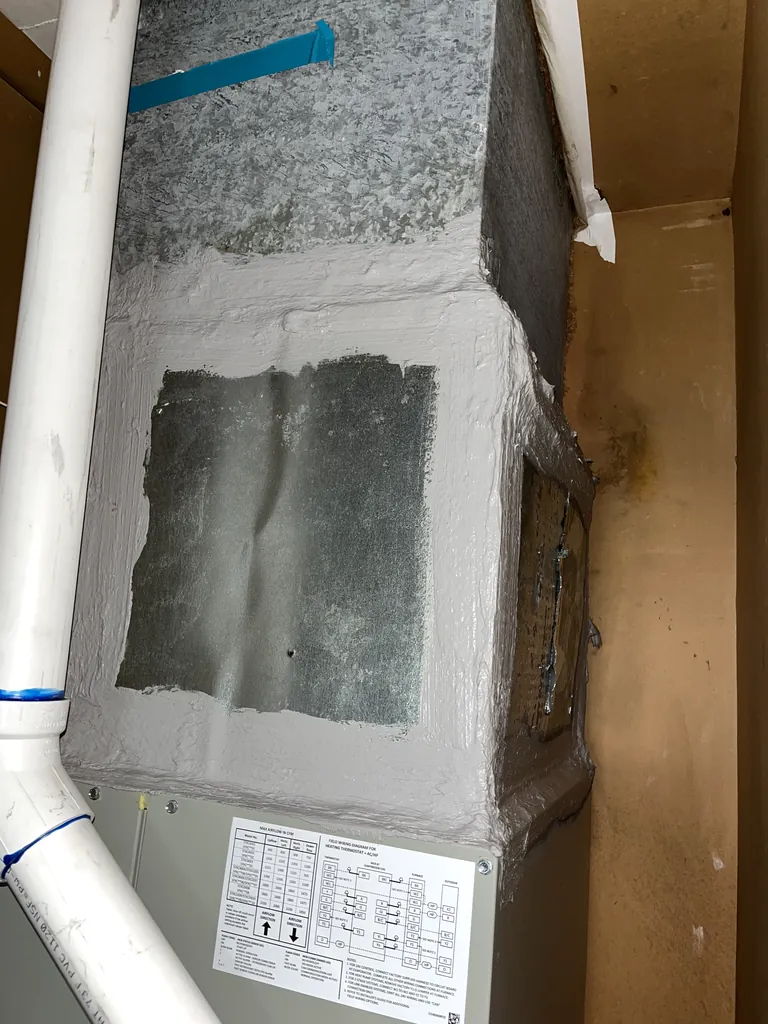
Mastic over the plenum seams on a Carmichael furnace and AC replacement, February 2026. Sealing like this is part of meeting the duct leakage test that a system change triggers.
On our jobs, sizing is not copied by default: we run a load calculation (Manual J) when the job needs one or when you ask.
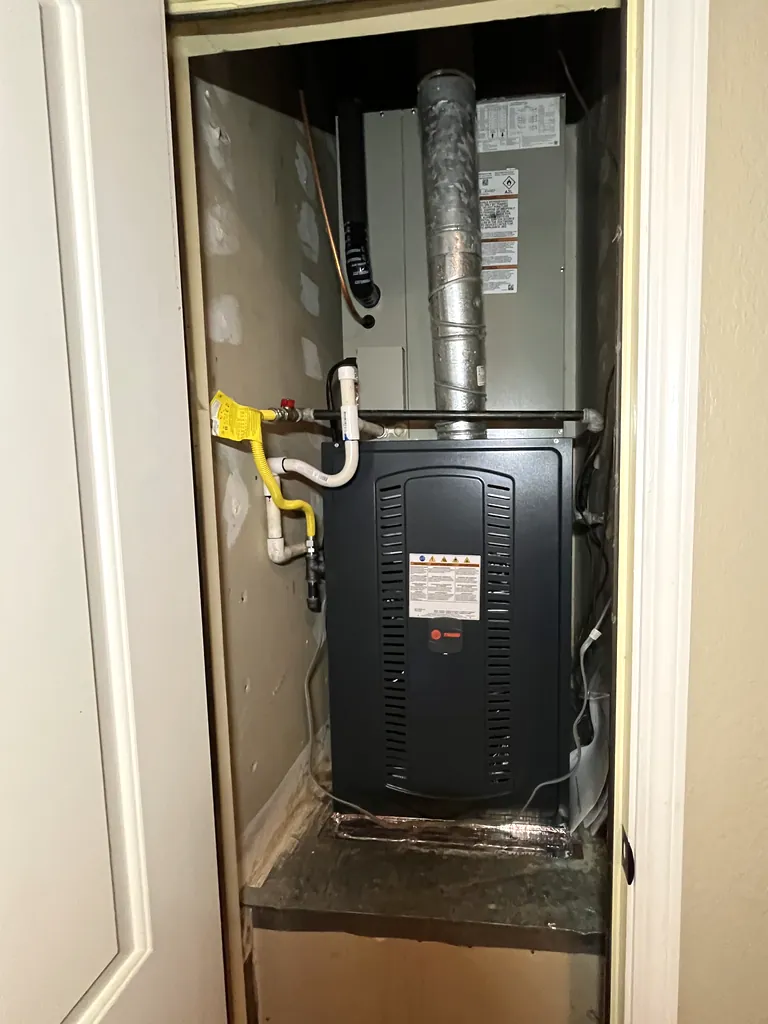
A hall closet replacement in Roseville, August 2026: the new furnace below, its matching indoor coil above, replaced together with the outdoor unit so the whole system starts its life on the same day.
Price is a range, quoted in writing after a site visit. A gas furnace on its own runs $4,500 to $9,000+ with us, as our furnace replacement service page above shows, and a whole system runs $9,500 to $25,000.
Already holding a written replacement quote from another licensed contractor? We give a free second opinion: we measure your house, check the sizing and put our number in writing. Our HVAC replacement cost guide breaks down what moves the price, and our HVAC salesman myths post covers the past-its-life-expectancy sales pitch.
How to Make a Furnace Last Longer
A furnace lasts longer when it breathes freely and gets checked every fall. ENERGY STAR's maintenance checklist is short:
- Inspect, clean or change the filter once a month. ENERGY STAR warns: "A dirty filter can increase energy costs and damage your equipment, leading to early failure."
- Book a pre-season check-up. ENERGY STAR suggests checking "the heating system in the fall." Our furnace maintenance service lists what our heating tune-up checks and its current price.
- Keep supply registers and the return grille open and clear, and let the check-up cover the blower. Because the furnace blower also moves your AC's air, ENERGY STAR's cooling check-up list applies to it: the contractor should "Clean and adjust blower components to provide proper system airflow," and ENERGY STAR notes: "Airflow problems can reduce your system's efficiency by up to 15 percent."
- Call when the pattern changes. New noises, short cycling or a smell are cheaper to chase early. Our guide to why furnace maintenance matters explains what a skipped year can cost.
If your furnace is over 15 years old and something feels off, book a heating diagnostic through our contact page or by phone. It is a flat $89, credited toward the repair if you go ahead, and you get a straight answer on whether the furnace has years left or is ready to retire.
Frequently Asked Questions
How long does a furnace last on average?
About 20 years. DOE estimates 21.5 years on average for indoor gas furnaces nationally, 22.5 years in the North and 20.2 years in the rest of the country. Published ranges run from about 15 to 25 years, depending on run hours, installation and maintenance.
Is a 20-year-old furnace too old?
Not by age alone. A 20-year-old furnace is close to DOE's average lifetime of 20.2 to 22.5 years, so it is time to plan and to have the heat exchanger checked at every fall tune-up. A 25- or 30-year-old furnace is past every average above, so that inspection matters more each year. Whether to repair or replace depends on the repair and the furnace's condition, which our repair or replace guide covers.
Should a 40-year-old furnace be replaced?
Start planning for it. At 40 years a furnace is well past every published lifetime in this guide: the literature review DOE cites tops out at 23.6 years, and InterNACHI's chart at 25. It may still run: the 1987 Payne furnace in our records was 38 years old when its fault turned out to be a bad fan limit switch, which we replaced. At that age, have the heat exchanger inspected before each heating season, and get a written replacement price before it fails on a cold night.
How long does a heat pump last in Sacramento?
About 15 to 19 years by DOE's and NAHB's figures. DOE's furnace analysis estimates 19 years on average, a Home Innovation Research Labs report for NAHB gives a 15-year median, and InterNACHI's chart says 10 to 15. In Sacramento a heat pump does both the cooling and the heating, so it works year-round.
How do I find out how old my furnace is?
Check the rating plate inside the furnace cabinet, usually on the burner or blower compartment door. Many plates print a manufacture date; otherwise the serial number often encodes it and the manufacturer or a technician can decode it. Turn the furnace off at its service switch before opening a panel.
What are the signs of a dying furnace?
Frequent repairs, rising energy bills, uneven heat between rooms and age past 15 years are ENERGY STAR's main signs. A cracked heat exchanger or flame rollout is a safety fault: turn the furnace off and call a technician. If you suspect carbon monoxide, get everyone out of the house and call 911 if anyone has symptoms, as PG&E advises.
Sources
Fact check: every figure and quote in this guide was checked against these sources on October 15, 2026. The job records are our own; more about us and how we work is on our About Us page.
- U.S. Department of Energy, Energy Conservation Standards for Consumer Furnaces, final rule, Federal Register, December 18, 2023
- Home Innovation Research Labs, Cost Impact of Electrification Strategies on Residential Construction, February 2021 (NAHB)
- InterNACHI, Standard Estimated Life Expectancy Chart for Homes
- ENERGY STAR, When is it time to replace?
- ENERGY STAR, Maintenance checklist
- NOAA NCEI, U.S. Climate Normals 1991 to 2020, annual and seasonal normals for Sacramento Executive Airport (USW00023232), annual heating and cooling degree days
- NOAA NCEI, U.S. Climate Normals 1991 to 2020, annual and seasonal normals for Detroit Metro Airport (USW00094847), annual heating and cooling degree days
- PG&E, Carbon monoxide safety
- California Energy Commission, Energy Code Support Center: HVAC (2025 Energy Code)
- Alpha Mechanical service records in Housecall Pro, read October 2026 and anonymized to city, ZIP and month.