

The classic bad flame sensor symptom is a furnace whose burners light, burn for a few seconds, then go out, after which the furnace tries again. Often the burners and the gas supply are fine; the furnace shuts the gas off because it cannot confirm the flame. On one Carrier control, the furnace has 2 seconds after ignition to prove the flame. If it cannot, it closes the gas valve and retries up to 3 more times, then locks out and stops trying (Carrier 58-3T troubleshooting guide, retrieved November 12, 2026).
If your furnace is doing that this winter, our Sacramento furnace and heating repair team can tell a dirty sensor from the other faults that look the same. A dirty sensor is a common reason; a bad ground, a weak flame, low gas pressure or a failing control can produce the same light-then-quit pattern, and cleaning alone will not fix those.
We fact-checked every manufacturer figure on this page against the document linked beside it. This guide covers what the sensor does, the symptoms that point at it, what a homeowner can safely check, and what a technician measures. A furnace that runs several minutes and then shuts off is a different pattern, covered in our guide to furnace short cycling.
Key Takeaways
- A bad or dirty flame sensor lets the burners light, then shuts them down within seconds because the furnace cannot prove the flame. Carrier's guide gives the control 2 seconds to prove it.
- After repeated failures the furnace locks out. On the Carrier control in its 58-3T guide that is 4 ignition attempts, and the lockout resets itself after 3 hours.
- Carrier's 58-3T guide puts a healthy flame signal at 4.0 to 6.0 microamps, with 0.5 microamps as the minimum. A technician measures it, cleans the sensor, and measures again.
- The same symptom has other causes on Carrier's checklist: a broken ground, a weak flame, low gas pressure, the igniter and the control. That is why one cleaning does not always end the call.
- What you can safely do: time the cycle, count the retries, write down the blink code, check the filter and thermostat, and allow one power reset. If you smell gas, leave the area and call 9-1-1, then PG&E.
- What a Furnace Flame Sensor Does
- Bad Flame Sensor Symptoms
- Dirty Sensor, Failed Sensor, or Something Else
- Why a Flame Sensor Gets Dirty
- What You Can Safely Check
- What a Technician Checks on a Flame-Sensing Call
- A Sacramento Flame Sensor Call From Our Records
- What a Flame Sensor Repair Costs at Alpha Mechanical
- How to Keep It From Coming Back
- Flame Sensor Repair Around Sacramento
- Sources
What a Furnace Flame Sensor Does
A flame sensor is a thin metal rod that sits in the flame of one burner. Its only job is to confirm there is a flame. Trane describes it as a part "designed to ensure that the gas valve only opens while flames are burning," which "prevents gas from building up when there are no flames to burn the fuel" (Trane, retrieved November 12, 2026).
The furnace control reads the flame as a very small electrical current through the sensor's wire. Carrier's troubleshooting guide has technicians measure it with a DC microammeter wired in series with the sensor wire, and it gives the numbers: 0.5 microamps DC minimum, with 4.0 to 6.0 microamps typical (Carrier 58-3T). A microamp is one millionth of an amp. A thin coating on the rod is enough to pull that signal down, which is why a part that looks fine can still fail.
On a modern gas furnace the start sequence runs in a fixed order: the inducer motor starts, the pressure switch proves the draft, the igniter heats, the gas valve opens and the burners light. Then comes the flame-proving step. Flame proving is the moment the control checks for that current before it keeps the gas on. In Carrier's sequence the igniter turns off after 5 seconds and a 2-second flame-proving period begins. If the flame is proved, the gas stays on and the blower follows. If it is not, the control closes the gas valve.
Bad Flame Sensor Symptoms
Every symptom of a bad flame sensor traces back to one event: the furnace lights, cannot prove the flame, and shuts the gas off. What changes is how far the cycle gets and how many times it repeats.
| What you see or hear | What it usually means | Where it points |
|---|---|---|
| Inducer starts, igniter glows, burners light, then go out within seconds | The flame was not proved in the proving window | Flame sensing: sensor, ground, flame quality |
| The same sequence repeats several times, then the furnace goes quiet | Ignition lockout after repeated failed attempts | The same causes, now with a lockout to clear |
| A blinking status light that repeats a pattern | The control logged the fault | Read the code before any reset |
The first symptom is the signature. If the burners light and die within a few seconds, think flame sensing first. If they never light at all, the igniter, the gas supply or an earlier step in the sequence is more likely, which our guide to why a furnace won't turn on sorts by sound.
The lockout is the second symptom homeowners notice, usually as "the furnace tried a few times and gave up." An ignition lockout is the control's decision to stop trying after repeated failures. Carrier's status code 14 describes a furnace that "failed to ignite gas and/or prove flame in 4 attempts," and on that control the lockout resets on its own after three hours. For example, a furnace on that control that fails its flame check on four tries in a row will sit quiet until its three-hour automatic reset or a brief interruption of power. Trane calls the first one or two stopped sequences a soft lockout and says a third becomes a hard lockout that needs a technician to reset after the cause is fixed (Trane hard lockout, retrieved November 12, 2026). The exact count and timer depend on the control board, so read your furnace's own label.
Air from the vents is a weaker clue than it looks. On the Carrier control in its guide, the blower starts only after the flame is proven, so a furnace that fails the 2-second check usually moves no house air between tries. If the flame proves and is lost later in the cycle, the guide says the blower runs a 90-second recycle delay, which can feel like a short burst of cool air. If air at the vents stays cold for longer stretches, our guide to why a furnace blows cold air covers the other causes.
The blinking light is the most useful symptom, because it is the control telling you what it saw. On a Goodman GMH8 furnace, 7 flashes means a low flame signal and 8 flashes means "check igniter or improper ground" (Goodman GMH8 specification sheet, retrieved November 12, 2026). Other brands use other counts. Our guide to reading a blinking furnace light lays the Goodman, Carrier and Rheem tables side by side.
Dirty Sensor, Failed Sensor, or Something Else
A furnace that lights and then shuts off has a flame-proving failure, and the sensor is only one possible cause. Carrier's checklist for an ignition-proving failure lists the sensor and several things around it, such as the ground wire, the flame and the gas pressure (Carrier 58-3T):
| Cause on Carrier's checklist | What is wrong | What fixes it |
|---|---|---|
| Oxide buildup on the flame sensor | A coating on the rod weakens the signal | Cleaning, then re-measuring the current |
| Flame current still not near the typical value after cleaning | The sensor itself is worn or damaged | Replacing the sensor (Carrier's guide says "replace electrode") |
| Ground wire not attached to the furnace sheet metal | The signal has no clean return path | Reconnecting or repairing the ground |
| Flame sensor grounded where it should not be (Carrier: it "must be ungrounded") | The rod is shorting to metal | Repositioning or replacing the sensor |
| Inadequate flame carryover or rough ignition | The flame is not reaching the sensor's burner cleanly | Burner and ignition work |
| Low inlet gas pressure, or a gas valve defective or turned off | The flame is too weak or never forms properly | Gas supply and gas valve work |
| A defective hot surface igniter | Ignition is unreliable | Replacing the igniter |
| Control ground continuity | The board cannot read the signal | Wiring or control repair |
Two lines in that table matter most to a homeowner. First, a dirty sensor and a failing sensor look identical from the outside. Only the current reading after cleaning separates them, and Carrier's troubleshooting steps say to clean the sensor, recheck the current, and replace the electrode if the current is still not near the typical value. Second, a perfectly clean sensor can still read low if the ground is broken or the flame is weak, so cleaning it again will not fix it.
Trane's list of hard lockout causes points the same way: a dirty or defective flame sensor, a faulty igniter, fuel pressure issues, overheating, a dirty filter, blocked vent pipes and a faulty control board. A lockout tells you the furnace protected itself; it does not tell you which of those it was.
Why a Flame Sensor Gets Dirty
The rod sits in the flame every time the furnace runs, and Carrier's guide names the result: oxide buildup on the sensor.
Location adds to it. In many of the Sacramento homes we service, the furnace sits in the attic or the garage, where dust reaches the burner compartment more easily than in a conditioned closet, and we tend to see flame sensor calls in the first weeks the heat runs hard in the fall. Both are our field observations, not a measured study.
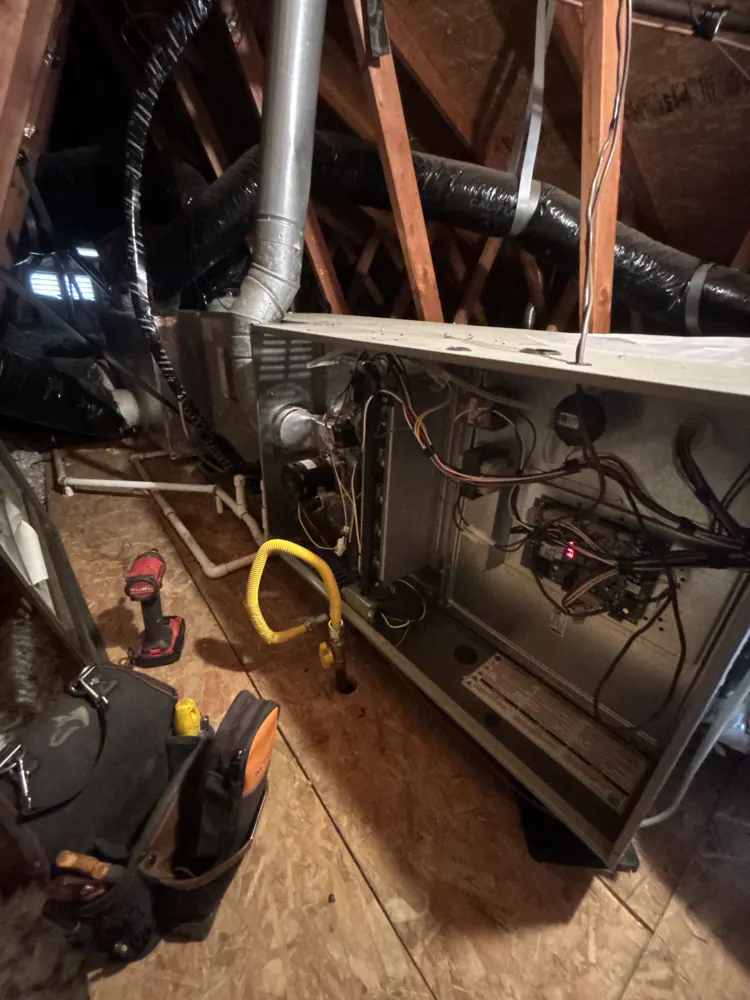
An attic furnace on one of our Sacramento-area service calls, panel off. In an attic or garage, dust reaches the burner compartment more easily than in a conditioned closet.
A dirty filter does not coat the sensor directly, but it belongs in the same conversation. Trane names a dirty filter and overheating among the causes of a lockout, and a filter is the one thing on that list a homeowner can fix without tools or a service call.
What You Can Safely Check
A homeowner can observe, record and reset once; everything inside the burner compartment stays with a technician. The flame sensor sits beside the gas valve, the igniter and the burners. Trane's advice when a furnace shows a fault is direct: "Do not try to fix your furnace yourself. There is an electrical hazard as well as a risk of hazardous gases and explosion" (Trane furnace light blinking, retrieved November 12, 2026). Trane also notes that taking the front panel off while the furnace runs is something "you should not" do.
What you can do safely, in this order:
- Time it. From the moment the burners light, count the seconds until they go out. Seconds point at flame sensing; several minutes points at overheating or the thermostat, covered in the short cycling guide.
- Count the tries. Note how many times the furnace repeats the sequence before it goes quiet. That number tells the technician whether it reached lockout.
- Write down the blink code. Trane's advice is to "pay attention to the pattern of the blinking and write down what you see." If the light shows through a window in the door, read it from there; do not remove the panel while the furnace runs.
- Check the filter. Trane says changing the air filter is the only thing a homeowner should do to try to resolve a lockout.
- Check the thermostat. Confirm it is set to Heat, the setpoint is above room temperature, and the fan is set to Auto, not On.
- Reset once, and only once. If your owner's manual describes a power reset, one reset is reasonable. If the light-then-quit pattern comes back, stop. Each reset starts another ignition attempt on a furnace that already failed the check, and our furnace safety switch guide explains which switches are meant to stay tripped.
If you smell gas at any point, do not touch the thermostat, switches or the furnace. PG&E's instruction is to "leave the area now and call 9-1-1," then call PG&E at 1-800-743-5000 (PG&E Gas Safety, retrieved November 12, 2026).
You will find videos that show homeowners pulling and sanding the sensor. We do not include those steps here. Cleaning is the easy part; the reading before and after, the ground check and the gas pressure are what tell you whether the furnace is actually fixed, and they need a meter and access to the gas train.
What a Technician Checks on a Flame-Sensing Call
A flame-sensing diagnosis is a measurement, not a guess. On a call for a furnace that lights and shuts off, our technician works through roughly the order Carrier's troubleshooting guide lays out:
- Reads the code and watches a full cycle to confirm the burners light and drop inside the proving window.
- Measures the flame current in microamps and compares it with the furnace's specification.
- Cleans the sensor and measures again.
- Checks the ground wire to the furnace sheet metal and the control's ground continuity.
- Checks the sensor's position in the flame and that it is not shorting to grounded metal.
- Checks inlet gas pressure and the burners' flame, because a weak or lifting flame reads low on a clean sensor.
- Replaces the sensor if the current stays low after cleaning and everything around it checks out.
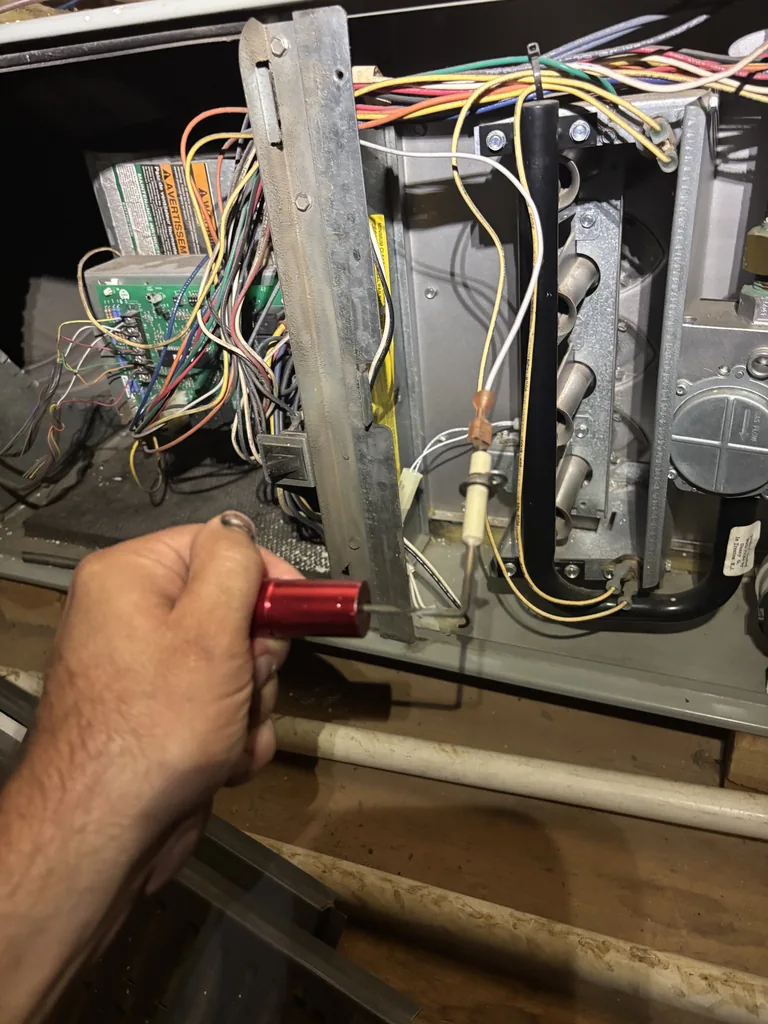
An Alpha Mechanical technician cleaning a flame sensor at the burner assembly, beside the igniter and the gas valve.
ENERGY STAR's maintenance checklist includes the same territory for a yearly heating check: gas connections, gas pressure, burner combustion and the heat exchanger. It warns that "a dirty burner or cracked heat exchanger causes improper burner operation," and that either "can cause the equipment to operate less safely and efficiently" (ENERGY STAR Maintenance Checklist, retrieved November 12, 2026).
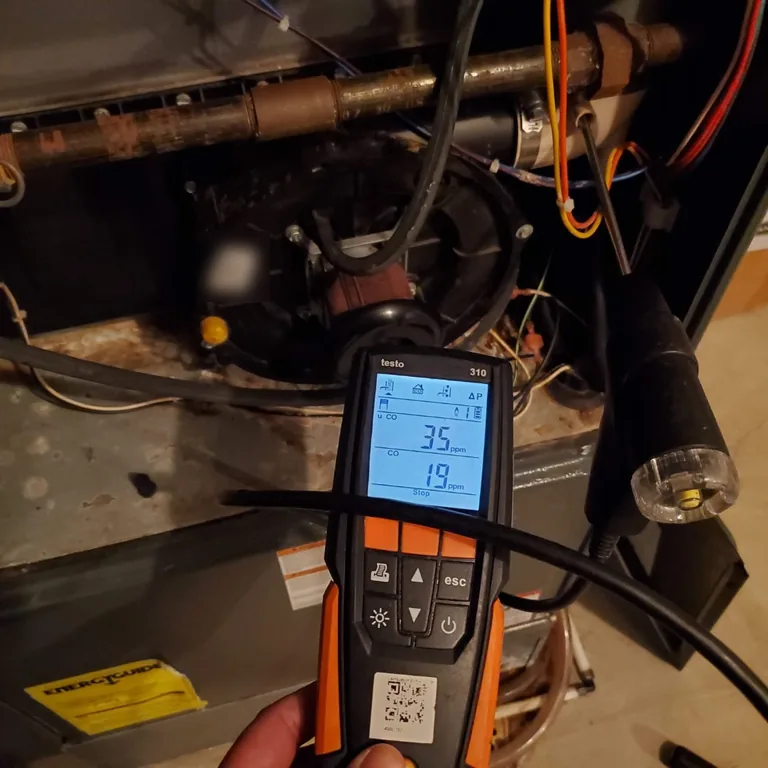
A combustion analyzer reading taken during one of our heating checks, part of checking burner combustion.
A Sacramento Flame Sensor Call From Our Records
One November 2025 call in Sacramento (ZIP 95831) turned up more than one finding on a single visit. The job record reads, as written: "Heater and AC doesn't work. Cleaned flame sensor. Setting thermostat was on, it should be auto always. Also the control board pin connector is glitching."
What the record shows:
- The technician cleaned the flame sensor.
- The thermostat was set to "on", and the technician noted it "should be auto always." We read that as the fan setting (On versus Auto); that reading is ours, not the record's words.
- A control board pin connector was "glitching."
The record does not say which finding stopped the heat or the air conditioning, so we will not guess. It is one call, not a pattern, but it shows why a technician checks the wiring and controls around the sensor as well as the sensor itself.
Our furnace short cycling guide, linked above, lists three more of our flame sensor calls, from Fair Oaks, Orangevale and Citrus Heights, in a table of 13 short-cycling records.
What a Flame Sensor Repair Costs at Alpha Mechanical
Our heating diagnostic is a flat $89, applied toward the repair if you go ahead, and you get the repair price before any work starts. Cleaning the sensor, replacing it, repairing a ground or replacing a control board are each quoted at the visit. You see the price of the fix before deciding.
If the furnace is working and you want to keep it that way, our flat $99 heating tune-up includes testing the ignition and cleaning the flame sensor, along with the rest of the seasonal service. Service is same-day on weekdays when the schedule allows.
How to Keep It From Coming Back
A yearly heating check in the fall is the simplest way to catch a coated sensor before the first cold night. ENERGY STAR recommends a contractor check the heating system in the fall. PG&E's carbon monoxide guidance goes further and says to "have a qualified professional routinely maintain and inspect all heating systems and any fuel-burning appliances annually" (PG&E carbon monoxide safety, retrieved November 12, 2026).
Between visits:
- Inspect the filter monthly, as ENERGY STAR advises, and change it when it is dirty.
- Keep a working carbon monoxide alarm. PG&E says an alarm should be considered a backup "and not as a replacement for proper use and maintenance" of fuel-burning appliances.
If the sensor needs cleaning every season, treat that as a symptom too. A sensor that coats quickly, or a reading that stays marginal after cleaning, points back at the flame, the gas pressure or the ground, which is what the technician's checklist above is for.
Flame Sensor Repair Around Sacramento
We are based in Fair Oaks and repair gas furnaces across the Sacramento region. The case above is a Sacramento house, where our HVAC service across Sacramento covers homes across the city. North of the city, our furnace repair service in North Highlands handles no-heat calls and lockouts with the same flat diagnostic.
If your furnace lights and then shuts off, write down the seconds, the number of tries and the blink code, and contact us to book a visit. Those three facts shorten the diagnosis. Read more about us and how we work.
Sources
Each source below is linked where it is cited in the text above.
- Carrier, Deluxe 2-Stage Gas-Fired Induced-Combustion Furnaces Troubleshooting Guide (Form 58-3T, dated 8-99), retrieved November 12, 2026
- Trane, "Furnace Main Burner Shuts Off After Ignition", retrieved November 12, 2026
- Trane, "Furnace Hard Lock Out: Causes and Solutions", retrieved November 12, 2026
- Trane, "Furnace Light Blinking", retrieved November 12, 2026
- Goodman, GMH8 two-stage gas furnace specification sheet (SS-GMH8), retrieved November 12, 2026
- ENERGY STAR, Maintenance Checklist, retrieved November 12, 2026
- PG&E, Gas Safety, retrieved November 12, 2026
- PG&E, Carbon Monoxide Safety, retrieved November 12, 2026
- Alpha Mechanical Housecall Pro job record, Sacramento 95831, November 2025, quoted as written