

No. In Sacramento, leave the outdoor unit uncovered for winter. Our winters are mild and wet, and a full cover traps that moisture against the metal and gives mice and insects a dry place to nest. If your unit sits under a tree that drops leaves or branches, a board or breathable cover on the top only is the most it ever needs. And if the outdoor unit is a heat pump, which runs all winter to heat the house, never cover it at all.
What protects a Sacramento condenser in winter is a clean, clear unit and a check before the season. Clear the leaves, keep the plants back, and look for nests. Then have the system looked over on a fall visit like our heating tune-up and system check for Sacramento homes. Below is why covers do more harm than good here and how to tell an air conditioner from a heat pump. You will also see what a top-only cover looks like, and what two real Alpha Mechanical job records say about pests in HVAC equipment.
- Why a Sacramento AC Unit Does Not Need a Winter Cover
- First, Is It an Air Conditioner or a Heat Pump?
- What a Full Cover Does to an Outdoor Unit
- What Actually Gets Into a Sacramento Outdoor Unit
- If You Cover Anything, Cover Only the Top
- What to Do Instead This Fall
- What a Fall Visit Checks Outside
Key Takeaways
- Do not wrap a Sacramento AC unit for winter. Lennox says full covers trap moisture and invite rust or pests, and that modern units are built for weather.
- Never cover a heat pump that heats your house. Lennox: "Heat pumps that run year-round should never be covered."
- Freezing nights are few here: NOAA's 1991-2020 normals for Sacramento Executive Airport average 6.7 nights at or below 32°F in December and 5.0 in January.
- Debris and nesting are the real winter risks. One of our 2025 job records reads "Outdoor unit wire chewed by rodents," and on a 2026 Rancho Cordova tune-up we cleaned a wasps' nest out of a unit.
- If a tree drops debris on the unit, protect the top only, with a board or a breathable cover, and keep plants at least two feet away.
Why a Sacramento AC Unit Does Not Need a Winter Cover
A Sacramento air conditioner does not need a winter cover because the valley's winter is mild and wet, and the unit is built to sit outside in it. Lennox, which makes air conditioners, puts it plainly: "Full AC covers trap moisture and invite rust or pests. Modern units are built for weather and rarely need full wraps" (Lennox).
The outdoor unit, often called the condenser, is the metal box beside the house that holds the compressor, the outdoor coil and the fan. Most advice about covering one is written for places with heavy snow and ice. Sacramento's numbers look different. NOAA's 1991-2020 climate normals for Sacramento Executive Airport put the average December low at 38.5°F and the average January low at 39.2°F (NOAA NCEI). The same normals count how many nights reach 32°F or colder:
| Month | Average low | Nights at or below 32°F |
|---|---|---|
| November | 42.7°F | 1.6 |
| December | 38.5°F | 6.7 |
| January | 39.2°F | 5.0 |
| February | 41.5°F | 1.9 |
Source: NOAA NCEI 1991-2020 monthly normals, Sacramento Executive Airport (station USW00023232), retrieved 2026-11-05.
So a normal Sacramento year brings only about 15 nights at or below freezing. What winter does bring is rain: the same normals put 12.2 of the year's 18.1 inches between November and February (NOAA NCEI). Damp air is the condition a full cover handles worst. A cover cannot keep humid air out, but it can keep the unit from drying out.
First, Is It an Air Conditioner or a Heat Pump?
Before you decide anything about a cover, find out whether your outdoor unit is an air conditioner or a heat pump, because a heat pump must never be covered. The two boxes look almost the same from the yard. The difference is what they do in winter.
- An air conditioner only cools. In winter a furnace or another heater warms the house, and the outdoor unit sits idle until spring.
- A heat pump cools in summer and heats in winter, so the outdoor unit runs every time the heat comes on. Our explainer on how a heat pump moves heat in both directions covers the parts involved.
Three quick ways to tell. Turn the heat on and walk outside: if the outdoor fan is running, it is a heat pump. Look at the thermostat: an "Emergency Heat" or "Aux Heat" setting usually means a heat pump, and our guide to emergency heat versus aux heat explains what each one does. Or read the label on the outdoor unit for the model type.
A heat pump is a system that moves heat into the house in winter and out of it in summer. If yours is a heat pump, the answer is settled. Lennox advises that "Heat pumps that run year-round should never be covered" (Lennox). A heat pump makes heat by pulling air through its outdoor coil, and it also needs open air to defrost. Trane notes that the outdoor coil typically runs 10 to 20°F colder than the outdoor air in winter, so a heat pump "could easily enter the defrost cycle when it's in the low 40s outside" (Trane). That is a common Sacramento winter morning. The defrost cycle is the heat pump briefly running in reverse to warm its outdoor coil and melt the frost. The steam that can rise from the unit during defrost is normal, in Trane's words. For the rest of the winter routine, see our heat pump maintenance checklist.
What a Full Cover Does to an Outdoor Unit
A full cover, especially plastic or vinyl, holds moisture inside the unit and gives animals shelter, which is why manufacturers advise against it. Lennox lists the problems a cover can cause (Lennox):
- Moisture captured under a cover can lead to rust and corrosion of the components and finish.
- The humidity that comes with that moisture can damage electronic components.
- Lack of airflow can invite mold and mildew.
- Covered units can attract rodents and other small animals looking to escape the cold.
- Moisture under the cover can make it colder in there than outside, and possibly freeze the coils.
- Depending on the manufacturer, covering the unit may void its warranty.
American Home Shield, a home warranty company, makes the same point about pests. It warns that an outdoor air conditioner cover "can invite unwelcome guests to make a nest inside during the cold winter months," and it names rodents and lizards among them (AHS).
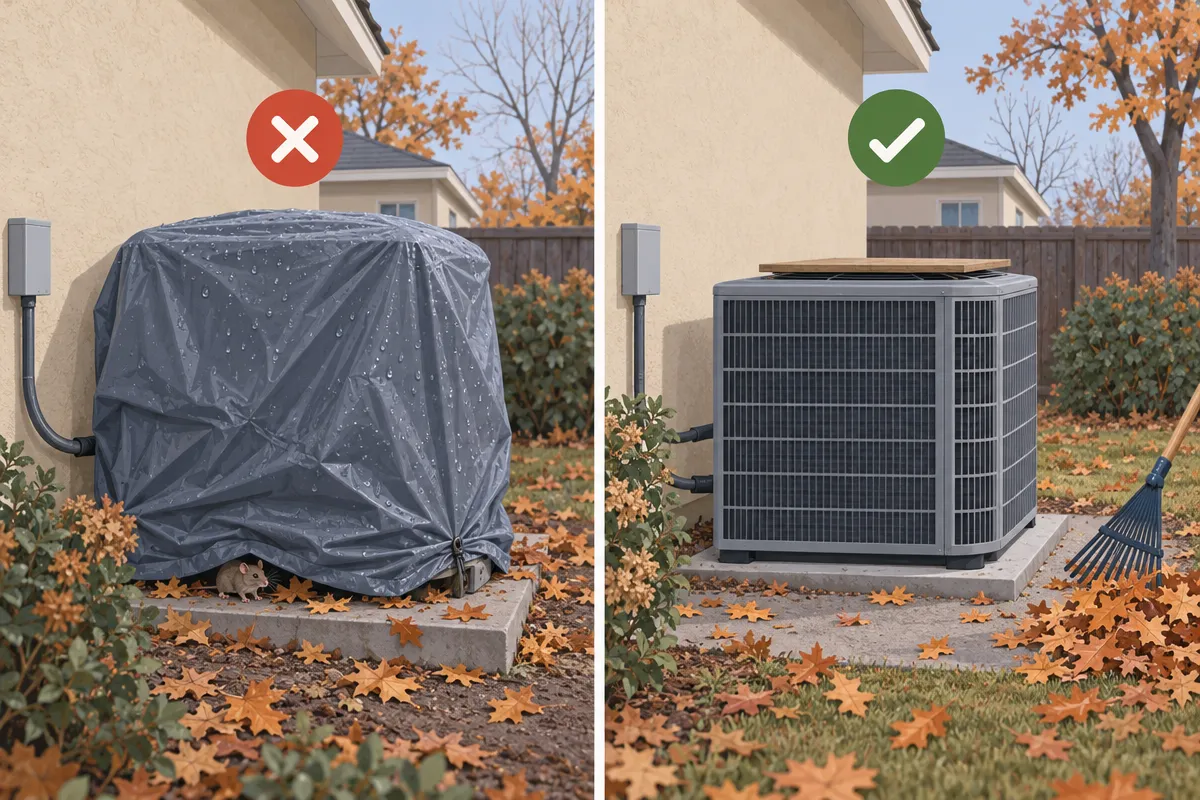
Illustration: a full wrap holds damp air and gives animals shelter, while the open unit with its leaves cleared can dry out.
In a damp valley winter, the moisture point matters more than the snow point. A wrapped unit stays wet for weeks, then becomes a dry, still pocket that a mouse or a wasp colony can move into. You would not find out until the day you switch on cooling and the system starts up with a nest or chewed wiring inside.
What Actually Gets Into a Sacramento Outdoor Unit
The winter threats to a Sacramento condenser are leaves, debris and the animals and insects that move into a still, sheltered unit. We see the results on service calls.
A real call: a wasps' nest in a unit, Rancho Cordova, 2026. The job was a cooling tune-up in Rancho Cordova (95670). Our technician's job record reads "Cleaning unit from wasps' nest and instal (sic) the metal damper to prevent the wasps." The record does not say which part of the system held the nest, how long it had been there, or whether anything had ever been covered, so we do not claim any of that. What it shows is that HVAC equipment offers sheltered space insects will use, and that the fix was a cleaning plus a metal damper to keep them from coming back. If you see wasps going in and out of your unit, keep the power off and keep your hands out; a wasp nest is a job for a pest professional first and an HVAC technician second. If you live nearby, our Rancho Cordova HVAC service page covers the area.
A second record, 2025: "Outdoor unit wire chewed by rodents." That is the whole job note from a 2025 Alpha Mechanical service call. Chewed wiring is an electrical fault that needs a technician, and a sheltered, covered unit is the kind of place rodents look for.
Leaves are the everyday problem. Fall leaves collect in the top grille and around the base of the unit, most of all in yards with big shade trees, from Orangevale to Fair Oaks. A layer of wet leaves holds moisture against the coil and the base of the unit, the same trap a cover creates. Clearing them by hand does more good than any cover.
If You Cover Anything, Cover Only the Top
If leaves, needles or branches fall on your unit, protect the top and leave the sides open. Lennox suggests securing "a covering such as plywood to the top of your air conditioner to prevent falling debris," building a shade or awning without restricting the airflow above the unit, or using "a lightweight, breathable cover" that will not hold water (Lennox).
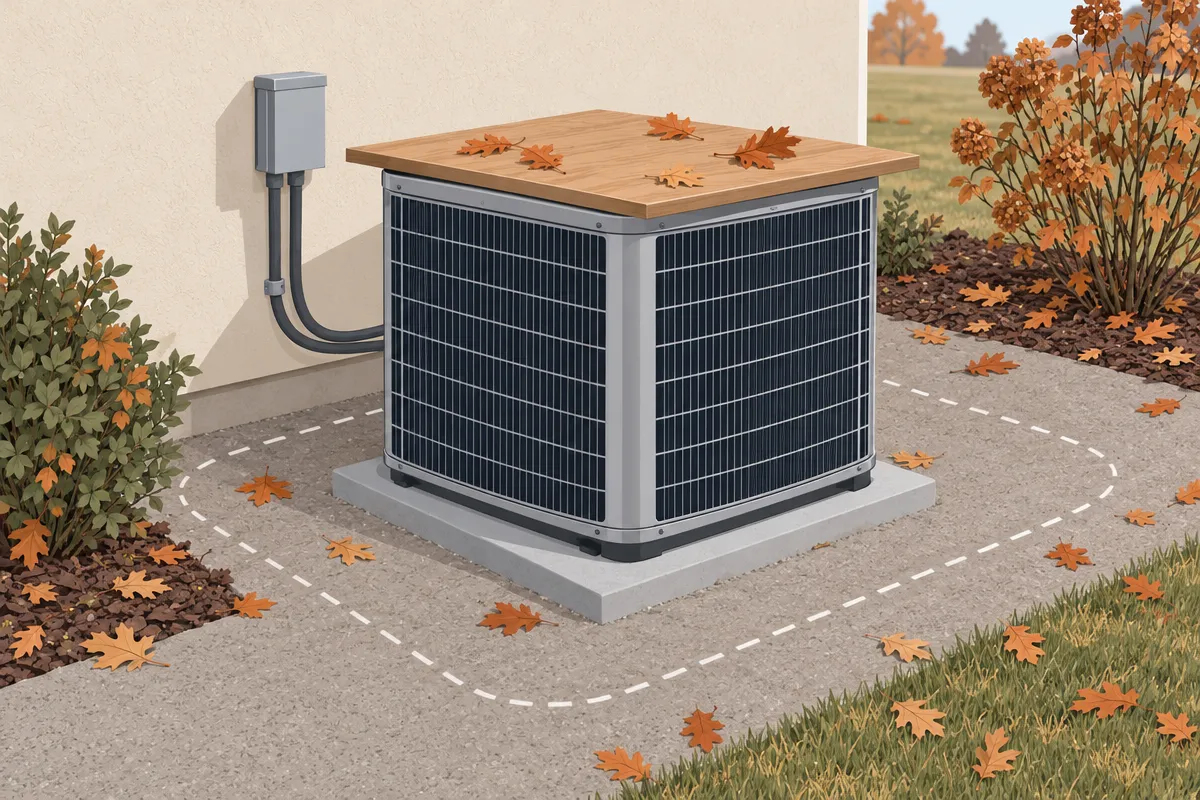
Illustration: a top-only cover. The board keeps falling leaves out of the fan opening, while the coil still breathes through all four open sides.
The photo at the top of this page is from one of our service calls. That Ruud outdoor unit has a hard plastic cover, shown raised and leaning against the wall behind it during the visit. Whatever kind of top cover you use, follow three rules:
- Air conditioner only. Never put anything on a heat pump that heats your house.
- Sides stay open. The coil breathes through its sides, so nothing should wrap down over them.
- It comes off before the system runs. Take the board or cover off before you switch to cooling in spring, so the fan can push air out of the top.
For most Sacramento yards without an overhanging tree, even a top cover is unnecessary.
What to Do Instead This Fall
A short fall cleanup protects an outdoor unit better than a cover does. These are safe homeowner checks; none of them opens an electrical panel or touches refrigerant.
- Clear the top and the base. Pick leaves, needles and twigs out of the top grille and from around the base by hand or with a soft brush. For example, a drift of leaves packed against one side blocks that side's coil until it is cleared.
- Keep plants back. Trane's guidance is to "keep flowers, shrubs, and vines at least two feet away from the outdoor unit" (Trane). Move trash cans, firewood and patio furniture away from it too.
- Look for nests and chewed wires. Use a flashlight from the outside. Do not reach in.
- Brush, do not hose, from the outside. Lennox's coil-cleaning steps start with cutting power at the electrical disconnect switch and clearing loose debris with a soft brush. Its rinse step works from the inside of the coil outward, because spraying from the outside drives debris deeper (Lennox). That means opening the unit, so leave the rinse to a technician.
Stop and call a professional if you find chewed or exposed wiring, a burnt smell, an active wasp nest, or a unit that hums but will not start. Those are electrical faults, and the safe homeowner check ends at the disconnect switch.
What a Fall Visit Checks Outside
A technician's check covers the outdoor parts a homeowner should not open. That means the coil, the electrical connections, the controls and the start-up. ENERGY STAR's maintenance checklist includes cleaning the evaporator and condenser coils, tightening electrical connections and checking that the system "starts, operates, and shuts off properly" (ENERGY STAR). It also advises checking the cooling system in spring and the heating system in fall.
For a home with a furnace and an air conditioner, the fall visit is the heating tune-up, a flat $99 at Alpha Mechanical, and the outdoor unit gets its full cooling check on the spring AC tune-up, a flat $125. For a heat pump home, the $99 heating tune-up covers the heat pump during the winter season, because the outdoor unit is the heater. Our Club Membership includes both visits, a spring AC tune-up and a fall heating tune-up, each year.
For the bigger picture on why the fall visit matters, read why regular furnace maintenance matters, and for the full list of what a technician checks, see our HVAC tune-up checklist. We serve homes across the Sacramento area from Fair Oaks, including Folsom, Orangevale and Rancho Cordova. You can read more about us on our About Us page. If you are not sure what you have outside, or what you found in it, contact us and we will take a look.