

Replacing ductwork in a crawl space is often the right call when the old ducts leak and the heating and cooling equipment is being replaced anyway. That is what happened on a September 2026 job in Carmichael (ZIP 95608): we swapped the home's gas furnace for an all-electric Bosch heat pump system, the kind of replacement our heat pump installation team quotes across the Sacramento area, and instead of reconnecting the leaking ducts under the house, we pulled them out and ran a complete new duct system through the attic.
This post walks through that job: what the house had, the three options for crawl-space ducts, what we installed, and what the numbers do and do not show. If you are weighing a conversion of your own, our comparison of a heat pump and a gas furnace for Sacramento homes covers the equipment decision. This one covers the ducts.
Methodology: the job facts come from our Housecall Pro record for this house and our own account of the install, read against the rating plates in the job photos. The efficiency figures come from the manufacturer's rating table and federal records linked beside each one. We fact-checked every manufacturer, federal and state figure against the document linked beside it. The homeowner's name and street are withheld.
Key Takeaways
- On this Carmichael job the crawl-space ducts leaked, so we removed them and ran an all-new duct system in the attic with new ceiling registers, at the same time as the gas furnace came out.
- The new Bosch system (5-ton outdoor unit, cased coil and 115V blower) is rated 17.5 SEER2 and 8.5 HSPF2 as a matched set in Bosch's AHRI table, not the higher "up to" figures for the outdoor unit alone.
- Against a typical 10 SEER system of the age this one replaced, that rating works out to about 45% less electricity for the same cooling. That is arithmetic on ratings, not a measured bill.
- California requires a permit to install a heat pump, and changing a system triggers duct sealing rules. We pulled the permit and tested the new ducts.
- The homeowner received a $3,000 rebate, applied as an instant rebate, with our office handling the paperwork.
- The Carmichael Job at a Glance
- Why the Crawl-Space Ducts Were the Real Problem
- Repair, Re-Run Under the House, or Move to the Attic
- What We Installed
- How the Job Went
- What the Efficiency Numbers Show, and What They Do Not
- The Rebate and the Cost
- When Replacing Crawl-Space Ductwork Makes Sense for Your House
- Sources
The Carmichael Job at a Glance
In short: one house, work started September 28, 2026, a full equipment change and a full duct change done together. The table below is the job as our records show it.
| Item | What the record shows |
|---|---|
| Location | Carmichael, ZIP 95608 |
| Work started | September 28, 2026 |
| Old system | Gas furnace with ductwork in the crawl space under the house |
| New system | Bosch all-electric heat pump: BOVA-60RTB-M20S outdoor unit (5 ton, R-454B refrigerant), BMAC4860CBTA cased coil, BMXFCCTA 115V blower |
| Ducts | All ducts replaced; crawl-space ducts removed; new ducts run in the attic; new ceiling registers cut in |
| Crawl-space labor noted | 5 hours of crawl space work |
| Code | Permit pulled; ducts tested |
| Incentive | $3,000 rebate, applied instantly; Alpha filed the paperwork |
| Old material | Old metal ducts and debris picked up by a scrap company for recycling |
From our records (Carmichael, ZIP 95608, 2026). The job notes read: "remove ducts from under the house and install in the attic" and "5hrs crawl space work". Those two lines are the whole story of the ductwork: the ducts were not patched, they were taken out.
Why the Crawl-Space Ducts Were the Real Problem
Crawl-space ductwork is the supply and return duct run in the shallow space under a raised floor, feeding registers in the floor above. The ducts under this house leaked, and leaking ducts waste part of what any heating or cooling system produces. ENERGY STAR estimates that in a typical house about 20 to 30 percent of the air moving through the duct system is lost to leaks, holes and poorly connected ducts (ENERGY STAR, Duct Sealing, retrieved November 19, 2026). The same page lists ducts located in an attic, crawlspace or garage as one of the signs that a home may have poorly performing ducts.
That matters most at the moment the equipment changes. A new heat pump connected to leaking ducts still pushes part of its output into the space under the floor. In Carmichael, the ducts were the weak link, so the conversion was the right time to deal with them rather than reconnect them.
Crawl spaces also make duct work hard. Access is tight, the work is done lying down, and every repair later means going back under the house. Our ductwork repair and replacement service sees the same pattern across older Sacramento-area homes: ducts that were fine when installed, then left alone for decades in a space nobody checks.
Repair, Re-Run Under the House, or Move to the Attic
There are three ways to handle old crawl-space ducts, and the right one depends on their condition, the house and what else is being replaced. This table is how we weigh them on a walk-through. It is our field guidance, not a rule from a code or a manufacturer.
| Option | When it fits | What to watch |
|---|---|---|
| Repair and seal in place | Ducts are intact, and the leaks are at joints, boots and connections | Sealing and insulating only what can be reached; a leakage test shows whether it worked |
| Replace in the crawl space | Ducts are damaged, but the floor registers and the crawl space layout work | New ducts still sit in the same space, so sealing and insulation quality decide the result |
| Move to the attic | The whole system is being replaced and the attic has room for the air handler path and ceiling registers | New ceiling openings, a new layout, and attic heat in summer, so the ducts must be sealed and insulated well |
Moving ducts to the attic is not automatically more efficient. An attic is also outside the conditioned space, and the ENERGY STAR page above names attics in the same breath as crawlspaces. The gain on a job like this comes from replacing an old, leaking system with a complete new one that is sealed, insulated and tested, and from putting it where it can be reached for service.
For example, ducts that are intact but leak at the boots and joints are a sealing job; ducts that are crushed, torn or disconnected along their length are a replacement job. If your ducts are mostly sound, sealing may be enough. Our guide to leaky ducts and duct sealing in Sacramento covers how sealing works and when it pays. ENERGY STAR advises mastic sealant or metal tape on duct seams and never ordinary duct tape; we seal with mastic.
What We Installed
The new system is a matched Bosch set, and its rating comes from Bosch's table for that exact combination. A matched rating is the efficiency listed for one specific combination of outdoor unit, indoor coil and blower, rather than for the outdoor unit alone. The rating plates show a BOVA-60RTB-M20S outdoor unit (5 ton, charged with R-454B), a BMAC4860CBTA cased coil and a BMXFCCTA 115V blower.
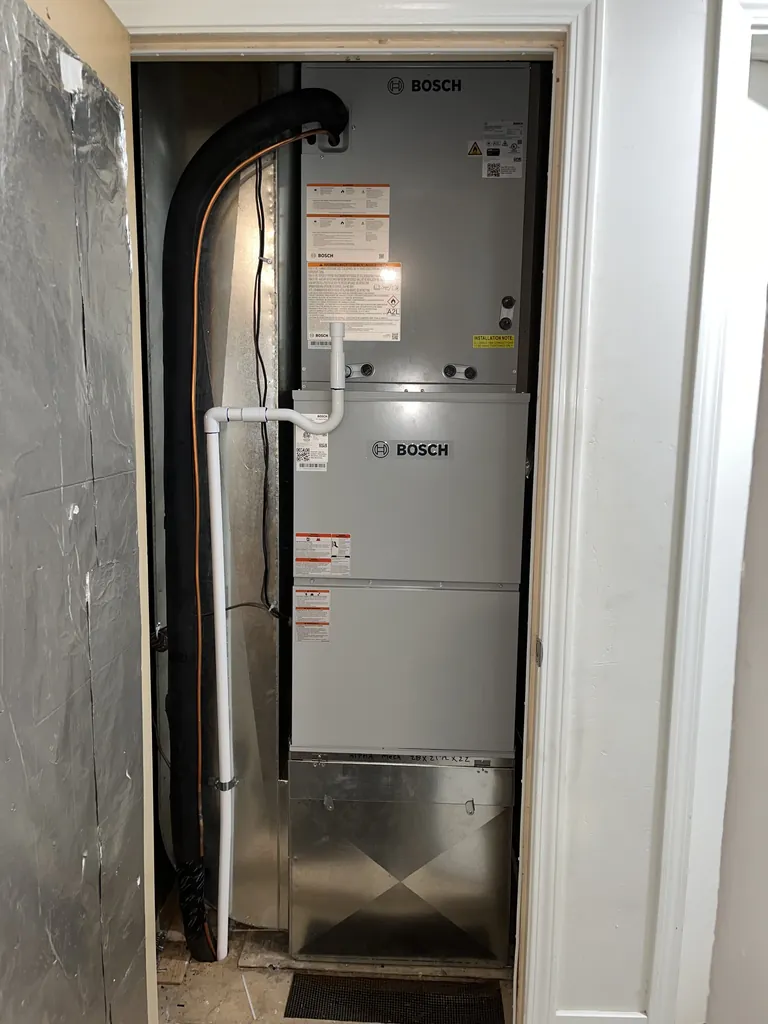
The new indoor unit in its closet.
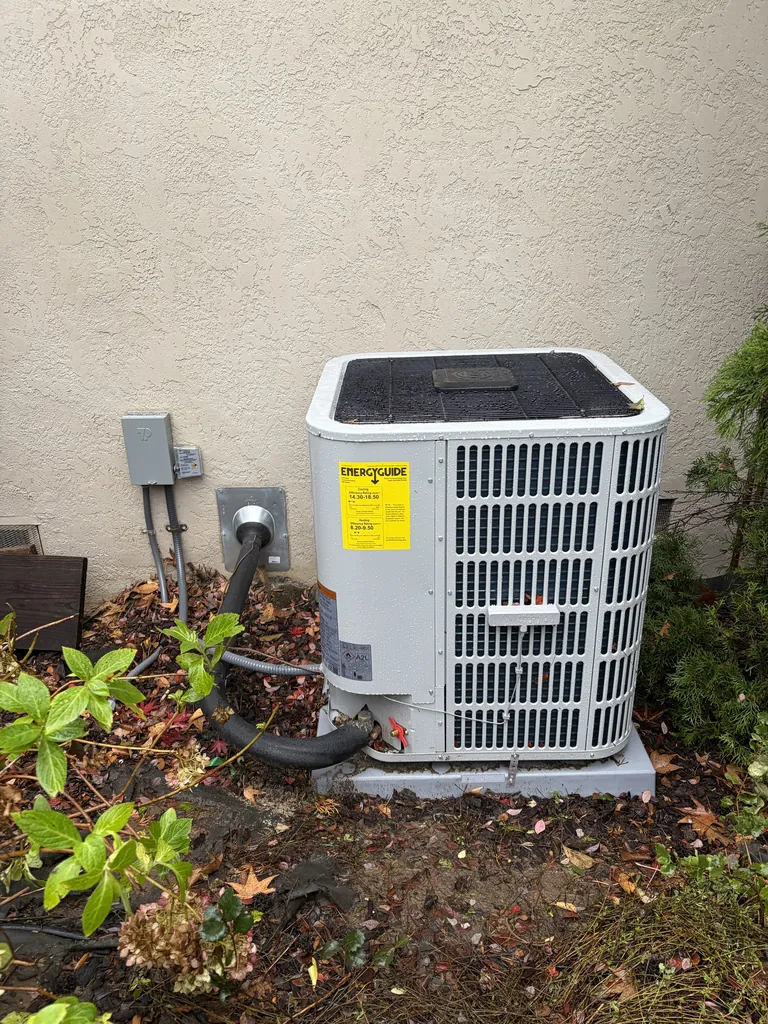
The new outdoor unit beside the house.
Bosch's 2026 Home Comfort Solutions catalog lists that outdoor unit, coil and blower together in its AHRI 210/240-2023 performance table at 51,500 Btu/h of cooling, 11.4 EER2, 17.5 SEER2 and 8.5 HSPF2 (Bosch, 2026 Home Comfort Solutions Catalog, p. 29, retrieved November 19, 2026). Those are the figures we quote for this house. An outdoor unit's headline figures can describe a different pairing than the one on your quote, so ask for the rating of the exact indoor and outdoor combination.
The heat pump replaces both the furnace and the old cooling equipment: one system heats in winter and cools in summer, with no gas burner. For a different all-electric conversion in a nearby town, one that went through a rebate program's field inspection, our Fair Oaks heat pump job story and its SMUD field inspection shows what that program's verifier checks after the install.
How the Job Went
The work came down to four parts: removing the old system, building the new duct system, setting the new equipment, and closing out the permit and paperwork.
- Out from under the house. The job notes record about 5 hours of crawl space work to remove the old ducts.
- New ducts in the attic. Every duct in the house was replaced, run through the attic, with new registers cut into the ceilings.
- New equipment. The gas furnace came out and the Bosch heat pump system went in.
- Permit and test. We pulled the permit and tested the ducts. We are not publishing the readings here because they are not part of the record we drew this post from.
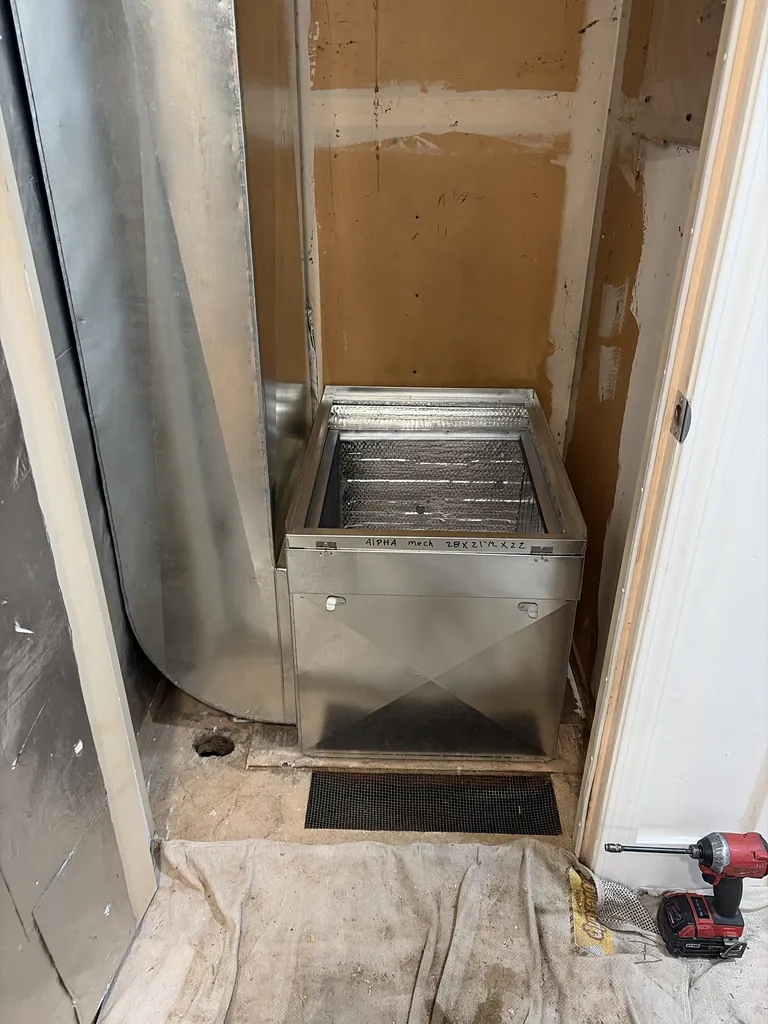
The base box for the new indoor unit, hand-labeled by our crew, set in the closet before the unit went on.
California's Energy Commission explains that installing a space-conditioning appliance requires a building permit, and that altering a space-conditioning system triggers duct sealing requirements; where the existing ducts stay, the installer and a certified (ECC) rater test them for leakage (California Energy Commission, Energy Code Support Center: HVAC, retrieved November 19, 2026). A quote for a conversion that leaves out the permit leaves out that test.
One detail homeowners ask about: the old metal ducts and debris did not go to a landfill. A scrap company picked them up for recycling.
What the Efficiency Numbers Show, and What They Do Not
Against a typical 10 SEER system, the new rating works out to about 45% less electricity for the same amount of cooling. SEER2 is the seasonal cooling efficiency rating used on current equipment; a higher number means less electricity for the same cooling. Here is the arithmetic, so you can check it.
- The old baseline. The federal minimum for central air conditioners was 10 SEER until DOE raised it to 13 SEER for products that had to meet the new standard from January 23, 2006 (U.S. Department of Energy, Federal Register, 69 FR 50997, August 17, 2004, retrieved November 19, 2026). A system made before that change could be as low as 10 SEER.
- Converting the new rating. Ratings now use SEER2, which reads lower than SEER for the same equipment. For a ducted split system, SEER2 equals SEER times 0.95, so it reads about 5% lower, using the factor developed by AHRI (the Air Conditioning, Heating, and Refrigeration Institute) and adopted by RESNET (RESNET, MINHERS Addendum 71f, SEER2 and HSPF2 Conversions, approved February 10, 2023, retrieved November 19, 2026). That puts 17.5 SEER2 at about 18.4 SEER.
- The comparison. Electricity for the same cooling scales with 1 divided by SEER: 10 divided by 18.4 is about 0.543, a little under 46% less; we call it about 45%.
For example, a household whose summer cooling used 1,000 kWh on a 10 SEER system would use about 540 kWh for the same cooling at 18.4 SEER, if everything else stayed the same. That is an illustration of the ratio, not this home's bill.
What this does not show: the old outdoor unit's own rating plate was not readable in the job photos, so 10 SEER is the typical figure for a system of its age, not a reading from this house. We have no before-and-after utility bills for this home. The new ducts add savings that we did not measure. We make no claim about heating bills, because they turn on gas and electric rates that differ from house to house.
The Rebate and the Cost
This homeowner received a $3,000 rebate, taken off as an instant rebate, and our office did the paperwork. Rebate rules, amounts and eligibility change, so our guide to heat pump rebates in California is the place to check what applies to your utility before you plan around a number.
For cost, our installed ducted heat pump replacements run $9,500 to $20,000. Where a job lands in that range depends on the equipment, the size of the system, how much ductwork changes and the condition of the house. Duct relocation like this one is quoted on the walk-through, after we have looked at the attic and the crawl space, and the price we give is the total.
When Replacing Crawl-Space Ductwork Makes Sense for Your House
Replace or relocate crawl-space ducts when they leak or are damaged and you are already changing the equipment; seal them when they are sound. The Carmichael job is one house, so treat it as an example rather than a promise. Three lessons carry over:
- Decide on the ducts before the equipment is ordered. Ducts are part of the system design, and new ducts change the registers, the layout and the test.
- Ask for the matched rating. The rating that applies is the one for your exact outdoor unit, coil and blower.
- Ask how the ducts will be tested. California's rules call for verification, and the test is the evidence the work was done well.
Where it may not apply: a house with sound ducts and an easy crawl space may only need sealing, and some homes do not have the attic room or ceiling layout for a new duct run. If you live in Carmichael, our HVAC service page for Carmichael shows what we do there; from our base in Fair Oaks, heating and cooling service across Fair Oaks covers the neighboring streets. To start, contact us to book a heat pump replacement consultation and ask us to look at the ducts in the same visit. Our About Us page explains who does the work.
Sources
Each source below is linked where it is cited in the text above.
- Bosch, 2026 Home Comfort Solutions Catalog (76HPL1801Y), p. 29, AHRI 210/240-2023 performance data, retrieved November 19, 2026
- U.S. Department of Energy, Federal Register 69 FR 50997, August 17, 2004, central air conditioner and heat pump standards, retrieved November 19, 2026
- RESNET, MINHERS Addendum 71f, SEER2 and HSPF2 Conversions (conversion factors developed by AHRI), retrieved November 19, 2026
- ENERGY STAR, Duct Sealing, retrieved November 19, 2026
- California Energy Commission, Energy Code Support Center: HVAC, retrieved November 19, 2026
- Alpha Mechanical Housecall Pro job record, Carmichael 95608, September 2026, and our own account of the install