

Your heat pump is running, the thermostat says HEAT, and the vents are pushing air that feels cold. Before you assume it's broken: a heat pump blowing cold air for 5–15 minutes at a time in winter is often a normal defrost cycle, not a failure. The question is whether what you're seeing is that cycle, or one of the four real faults that produce the same symptom.
- The 60-Second Answer: Normal or Broken?
- Defrost Mode: The Cold Air That's Supposed to Happen
- The "Cold Air" That's Really a Settings Problem
- The Real Faults: When Cold Air Means Repair
- Why Sacramento Winters Change the Diagnosis
- When to Stop Troubleshooting and Call
- Frequently Asked Questions
The 60-Second Answer: Normal or Broken?
Here's the fast sort:
| What you're seeing | What it usually means | What to do |
|---|---|---|
| Cool air for 5–15 minutes, then warm again; steam rising off the outdoor unit | Normal defrost cycle | Nothing. This is the system protecting itself |
| Air feels cool but the house holds temperature | Normal heat pump supply air (cooler than furnace air) or fan set to ON | Switch the fan from ON to AUTO |
| Outdoor unit encased in solid ice, top and sides | Failed defrost or airflow fault | Shut it down and call |
| Cold air for hours; house losing temperature | Low refrigerant, reversing valve, or defrost board | Repair call |
| Cold air only in some rooms | Duct problem, not the heat pump | Duct inspection |
Key Takeaways
- Cold air from a heat pump in winter has one normal cause, the defrost cycle: and it announces itself: short, self-ending, often with steam rising off the outdoor coil.
- A thermostat fan set to ON instead of AUTO circulates room-temperature air between heating cycles and is the cheapest "repair" on this page.
- Heat pump supply air runs 85–93°F: warm enough to heat the house, cool against skin at a body temperature of 98.6°F, and well below a gas furnace's blast. Cool-feeling air with a warm house is a heat pump working correctly.
- A solid block of ice on the outdoor unit is never normal. Frost that comes and goes is.
- In Sacramento's mild winters, a healthy heat pump should carry the house on its own. Cold air at 45°F outside points to a fault, not a capacity limit.
Defrost Mode: The Cold Air That's Supposed to Happen
In heat mode, your heat pump pulls heat out of outdoor air, and its outdoor coil runs colder than the air around it. On cold, damp valley mornings, moisture in the air freezes onto that coil as frost. Frost blocks airflow, so the system periodically clears it: it reverses into cooling mode for a few minutes, sending hot refrigerant through the outdoor coil to melt the frost. While that happens, the indoor vents blow unheated, and sometimes noticeably cool, air. (Our how a heat pump works guide covers the refrigerant cycle behind this.)
A normal defrost cycle looks like this:
- It lasts 5 to 15 minutes by manufacturer spec. Lennox puts the entire process at 5–15 minutes depending on frost load, and Trane's demand-defrost systems often finish in 3–5.
- You may hear a whoosh or swoosh as the reversing valve shifts, and the outdoor fan usually stops.
- Steam or water vapor rises off the outdoor unit as the frost melts. That's melting frost flashing to vapor on a hot coil. It looks alarming and is completely normal.
- The system returns to heating on its own, and the air warms back up.
If that's what you're seeing, especially on a cold morning after a damp night. Your heat pump isn't broken. It's protecting its own airflow.
What's not normal: defrost cycles that run back-to-back all day, a cycle that never seems to end, or frost that returns within minutes of clearing. Those patterns point at a defrost sensor, control board, or charge problem, the real faults below.
The "Cold Air" That's Really a Settings Problem
Two settings produce "cold air" complaints with nothing wrong at all.
Fan set to ON instead of AUTO. With the fan on ON, the blower runs continuously, including between heating cycles, when there's no heat to move. Between cycles it circulates room-temperature air that feels cool coming out of a vent. Set the fan to AUTO and the blower only runs when the system is actually heating.
Expecting furnace-temperature air. A gas furnace delivers very hot supply air. A heat pump delivers air at roughly 85–93°F: comfortably warmer than the room, but cool against your skin, because your body reads the world from 98.6°F. Hold a thermometer in the airflow: if supply air reads well above the return air and the house is holding its setpoint, the system is doing its job. This is the single most common "cold air" call that ends with no repair needed. If you're comparing the two systems, our heat pump vs. gas furnace guide for Sacramento covers why they feel different.
Also worth 30 seconds: confirm the thermostat is in HEAT (not COOL or an "eco" hold), the setpoint is above the room reading, and the air filter isn't clogged, ENERGY STAR's maintenance checklist calls for checking the filter monthly, and a starved blower makes every heating problem worse.
The Real Faults: When Cold Air Means Repair
When cold air persists beyond a defrost window and settings check out, four faults dominate:
Low refrigerant charge, which means a leak. Refrigerant isn't a fuel; the system never "uses it up." A low charge always means it leaked out, and low charge guts heating capacity: the coil can't absorb enough outdoor heat, supply air runs lukewarm to cold, and the outdoor unit ices up more aggressively. "Topping off" without finding the leak just schedules the same failure for next month, and refrigerant handling is EPA-regulated work. This is a diagnosis-and-repair call, not a refill.
Reversing valve stuck. The reversing valve is what points the refrigerant cycle at heating or cooling. Stuck in between, or stuck in cooling, the system literally air-conditions your house in December. If the air from the vents is truly cold (not just cool) and the outdoor unit is running, suspect the valve.
Outdoor unit iced solid. Frost on the coil surface is routine. A solid ice shell over the top and sides of the unit is not. It means defrost isn't running or can't keep up, often from a failed defrost sensor, low charge, or blocked airflow. Shut the system down before the ice damages the fan blades and coil fins, and don't chip at the ice, the fins bend with almost no force.
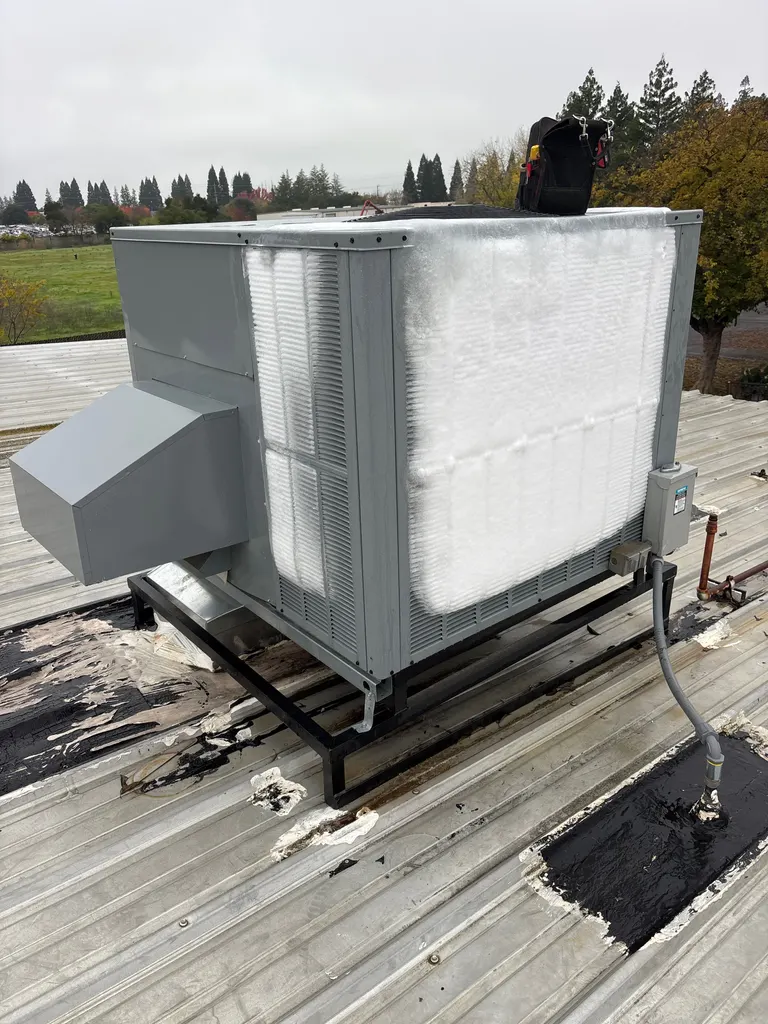
This is the ice shell in the field. A unit we were called out to when it stopped heating. The entire coil face is frozen solid, which chokes off the airflow the coil needs, and no defrost cycle can catch up with frost this deep.
Defrost board or sensor failure. The defrost cycle is triggered by a sensor and timed by a control board. When either fails, the symptoms run in both directions: constant defrosting (endless cool-air cycles) or no defrosting (the ice shell above). Board-level diagnosis is meter work behind a live panel, a technician call.
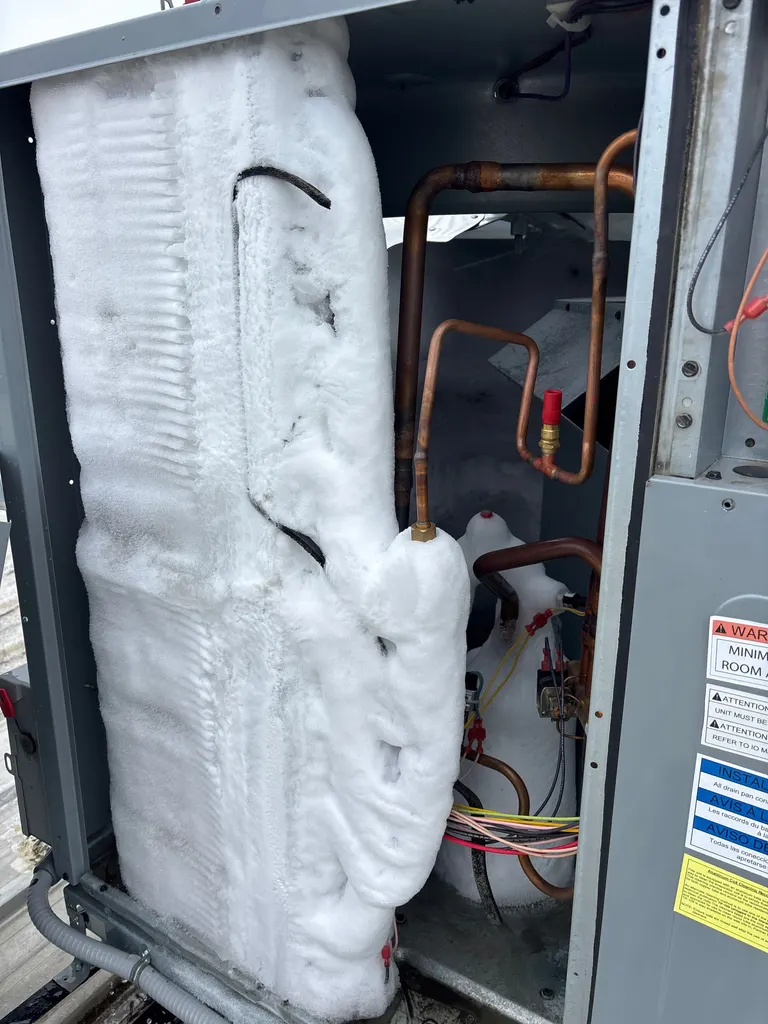
The same unit with the access panel off: the coil and refrigerant lines are buried under inches of ice. By this stage the fix is never "chip it off". The system has to be shut down, thawed, and diagnosed, because ice this thick is the symptom of a defrost or charge fault, not the fault itself.
One more suspect that isn't the heat pump: if the outdoor unit sounds labored, screeches, or hums without starting, you may be looking at a failing motor or capacitor rather than a refrigerant-side fault, the same failure family we cover for furnaces in our furnace motor troubleshooting guide.
Why Sacramento Winters Change the Diagnosis
National heat pump guides are written for climates where 20°F nights push heat pumps to their limits and backup heat runs nightly. Sacramento isn't that climate. NOAA's 1991–2020 climate normals put December overnight lows near 38.5°F: cold enough to frost a coil on a damp delta morning, nowhere near cold enough to outrun a properly working heat pump.
That changes what cold air means here:
- A healthy heat pump should carry a Sacramento house without leaning on auxiliary heat. If your system runs cold at 45°F outside, that's a fault signal, not a capacity limit. Don't let "heat pumps just do that in winter" talk you out of a diagnosis.
- Frost is a morning event here. Tule-fog humidity plus 38°F overnight lows is exactly the recipe for coil frost, so seeing defrost steam at 7 AM in January is expected behavior, not decline.
- All-electric homes feel it faster. In SMUD territory, where many homes have converted to all-electric heat pump systems (our California heat pump rebates guide covers the current programs), the heat pump is the only heat source, which makes knowing the normal-vs-broken line worth learning before the first cold snap, and makes a real fault a same-day call.
When to Stop Troubleshooting and Call
The checks worth doing yourself are the free ones: thermostat mode and setpoint, fan AUTO, filter, and a look at the outdoor unit for the ice shell. Past that, every remaining cause, charge, valve, board, sensor, is refrigerant-circuit or live-electrical work.
Call sooner rather than later if:
- The outdoor unit is encased in ice, or defrost cycles run back-to-back.
- Supply air is cold for more than 20 minutes with settings verified.
- The house is losing temperature with the system running continuously. Every hour it runs in a fault state is capacity you're paying full price for and not receiving.
- You smell anything burning, or a breaker trips more than once. Reset a breaker one time only.
Alpha Mechanical diagnoses heat pump heating faults across Sacramento and Fair Oaks with gauges and meters, not guesswork. Book heat pump repair in Sacramento and get a cold-air answer before the next cold snap settles in.
Frequently Asked Questions
Why is my heat pump blowing cold air when the heat is on?
The most common causes, in order: a normal defrost cycle (cool air for 5–15 minutes, then warm), a thermostat fan set to ON circulating unheated air between cycles, and heat pump supply air simply feeling cool against skin even though it's a working 85–93°F. Persistent cold air points to low refrigerant from a leak, a stuck reversing valve, or a failed defrost board.
Is cold air during defrost normal?
Yes. During defrost the system briefly reverses into cooling to melt frost off the outdoor coil, so the indoor vents blow unheated air for a few minutes, 5 to 15 by manufacturer spec, often with steam rising from the outdoor unit. Back-to-back cycles, a cycle that never ends, or a solid ice shell on the unit are the abnormal versions.
How do I fix my heat blowing cold air?
Start with settings: thermostat on HEAT with the setpoint above room temperature, fan on AUTO instead of ON, and a clean air filter. Give a suspected defrost cycle 15 minutes to end on its own. If cold air continues past that, the remaining causes, refrigerant leak, reversing valve, defrost board, are professional repairs.
Should I run emergency heat while I wait for repair?
Yes, if your system has it and the heat pump genuinely isn't heating. Emergency heat (EM HEAT) runs the electric backup elements alone, so the house stays warm, but it costs considerably more to run than the heat pump. Use it as a bridge to the repair visit, not a permanent setting, and switch back once the repair is done.
The Bottom Line
Cold air from a heat pump in winter is a fork, not a verdict: a short, self-ending, steam-producing cycle is the system working; ice shells, hours of cold air, and a house losing ground are faults that only get more expensive with runtime. Sort it with the 60-second table at the top, and when it lands on the fault side, that's our department.
Written by Andrey Yev, PE, the licensed Professional Mechanical Engineer and CSLB contractor who manages Alpha Mechanical in Sacramento, drawing on 25+ years of field and engineering experience.
Sources
- ENERGY STAR, "Maintenance Checklist" (inspect, clean, or change air filters monthly on furnaces and heat pumps): https://www.energystar.gov/saveathome/heating-cooling/maintenance-checklist
- NOAA / NCEI, U.S. Climate Normals 1991–2020, Sacramento (December overnight lows near 38.5°F): https://www.ncei.noaa.gov/access/us-climate-normals/
- Lennox, "What Is the Heat Pump Defrost Cycle?" (the entire defrost process usually lasts between 5 and 15 minutes, depending on weather and frost levels): https://www.lennox.com/residential/lennox-life/consumer/heat-pump-defrost-cycle
- Trane, "What Is the Heat Pump Defrost Cycle?" (steam rising from the outdoor unit during defrost is the ice melting and evaporating, and is perfectly normal; demand-defrost cycles usually run 3–5 minutes): https://www.trane.com/residential/en/resources/blog/what-is-heat-pump-defrost-cycle/
- Trane, "Heat Pump Not Heating" (supply air between 85 and 93°F feels cool because average body temperature is 98.6°F; a fan set to On blows air even when the heat pump is not actively heating): https://www.trane.com/residential/en/resources/troubleshooting/heat-pumps/heat-pump-not-heating/
- Honeywell Home, thermostat support (the On position runs the fan continuously regardless of whether heating or cooling is active; Auto runs it only during calls): https://www.honeywellhome.com/blogs/support/7-day-programmable-thermostats-3