
- Quick Answer: Heat Pump vs. Gas Furnace in Sacramento
- What's the Difference Between a Heat Pump and a Gas Furnace?
- What Are the Pros and Cons of a Heat Pump vs. a Gas Furnace?
- Operating Costs: Which Is Cheaper to Run in Sacramento?
- Do Heat Pumps Work in Sacramento's Cold Mornings?
- Case Study: The "Expensive" Heat Pump That Cost $2,200 Less
- Case Study: Dual-Fuel Hybrid in Rancho Cordova
- When Should You Choose a Heat Pump vs. a Gas Furnace?
- What Does 2026 Mean for Your Heat Pump Decision?
- How Alpha Mechanical Can Help
- Frequently Asked Questions
For most Sacramento homes, a heat pump is the better choice over a gas furnace. The reason is structural: Sacramento sits in DOE Climate Zone 3, where winters rarely drop below 30°F, which is exactly the range an air-source heat pump runs most efficiently in. You also replace two pieces of equipment with one, and SMUD's gas-to-electric rebate (up to $3,000 as of February 2026) plus contractor incentives often make the upfront cost lower than a comparable furnace + AC. Gas still wins in two specific situations covered below.
Key Takeaways
- Heat pumps move heat, furnaces make it. Modern air-source heat pumps deliver roughly 300% effective efficiency (COP ~3) in mild winters — they output ~3 units of heat per unit of electricity, versus 80-98% AFUE for a gas furnace.
- Sacramento's climate (Zone 3) favors heat pumps. Heat pumps lose efficiency below ~30°F; Sacramento rarely drops there. The U.S. DOE notes a heat pump can cut electricity used for heating by roughly 50% or more compared to electric resistance heat in moderate climates (DOE).
- The rebate math flips the sticker price. SMUD pays up to $3,000 for a gas-to-heat-pump conversion as of February 2026 (SMUD). Combined with Tech Clean California, the "more expensive" heat pump frequently nets lower than a furnace + AC.
- The federal 25C tax credit expired December 31, 2025. Sacramento incentives in 2026 are utility-driven (SMUD) and state-driven (Tech Clean California), not federal — see our California heat pump rebates guide for current numbers.
- Gas furnace still wins when natural gas is cheap and winter lows routinely drop below ~25°F, or when the home has no electrical panel capacity for a heat pump and a service upgrade isn't viable.
Quick Answer: Heat Pump vs. Gas Furnace in Sacramento
| Factor | Air-Source Heat Pump | Gas Furnace + AC |
|---|---|---|
| Heating efficiency (Sacramento winters) | ~300% (HSPF2 ≥ 7.5) | 80-98% AFUE |
| Provides cooling? | Yes — single system | No — needs a separate AC |
| Typical installed cost (residential, before rebates) | $14,000-$22,000 | $12,000-$18,000 (furnace + AC) |
| SMUD rebate (2026) | Up to $3,000 (gas-to-heat-pump) | Limited |
| Federal 25C tax credit | Expired 12/31/2025 | Expired 12/31/2025 |
| Best when winter lows stay above… | 30°F | Any |
| Carbon monoxide risk | None (electric) | Yes — annual heat-exchanger inspection |
| Equipment lifespan | 15-20 years | Furnace 20-25, AC 12-15 |
If your existing AC is dying, the cheapest path forward in 2026 is almost always a heat pump (you replace one box, not two, and the rebates only apply in that direction). If you're swapping a working furnace just because you can, the math gets tighter — see operating costs below.
What's the Difference Between a Heat Pump and a Gas Furnace?
A gas furnace makes heat by burning fuel. Natural gas (or propane) flows into a burner assembly, ignites, and heats a metal heat exchanger. A blower then pushes house air across that exchanger and into your ducts. The system is purely a heater — you need a separate AC for cooling.
A heat pump moves heat with refrigerant. The same refrigerant cycle a central AC uses runs in reverse in winter: the outdoor coil absorbs heat from outside air (even cold air carries thermal energy), the compressor concentrates it, and the indoor coil releases it into your ducts. In summer the cycle reverses and the unit cools the house like a standard AC.
Moving heat instead of creating it is why a heat pump's seasonal efficiency (HSPF2) translates to roughly 300% effective efficiency in Sacramento's climate. A 98% AFUE gas furnace — the very best on the market — never breaks the 100% line, because it converts chemical energy to heat rather than multiplying it. That doesn't make a furnace "bad"; it means a heat pump has a structural physics advantage in any climate where it doesn't have to fight extreme cold.
What Are the Pros and Cons of a Heat Pump vs. a Gas Furnace?
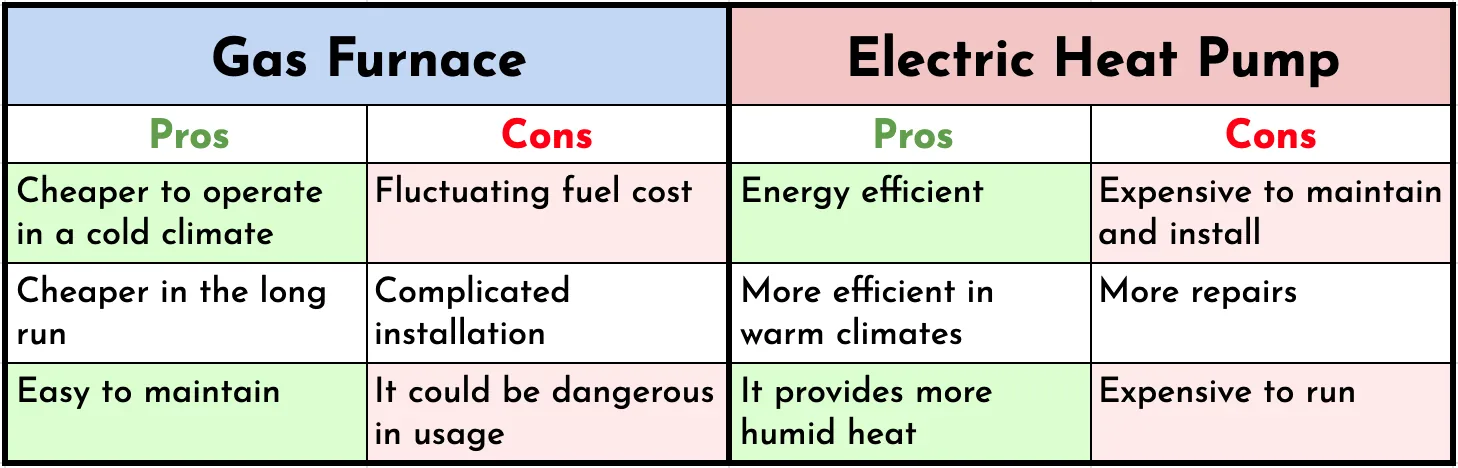
Gas Furnace — Pros
- Long lifespan. Furnaces routinely hit 20-25 years with annual service. Fewer moving parts than a heat pump.
- Powerful, fast heat. Furnaces deliver supply-air temperatures around 120-140°F, which feels warm immediately. Heat pump supply air runs cooler (~95-105°F), which some homeowners initially describe as "drafty" until expectations adjust.
- Cheaper to run in very cold climates. Below about 25°F, a heat pump's efficiency drops and resistance backup heat kicks in. Gas wins decisively in DOE Zones 5+. Sacramento is Zone 3.
- Lower upfront cost as a standalone unit. A new gas furnace alone is typically cheaper than a new heat pump alone — but you still need a separate AC for cooling, which is where the math turns.
Gas Furnace — Cons
- Combustion safety risk. A cracked heat exchanger can leak carbon monoxide into the home. Annual inspection isn't optional — see our guide on cracked heat exchanger symptoms. When a furnace stops working, the thermostat or control board is often the real culprit; our furnace-won't-turn-on troubleshooting walkthrough covers the common causes.
- Gas line required. If your home doesn't already have natural gas service, installing one is significant cost and permitting work.
- Rising fuel cost. Natural gas rates in PG&E territory have climbed substantially over the last several years. SMUD electricity costs have been more stable.
- Two boxes, two maintenance schedules. Furnace + AC means twice the equipment, twice the service visits, twice the failure points.
Air-Source Heat Pump — Pros
- One system, two seasons. Heating and cooling from a single outdoor unit. Less roof or yard footprint and one maintenance contract.
- High efficiency in Sacramento's climate. Modern variable-speed inverter models hit COPs around 3.0-4.0 in our winter temperature range — roughly three to four times the heat output per kWh of electric resistance.
- Big rebates are pointed at this direction. SMUD's gas-to-heat-pump rebate is up to $3,000 in 2026, and Tech Clean California stacks an additional incentive in many ZIP codes. Furnace replacements don't qualify for these programs.
- No combustion in the home. No CO risk, no flue, no gas-line work. Better indoor air for households with respiratory sensitivities.
- Pairs naturally with rooftop solar. Heating runs on the same electricity your panels generate.
Air-Source Heat Pump — Cons
- Loses efficiency below ~30°F. Cold-climate models with enhanced vapor injection mitigate this, but standard air-source units lean on auxiliary resistance heat in deep cold, which is expensive to run. Sacramento sees this only a handful of nights per year.
- More moving parts than a furnace. Outdoor unit, indoor coil, reversing valve, defrost control — more components that can fail. A lost refrigerant charge stops heat production entirely. See top heat pump problems for what tends to go wrong.
- Higher installation cost. Refrigerant piping, electrical work, and sometimes a panel upgrade make the install more involved than swapping a like-for-like furnace. The rebates exist because the unsubsidized sticker is higher.
- Service depth matters more. Heat pumps reward correct refrigerant charge, airflow, and duct sizing far more than furnaces do. A bad install on a heat pump is much more punishing than a bad install on a furnace.
Operating Costs: Which Is Cheaper to Run in Sacramento?
Operating cost depends on four levers: equipment efficiency, fuel price, climate, and how long you stay in the home.
In Sacramento, with SMUD electric rates and PG&E gas rates as they currently sit, a modern variable-speed heat pump typically beats a 95% AFUE gas furnace + 15 SEER2 AC on combined annual energy cost. Annual heating costs around $250-$350 for a heat pump versus $350-$500 for a gas furnace heating the same home — and that's before counting summer cooling, which is identical on the AC side but free on the heat pump (you'd pay for an AC either way).
Three caveats:
- Stay length matters. Higher-efficiency equipment has a longer payback. Under 5 years in the home, the spread shrinks; in a forever home, every additional efficiency point compounds.
- Repair frequency favors furnaces over time. Heat pumps work year-round; furnaces only six months. So heat pumps accumulate hours and small failures faster. A labor warranty (often 10 years bumper-to-bumper) materially changes the lifetime cost equation.
- Geothermal is even more efficient — but the upfront cost is much higher. Air-source heat pumps are the practical choice for residential Sacramento; geothermal usually only pencils out on larger custom builds.
A competent HVAC contractor should be able to model your specific home and quote both options. Treat any contractor who pushes one option without modeling the other as a red flag.
Do Heat Pumps Work in Sacramento's Cold Mornings?
The big concern people raise about heat pumps is "do they work when it's cold?" The honest answer: yes, in Sacramento, very well; no, in Minnesota.
As of 2026, Sacramento's average January low sits around 38°F (NOAA climate normals). Our coldest mornings typically bottom in the high 20s to low 30s. That's exactly the range modern air-source heat pumps are designed for, and the DOE efficiency advantage cited in the Key Takeaways above applies directly here. Trane and Carrier rate most of their air-source models for full-capacity operation down to 25-30°F, with degraded operation continuing well below that.
When the outdoor temperature drops below the heat pump's "balance point" (the temp where it can no longer cover the home's heat loss on its own), one of two things happens:
- All-electric heat pump: Resistance heat strips engage as backup. Expensive to run, but they only kick on the handful of hours per year Sacramento sees those temps.
- Dual-fuel hybrid: A gas furnace is wired as the backup. The heat pump covers 80-90%+ of the heating season; the furnace handles the cold snaps. This is the highest-comfort, highest-resilience configuration in our area.
For Sacramento, the practical comparison is heat pump vs gas furnace — not heat pump vs electric furnace, which a heat pump beats decisively in any climate (both run on kWh, but a heat pump multiplies the output by 3-4x).
Case Study: The "Expensive" Heat Pump That Cost $2,200 Less
The situation. A homeowner in Elk Grove had a 20-year-old gas furnace and AC. The AC compressor died during a July heatwave. They called for a replacement quote, assuming they'd swap just the AC and keep the old furnace to save money.
The two quotes.
- Option A (Traditional): Replace the AC, keep the furnace. $14,500.
- Option B (Heat Pump): High-efficiency variable-speed heat pump system, retire the furnace. $17,800.
On sticker, Option B looked like a $3,300 splurge. They almost signed Option A.
The "rebate math" intervention. Our technician ran the incentives that apply specifically to the gas-to-electric switch in SMUD territory:
- SMUD gas-to-heat-pump rebate: -$2,500
- Federal tax credit (25C, still active that year): -$2,000
- Tech Clean California: -$1,000 (varies by ZIP, applied in their case)
The final numbers.
- Option A (Gas/AC): $14,500 (no major rebates).
- Option B (Heat Pump): $17,800 − $5,500 = $12,300.
The outcome. The "expensive" heat pump ended up costing $2,200 less than the traditional system. The homeowner switched. Six months later their winter heating bills dropped roughly 20% — they were no longer buying natural gas — and rooftop solar offset much of the new electric heating load.
The lesson: look at net price, not sticker price. In Sacramento, the rebates often make the better technology cheaper than the legacy one. Always ask the contractor to run the rebate math before you sign. (Note: 25C federal credit expired December 31, 2025 — this same scenario in 2026 saves $2,000 less, but the SMUD and Tech Clean California pieces still apply.)
Case Study: Dual-Fuel Hybrid in Rancho Cordova
The situation. Older ducted home, working gas furnace, working AC reaching end of life. The owners wanted lower bills but didn't want to rip out a furnace that still had years on it.
The choice. Replaced the AC with an air-source heat pump and wired the existing gas furnace as backup heat — a dual-fuel hybrid. The system runs as a heat pump above the balance point (~85-90% of Sacramento winter hours) and switches to gas only on the coldest mornings.
The outcome. Noticeable savings versus the old gas-only setup, plus full furnace redundancy on the rare cold snap. For homes with a furnace that still has meaningful life left, this is often the best move: most of the heat pump efficiency without scrapping working equipment.
When Should You Choose a Heat Pump vs. a Gas Furnace?
Choose a heat pump when:
- You want one system for heating and cooling instead of two.
- Energy efficiency, indoor air quality, or lower emissions are priorities.
- You qualify for SMUD's gas-to-heat-pump rebate or Tech Clean California incentives.
- You have or plan to add rooftop solar.
- Your electrical panel has capacity for a 30A 240V circuit (or you're willing to upgrade — sometimes covered by stacked rebates).
Choose a gas furnace when:
- Your electrical panel is fully loaded and a service upgrade is impractical.
- Your home has cold spots or poor insulation that benefit from very hot supply air.
- You explicitly prefer the feel of a gas burn and operating costs aren't the deciding factor.
- You're in a microclimate that regularly drops below 25°F (rare in Sacramento).
Choose a dual-fuel hybrid when:
- You already have a working gas furnace and a dying AC.
- You want heat pump efficiency on 90% of days plus the certainty of gas on the coldest nights.
- You can't or won't decommission the gas line, but you do want lower bills.
What Does 2026 Mean for Your Heat Pump Decision?
Three regulatory changes affect this decision in 2026:
- California's 2025 Title 24 code (in effect 1/1/2026) makes a heat pump the prescriptive baseline for most new homes and requires R-6 duct insulation with a 5% leakage cap (California Energy Commission). New construction strongly favors heat pumps.
- The federal Section 25C tax credit expired December 31, 2025. The $2,000 federal credit that used to apply to qualifying heat pump installs is gone. Sacramento incentives are now utility-led (SMUD) and state-led (Tech Clean California).
- A2L refrigerant transition. Most 2026 equipment ships with R-454B or R-32 refrigerant instead of R-410A. Different service procedures, slightly different parts pricing — see our 2025 refrigerant mandate explainer for what changes.
For Sacramento homeowners, the net effect: heat pump remains the favored direction, but the financial case relies more on SMUD's rebate stack and less on the federal credit than it did even a year ago.
How Alpha Mechanical Can Help
Whether you land on a heat pump, a high-efficiency furnace, or a dual-fuel hybrid, install quality is what determines whether the system delivers on its rated efficiency. We're a NATE-certified Sacramento HVAC contractor and we model both options for every replacement quote so you can see the rebate math, the lifecycle cost, and the comfort tradeoffs side by side.
- View heat pump replacement options
- Compare furnace replacement
- Check current SMUD specials and rebates
- Financing options (Wells Fargo, GreenSky, Enerbank, Foundation Finance)
Or contact us and we'll walk you through the math for your specific home.