
- Which Motor Is Actually Failing?
- Symptom Table: What the Blower Is Telling You
- Step-by-Step: The Checks in Order
- PSC vs. ECM: Why Your Motor Type Changes the Repair
- What Blower Motor Replacement Costs in 2026
- When a Failing Blower Argues for Replacing the System
- Frequently Asked Questions
Your furnace fires, you hear the burners running — and no air comes out of the vents. That's a blower problem, but not necessarily a blower motor problem. A run capacitor, a control board that never sends the fan signal, or even a filter clogged enough to trip the limit switch all produce the same dead-vent symptom, and two of those three cost a fraction of a motor.
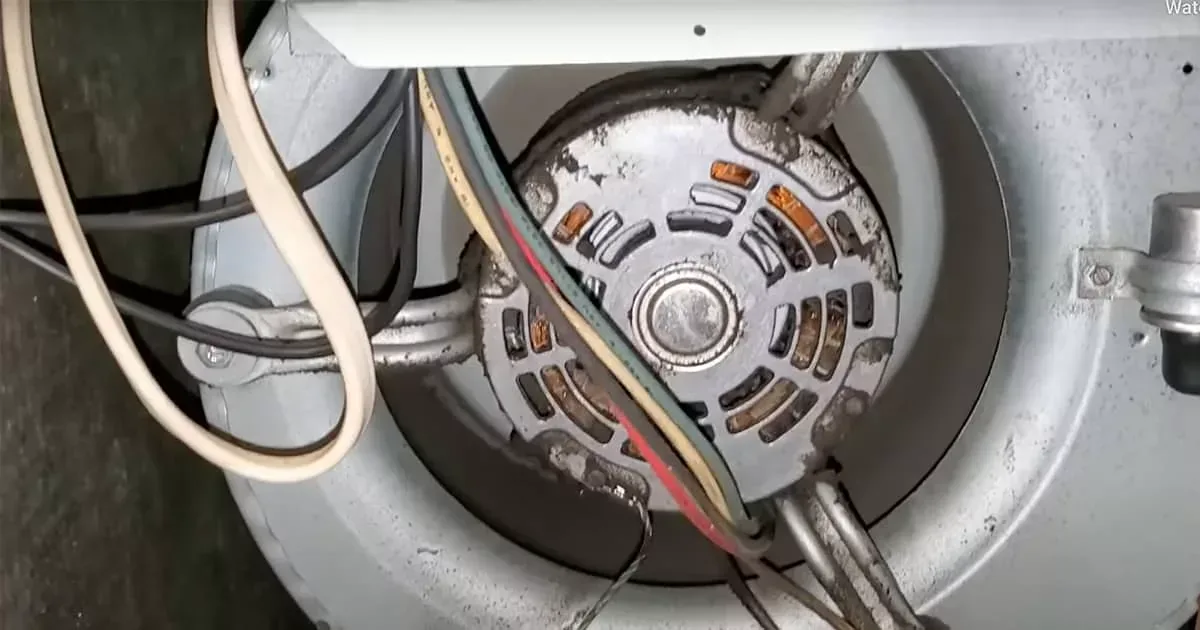
Which Motor Is Actually Failing?
First, a disambiguation that saves Sacramento homeowners real money: your furnace has two motors, and they fail differently.
- The draft inducer motor is the small blower that starts first, before ignition, to pull combustion air through the furnace. Grinding or humming before the burners light is the inducer's signature — that's a different part and a different guide: 5 signs of a bad furnace inducer motor.
- The blower motor (air handler motor) is the big one that starts last, about 30–90 seconds after the burners light, and pushes warm air through the ducts. No airflow at the vents while the burners run is the blower's signature — this guide.
If the sequence dies before ignition, go to the inducer guide. If the furnace heats but nothing moves, stay here.
Symptom Table: What the Blower Is Telling You
| Symptom | Most likely cause | Typical fix |
|---|---|---|
| Motor hums but won't start | Failed run capacitor | Capacitor replacement — the cheap fix |
| No hum, no response, burners shut down on limit | Control board fan signal, wiring, or dead motor | Meter diagnosis |
| Runs, then stops mid-cycle, runs again later | Overheating motor cycling on thermal protection — often a dirty filter or seized bearings | Filter first, then motor |
| Squealing or screeching | Worn bearings (or belt on older units) | Motor replacement soon |
| Runs constantly, never shuts off | Fan relay stuck or thermostat fan set to ON | Settings, then relay |
| Weak airflow at every vent | Clogged filter, crushed duct, or a motor running slow | Filter, then static pressure check |
Key Takeaways
- No air from the vents while the burners run points at the blower circuit — but a capacitor or control board causes the same symptom as a dead motor at a fraction of the price. Diagnose before you buy a motor.
- Hum-but-no-start is the capacitor's signature. It's the first thing a technician tests and the cheapest of the likely repairs.
- Furnaces have two motors — the draft inducer (starts before ignition) and the blower (starts after). Which one is failing changes the part, the price, and the guide you need.
- A clogged filter can shut the whole furnace down. Overheating trips the limit switch, and the blower gets blamed. Check the filter before anything else — ENERGY STAR's checklist calls for a monthly look.
- Motor type matters: a standard PSC motor is a straightforward swap, while a variable-speed ECM motor is dearer but can often be repaired at the module level.
Step-by-Step: The Checks in Order
Work these in sequence — they run cheapest-first, and each one exonerates or convicts a specific part.
- Filter and airflow first. Pull the filter and hold it to a light. A blocked filter overheats the furnace, trips the high-limit switch, and shuts the burners and eventually the blower down — a "blower failure" that costs the price of a filter. Check that supply registers and the return grille are open and unblocked while you're at it.
- Thermostat fan test. Switch the thermostat fan from AUTO to ON. If the blower starts, the motor and its power are fine — the fault is in the heat-call chain (board relay, limit) rather than the motor itself. If nothing happens, keep going.
- Listen at the cabinet during a heat call. Burners light, then 30–90 seconds later you should hear the blower ramp. A hum with no spin at that moment is the classic failed-capacitor signature. Silence — no hum at all — points at the board's fan relay, the wiring, or a motor with open windings.
- Power down and look. Kill power at the switch and breaker. Open the blower compartment: check for a seized wheel (spin it by hand — it should turn freely and quietly), scorched wiring, a swollen or leaking capacitor casing, and dust cake on the squirrel-cage blades heavy enough to unbalance the wheel.
- Know where DIY ends. Testing a capacitor properly means discharging it first — it stores a jolt even with the power off — and metering microfarads against the rating on the case. Swapping a motor means matching horsepower, RPM, rotation direction, frame size, and capacitor rating. Both are fast work for a technician with the parts on the truck, and both are where we tell honest DIYers to stop.
If the diagnosis lands on the control board or wiring rather than the blower itself, the fault family and its costs look different — our furnace gas valve guide shows the same board-diagnosis logic applied to a different output.
PSC vs. ECM: Why Your Motor Type Changes the Repair
Furnace blowers come in two families, and the repair math is different for each:
PSC (permanent split capacitor) motors — the standard single-speed or multi-speed motor in most furnaces installed before ECMs became the industry standard in 2019. They're inexpensive, they fail predictably (capacitor first, bearings second), and replacement is a straightforward like-for-like swap. If your furnace is older and has a PSC motor, a blower failure is usually a same-week, moderate-cost repair.
ECM (electronically commutated) motors — the variable-speed, electronically controlled motors in newer and higher-efficiency furnaces. The Department of Energy's Building America program rates ECMs at roughly 80% efficient against a PSC's 60% at best, cutting fan energy use by 50% or more — and in continuous-fan mode the difference is dramatic, around 80 watts for an ECM against 500–550 for a PSC. They also ramp smoothly instead of slamming to full speed and hold airflow steady as filters load up. They cost more to replace — but an ECM motor is two components, the motor itself and an electronic control module bolted to its back, and on many failures only the module needs replacing. Always ask whether a module-level repair is on the table before approving a full ECM motor swap.
What Blower Motor Replacement Costs in 2026
The honest national numbers, from published 2026 cost data rather than a quote screen: This Old House puts the motor itself at $70–$2,400 before installation, with labor adding $200–$400 — the enormous part spread is the PSC-versus-ECM split, with a standard PSC replacement running $300–$1,100 and an ECM replacement $600–$1,500 installed. Trane's own repair-cost table lands the common case at $300–$900. Where a specific job falls inside those ranges comes down to motor type, horsepower, and how buried the blower compartment is.
Three cost anchors to keep the quote conversation honest:
- Capacitor replacement is the outcome you're hoping for — Trane's repair table puts a furnace blower capacitor at $100–$250, a fraction of any motor.
- PSC motor replacement sits in the middle of the range; parts are commodity, labor is the constant.
- ECM replacement occupies the top of the range — but ask about module-only repair, which can bring an ECM failure back toward PSC money.
Get the itemized split: part, labor, and diagnostic fee, and whether the diagnostic credits toward the repair (ours does).
When a Failing Blower Argues for Replacing the System
A blower motor is a wear part, and one failure on an otherwise healthy furnace is just a repair. But a blower motor typically lasts 10–20 years — about as long as the furnace itself — so a blower failure on a furnace already deep into its service life is a fork worth pausing at: a top-dollar ECM replacement on an 18-year-old furnace can be money you re-spend when the heat exchanger or board goes next season. Our guide to the factors that decide repair vs. replace walks that math honestly — and if the furnace is on the young side, repair and move on.
No airflow in season is a same-day problem — a furnace that heats without moving air is also cooking its own heat exchanger. Book heating repair in Sacramento and we'll put a meter on the capacitor, the windings, and the board signal before anyone prices a motor.
Frequently Asked Questions
Why is my furnace running but no air coming out?
The burners can run while the blower doesn't, and the blower circuit is the suspect list: a failed run capacitor (hum but no spin), a control board that never sends the fan signal, a motor with seized bearings or open windings, or a filter clogged badly enough to trip the safety limit. A capacitor or filter is a cheap fix; diagnose before pricing a motor.
How much does furnace blower motor replacement cost?
Published 2026 national data puts the motor at $70–$2,400 before installation plus $200–$400 labor, with the split driven by motor type: a standard PSC replacement typically runs $300–$1,100, a variable-speed ECM $600–$1,500 installed, and Trane's repair table lands the common case at $300–$900. If the diagnosis is the run capacitor instead, expect $100–$250.
Can I replace a furnace blower motor myself?
Checking the filter, the thermostat fan setting, and listening for hum-versus-silence are safe and useful. Beyond that, capacitor testing requires discharging a stored charge safely, and a motor swap has to match horsepower, RPM, rotation, frame size, and capacitor rating — get one wrong and the new motor runs hot or backward. Most homeowners are money ahead having the diagnosis and swap done professionally.
How long does a furnace blower motor last?
Typically 10–20 years — about the service life of the furnace itself. Heavy filter neglect shortens that: a starved blower runs hot, and heat is what kills motor windings and bearings. If your blower fails young, have the static pressure and filter habits looked at along with the motor, or the replacement inherits the same conditions.
The Bottom Line
"Furnace runs, no air" is a solvable sequence, not a sentence: filter, fan-ON test, hum check, then the meter. The cheap causes (filter, capacitor) outnumber the expensive one, the two-motor mix-up is worth ruling out before any part gets ordered, and an ECM failure deserves the module-repair question before the full-swap quote. When the checks land on the motor — or you'd rather skip straight to the meter — that's our department.
Written by Andrey Yev, PE, the licensed Professional Mechanical Engineer and CSLB contractor who manages Alpha Mechanical in Sacramento, drawing on 25+ years of field and engineering experience.
Sources
- ENERGY STAR, "Maintenance Checklist" (inspect, clean, or change air filters monthly on furnaces and heat pumps): https://www.energystar.gov/saveathome/heating-cooling/maintenance-checklist
- This Old House, "Furnace Blower Motor Replacement Cost" (motor $70–$2,400 before installation, labor $200–$400, PSC $300–$1,100, ECM $600–$1,500 installed; blower motors last 10–20 years, about as long as the furnace; ECMs became the industry standard in 2019): https://www.thisoldhouse.com/heating-cooling/furnace-blower-motor-cost
- Trane, "Average Furnace Repair Cost" (furnace blower motor $300–$900; blower motor capacitor $100–$250): https://www.trane.com/residential/en/resources/blog/furnace-repair-cost/
- U.S. DOE Building America Solution Center, "ECM Air Handler Fans" (ECMs about 80% efficient vs. 60% at best for PSC; 50%+ fan energy reduction; ~80 W continuous-fan draw vs. 500–550 W): https://basc.pnnl.gov/resource-guides/ecm-air-handler-fans