

When Sacramento air turns orange, you need two things working together: a central system running a filter that actually catches smoke particles, and a portable air cleaner sized for the room you sleep in. Neither alone is enough, and the usual first piece of advice, open a window and ventilate, is exactly wrong during a smoke event because the outdoor air is the pollutant.
One California-specific rule before you buy anything: every portable air cleaner sold in California must be certified by CARB. That is not a recommendation, it is the regulation, and it exists to keep ozone generators off the market. Check the CARB certified list before you order.
How the EPA ranks your options
The EPA's guidance is deliberately ordered, and the order matters: the most effective ways to improve your indoor air are to reduce or remove the sources of pollutants and to ventilate with clean outdoor air, and research shows filtration can be an effective supplement to those two.
During a wildfire smoke event the middle option is unavailable. Outdoor air is the source. So the order inverts for a few days: seal what you can, then lean entirely on filtration. That is a genuinely different playbook from normal indoor air quality advice, and it is why generic air purifier articles do not serve a smoke week well.
The EPA is also clear on the division of labor. Portable air cleaners, also called air purifiers, are designed to filter the air in a single room or area. Central furnace or HVAC filters are designed to filter air throughout a home. And a caveat worth keeping: they can reduce indoor air pollution, but they cannot remove all pollutants from the air.
The central system: MERV 13, with one condition
Wildfire smoke is mostly fine particulate, the fraction measured as PM2.5. A basic MERV 8 filter is built to protect the equipment, not your lungs. MERV 13 is the practical target for catching smoke-sized particles in a residential system.
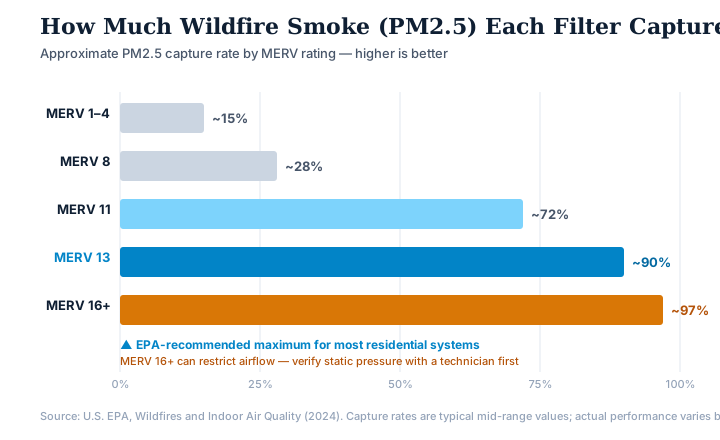
The condition: a higher-MERV filter is more restrictive, and a system that was not designed for the extra pressure drop loses airflow. Lost airflow means less cooling capacity, a colder coil, and in a bad case a frozen coil. So the right move is a MERV 13 in the correct thickness for your cabinet, ideally a deeper media filter if your system can take one, and a check that the system is still moving air properly afterward. If you are unsure what your system will tolerate, ask before you upgrade, and see how to make your AC more efficient for why airflow is worth protecting.
Two more things about the central system during smoke:
Run the fan, not just cooling. Setting the thermostat fan to on keeps air moving through the filter continuously rather than only when the compressor runs. On a smoke day that turns your whole-house system into a whole-house air cleaner.
Close the fresh air intake if you have one. Most older Sacramento homes do not, but newer builds and some systems have a mechanical ventilation path that pulls outdoor air in by design. During a smoke event that path is working against you.
Choosing a portable air cleaner
Three numbers decide it.
CADR. Clean Air Delivery Rate, the volume of filtered air a unit actually delivers. It is the number that lets you compare two machines honestly, and it is tested through the AHAM program. For smoke, look at the smoke CADR specifically, not the pollen or dust number.
Room size rating. CARB's own selection advice starts here: check the room size rating in square feet and use the right sized unit for your home. A small unit in a large room is the most common wasted purchase.
True HEPA filtration. For PM2.5 you want mechanical HEPA filtration. Avoid anything marketed on ozone, ionization or "activated oxygen" as its primary mechanism, which is precisely what the CARB certification program exists to control.
CARB also gives placement advice that most buyers ignore: install the unit in the room where you spend the most time, and place it away from doors, windows and foot traffic, but not tight against a wall or in a corner, so air can actually reach it.
The practical Sacramento approach: one properly sized unit in the bedroom, running overnight, does more for your week than a small one in the living room. You spend eight hours a night in one room with the door mostly closed. That is the easiest room in the house to actually clean.
Where we fit
Our side of this is the central system: indoor air quality equipment that integrates with your HVAC, including media air cleaners, CARB-certified low-ozone electrostatic units, and UV germicidal treatment at the coil. We do not sell portable air purifiers. That is worth saying plainly, because it means we have no reason to talk you into one or out of one: for a smoke week, a correctly sized portable unit from the CARB list in the bedroom is often the better spend than anything ducted, and we will tell you so.
During a smoke event: the order of operations
- Check the AQI at AirNow before deciding how hard to work at this. A day at 60 and a day at 200 are different problems.
- Close windows and doors. Yes, even when it is 100 degrees. Run the AC instead.
- Set the thermostat fan to on so the filter works continuously.
- Check the filter. A smoke week loads a filter fast. Look at it during the event, not after.
- Run a portable cleaner in the bedroom, sized for the room, on the CARB list.
- Do not vacuum, fry food, burn candles or use a gas fireplace. These add particles indoors when you have no way to ventilate them out.
- Skip the DIY box fan filter unless you have no alternative. It is better than nothing in an emergency, and it is not a substitute for a rated unit or a properly filtered central system.
After the smoke clears
Change the filter, even if it does not look bad yet. Then ventilate properly once the AQI comes down, because the EPA's normal ranking applies again and clean outdoor air is back on the menu.
It is also worth having the coil and blower looked at after a heavy season. Smoke particulate that gets past a filter lands on a wet evaporator coil and stays, which costs airflow and can start the musty odor problem covered in why your AC smells. That is a normal part of an AC tune-up.
Does a MERV 13 filter help with wildfire smoke?
Yes, meaningfully, because MERV 13 is rated to capture much finer particles than the MERV 8 filters most systems ship with, and wildfire smoke is dominated by fine particulate. The caveat is airflow: use the correct thickness for your cabinet, and confirm the system still moves air properly afterward.
Do I need an air purifier if I have central air?
They do different jobs. The EPA describes central HVAC filters as filtering air throughout a home and portable air cleaners as filtering a single room. On a heavy smoke day the useful combination is both: the central system filtering the whole house continuously, and a portable unit concentrating on the room where you sleep.
Which air purifiers are legal to sell in California?
Only CARB-certified ones. CARB states that all portable indoor air cleaning devices sold in California must be certified to meet ozone and electrical safety standards, and it publishes the certified list. If a device is not on that list, that is a reason to look elsewhere.
Will an air purifier remove the smoke smell?
Partly. HEPA filtration captures particles very well and gases less so, which is why a unit with a substantial activated carbon stage does better on the smell than one without. The EPA's caveat stands: air cleaners reduce indoor air pollution and cannot remove all pollutants.
Is it safe to run the AC during a wildfire?
Yes, and it is usually the better choice than opening windows. A central system with a good filter and the fan running is doing useful work. What to avoid is a fresh air intake pulling smoke in and a filter nobody has checked since the season started.
Want the central side of this set up properly before the next smoke week? Look at indoor air quality options, book an AC tune-up, or contact us and tell us what your system is and we will tell you what filter it can take.