

Mobile home HVAC is not the same job as heating and cooling a site-built house, and treating a manufactured home the same way is how owners end up with equipment that fails early or was never legal to install in the first place. For most Sacramento-area manufactured homes the realistic choice comes down to three systems: a packaged unit, central air riding on the home's existing furnace and ducts, or a ductless mini-split. And two rules surprise almost everyone: the equipment must be listed for manufactured homes under the federal HUD code, and in California the permit for the work comes from the state, not your city or county.
Key takeaways
- Most Sacramento manufactured homes choose between a packaged unit, central AC on the existing ductwork, or a ductless mini-split. Window units are a stopgap, not a plan.
- National installed costs: furnace and AC combo $4,000 to $9,000, packaged unit $3,800 to $7,000, central AC alone $2,400 to $5,300, furnace alone $1,200 to $2,500 electric or $1,700 to $3,700 gas (HomeGuide).
- Federal law requires HVAC equipment in a manufactured home to be listed or certified for that application. A furnace or AC built for a site-built house is not a legal substitute.
- In California, altering a manufactured home, including its heating and cooling equipment, requires a permit from the state housing department, HCD, on form HCD MH 415. Your contractor should handle the filing.
- Right-sizing beats upsizing. Manufactured homes have smaller envelopes and smaller ducts than site-built houses, and an oversized system short cycles itself to an early death.
The Four Ways to Heat and Cool a Mobile Home
Option 1: Window or room AC units
The cheapest way in, and the weakest. Window units are loud, cool one room at a time, and cost the most to run per square foot of cooling. In a Sacramento July they make sense as a stopgap while you plan a real system, or as a supplement for one stubborn room, and not as the plan itself.
Option 2: Central air on your existing furnace and ducts
If your home already has a working downflow furnace and duct system, adding a matched cooling coil and outdoor condenser is often the cheapest whole-home option: $2,400 to $5,300 installed nationally (HomeGuide). The catch is that this option is only as good as the ducts it rides on, which is where many manufactured homes lose (more on that in the misconceptions below). One maintenance note if you go this route: make sure the install includes a working condensate safety switch, which shuts the system down before an overflowing drain pan soaks the subfloor.
Option 3: A packaged unit
The classic manufactured-home system. The compressor, coils, and air handler all live in one weatherproof cabinet that sits on a pad beside the home and connects to the existing duct system. Packaged units come as AC-only, heat pump, gas and electric, or dual fuel, and installation runs $3,800 to $7,000 nationally depending on which of those you pick (HomeGuide). Everything is serviceable from outside, nothing takes up closet space, and the equipment is purpose-built for manufactured homes.
Option 4: Ductless mini-split
Some manufactured homes have no usable ductwork at all, and for them the mini-split is usually the answer: a compact outdoor unit feeding one or more wall-mounted indoor heads through a small line-set penetration. Mini-splits are quiet, highly efficient, and zone naturally, since each head has its own thermostat. Larger multi-zone systems pair one outdoor unit with three to five indoor heads, which comfortably covers a double-wide. Our mini-split installation page covers how we spec them.
| System | Installed cost (national) | Uses ducts? | Best fit |
|---|---|---|---|
| Window units | Lowest upfront | No | Stopgap cooling for one room |
| Central AC add-on | $2,400 to $5,300 | Yes, existing | Homes with a sound furnace and duct system |
| Packaged unit | $3,800 to $7,000 | Yes | Full replacement in one outdoor cabinet |
| Ductless mini-split | Varies with zone count | No | Homes without ductwork, or owners who want zoned comfort |
Cost figures: HomeGuide's 2026 mobile home HVAC cost guide, published October 2025. They are national ranges, not Sacramento quotes: an Alpha Mechanical quote depends on the individual home, and Alpha Mechanical puts every number in writing before work begins.
Mobile Home Furnaces: What Is Actually Different
A manufactured-home furnace is not a shrunken house furnace. It is a downflow design, pushing heated air down into the belly ducts under the floor rather than up into an attic plenum, and it is built to fit a dedicated furnace closet with tight clearances. Gas models are sealed-combustion designs that draw their combustion air from outside the living space. Electric furnaces are common in homes without gas service, and they answer to the same rule as everything else here: the unit must be listed for manufactured-home use.
Replacing the furnace alone runs $1,200 to $2,500 installed nationally for an electric furnace and $1,700 to $3,700 for gas (HomeGuide). If you are replacing furnace and cooling together, the combo runs $4,000 to $9,000, and it is worth pricing as a package: one crew, one permit, matched equipment, and one warranty clock.
The upgrade path worth a look in 2026 is the packaged heat pump, which heats and cools from the same cabinet and pairs well with Sacramento's mild winters. For homes in SMUD territory, a qualifying heat pump can also earn a rebate; our SMUD rebates guide covers the current program.
What a New Mobile Home HVAC System Costs
National installed ranges, from HomeGuide's mobile home HVAC cost guide, published October 2025 (HomeGuide):
| Project | National range |
|---|---|
| Furnace and AC combo | $4,000 to $9,000 |
| Packaged unit (AC only, heat pump, or dual fuel) | $3,800 to $7,000 |
| Central AC added to an existing furnace | $2,400 to $5,300 |
| Furnace replacement alone, electric | $1,200 to $2,500 |
| Furnace replacement alone, gas | $1,700 to $3,700 |
What moves a Sacramento quote inside those ranges: the size of the home (single-wide vs double-wide), gas vs electric, the condition of the belly ducts, electrical panel capacity, and how much of the old setup can be reused. If the upfront number is the obstacle, we offer financing options on qualifying installs.
The Two Rules That Surprise Mobile Home Owners
Rule 1: The equipment must be listed for manufactured homes
This one is federal. The HUD Manufactured Home Construction and Safety Standards, the code every manufactured home is built to, require that "every air conditioning unit or a combination air conditioning and heating unit shall be listed or certified by a nationally recognized testing agency for the application for which the unit is intended" (24 CFR 3280.714), and heat-producing appliances carry their own listing requirement (24 CFR 3280.707).
In plain terms: the furnace or AC has to be approved for manufactured-home use, not just be the right physical size. A site-built-house furnace wedged into a mobile home closet is a code violation, a warranty voider, and depending on the insurer, a claim problem. This is the first thing to check on any quote, and any contractor who works on manufactured homes regularly will name the listing without being asked.
Rule 2: In California, the permit comes from HCD, not the county
For a site-built house you pull a permit from the city or county. For a manufactured home, alterations run through the California Department of Housing and Community Development. HCD's own instruction is blunt: "To perform any work on your mobilehome, manufactured home ... you must submit an application for permit (form HCD MH 415)" (HCD). The same page confirms HVAC is covered: HCD reviews and approves the plans, and HCD employees inspect alterations to the mechanical systems of regulated units, which is where heating and air conditioning sits.
In practice your contractor files the HCD MH 415 and schedules the state inspection as part of the job. The rule of thumb: if a bid for manufactured-home HVAC work never mentions a permit, ask why before you sign.
Getting the Size Right
Sizing a manufactured-home system is a load calculation, not a guess from square footage. Trane's sizing guidance lists the variables that actually drive it: square footage, climate zone, ductwork, number and style of windows, natural shade or sunlight, quality and amount of insulation, number of people using the space, and heat-generating appliances (Trane).
Manufactured homes add their own wrinkles: a long, narrow footprint that heats up fast through a low-mass roof, less insulation in older homes than anything built to today's standards, and duct runs sized for the original factory equipment. A single-wide and a double-wide with the same nominal square footage can need meaningfully different systems. The one mistake we see most is oversizing "to be safe": an oversized unit satisfies the thermostat before it dehumidifies or mixes the air, short cycles constantly, and wears itself out early.
Three Misconceptions Worth Retiring
"Bigger is better"
Covered above, but it earns its own heading because it is the most expensive myth in manufactured-home HVAC. The right system is the one matched to the load calculation. When in doubt between two sizes, the answer is a better load calculation, not the bigger unit.
"Central is always cheaper than mini-splits"
If your ducts are sound, central usually does win on upfront cost. But ENERGY STAR estimates that in a typical house "about 20 to 30 percent of the air that moves through the duct system is lost due to leaks, holes, and poorly connected ducts" (ENERGY STAR), and manufactured-home belly ducts are especially exposed to the age, moisture, and rodent damage that create those leaks. If the ducts need major repair, priced through a proper duct evaluation, the math can flip toward a ductless system that skips the ducts entirely.
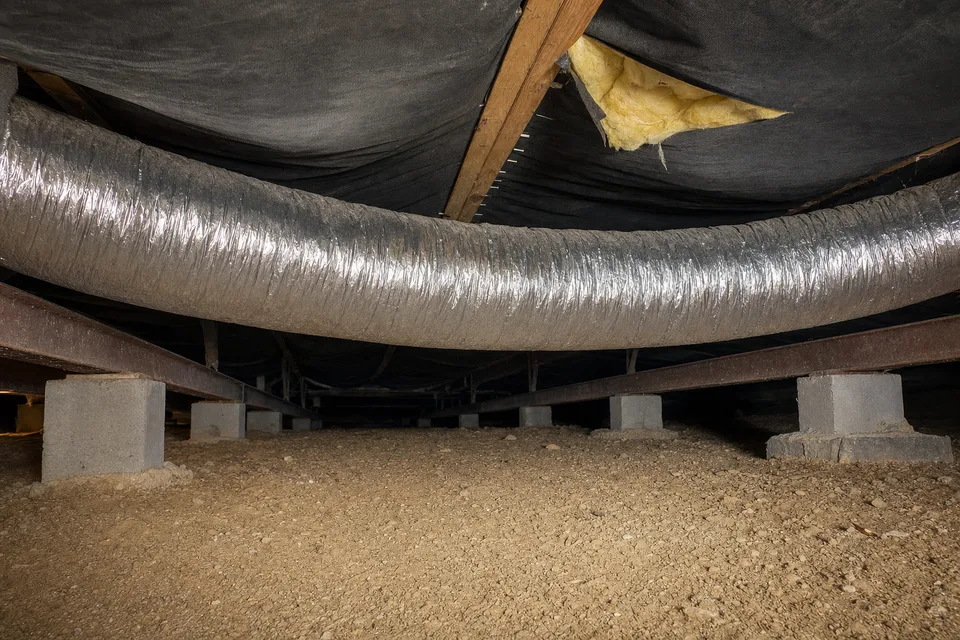
On a double-wide, the piece doing the most work is the crossover duct: a large insulated flexible duct, usually 14 to 16 inches across, that carries air from one half of the home to the other underneath the floor. It hangs in the crawl space where age, moisture, and animals get at it, and a crossover that has torn, crushed, or pulled loose at its collar dumps conditioned air under the home instead of into your rooms. That is why a duct evaluation, not a guess, should decide between ducted and ductless.
"Mini-splits cannot handle a double-wide"
This one dates from when mini-splits were single-room devices. A modern multi-zone system pairs one outdoor unit with three to five indoor heads, each independently controlled, which covers a double-wide with capacity to spare. The design question is head placement and zoning, not whether the technology is up to the job.
The Bottom Line for Sacramento Manufactured Homes
Match the system to the home: packaged unit or furnace-plus-coil if your ducts are sound, mini-split if they are not or if you want zoning. Insist on manufactured-home-listed equipment, expect the HCD permit on the paperwork, and size from a load calculation rather than fear. Do that and the mechanical part is straightforward.
If you are weighing options for a manufactured home anywhere in the Sacramento area, Alpha Mechanical will assess the home, the ducts, and the electrical, and put a number in writing: AC installation, furnace replacement, or both at once. Call 916-848-5980 to schedule a visit. And once the new system is in, an annual visit keeps it living its full lifespan; here is what a proper tune-up includes.
Frequently Asked Questions
Which mobile home HVAC system is most popular?
For a full replacement, the packaged unit is the manufactured-home standard: everything in one outdoor cabinet, purpose-built for the application, at $3,800 to $7,000 installed. For homes without usable ductwork, the ductless mini-split has taken over, and one multi-zone outdoor unit feeding three to five heads covers even a double-wide.
Do I need a mobile-home-approved HVAC unit?
Yes, by federal law. HUD's construction standards require air conditioning and heating equipment in a manufactured home to be listed or certified by a nationally recognized testing agency for that application (24 CFR 3280.714). Equipment built for site-built houses voids warranties and fails inspection.
Do I need a permit to replace HVAC in a California mobile home?
Yes. Alterations to a manufactured home, including replacing the furnace or air conditioner, are permitted by the state Department of Housing and Community Development on form HCD MH 415, not by your city or county building department. A contractor experienced with manufactured homes files it as part of the job.
How much does a new mobile home HVAC system cost?
Nationally: a furnace and AC combo runs $4,000 to $9,000 installed, a packaged unit $3,800 to $7,000, central AC added to an existing furnace $2,400 to $5,300, and a furnace alone $1,200 to $2,500 for electric or $1,700 to $3,700 for gas. Home size, duct condition, and panel capacity move the number within those ranges.
Can I add central AC to my existing mobile home furnace?
Usually, yes. If the furnace is sound and the ducts hold air, a matched cooling coil and outdoor condenser typically run $2,400 to $5,300 installed. The ducts are the deciding factor: leaky belly ducts waste cooled air, so have them evaluated before committing to a ducted system.